
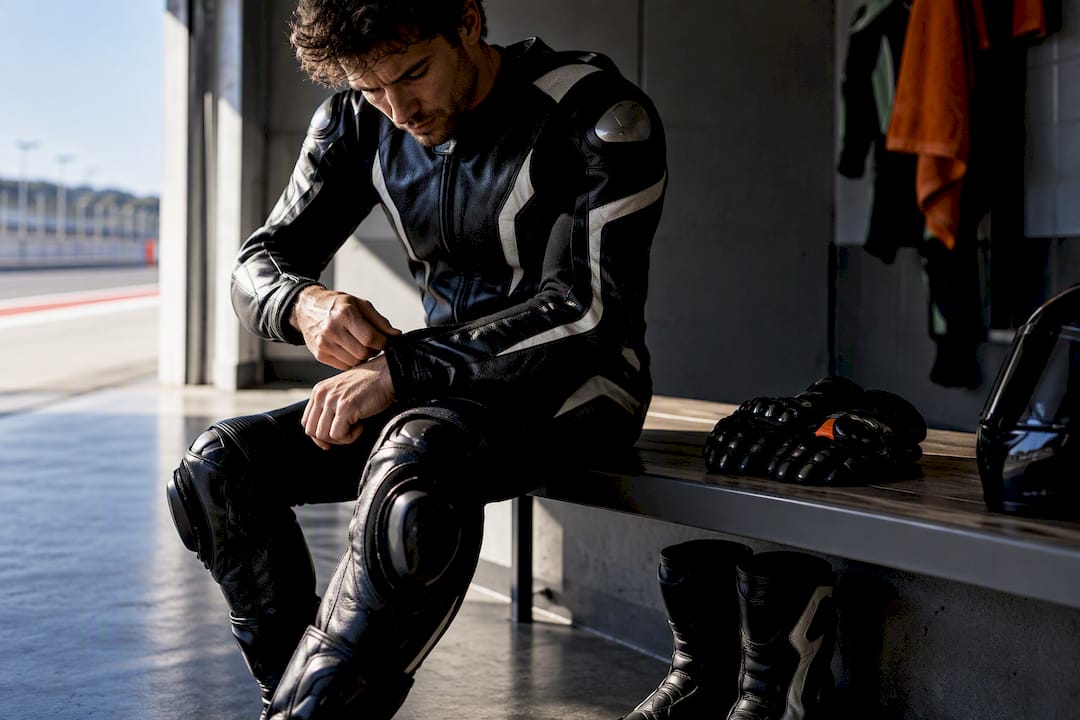
There are five non-negotiables before any wheel touches a circuit: a helmet meeting ECE requirements, a certified racing suit built to EN 17092, gloves with knuckle and wrist protection, boots designed for track use, and a back protector meeting EN 1621-2 (chest protection meeting EN 1621-3 where required). On the trackside, the circuit itself must offer impact-absorbing mattresses or TECPRO barriers with continuous coverage on run-off areas. Karters add FIA 8877-2022 compliant apparel to that list. Miss any one item and you are riding under-protected, whatever else you have spent money on.
TL;DR:
- Ensure your helmet has ECE 22.06 certification and replace it after any impact or every five to seven years to maintain safety.
- Choose a Class AAA suit made of leather, with double stitching and sliders, for maximum abrasion resistance and impact protection.
- Wear gloves with knuckle guards, wrist straps, and palm sliders, along with boots featuring ankle cups, rigid shanks, and toe sliders, for full protection.
- Use back protectors rated Level 2 under EN 1621-2 for repeated track sessions, and verify proper fit with the suit zipped and arms raised.
- Confirm circuit barriers are in good condition, with impact-absorbing mattresses or TECPRO barriers, and verify safety standards before your session.
Table of Contents
- Protezioni pista indispensabili per il rider: helmet, suit, gloves, boots and back protection
- Kart-specific gear and the FIA 8877-2026 rule change
- What trackside barriers actually protect you from
- How to decode certification labels before you buy
- Who is responsible for the circuit itself
- Your pre-track-day checklist, step by step
- Why certification and maintenance matter more than brand names
- An honest take on prioritising your budget
- Get your track kit sorted with Sixrace
- Sources
- FAQ
Protezioni pista indispensabili per il rider: helmet, suit, gloves, boots and back protection
Getting these five categories right is the foundation of protezioni pista indispensabili, and each one has its own certification trail worth checking before you buy.
Helmet. Look for ECE 22.06 marking on the retention strap, and treat a helmet as disposable after any significant impact, regardless of visible damage. Most manufacturers recommend replacement every five to seven years even without a crash, since the EPS liner degrades with UV exposure and sweat. For track use, a clear or lightly tinted visor rated for the circuit’s session times is safer than a heavily mirrored one that some organisers restrict outright.
Suit (tuta). EN 17092 sets five classes from AAA down to A, based on abrasion resistance, seam strength and impact protection zones. Class AAA is the standard most circuits expect for competitive track riding, and it is usually achieved with a one-piece leather suit rather than a two-piece combination, which tends to sit in lower classes. Check for double or triple stitching at the seams and factory-fitted sliders at the knees and shoulders.
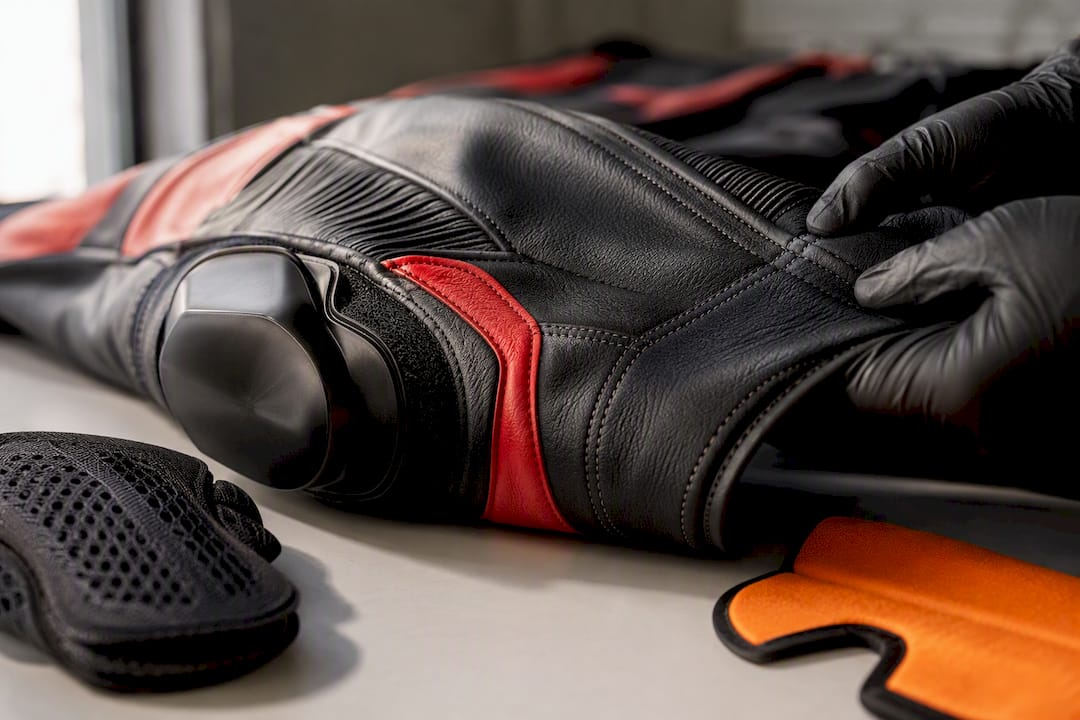
Gloves and boots. Track gloves need hard knuckle protection, a secure wrist closure (strap or zip with a stud), and palm sliders to manage abrasion during a slide. Avoid short-cuff gloves that don’t overlap the suit sleeve. Boots need a reinforced ankle cup, a rigid shank through the sole, and toe sliders. Trainers, road boots without shin plates, or anything with exposed laces have no place on track.
Back and chest protectors. EN 1621-2 governs back protectors, and Level 2 absorbs roughly half the impact force that a Level 1 unit does under the same test, so Level 2 is worth the extra thickness for anyone doing repeated track sessions. Chest protectors fall under EN 1621-3 and matter more than most riders assume for high-speed circuits.
- Helmet: ECE 22.06, replace after five to seven years or any impact
- Suit: EN 17092, Class AAA preferred, one-piece for competitive use
- Gloves: hard knuckle guard, wrist strap, palm slider
- Boots: ankle cup, rigid shank, toe slider
- Back protector: EN 1621-2, Level 2 for regular track use
Pro Tip: Check protector fit with the suit zipped and your hands raised above your head. If the back protector shifts more than a couple of centimetres, the fit is wrong, no matter what the certification label says.
Browse certified protectors, track-rated gloves, and racing trousers with these standards in mind before your next session.
Kart-specific gear and the FIA 8877-2026 rule change
Karting has its own compliance chain, and it moved substantially in 2025. FIA 8877-2022 became mandatory for FIA karting events from 2025, covering tute, gloves and shoes with defined minimum abrasion and construction requirements, replacing a patchwork of older national norms.
Kart drivers need to check for:
- A homologated tuta bearing the FIA 8877-2022 label, not an older or expired FIA-CIK sticker
- Gloves and shoes carrying matching 8877-2022 approvals, sold as a set by most kart-suit manufacturers
- Paracostole (rib protectors) fitted under or integrated with the suit
- A helmet compatible with karting regulations and the driver’s chin bar clearance
Club-level events are moving toward enforcing the new standard at scrutineering rather than at entry, so a suit that looked fine last season could fail a label check this year. Confirm with your local organiser whether older stock is still tolerated during the transition, because policies vary between clubs.
What trackside barriers actually protect you from
Circuit protection is not one product but a layered system, and each layer does a different job.
- Energy-absorbing mattresses and Air Pads. These sit in front of rigid obstacles (walls, barrier posts, marshal huts) and are designed to compress progressively under impact, spreading deceleration over a longer distance than a solid barrier would. Suppliers describe Air Pad and equivalent energy-absorber systems as tested units rather than generic foam blocks, which matters because untested padding can bottom out on a hard hit.
- TECPRO barriers and tyre walls. TECPRO units are modular, quick to reposition after an impact, and widely used on corners with repeated contact. Tyre walls cost less and work well for lower-speed sections, but they need tight strapping and a covering membrane, or tyres can separate on impact and create a secondary hazard.
- Guard-rails, straw bales and temporary solutions. These fill gaps where permanent attenuators aren’t practical, but coverage has to be continuous. A single unprotected metre of catch fence or exposed post along a run-off zone undermines everything either side of it.
On arrival at any circuit, check for visible damage or deflation in mattresses, gaps in barrier lines, and whether marshals have visible spare absorbers staged nearby. A quick lap of reconnaissance before your first session often reveals degraded protection that no amount of paperwork would flag.
How to decode certification labels before you buy
Reading a garment tag correctly is the difference between assuming you’re protected and knowing it.
- EN 17092 classes run AAA, AA, A, B and C. AAA and AA suits are built for abrasion resistance and seam integrity at racing speeds; B and C classes prioritise comfort and are not intended for competitive track riding.
- EN 1621-1 covers limb protectors (elbows, shoulders, knees), while EN 1621-2 covers back protectors specifically, each rated Level 1 or Level 2 based on force transmitted through the pad during a standardised impact test.
- EN 1621-3 applies to chest protectors, following the same Level 1/Level 2 logic as back protection.
- A proper tag shows the standard number, the class or level, the CE marking, and the notified body number that carried out testing. A tag with only a brand logo and no standard reference is not proof of compliance.
Independent testing houses such as Intertek run the abrasion and impact protocols that these ratings depend on, and their own guidance is blunt on one point: certification measures defined lab behaviours, not your actual fit or the condition of a five-year-old protector. A Level 2 back protector that has gone soft with age offers less than the label promises.
Who is responsible for the circuit itself
Personal kit is only half the equation. The other half sits with the venue, and the FMI assigns that responsibility formally to a “responsabile di pista”, a named track manager accountable for maintenance, barrier checks and marshal deployment.
- Maintains and inspects barriers, mattresses and run-off zones ahead of every session
- Assigns marshal posts based on rider numbers and weather conditions, increasing coverage in wet or reduced-visibility sessions
- Ensures minimum run-off widths and neutral zone sizes are met, along with medical and fire response availability
- Keeps a stock of spare absorbers and barrier sections on-site for same-day replacement after an incident
Before attending an unfamiliar circuit, ask the organiser three things: is the track currently homologated, is protective equipment stocked on-site for quick repairs, and how many marshals will be posted for your specific session. A straight answer to all three tells you more about the day’s safety than any glossy event listing.
Your pre-track-day checklist, step by step
Run through this sequence every time, not just for your first session.
- Administrative checks. Confirm your licence or tessera is valid, attend the mandatory rider briefing, and carry any required medical documentation.
- Rider kit inspection. Try the helmet on and check the strap tension, run the suit zip fully closed and inspect seams for fraying, and confirm protectors sit flush with straps secured.
- Bike quick checks. Verify tyre pressure and remaining tread, inspect brake pads and fluid level, check for oil or chain leaks, and confirm frame sliders are fitted.
- Circuit arrival check. Take a slow reconnaissance lap, note marshal post locations, and visually inspect the barriers nearest to the sections you’ll be riding hardest.
Pro Tip: Keep a laminated card in your kit bag with this exact sequence. On a cold, early paddock morning it is easy to skip step three and only notice a slow leak on the first lap.
A broader pre-track safety inspection routine is worth building into your regular preparation, alongside a basic bike wash routine that keeps you from missing leaks or wear hidden under grime.
Why certification and maintenance matter more than brand names
Lab testing exists precisely because visual inspection cannot tell you whether a suit or protector will hold up at speed. Intertek’s own position is that a garment can look compliant and still fail under real abrasion or impact loads if it hasn’t actually been through certified testing, and the FMI’s rules echo the same principle on the trackside side: protection is a shared responsibility between rider and circuit, not something either party can assume the other has covered.
That’s the gap Sixrace works to close on the retail side. The catalogue is organised by make, model and year, which removes the guesswork of matching a suit or glove size to your specific bike setup, and the brand partnerships include established names in protective gear.
- Filter listings by certification standard where the product page states one
- Cross-check the EN 17092 class or EN 1621 level against what your circuit requires
- Confirm the tag details before purchase, not after your first session
An honest take on prioritising your budget
If you’re building a track kit from scratch, spend on the helmet and back protector first. They matter most in the crashes that actually hurt riders, and neither improves much with brand prestige once it meets the right standard. Suit and boots come next; renting for a first outing is reasonable, provided you check the rental kit’s labels and that it actually fits you, not just the previous renter. Chase fit and maintenance before you chase a flashier logo. A well-maintained Level 1 protector that fits properly beats a neglected Level 2 unit that has gone soft with age.
— Matteo
Get your track kit sorted with Sixrace
You can find certified track gear gathered for easy browsing without hunting across scattered listings for the right standard, size and fitment. The catalogue is matched by motorcycle make, model and year, designed to simplify checking compatibility, and it spans a range of recognised names across protective clothing and accessories.

Before checkout, check the certification label on any suit, glove or protector listing against the EN 17092 class or EN 1621 level your circuit expects. Secure payments and tracked shipping aim to provide order security and visibility between confirmation and paddock day. Head to the Sixrace discount page to claim your reserved discount on certified track gear and accessories before your next session.
Sources
FAQ
What are the mandatory accessories for a motorcycle?
For road use, a homologated helmet is the only strictly mandatory item in most countries, though gloves are increasingly required by law in several European markets. For track use, expect circuits to also demand a certified suit, boots and back protection before you’re allowed on track.
What do you need to ride on a track?
You need a certified helmet, a suit meeting EN 17092 (Class AAA preferred), gloves with knuckle protection, boots with ankle reinforcement, and a back protector meeting EN 1621-2. Most circuits also require valid licensing and attendance at the rider briefing before your first session.
What’s the difference between Level 1 and Level 2 protection?
Level 2 protectors absorb more impact force than Level 1 under the same standardised test, roughly half as much force transmitted through the pad. For regular track riding, Level 2 back and chest protection is the safer choice despite the added bulk.
Do you need a licence to race on track?
Organised racing events typically require a valid competition licence or tessera issued by the relevant federation, alongside proof that your kit meets the circuit’s stated standards. Open track days for road riders usually only require a valid road licence and compliant PPE, but requirements vary by organiser, so check before you book.
 Italiano
 Deutsch
 Français
 Español
 English
 Polski