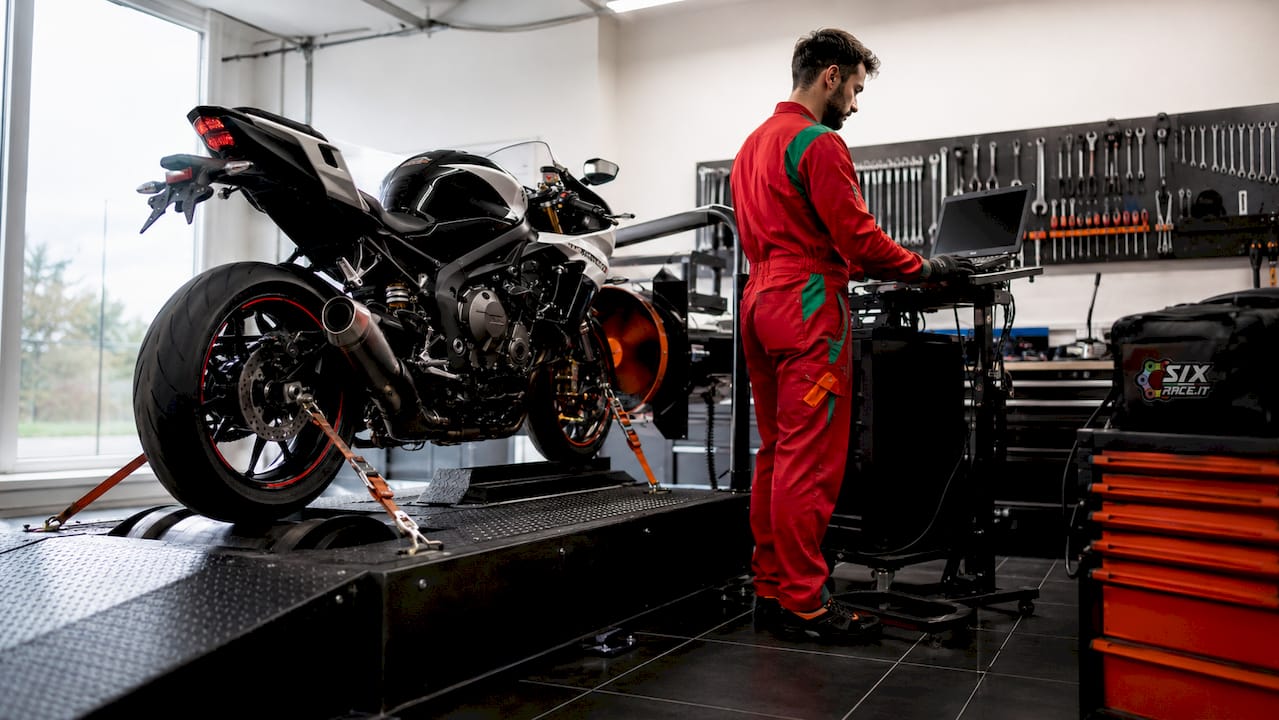
Motorcycle dyno tuning is the process of assessing and optimising your bike’s engine performance through specialised measurements and adjustments on a dynamometer. The dynamometer, commonly called a dyno, measures power, torque, air/fuel ratio, and ignition timing across the full rpm range to give a complete picture of how your engine behaves. A standard dyno session lasts approximately one hour, covering preparation, multiple test runs, data analysis, and a documented performance report. Whether you ride a sport bike, tourer, or adventure machine, understanding this process helps you make informed decisions about your engine and the parts you fit to it.
What equipment and preparation are needed for a dyno session?
A dyno session requires specific tools and a methodical preparation routine before a single run takes place. Skipping preparation steps is the most common reason for inaccurate results, so technicians treat this phase with the same care as the tuning itself.
Two main dynamometer types exist in professional workshops:
- Inertial dynos measure power by accelerating a heavy roller drum. They are fast to set up and give a quick snapshot of peak power.
- Braked dynos use an eddy-current brake to hold the engine at a fixed rpm. They deliver detailed, precise measurements of torque and power at each point across the rev range.
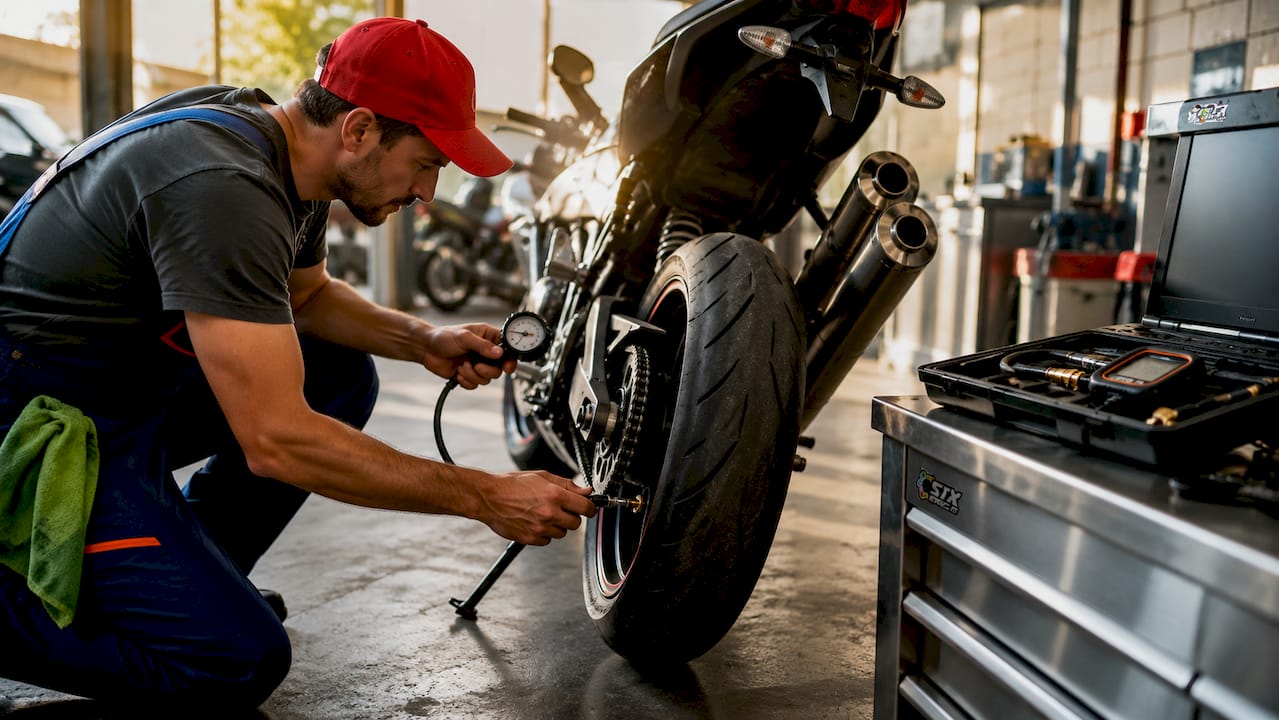
Before the bike goes on the rollers, the technician carries out a full inspection. This covers tyre pressure, chain tension, coolant level, and a scan of the ECU for stored fault codes. Any mechanical fault found at this stage stops the session until it is resolved.
| Tool or sensor | Purpose |
|---|---|
| Dynamometer (inertial or braked) | Measures wheel power and torque |
| Wideband lambda sensor | Monitors air/fuel ratio in real time |
| ECU diagnostic interface | Reads and writes engine maps |
| Data logging software | Records all parameters simultaneously |
| Exhaust gas temperature probe | Detects thermal stress and lean conditions |
| Knock detection sensor | Identifies detonation before damage occurs |
The technician and rider each have a defined role. The technician monitors data and controls the session from a workstation. The rider, if present on the bike, holds a steady throttle position during braked runs. On most modern setups, the bike runs unmanned on the rollers with the technician operating remotely.
Pro Tip: Bring your bike to the dyno with a full tank and at normal operating temperature. Cold starts and low fuel levels introduce variables that skew baseline measurements.
Step-by-step execution of the motorcycle dyno tuning process
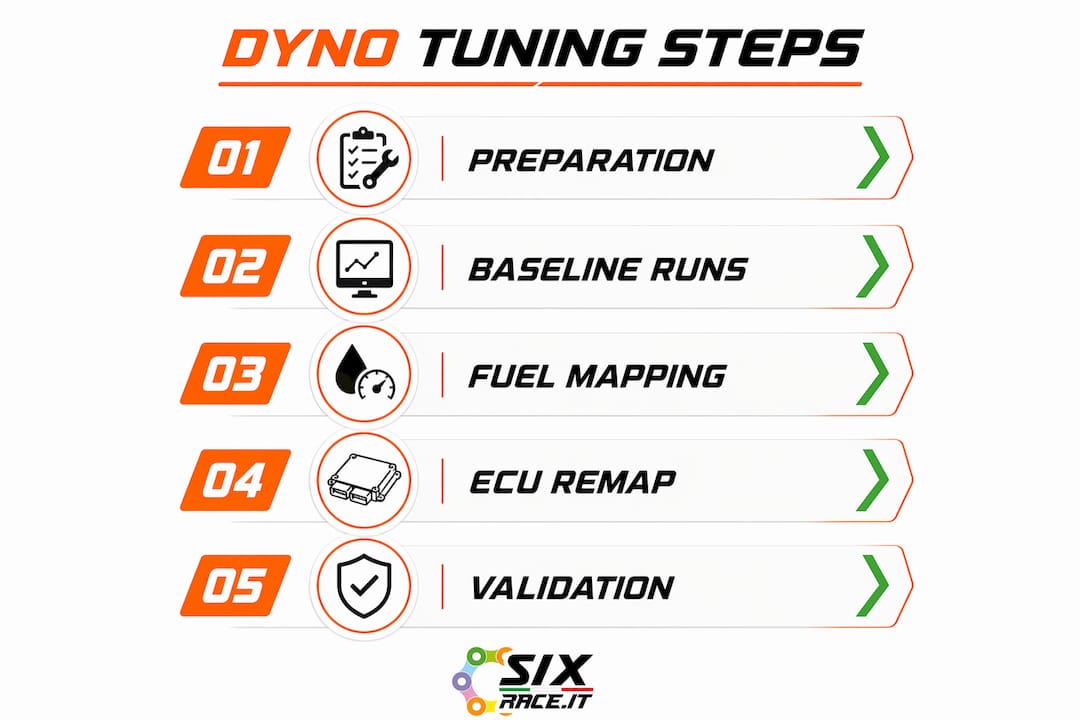
The professional dyno tuning process follows a defined sequence. Each step builds on the last, and skipping any phase risks inaccurate tuning or engine damage.
- Preliminary diagnostic check. The technician scans the ECU for fault codes and reviews the engine’s current map. Any anomaly is logged before the session begins.
- Dyno installation. The bike is secured to the roller with straps at the front forks and rear subframe. Wheel alignment with the roller is checked carefully.
- Baseline measurement runs. The bike completes several full-throttle runs in the same gear to establish a repeatable baseline. Power, torque, and air/fuel ratio are recorded simultaneously.
- Map adjustment. The technician modifies the fuel map and ignition timing based on the baseline data. Adjustments target specific rpm zones where the engine shows weakness or excess richness.
- Verification runs. After each adjustment, the bike runs again to confirm the change produced the intended result. This cycle repeats until the map is stable.
- Final full-range test. A complete run across the entire rpm range confirms the tuned map delivers consistent gains without anomalies.
- Data logging and reporting. All parameters, including power curves, torque curves, air/fuel ratio, ignition timing, exhaust gas temperature, and knock detection, are saved and presented to the owner.
Custom ECU remapping delivers better reliability and performance balance than piggyback modules because it works directly within the engine management system. Piggyback devices intercept signals rather than rewriting the underlying map, which limits their precision and can introduce instability at high rpm.
The fuel map adjustment phase is where most of the skill lies. A technician looks for areas where the air/fuel ratio runs lean, which risks detonation, or excessively rich, which wastes fuel and reduces power. Ignition timing is adjusted in parallel, as advancing timing too aggressively on a lean mixture causes knock.
Pro Tip: Always complete at least three baseline runs before touching the map. A single run can be skewed by tyre temperature or a brief sensor fluctuation. Three consistent runs confirm the data is reliable.
How does the dyno measure performance and why do different modes matter?
The mode in which a dyno operates directly affects the quality and usefulness of the data it produces. Choosing the wrong mode for your tuning goal wastes time and can lead to an inaccurate map.
An inertial dyno works by measuring how quickly the roller drum accelerates under engine power. The calculation is straightforward: the heavier the drum and the faster it spins, the more power the engine is producing. This mode suits quick diagnostic checks and before/after comparisons, but it cannot hold the engine at a fixed operating point for steady-state tuning.
A braked dyno uses an eddy-current or hydraulic brake to resist the roller at a set load. The technician can hold the engine at exactly 4,000 rpm under full load for as long as needed. This allows precise adjustment of the fuel map at that specific point before moving to the next rpm step.
| Feature | Inertial dyno | Braked dyno |
|---|---|---|
| Test speed | Fast | Slower |
| Measurement precision | Moderate | High |
| Steady-state testing | Not possible | Standard capability |
| Best use case | Quick power checks | Full ECU remapping |
| Thermal load on engine | Lower | Higher |
| Cost per session | Generally lower | Generally higher |
The practical implication is clear. If your goal is a full ECU remap across the rpm range, a braked dyno gives the technician the control needed to tune each cell of the fuel map individually. An inertial dyno is adequate for confirming that a new exhaust or air filter has produced the expected power gain.
Common issues and troubleshooting tips during dyno tuning
Dyno tuning surfaces problems that road riding masks. Dyno charts diagnose hidden irregularities beyond peak power, revealing flat spots, erratic air/fuel ratios, and ignition faults that feel vague on the road but show clearly in the data.
The most frequent issues encountered during sessions include:
- Incorrect sensor readings. A faulty lambda sensor reports a false air/fuel ratio, causing the technician to enrich or lean out a map that was already correct. Always verify sensor calibration before the first run.
- Improper bike setup on the rollers. Misaligned wheels or loose straps cause the bike to move during acceleration runs, producing inconsistent power figures between runs.
- Aggressive timing advance. Pushing ignition timing too far forward on a standard engine causes knock. The knock sensor detects this, but repeated detonation events damage pistons and valve seats before the technician can intervene.
- Overheating during extended sessions. Braked dyno sessions place sustained thermal load on the engine. Without adequate cooling fans directed at the radiator, coolant temperature climbs and the ECU pulls timing as a protection measure.
- ECU communication errors. Incompatible diagnostic cables or outdated software versions cause map writes to fail or corrupt. Always confirm software compatibility before the session.
“Safety and repeatability are the foundation of effective dyno tuning. The controlled environment allows real-time monitoring with immediate shutdown capability if any parameter exceeds safe limits. This level of control is simply not possible on a public road.”
Pro Tip: Direct a large workshop fan at the front of the bike throughout every braked dyno run. This replicates the airflow the engine receives at road speed and prevents heat-related ECU interventions from distorting your data.
What are the real benefits of dyno tuning for everyday riding?
Dyno tuning focuses on optimisation across the entire rpm range rather than chasing a peak horsepower figure. This distinction matters because most riding happens between 3,000 and 7,000 rpm, not at the redline.
The tangible benefits of a properly executed dyno session include:
- Smoother throttle response. Correcting a lean or rich spot in the mid-range eliminates the hesitation or surge that makes low-speed riding tiring.
- Improved fuel efficiency. A well-tuned fuel map uses only the fuel the engine needs at each load point, reducing consumption on touring rides.
- Better reliability. Removing lean conditions and correcting knock-prone timing maps reduces long-term wear on pistons, valves, and bearings.
- Accurate performance data. You leave the session with documented power and torque curves, giving you a factual baseline for future modifications.
- Safer tuning margins. A professional session keeps air/fuel ratios and timing within safe limits, unlike aggressive street tunes that prioritise power over longevity.
Road testing after the dyno session is not optional. The dyno environment cannot replicate every real-world condition, particularly adaptive strategies that the ECU activates only under varying load and temperature cycles on the road. A short validation ride confirms the map behaves correctly in traffic, at motorway speeds, and during hard acceleration from low rpm.
Sixrace stocks performance components from brands including Dynojet and Evotech Performance that complement a freshly tuned engine. Fitting quality aftermarket motorcycle accessories after a dyno session ensures the hardware matches the calibrated map.
Key takeaways
Dyno tuning is a diagnostic and optimisation process that improves rideability, reliability, and fuel efficiency across the full rpm range, not just at peak power.
| Point | Details |
|---|---|
| Session duration | A standard dyno session lasts approximately one hour, covering preparation, runs, analysis, and reporting. |
| Dyno mode selection | Choose a braked dyno for full ECU remapping and an inertial dyno for quick power verification checks. |
| Parameters monitored | Power, torque, air/fuel ratio, ignition timing, exhaust gas temperature, and knock are recorded simultaneously. |
| Road validation required | Always follow a dyno session with a road test to confirm the map performs correctly under real-world conditions. |
| Custom remapping preferred | Custom ECU remaps deliver better reliability and balance than piggyback modules by working within the engine management system directly. |
Why I think most riders misunderstand what a dyno actually does
Most riders walk into a dyno session expecting to leave with a bigger power number. That expectation misses the point almost entirely. The most valuable thing a dyno session produces is not the peak figure at the top of the chart. It is the shape of the curve below it.
I have seen bikes with perfectly respectable peak power figures that felt awful to ride because the mid-range was a mess of lean spots and erratic fuelling. A dyno session fixed that, and the owner reported the bike felt completely transformed on the road, despite the peak number barely changing. That is what balanced engine tuning actually delivers.
The other misconception I encounter regularly is that a dyno session is only for modified bikes. A standard bike with 10,000 kilometres on the clock benefits just as much. The dyno reveals whether the factory map still suits the engine’s current state, particularly after a filter change, an exhaust swap, or simply the natural wear that shifts an engine’s fuelling requirements over time.
My honest advice is this: treat your first dyno session as a diagnostic appointment, not a performance upgrade. Go in wanting to understand your engine, not to beat a number. The performance gains follow naturally from that mindset.
— Matteo
Parts and accessories to support your tuning at Sixrace
Quality components make the difference between a tuned engine that performs and one that underperforms because the hardware cannot keep pace with the map.
Sixrace carries a wide catalogue of performance and replacement parts matched by make, model, and year, so compatibility is confirmed before you buy. Whether you need valve parts for your engine after a rebuild or spare parts to support a fresh tune, the Sixrace catalogue covers road, sport, touring, adventure, and off-road motorcycles. Brands including Dynojet, Evotech Performance, and HP Corse are stocked alongside a broad range of maintenance components. Access your reserved discount and browse the full range at the Sixrace discount page to get the best price on your next order.
FAQ
What is motorcycle dyno tuning?
Motorcycle dyno tuning is the process of measuring and adjusting engine performance parameters, including power, torque, and air/fuel ratio, on a dynamometer to optimise how the engine runs across its full rpm range.
How long does a dyno tuning session take?
A standard dyno session lasts approximately one hour, covering preparation, multiple test runs, data analysis, and a documented performance report.
What is the difference between an inertial and a braked dyno?
An inertial dyno measures power by accelerating a roller drum and suits quick checks, while a braked dyno holds the engine at a fixed rpm using an eddy-current brake and is required for precise ECU remapping.
Does dyno tuning require road testing afterwards?
Road testing after a dyno session is necessary to confirm the tuned map performs correctly under real-world conditions, as the dyno environment cannot replicate all adaptive engine strategies activated during normal riding.
Is dyno tuning only for modified motorcycles?
Dyno tuning benefits both modified and standard motorcycles. It diagnoses fuelling irregularities, lean conditions, and ignition timing issues that affect rideability and reliability regardless of whether aftermarket parts have been fitted.
 Italiano
 Deutsch
 Français
 Español
 English
 Polski