

Fuel tuning is the process of adjusting a motorcycle engine’s air-fuel mixture to achieve the best possible combustion, power, and efficiency. The industry standard term for this process is air-fuel ratio (AFR) calibration, and it applies whether your bike runs a modern electronic fuel injection (EFI) system or a traditional carburettor. The stoichiometric target for a petrol engine sits at 14.7:1 AFR, meaning 14.7 parts air to one part fuel for complete combustion. Understanding how fuel tuning works on motorcycles gives you the knowledge to make informed decisions about performance upgrades, fuel economy, and long-term engine health.
How does fuel tuning work in modern EFI motorcycles?
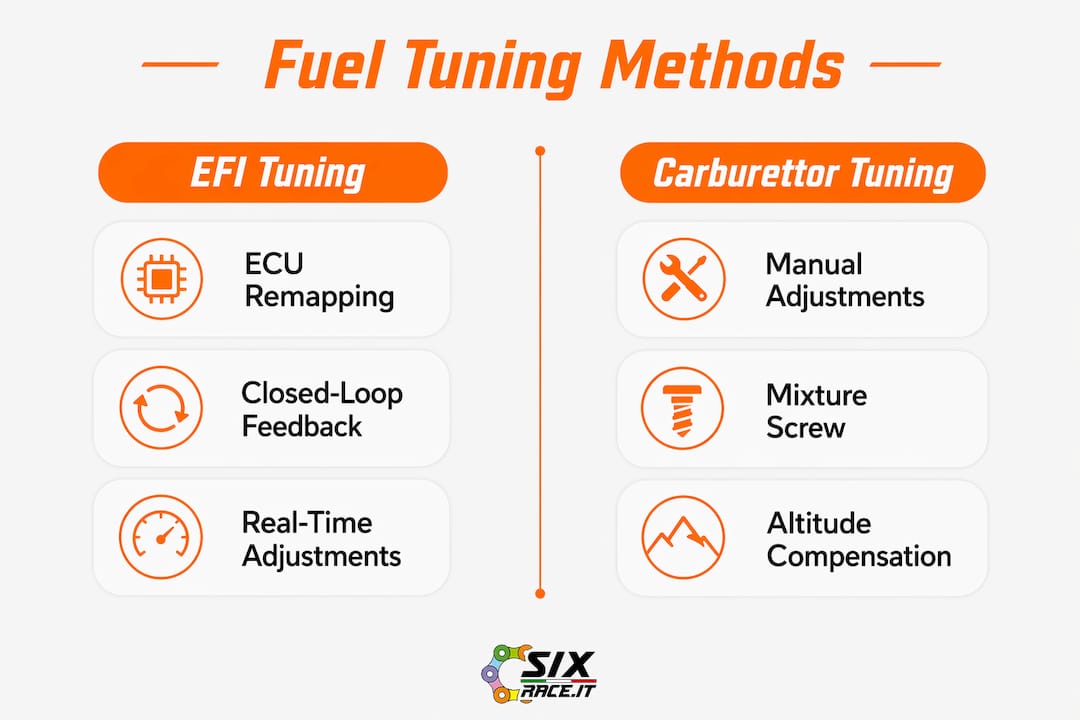
Modern EFI motorcycles rely on the Engine Control Unit (ECU) to manage fuel delivery in real time. The ECU reads signals from several sensors, including the Manifold Absolute Pressure (MAP) sensor, the RPM sensor, and the intake air temperature sensor, then calculates the precise injector pulse width needed to maintain the target AFR. This happens hundreds of times per second, making EFI far more responsive than any manual system.

The closed-loop feedback process is what separates EFI from older systems. An oxygen (O2) sensor in the exhaust measures the actual AFR of spent gases and reports back to the ECU. If the mixture runs too rich or too lean, the ECU corrects injection duration immediately. Continuous closed-loop tuning keeps the AFR consistent across varying conditions, from cold morning starts to motorway cruising.
Fuel maps and ignition timing maps sit at the heart of EFI calibration. A fuel map is a three-dimensional table that plots injector duration against RPM and throttle position. Tuners modify these tables to shift the engine’s behaviour toward more power, better economy, or a smoother throttle response.
ECU remapping vs tuning boxes
Two main methods exist for modifying EFI calibration on a motorcycle.
- ECU remapping rewrites the core software maps inside the ECU itself. It preserves all factory safety systems, including overheating protection and rev limiters. Professional ECU remapping can yield a 15–30% increase in engine performance and torque.
- Tuning boxes intercept sensor signals between the sensors and the ECU, feeding altered data to trick the ECU into changing fuelling. They are easier to fit and remove, but tuning boxes can disable ECU safety systems, risking increased fuel consumption and accelerated engine wear.
- Piggyback modules sit between the factory ECU and the injectors, adding corrections on top of the stock map. They offer a middle ground in terms of cost and reversibility, though they cannot match the depth of a full remap.
Pro Tip: Always request a reversible remap from a qualified tuner. A reputable professional will retain a copy of your stock map so the ECU can be restored to factory settings at any point.
For riders who want a structured starting point, the fuel controller installation guide from Sixrace walks through the process step by step.
What are the fuel tuning methods for carburettor motorcycles?
Carburettor tuning is a manual process that requires patience and a methodical approach. Unlike EFI, there is no ECU to make automatic corrections. The rider or mechanic must adjust physical components and read the engine’s response directly.
The standard starting point for mixture screw adjustment is 1.5–2 turns out from the fully seated position. This baseline applies to most single-carburettor setups and gives the engine enough fuel to idle without flooding. From there, fine-tuning begins.
Follow these steps for accurate carburettor fuel mixture adjustment:
- Warm the engine fully. Cold-engine carburettor tuning is unreliable; the mixture behaves differently at operating temperature. Allow at least ten minutes of running before touching the mixture screw.
- Turn the mixture screw out by ¼ turn. Wait 30 seconds for the engine response to stabilise before making another adjustment.
- Listen for the highest, smoothest idle. The engine will respond with a rise in idle speed as the mixture approaches the correct setting.
- Adjust the idle speed screw to bring the idle back to the manufacturer’s specified RPM once the mixture is set.
- Test under load. Ride at low throttle openings and check for hesitation (lean) or blubbering (rich). Return to the bench and repeat adjustments if needed.
Common signs of incorrect mixture
A rich mixture produces black, sooty spark plugs, poor fuel economy, and a heavy exhaust smell. A lean mixture causes white or blistered plugs, overheating, and a flat, hesitant throttle response. Both conditions accelerate engine wear if left uncorrected.
Environmental variables complicate carburettor tuning significantly. At higher altitude, thinner air means less oxygen, so a jet needle or main jet change may be necessary to prevent a rich condition. Temperature swings between seasons can shift the mixture enough to affect performance noticeably.
Pro Tip: Keep a tuning log. Note the number of turns on the mixture screw, the ambient temperature, and the altitude for each session. This record becomes invaluable when diagnosing future issues or returning to a known good setting.
Why is the correct air-fuel ratio essential for motorcycle tuning?
The stoichiometric ratio of 14.7:1 represents the chemically ideal balance for complete combustion in a petrol engine. At this ratio, all available fuel burns fully, producing maximum energy with minimum waste. Deviating from this target in either direction carries measurable consequences for power, economy, and engine longevity.
| AFR condition | Effect on power | Effect on engine | Spark plug appearance |
|---|---|---|---|
| Too rich (below 14.7:1) | Power loss, sluggish response | Carbon build-up, fouled plugs | Black and sooty |
| Stoichiometric (14.7:1) | Optimal combustion efficiency | Clean burn, stable temperatures | Light tan or grey |
| Slightly lean (above 14.7:1) | Marginal power gain possible | Higher combustion temperatures | White or light grey |
| Very lean (well above 14.7:1) | Severe power loss, misfires | Overheating, piston damage risk | White, blistered, or cracked |
Running rich wastes fuel and deposits carbon on valves and piston crowns. Running lean raises combustion temperatures to dangerous levels. Sustained lean running is one of the leading causes of piston failure on air-cooled engines. Precise AFR calibration, whether through EFI sensor feedback or careful carburettor adjustment, protects the engine while delivering the throttle response riders expect.
Smooth throttle response is a direct product of correct AFR across the full RPM range, not just at idle. A bike that stumbles off the line or surges at mid-throttle almost always has an AFR problem in a specific part of the fuel map.
How do professionals approach fuel tuning for performance and efficiency?
Professional tuners treat fuel calibration as one part of a broader system. Fuel efficiency tuning balances torque, air management, and ignition timing together, and often sacrifices peak top speed in favour of better economy and engine longevity. This philosophy is most visible in endurance racing, where engine efficiency over a long stint matters more than outright peak horsepower.
A professional tuning session typically follows this structure:
- Baseline dynamometer run. The tuner records power, torque, and AFR across the full RPM range before touching any settings. This establishes a reference point.
- Data logging under real conditions. Sensors record AFR, throttle position, and RPM during actual riding. This reveals problem areas that a static dyno run can miss.
- Ignition timing adjustment. Advancing timing increases power but raises the risk of detonation. Retarding timing protects the engine at the cost of some output. Fuel and timing maps are adjusted together, not in isolation.
- Iterative dyno testing. Each map change is tested on the dyno and compared against the baseline. Changes are made in small increments to avoid overshooting the target.
- Road verification. Final confirmation happens on the road, where real-world throttle inputs and load conditions validate the dyno results.
Reputable tuners insist on reversible ECU remapping to protect the engine and maintain compliance with manufacturer standards. A remap that cannot be undone creates problems if the bike needs warranty work or a factory software update.
Sustainable tuning also incorporates friction reduction and gearing adjustments alongside fuel system work. These changes compound the efficiency gains from AFR calibration and deliver a more complete improvement to the riding experience.
Pro Tip: Ask your tuner for a printed AFR trace from the dyno run. A flat, consistent trace across the RPM range is the clearest evidence that the fuel map is working correctly. Spikes or dips in the trace indicate areas that need further attention.
Riders looking for quality Dynojet tuning products can browse the Dynojet product range at Sixrace, which stocks fuel controllers and power commanders suited to a wide range of motorcycle models.
Key takeaways
Correct AFR calibration, whether through ECU remapping, closed-loop EFI feedback, or careful carburettor adjustment, is the single most important factor in motorcycle fuel tuning.
| Point | Details |
|---|---|
| Target AFR is 14.7:1 | This stoichiometric ratio delivers complete combustion and protects engine components. |
| EFI uses closed-loop feedback | The O2 and MAP sensors continuously correct injection duration to maintain the target AFR. |
| Carburettor baseline is 1.5–2 turns out | Start here and adjust in ¼-turn increments only after the engine reaches operating temperature. |
| ECU remapping outperforms tuning boxes | Remapping preserves safety systems and delivers 15–30% performance gains; tuning boxes carry engine risk. |
| Ignition timing and fuelling work together | Adjusting one without the other produces incomplete results and can damage the engine. |
Fuel tuning is more nuanced than most riders realise
I have spent years watching riders chase power gains through exhaust upgrades and air filters, then wonder why the bike feels worse than stock. The answer is almost always fuelling. Bolt-on modifications change the airflow characteristics of the engine, and if the fuel map does not follow, the AFR shifts lean. A lean engine runs hot, hesitates, and wears faster. The modification that was supposed to improve performance actually degrades it.
The gap between EFI and carburettor tuning is wider than most people expect. EFI is forgiving because the ECU compensates for small errors automatically. Carburettor tuning is unforgiving. A ¼-turn too far on the mixture screw can take a well-running engine to a stumbling mess. That is why the incremental approach matters so much. Patience is not optional here.
My strongest advice is this: prioritise fuel economy alongside power. A bike tuned for efficiency runs cooler, lasts longer, and costs less to operate. The riders who get the most from their machines are not always chasing peak dyno numbers. They are the ones who understand that a smooth, consistent power delivery across the full RPM range is worth more than a spike at the top end. If you want to go further with sportbike performance tuning, start with the fuelling before touching anything else.
— Matteo
Sixrace: parts and accessories for your tuned motorcycle
Fuel tuning delivers the most when the rest of your motorcycle is in equally good condition. Sixrace stocks a carefully selected range of performance components and accessories from brands including Dynojet, Evotech Performance, HealTech, and Gilles Tooling, all matched by make, model, and year so compatibility is never a question.
Whether you are fitting a fuel controller, replacing consumables after a tuning session, or upgrading protection components, Sixrace covers the full range. Every order ships with tracked delivery across Europe, and the catalogue is organised to make finding the right part straightforward. Visit the Sixrace accessories store and use your reserved discount to get the best price on the components your bike needs.
FAQ
What is the ideal air-fuel ratio for a motorcycle?
The stoichiometric AFR for a petrol engine is 14.7:1. Most EFI systems target this ratio under normal riding conditions, with slight enrichment at full throttle for additional cooling and power.
Can I tune my motorcycle’s fuel system without a dyno?
Carburettor motorcycles can be tuned using incremental mixture screw adjustments and road testing. EFI motorcycles benefit significantly from dyno testing because the fuel map covers hundreds of data points that road testing alone cannot verify accurately.
What is the difference between ECU remapping and a tuning box?
ECU remapping rewrites the factory software maps directly and preserves all built-in safety systems. A tuning box intercepts sensor signals externally and can disable ECU protections, increasing the risk of engine damage and inefficient combustion.
How does altitude affect motorcycle fuel tuning?
At higher altitude, air density drops, reducing the amount of oxygen available for combustion. This shifts the AFR rich, causing poor performance and increased fuel consumption. Carburettor bikes may need a smaller main jet; EFI systems compensate automatically through MAP sensor feedback.
How often should fuel tuning be reviewed?
Fuel tuning should be reviewed after any significant modification to the intake, exhaust, or engine internals. It is also worth checking after a major service or if the bike is used regularly at a different altitude or in a significantly different climate.
 Italiano
 Deutsch
 Français
 Español
 English
 Polski