
You're looking at a Yamaha TMAX 500 exhaust because the original system feels heavy, the sound has become dull, or the scooter doesn't respond as sharply as it once did. Then the product pages start raising harder questions. Should you choose a terminal or a complete system? Does “racing” mean better acceleration, or just more noise? Will a supposedly approved exhaust remain legal after installation?
The right answer depends less on the loudest sound clip and more on how the TMAX is used. A city commuter needs smooth roll-on response, controlled sound and reliable compliance. A touring rider may value low noise and heat management, while a track user can accept compromises that would be unsuitable on public roads. This guide builds the decision from the engine and exhaust basics through compatibility, homologation, measurable performance, installation and maintenance. By the end, you'll be able to assess a scarico TMAX 500 by generation, system type, legal status and real-world usefulness, then narrow compatible options through Sixrace.
Table of Contents
- Introduction to Scarico TMAX 500 and Why It Matters
- How a TMAX 500 Exhaust Works in Simple Terms
- Slip-On Terminal Versus Full System Compared
- Homologation and European Rules You Must Know
- Real Performance Impact on Power Torque and Weight
- Installation Mapping and Long Term Maintenance
- Choosing the Right Scarico TMAX 500 for Your Riding Style
Introduction to Scarico TMAX 500 and Why It Matters
A rider searching for a scarico TMAX 500 often starts with a simple goal. The scooter may need a fresher appearance, a deeper exhaust note or a more responsive feel in traffic. Those goals overlap, but they aren't identical. A muffler that changes the look and sound may do little for mass, while a complete system can affect sensors, catalyst placement and legal approval.
The TMAX 500 also isn't one single fitment. Its early generations were defined by different chassis and bodywork arrangements. The first generation ran from 2000 to 2003, the second from 2004 to 2007, and the third began in 2008, when Yamaha introduced new bodywork and a lighter cast-aluminum frame in place of the earlier tubular steel frame, as documented in the TMAX model history. A part that fits one year can therefore be unsuitable for another, even when the engine size appears identical.
Yamaha introduced the TMAX in 2001 as a European-market sports commuter, using a 499 cc liquid-cooled parallel-twin engine with DOHC and eight valves. Published launch specifications listed about 40 hp at 7,000 rpm and 45.8 Nm at 5,500 rpm, according to this contemporary TMAX specification reference. Those figures help explain why the model developed a substantial aftermarket around exhaust systems designed for a twin-cylinder scooter rather than a conventional geared motorcycle.
Workshop perspective: On a CVT scooter, an exhaust change should be judged by how the engine responds while the transmission is already managing ratio and engine speed, not by peak power alone.
The useful path is straightforward. First, understand what the headers, catalyst and silencer do. Then compare a slip-on with a full system, check the approval documents, examine realistic gains in power and weight, and plan installation around sensors and the scooter's model year. That sequence prevents the most expensive mistake, buying a visually attractive exhaust that doesn't suit your TMAX or your daily riding.
How a TMAX 500 Exhaust Works in Simple Terms
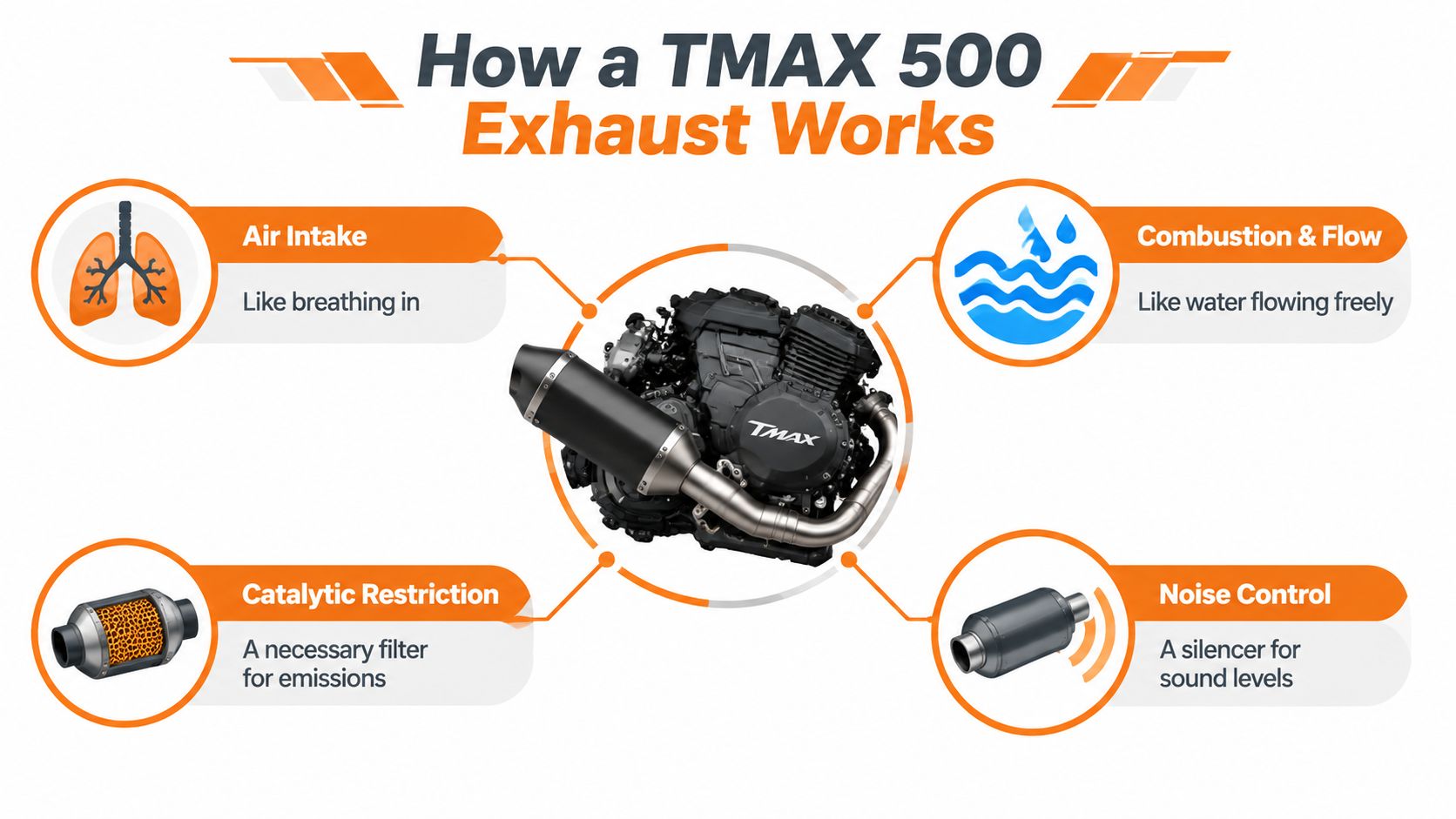
Think of the exhaust as the engine's breathing route after combustion. The engine draws air in, burns the air and fuel mixture, then pushes hot gas into the exhaust. If that route is too restricted, the engine struggles to clear the cylinder. If it's too open, the scooter can lose some low-speed efficiency, become excessively loud and fail emissions or noise requirements.
A water-pipe analogy helps. A blocked pipe creates pressure and slows flow. A very large, unrestricted pipe allows plenty of flow, but it may not maintain the flow speed and pressure behavior that the system needs at every operating point. Exhaust design balances the diameter, bends, collector shape, silencer volume and internal packing so the engine can breathe effectively across its useful range.
The parts that shape the result
The headers carry gas away from the cylinder head. Their length and diameter influence gas speed and the pressure waves that travel back toward the engine. On the TMAX's parallel-twin layout, the two cylinders share an exhaust design that must work with the engine's firing rhythm and the collector's merging behavior.
The collector and mid-pipe combine and direct the flow. Their shape can support a smoother route, but changing them also changes the location of the catalyst and oxygen-sensor fittings. That's why a complete system involves more than replacing a visible muffler.
The catalyst acts like a filter for unwanted exhaust constituents. It introduces flow resistance, but it also supports emissions control. Technical material on TMAX 500 exhaust systems links catalyst treatment with backpressure, and the documented exhaust study reports that the highest catalyst coating mass produced the highest backpressure.
Finally, the silencer controls sound through chambers, perforated tubes and packing material. The dB-killer, where fitted, reduces acoustic output further. Removing it may make the scooter louder, but it can also change the approval status and create an inspection problem.
The CVT makes this especially important. A geared motorcycle can be ridden around a change in the engine's preferred range by selecting another gear. The TMAX's transmission controls engine speed automatically, so a system that preserves useful midrange behavior can feel more effective in traffic than one that produces a small gain only at the top of a dyno run.
Slip-On Terminal Versus Full System Compared
A slip-on terminal replaces the rear silencer while retaining most or all of the original headers and front exhaust components. It's usually the simpler route when the rider wants a different appearance, sound or some weight reduction without disturbing the engine-side plumbing. Because the original catalyst and sensor arrangement may remain in place, installation can be less involved, although the exact result depends on the product and model year.
A full system replaces the headers, connecting pipes and terminal. That gives the manufacturer more control over the complete gas path and can remove more mass, but it also creates more compatibility checks. Catalyst location, oxygen-sensor fittings, mounting points and approval documentation all become central questions.
The common assumption that a full system automatically creates a major power increase is unreliable on a scooter platform. The engine, CVT calibration, catalyst and noise limits still define the usable result. A full system can offer a broader change in weight and flow, but that doesn't guarantee a dramatic difference in acceleration.
Decision matrix
| Criterion | Slip-On Terminal | Full System |
|---|---|---|
| What it replaces | Rear silencer or end can | Headers, mid-pipe and muffler |
| Installation | Usually simpler | More complex, with sensor and catalyst checks |
| Weight change | Usually moderate | Can be more substantial |
| Sound change | Controlled to moderate, depending on design | Broader change across the complete exhaust path |
| Catalyst position | Often retains the original arrangement | May integrate, relocate or remove the catalyst |
| Mapping implications | Often limited, but must be checked | More likely to require a fueling or ECU assessment |
| Road use | Can be legal when correctly approved and unchanged | Approval depends on the complete system and emissions hardware |
| Best fit | Commuting, styling and restrained sound changes | Weight reduction, system-wide development or track preparation |
Budget isn't the only separator. A slip-on may reduce labor and preserve more factory hardware, while a full system can require additional attention to gaskets, sensor wiring and heat clearance. A racing system may also be unsuitable for public-road use if it lacks the required catalyst or approval.
For a daily TMAX, the terminal is often the lower-risk change. Choose a full system when you have a clear reason, such as a documented weight target, a complete homologated package or a dedicated track setup. Don't pay for headers merely to chase a sound that the CVT and road restrictions won't turn into useful performance.
Homologation and European Rules You Must Know
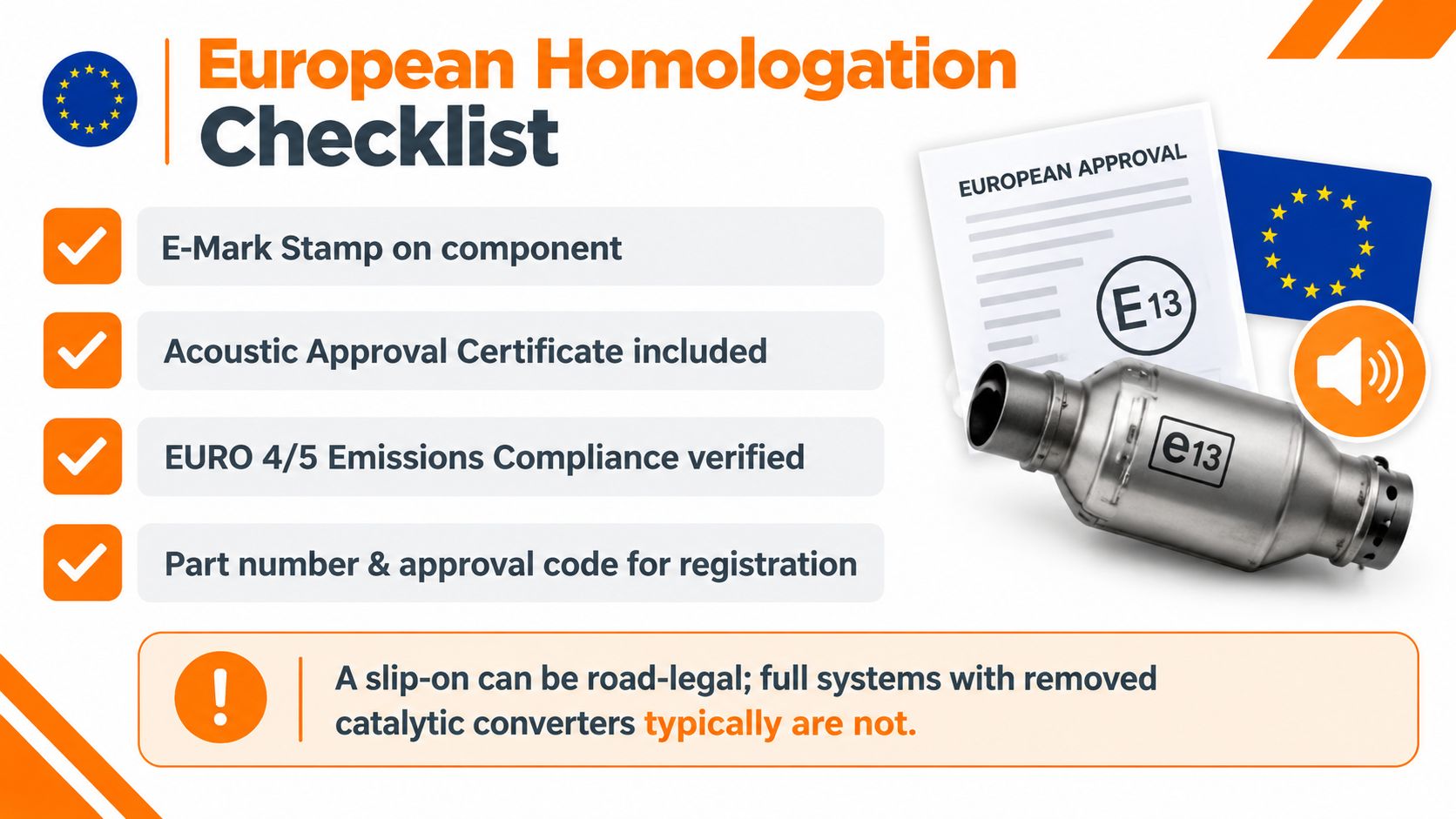
Arrive at a roadside inspection with a loud exhaust and no paperwork, and a good physical fit will not help. For a TMAX 500 used on European roads, check the E-mark or approval marking, the certificate, the exact part number and the emissions configuration. These items connect the component to the correct TMAX generation and its approval conditions.
The certificate works like a recipe. If the catalyst, dB-killer or internal parts differ from the approved version, the finished system may no longer match that recipe. A terminal that keeps the original catalyst and emissions layout is generally easier to verify. A header set that removes or bypasses the catalyst falls under different conditions, even if it bolts on without difficulty.
The Sixrace guide to motorcycle exhaust approval in Europe explains how to read the E-mark code and which certificate lines must match your TMAX generation before purchase. Keep the certificate as part of the component's documentation, not as optional reading after installation.
What changed from 2025
From January 1, 2025, motorcycle noise testing has had to meet UNECE R41.05 under more operating conditions. Anti-tampering requirements for replacement silencers were also tightened through UNECE R92 amendments, as described in this overview of the 2025 motorcycle exhaust noise rules. For a newer replacement silencer, post-2025 compliance therefore includes how the system is secured against modification, not only its sound during one test.
The approval applies to a defined configuration. The dB-killer may need to remain installed and fixed, while the catalyst, sensor fittings and packing must stay as supplied. Drilling, cutting, changing internal parts or fitting an unapproved insert can invalidate that approval.
Before installation, check four points:
- Marking: Confirm the component carries the appropriate approval mark and code.
- Certificate: Store the approval document with the scooter's records.
- Configuration: Verify that the catalyst and dB-killer match the approved setup.
- Fitment: Check the exact TMAX year and model listed by the manufacturer.
Legal habit: Photograph the markings and keep a copy of the certificate. During an inspection or roadside check, clear documentation is more useful than a seller's informal statement that the exhaust is “approved.”
Older TMAX models do not automatically avoid every issue. The applicable approval and inspection treatment can depend on the vehicle, replacement part and local enforcement practice. After any modification, assume the original approval may no longer cover the altered configuration.
Real Performance Impact on Power Torque and Weight
Peak horsepower attracts attention, but it's only one part of the riding result. A documented homologated full system for the TMAX platform preserved a measured static noise level of 88 dB at 3,750 rpm, while increasing peak power from 28.5 kW to 29.3 kW at 6,200 rpm and peak torque from 46.0 Nm to 46.6 Nm at 6,200 rpm. The same setup reduced exhaust mass from 8.1 kg to 4.2 kg, according to the documented Akrapovič system data.
| Metric | Stock | With Homologated Full System |
|---|---|---|
| Peak power | 28.5 kW at 6,200 rpm | 29.3 kW at 6,200 rpm |
| Peak torque | 46.0 Nm at 6,200 rpm | 46.6 Nm at 6,200 rpm |
| Static noise | Not specified in the documented comparison | 88 dB at 3,750 rpm |
| Exhaust mass | 8.1 kg | 4.2 kg |
The power and torque changes are real but modest. The mass difference is more striking. Removing 3.9 kg from a rear-mounted component can make the scooter feel quicker to respond in stop-start riding, reduce the inertia associated with the exhaust assembly and lessen the load carried behind the engine and chassis. That doesn't turn the TMAX into a different class of vehicle, but it can make everyday transitions feel cleaner.
Why backpressure is a compromise
Backpressure isn't just “bad pressure.” A catalyst and dense silencer packing restrict flow, but they also support emissions and noise control. A freer-flowing racing system reduces restriction, which may help flow at higher demand, yet it generally raises acoustic output and can reduce low-rpm efficiency.
That trade-off matters more on a CVT scooter because the transmission keeps the engine working through its automatic operating range. A system that shifts the useful response toward conditions the rider rarely uses may look attractive on a test sheet but feel less satisfying while pulling away from a junction or rolling on between traffic gaps.
The practical gain is often the combination of lower mass, controlled sound and usable torque delivery, not the largest number printed beside peak power.
Use the figures as an expectation-setting reference, not a promise for every product. Different generations, dynos, catalysts, intake setups and CVT calibrations can produce different results. A street-legal full system should be evaluated as a complete package, especially when emissions hardware and noise limits are part of the brief.
Installation Mapping and Long Term Maintenance
A TMAX that starts, idles and rolls on cleanly after an exhaust change usually reflects careful fitment, not just a good-looking terminal. Begin with the model year and engine variant. The 500, 530 cc and 560 cc variants have different parts and bodywork, so match the manufacturer's fitment code rather than relying on a photograph or a broad “TMAX” label.
A careful installation sequence
- Inspect the supplied parts. Confirm headers, joints, springs, brackets, gaskets, catalyst, sensor ports and dB-killer components before removing the original system.
- Protect the sensors. Disconnect oxygen-sensor wiring without twisting the cables. Keep each lead away from heat, the rear suspension and moving drivetrain parts.
- Fit without forcing. Start every fastener loosely, align the system, then tighten it progressively. Forced alignment can stress brackets and leave joints leaking.
- Check clearance. Examine the space around body panels, rear suspension, tyre, CVT area and passenger-foot regions. Position heat shields as specified by the design.
- Inspect for leaks. After the first heat cycle, let the system cool, then recheck joints, springs and fasteners.
A warning light needs investigation. Changing catalyst behavior or sensor readings can affect ECU operation, although every exhaust does not automatically require mapping. Do not load an unverified map. A qualified technician can check fueling, sensor operation and CVT behavior before deciding whether adjustment is appropriate. The motorcycle dyno tuning process guide explains why controlled testing is safer than guessing.
Ownership checks that prevent small faults
Inspect the system regularly for discoloration, corrosion, cracked springs, loose brackets and soot around the joints. Soot commonly indicates a leak. A rattling silencer may point to internal damage or worn packing. Keep the dB-killer installed for road use when approval depends on it, and leave its fixing method unchanged.
Post-2025 compliant systems may contain more hardware, including a catalyst and provisions for multiple lambda sensors. Product documentation for the 2025 TMAX 560 shows an approved system with catalyst and double-lambda compatibility in the Akrapovič TMAX product listing. That product concerns a later TMAX variant, not a direct 500 fitment. It does show why sensor access, emissions components and tamper-proof approval details can affect installation time and long-term cost.
For a CVT scooter, maintenance also protects the riding response you bought the exhaust for. A loose bracket can create noise, while a leak or altered sensor reading can disturb the smooth midrange roll-on that matters in stop-start traffic. Recheck fasteners after initial use and keep the approved configuration intact.
Choosing the Right Scarico TMAX 500 for Your Riding Style
Your riding pattern should decide the exhaust before styling preferences do.
For daily commuting, choose a homologated terminal or full system that retains the required catalyst and dB-killer. Smooth roll-on response, low noise and dependable sensor behavior matter more than a race-only claim.
For touring, favor controlled sound and secure mounting. A system that becomes tiring on long rides is a poor upgrade even if the first ride feels exciting.
For sporty road use, a lighter homologated full system can make sense when the installation preserves emissions equipment and the product lists your exact generation. The documented results show why weight can matter alongside modest peak gains.
For track days, a racing system may suit the environment, but it shouldn't be confused with a public-road solution. Track use can accept more noise and fewer emissions controls, while road use requires the approved configuration.
For appearance alone, a terminal is usually the clearest route. You'll change the visible rear section without automatically disturbing the entire exhaust path.
Before ordering, verify the year, engine variant, mounting arrangement, sensor provisions, catalyst status and approval note. The aftermarket versus OEM motorcycle parts guide can help frame the broader choice between original and replacement components. The core rule remains simple: if you ride mainly on the street, select balanced flow, legal sound and lower weight. If you can't confirm those points, the exhaust isn't ready to buy.
Sixrace provides model-specific motorcycle and scooter parts, including exhaust-related components where fitment and approval details are listed. Visit Sixrace to check TMAX-compatible options by model year, compare terminal and complete-system choices, and review the documentation before you order.
 Italiano
 Deutsch
 Français
 Español
 English
 Polski