
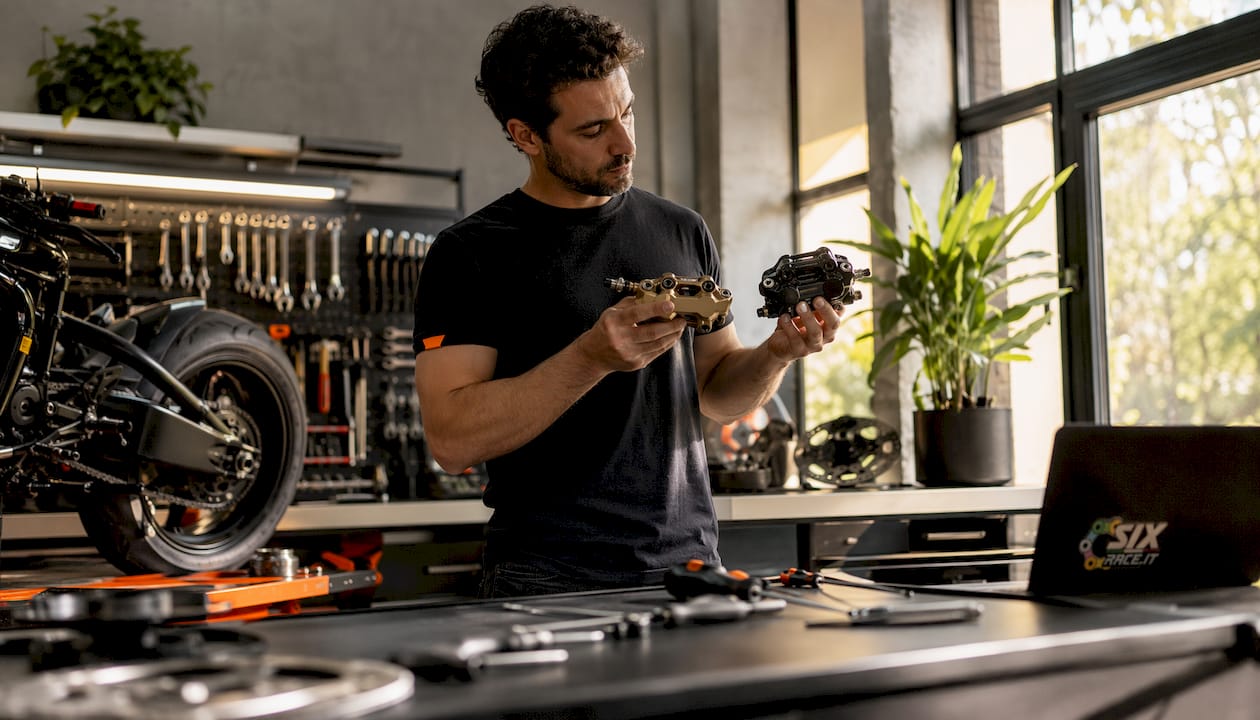
OEM motorcycle parts are components produced by the original manufacturer to exact factory specifications, while aftermarket parts are alternatives made by independent manufacturers. The choice between them affects performance, cost, legal compliance, and long-term reliability. The EU’s aftermarket parts and accessories sector services a two-wheeler parc of over 30 million units, with replacement cycles typically running 3–7 years for critical components. That scale means the decision between aftermarket vs OEM motorcycle parts is one most riders face repeatedly throughout ownership.
What are the quality and safety differences between aftermarket and OEM parts?
OEM parts undergo rigorous manufacturer testing to meet specific standards, guaranteeing exact fit and reliability. This matters most for safety-critical systems such as brakes, suspension, and electronics, where tolerances are tight and failure consequences are severe.
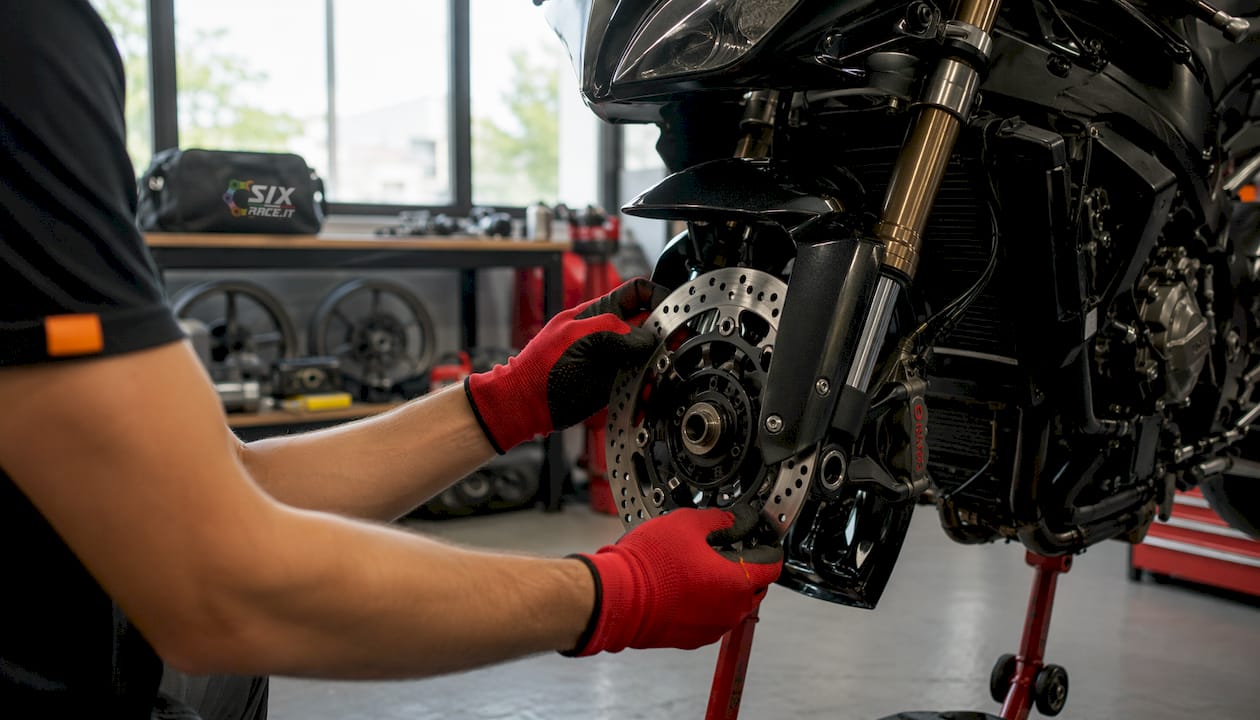
Aftermarket parts span a wide quality spectrum. At the top end, established brands such as Evotech Performance, Brembo, Acerbis, and R&G produce components that meet or exceed OEM specifications. At the lower end, unverified parts may carry no meaningful certification at all.
EEC/E-type approval is mandatory for all aftermarket components sold for road use in the EU. This approval confirms compliance with essential safety, emissions, and noise standards. A part without this marking is not legally road-legal in EU member states, regardless of how it looks or how cheaply it is priced.
Braking systems illustrate the stakes clearly. OEM integration holds approximately 55–60% of total motorcycle braking system market value in the EU. Dynamic friction characteristics and thermal stability in braking components must meet exact specifications. Unverified aftermarket brakes can reduce stopping performance in ways that are not immediately obvious during normal riding.
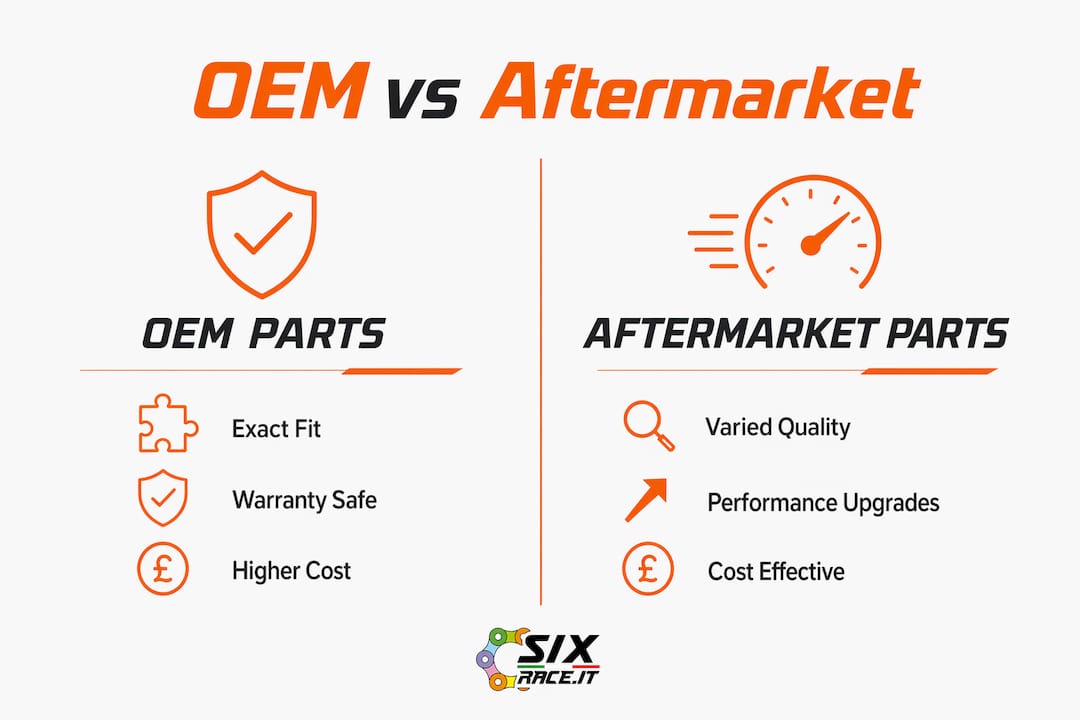
| Characteristic | OEM parts | Aftermarket parts |
|---|---|---|
| Fit and tolerances | Exact factory specification | Varies by manufacturer |
| Testing and certification | Full manufacturer validation | Ranges from EEC-approved to uncertified |
| Road legality (EU) | Always compliant | Requires EEC/E-type approval marking |
| Safety-critical suitability | Recommended | Only if fully certified |
| Price point | Higher | Lower to comparable, depending on brand |
Pro Tip: Always check for the EEC or E-type approval marking on any aftermarket part before purchase. The marking is a legal requirement, not a marketing claim, and its absence is a clear warning sign.
How do cost and pricing compare between OEM and aftermarket parts?
OEM parts in the EU command a 30–60% price premium over independent aftermarket equivalents. That gap reflects genuine differences in development costs, supply chain integration, and the manufacturer’s liability for the component’s performance within the complete vehicle system.
Counterfeit parts sit at the opposite extreme. They can undercut genuine pricing by 40–60%, but they routinely fail safety and type-approval standards. The short-term saving disappears quickly when a counterfeit brake pad glazes under heat or a fake fork seal fails after two months.
The homologation process for performance aftermarket parts can increase development and certification costs by up to 30% for manufacturers. Reputable aftermarket brands absorb that cost and pass a portion on to the buyer. When a certified aftermarket part is priced well below OEM, it is because the manufacturer has achieved production efficiencies, not because corners have been cut on compliance.
Paying the OEM premium makes clear economic sense in several situations:
- Safety-critical components. Brakes, ABS sensors, and suspension linkages directly affect rider safety. The cost of failure exceeds any price saving.
- Warranty-active motorcycles. Fitting non-OEM parts can void the manufacturer warranty, creating significant financial exposure.
- Modern electronics-integrated systems. Ride-by-wire throttle bodies, traction control sensors, and quickshifter components require exact calibration. OEM parts carry that calibration by design.
- Rare or specialist models. When only one part number fits correctly, the OEM option removes all compatibility risk.
Pro Tip: Calculate total cost of ownership, not just purchase price. A certified aftermarket part at 40% less than OEM is excellent value. An uncertified part at 70% less that fails within a season costs more in labour, downtime, and potential damage to surrounding components.
When do aftermarket parts offer a genuine advantage?
Aftermarket parts deliver clear advantages in three situations: performance upgrades, personalisation, and sourcing parts for older or discontinued models.
Performance upgrades are the strongest case. Brands such as Öhlins for suspension, HP Corse for exhaust systems, and Dynojet for fuelling management produce components that measurably exceed factory specifications. A stock mid-range adventure bike fitted with Öhlins suspension and a Dynojet Power Commander gains measurable improvements in handling and throttle response that the OEM parts catalogue simply cannot match. Sixrace stocks a broad range of these performance motorcycle accessories from verified manufacturers.
Personalisation is the second strong case. Ergonomic adjustments, such as bar risers from Gilles Tooling, adjustable footpegs, or Powerbronze screen options, are almost always aftermarket territory. OEM catalogues are designed for average rider dimensions and standard aesthetics. Aftermarket options exist precisely because factory configurations do not suit every rider.
Older and rare models present a practical challenge for OEM sourcing. Manufacturers discontinue part numbers, and dealer stock runs dry. For a 15-year-old motorcycle, a quality aftermarket spare parts supplier may be the only viable source for a replacement component.
The key conditions for choosing aftermarket with confidence are:
- The part carries valid EEC/E-type approval for road use.
- The manufacturer is established and identifiable, with a traceable warranty.
- The part is matched to the exact make, model, and year of the motorcycle.
- For exhaust systems, the part complies with Euro 5 or Euro 5+ emissions standards as applicable to the motorcycle’s registration year.
What compatibility and installation checks are critical before buying?
Compatibility is not just about whether a part physically bolts on. Modern motorcycles integrate electronics, sensors, and control systems that interact with every major component. A part that fits mechanically but communicates incorrectly with the ABS control unit creates a safety problem that is harder to diagnose than a simple mechanical mismatch.
The following checks apply before any aftermarket or OEM part purchase:
- Confirm the exact make, model, year, and variant. Many manufacturers produce multiple variants of the same model in the same year, with different brake caliper specifications, frame geometry, or electronics packages. A part listed for a model may not fit all variants.
- Verify the approval code matches the motorcycle’s registration. Homologation is vehicle-specific. A part approved for a Euro 4 motorcycle may not satisfy the requirements of a Euro 5 registered bike.
- Check ABS and electronic system compatibility. Mismatched aftermarket hydraulic brakes can cause unintended ABS behaviour, producing paradoxically worse braking performance despite an apparent upgrade.
- Assess the impact on vehicle homologation. An aftermarket licence plate holder that alters the targa position can cause a motorcycle to fail periodic inspection, even if the part itself carries an approval marking. Homologation applies to the complete vehicle, not individual components in isolation.
- Check exhaust db-killer status. Removing a db-killer may invalidate Euro 5 homologation if the system was tested only with the db-killer fitted. The result is a road-illegal motorcycle and potential insurance complications. The Sixrace guide on motorcycle exhaust approval covers this in detail.
- Confirm installation requirements. Some aftermarket parts require professional fitting or ECU remapping to function correctly. Factor that into the total cost before purchase.
Incorrect installation of non-approved parts, such as exhaust systems missing catalytic converters or fitted at altered mounting angles, can void homologation and insurance, making the motorcycle illegal for road use.
Key takeaways
The safest and most cost-effective approach to motorcycle parts selection is to match the part type to its function: OEM or fully certified aftermarket for safety-critical systems, and quality aftermarket for performance upgrades and personalisation.
| Point | Details |
|---|---|
| OEM guarantees exact fit | Factory-tested parts eliminate compatibility risk, especially for electronics-integrated systems. |
| EEC approval is non-negotiable | Any aftermarket part for EU road use must carry EEC/E-type approval to be legal and insurable. |
| OEM costs 30–60% more | The premium reflects testing, liability, and supply chain integration, not arbitrary markup. |
| Aftermarket excels for upgrades | Brands like Öhlins, HP Corse, and Dynojet exceed factory specs in performance categories. |
| Compatibility goes beyond fitment | Verify approval codes, ABS compatibility, and homologation impact before any purchase. |
My view on the OEM vs aftermarket decision
I have seen riders make both mistakes: spending OEM prices on a cosmetic bracket that any certified aftermarket option would have covered, and fitting uncertified brake pads to save £30 on a motorcycle worth £12,000. Neither decision is rational when you understand what the part actually does.
The function of the component is the only logical starting point. If a part sits in the braking circuit, the suspension linkage, or the fuel management system, the certification level is not optional. Riders often underestimate how tightly modern motorcycle systems are integrated. A brake caliper that does not communicate correctly with the ABS module does not just perform slightly worse. It can behave unpredictably under hard braking, which is precisely the moment you need it most.
Where I think conventional wisdom gets it wrong is the assumption that OEM always means better. For performance upgrades, that is simply not true. Öhlins suspension, for example, is fitted as OEM equipment on premium models precisely because it outperforms what most manufacturers would specify as standard. When you buy Öhlins as an aftermarket upgrade, you are getting the same component. The label changes; the engineering does not.
My practical advice is to consult a qualified mechanic or a specialist retailer before fitting anything that touches safety-critical systems. Regulatory compliance and road legality are factors that many riders overlook until they face an insurance claim or a failed roadworthiness inspection. Those are expensive moments to learn the lesson.
— Matteo
Sixrace: verified parts for every riding discipline
Sixrace carries a carefully selected range of OEM-equivalent and certified aftermarket components, covering road, sport, touring, adventure, motocross, and off-road motorcycles. Every product in the catalogue is matched by make, model, and year, so compatibility checks are built into the purchasing process rather than left to chance.
Whether you need brake accessories for a safety-critical replacement or performance components for a track-focused build, Sixrace works with established manufacturers including Evotech Performance, Acerbis, Gaerne, Powerbronze, R&G, and Kayaba. All listed parts meet the regulatory standards required for EU road use. Sixrace customers across Europe also have access to a reserved discount on motorcycle parts and accessories, with multilingual support and tracked shipping included.
FAQ
What is an aftermarket motorcycle part?
An aftermarket motorcycle part is a component produced by a manufacturer other than the original equipment manufacturer. It offers an alternative to the factory part in terms of price, fit, or performance, and must carry EEC/E-type approval for legal road use in the EU.
Are aftermarket motorcycle parts legal in the EU?
Aftermarket parts are legal in the EU provided they carry EEC/E-type approval confirming compliance with safety, emissions, and noise standards. Parts without this marking are not road-legal, regardless of price or appearance.
Do aftermarket parts void a motorcycle warranty?
Fitting non-OEM parts can void the manufacturer warranty on a motorcycle that is still within its warranty period. OEM parts are the safest choice for warranty-active motorcycles to avoid financial exposure.
When should I choose OEM over aftermarket parts?
OEM parts are the correct choice for safety-critical systems such as brakes, ABS sensors, and suspension linkages, for warranty-active motorcycles, and for modern bikes with tightly integrated electronics where exact calibration is required.
Can aftermarket parts outperform OEM components?
Certified aftermarket parts from established manufacturers can exceed OEM specifications in performance categories. Suspension brands such as Öhlins and exhaust manufacturers such as HP Corse produce components that measurably improve on factory-standard parts when correctly fitted and homologated.
 Italiano
 Deutsch
 Français
 Español
 English
 Polski