
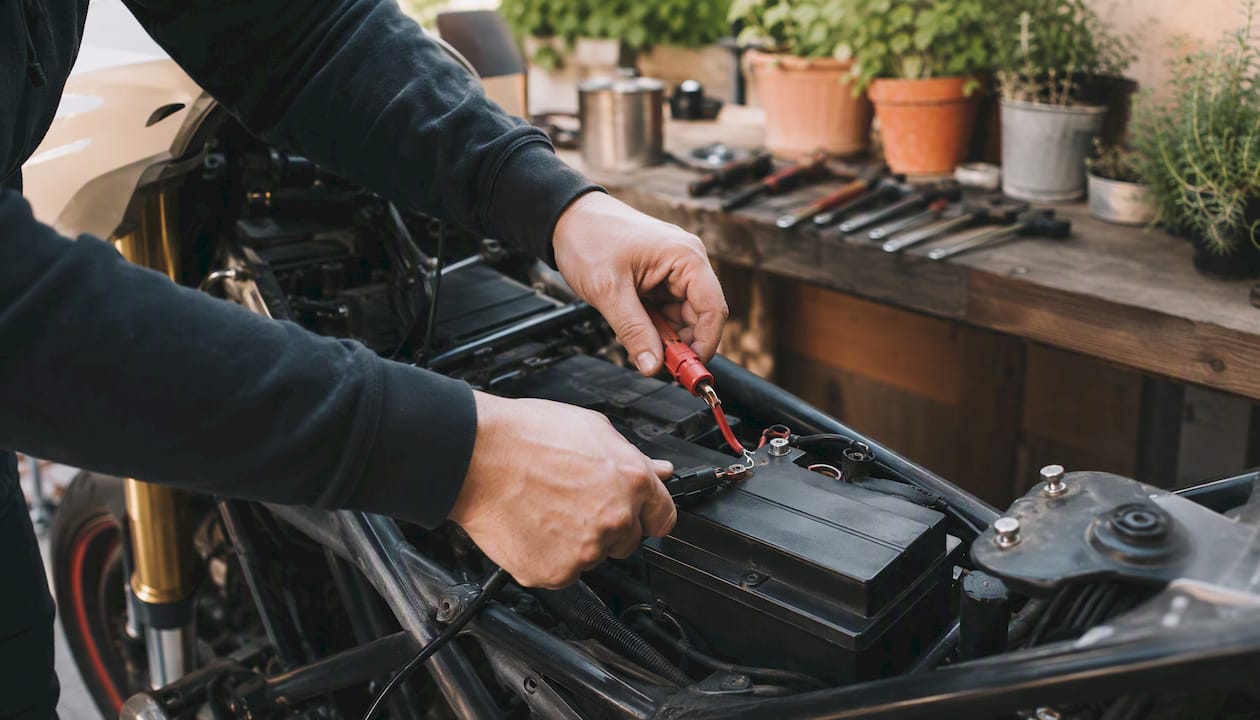
A motorcycle battery tender, also called a smart maintainer, keeps your battery at its optimal charge voltage without overcharging it. Use one whenever your bike sits unused for more than two weeks, during winter storage, in cold Central European climates, or when your motorcycle has parasitic draws from alarms, ECU memory, or tyre-pressure sensors. The key rule: choose a smart maintainer matched to your battery’s chemistry, and you can leave it connected for extended periods without risk.
“Battery Tender” is technically a brand name that has become industry shorthand for any smart maintainer. The standard industry term is battery maintainer or smart charger, and both terms appear throughout this guide.
Key takeaways
A smart battery maintainer is the most cost-effective single investment in motorcycle battery maintenance, because it prevents the sulfation and deep discharge that shorten battery life during Central European winters.
| Point | Details |
|---|---|
| Use a smart maintainer, not a trickle charger | Multi-stage control prevents overcharging and sulfation; indefinite connection is safe with a quality unit. |
| Match chemistry before connecting | Flooded, AGM, gel, and LiFePO4 batteries each require a specific profile; never use a lead-acid setting on lithium. |
| Recommended maintenance rates | 750 mA for small 7–20 Ah batteries; 1.25 A for larger touring batteries. |
| Connect via permanent SAE harness | A ring-terminal harness with an inline fuse makes winter maintenance simple and protects charger electronics. |
| Sixrace for compatible accessories | Browse the Sixrace accessories catalogue to match SAE harnesses and battery products to your specific motorcycle. |
Table of Contents
- What is the role of a motorcycle battery tender?
- How does a smart battery maintainer actually work?
- Why do motorcycle batteries lose charge between rides?
- When should you use a battery tender for your motorcycle?
- Which battery chemistry does your tender need to support?
- How to connect a battery tender safely
- How long can you safely leave a tender connected?
- Common mistakes that undermine battery maintenance
- What to look for when buying a maintainer in Central Europe
- Get your reserved discount on motorcycle accessories at Sixrace
- Sources
What is the role of a motorcycle battery tender?
A battery tender’s core function is to maintain a fully charged battery in a healthy state of readiness, not simply to charge a flat one. Microprocessor-controlled maintainers supply a controlled charge, prevent sulfation, and prolong battery life, making them particularly useful for bikes that sit unused for extended periods. Where a conventional charger pushes current until you disconnect it, a smart maintainer monitors voltage continuously and responds to what the battery actually needs.
A battery tender is important for extending battery life during storage and preventing sulfation, ensuring reliable starts after long periods of inactivity. For Central European riders who typically park their bikes from November through March, that distinction between a charger and a maintainer is the difference between a battery that lasts four or five seasons and one that fails after two.
How does a smart battery maintainer actually work?
Modern smart maintainers use a multi-stage charging process controlled by a microprocessor. Each stage serves a specific purpose, and the sequence is what separates a quality maintainer from a basic trickle charger.
- Initialisation: The unit reads the battery’s resting voltage and checks for faults or deeply discharged cells before committing to a charge cycle.
- Bulk charge: Maximum safe current is applied until the battery reaches roughly 80% capacity. Voltage rises steadily; current remains near its rated output.
- Absorption: Current tapers as voltage approaches the target ceiling (typically 14.4–14.7 V for lead-acid). This stage saturates the remaining capacity without stressing the plates.
- Maintenance/float: Once full, the unit switches to low-level pulses, delivering current only when voltage drops below a threshold. No continuous current flows; overcharge risk drops to near zero.
Brands such as Battery Tender, CTEK, and OptiMate (TecMate) each implement variations of this algorithm. CTEK calls its approach a seven-step programme; OptiMate uses a similar demand-responsive logic under its own naming. The underlying principle is identical: read voltage, respond proportionally, never push current into a full battery.
ISM-style multi-stage charging divides the process into initialisation, bulk, absorption, and maintenance, and this design eliminates overcharge risk while allowing indefinite connection in maintenance mode.
Why do motorcycle batteries lose charge between rides?
Two forces drain a parked motorcycle battery: self-discharge and parasitic draws. Understanding both explains why a maintainer earns its place even for bikes ridden regularly.
Self-discharge is a natural electrochemical process. A fully charged lead-acid battery loses charge at rest, and temperature accelerates the rate significantly. In Central Europe, where garage temperatures can fall to 0 °C or below between November and February, a battery that might hold its charge for six weeks at 20 °C may drop to a critically low voltage in three weeks or less. Cold slows the chemical reactions that deliver cranking power, so a battery that reads an acceptable voltage at room temperature may still fail to start a cold engine.
Parasitic draws compound the problem. Modern motorcycles draw small but continuous currents from:
- Alarm systems and immobilisers
- ECU memory and fuel-injection mapping retention
- Clocks and instrument backlights
- Tyre-pressure monitoring sensors (increasingly common on adventure and touring models)
A typical combined parasitic draw of 5–15 mA is enough to flatten a 10 Ah battery over several weeks of inactivity.
Sulfation is the failure mode that follows. When a lead-acid battery sits in a partially discharged or fully discharged state, lead sulphate crystals form on the plates. Small crystals dissolve during a normal charge cycle; large, hardened crystals do not. The sequence runs: voltage drops below 12.4 V → sulphate crystals begin forming → capacity reduces → the battery can no longer accept a full charge → premature failure. Regular maintenance charging reduces the risk of sulfation and can materially increase service life compared with untreated batteries.
When should you use a battery tender for your motorcycle?
The practical answer depends on how you ride and where you store your bike. Four scenarios cover the majority of Central European riders.
- Winter storage (October–March): Connect a maintainer as soon as the bike goes into storage. A motorcycle storage preparation guide recommends connecting a tender as part of the seasonal shutdown checklist, alongside fuel stabilisation and tyre inflation checks.
- Infrequent riding: If your bike sits for more than two weeks between rides, a maintainer prevents the slow discharge that leads to sulfation. Weekend riders who skip a fortnight during busy periods fall into this category.
- Cold-weather parking: When temperatures fall regularly below 5 °C, connect a maintainer even if you ride weekly. Cold reduces effective battery capacity, and a battery that starts fine at 15 °C may not crank reliably at 2 °C unless it is kept at full charge.
- Long-term storage at a second location: Bikes stored at a holiday property or lock-up for months at a time need a maintainer connected via a permanent SAE harness, since manual reconnection is impractical.
Pro Tip: If your motorcycle has a factory alarm or a GPS tracker, assume a parasitic draw is present. Connect a maintainer any time the bike sits for more than ten days, regardless of season.
Which battery chemistry does your tender need to support?
Not all maintainers work safely with all battery types. Matching the charger to the chemistry is the single most consequential purchasing decision.
Categories of charger:
- Dumb trickle charger: Applies constant low current with no voltage monitoring. Safe for short top-up sessions under supervision; never leave connected overnight or for days.
- Smart maintainer/tender: Multi-stage, microprocessor-controlled, suitable for indefinite connection. The correct choice for storage and infrequent-use scenarios.
- Multi-mode charger: Offers selectable profiles for different chemistries, often with a recovery/desulphation mode. The most versatile option for riders with multiple bikes or mixed battery types.
Chemistry compatibility:
| Battery type | Charger requirement | Key notes |
|---|---|---|
| Flooded lead-acid | Standard smart maintainer | Most common; 14.4–14.7 V absorption ceiling |
| AGM | Smart maintainer with AGM mode | Lower absorption voltage (14.2–14.4 V); no venting |
| Gel | Gel-specific profile | Sensitive to overvoltage; dedicated mode required |
| LiFePO4 (lithium) | Explicit lithium/LiFePO4 profile | Never use a lead-acid profile on lithium batteries |
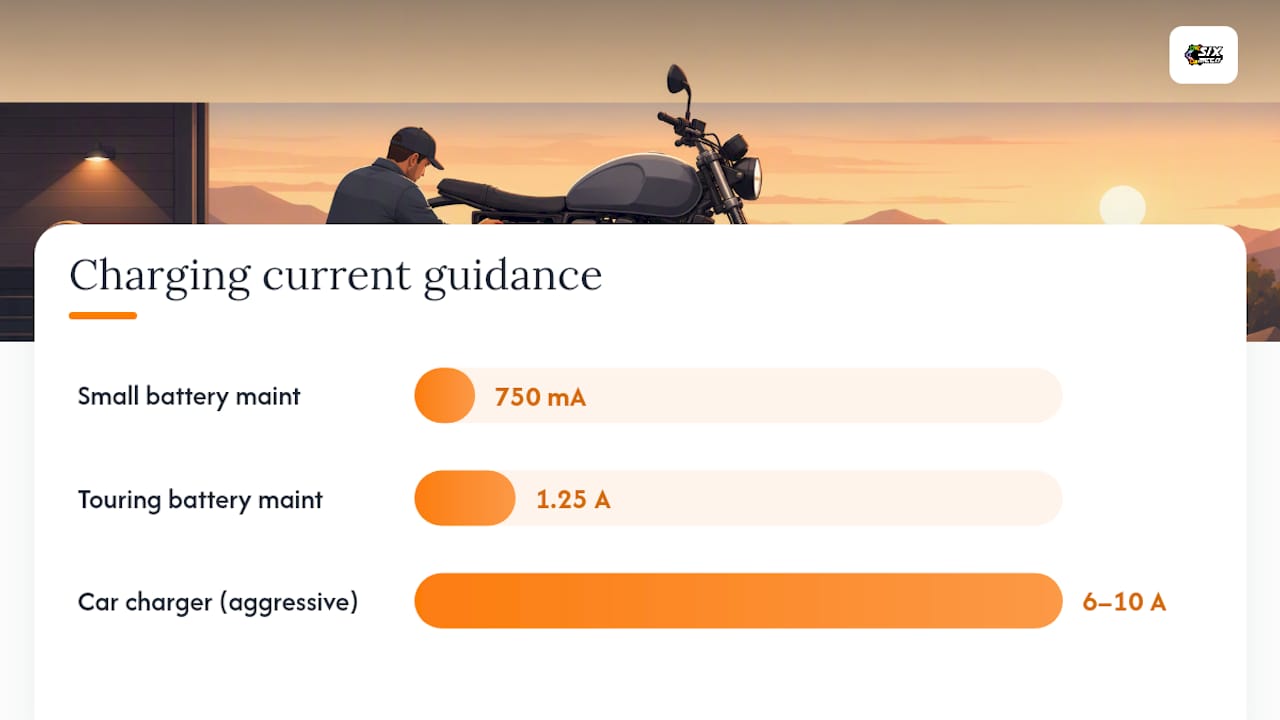
Match a tender to battery chemistry and connector type; smart chargers with chemistry profiles and polarity protection are recommended to avoid damage and user error.
Amperage guidance: Typical motorcycle batteries range from 7 Ah (small naked or sport bikes) to 20 Ah (large tourers). Recommended maintenance rates are around 750 mA for small 7–20 Ah batteries and 1.25 A for larger touring batteries. A car charger rated at 6–10 A is far too aggressive for a small motorcycle battery and risks plate damage.
Safety warning: Using a lead-acid charging profile on a LiFePO4 battery can cause thermal runaway. Always confirm explicit lithium support before connecting.
How to connect a battery tender safely
Two connection methods suit different situations: temporary clamp connections for occasional use, and permanent ring-terminal installations for bikes that need regular maintenance charging.
Step-by-step connection (clamps):
- Switch the motorcycle off completely and remove the key.
- Set the tender to the correct chemistry profile before connecting anything.
- Connect the positive (red) clamp to the battery’s positive terminal first.
- Connect the negative (black) clamp to the battery’s negative terminal or a clean chassis earth point.
- Plug the tender into the mains supply.
- Confirm the indicator shows the correct charging stage.
Permanent ring-terminal installation:
A permanent SAE quick-connect harness routed under the seat is the preferred solution for bikes stored over winter. The procedure adds an inline fuse (typically 7.5 A) between the ring terminal and the positive battery post, which protects the circuit if the connector is accidentally shorted. The SAE connector routes to a convenient access point, and the tender plugs in without opening the seat each time.
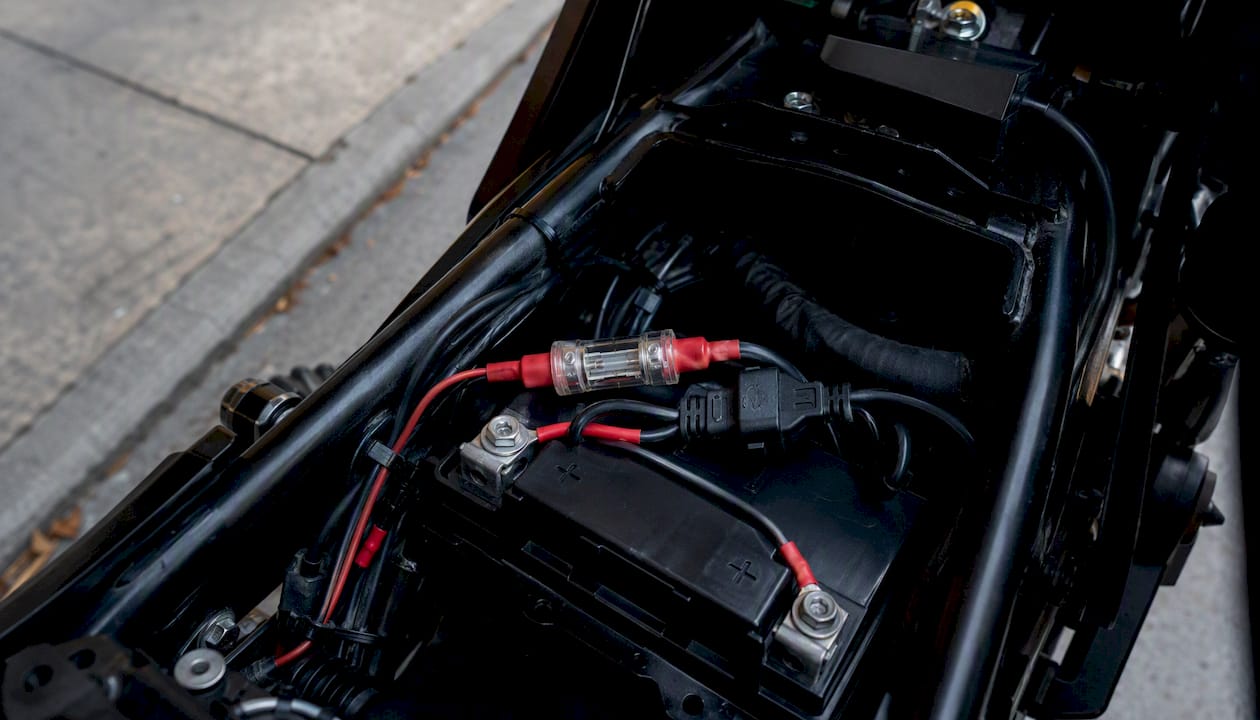
Pro Tip: Route the SAE connector to a weatherproof location, such as behind the front fairing or under the tail unit, and use a rubber cap on the connector when the tender is not plugged in. This prevents moisture ingress and corrosion at the contact points.
Clean battery terminals before any connection. Electrical contact cleaners and spray lubricants remove oxidation that increases resistance and can cause inaccurate voltage readings.
How long can you safely leave a tender connected?
Modern smart maintainers are designed for indefinite connection in maintenance mode. Once the battery reaches full charge, the unit delivers pulses only when voltage drops, drawing negligible current from the mains and applying no continuous load to the battery. Leaving a quality smart maintainer connected throughout a five-month Central European winter is standard practice and causes no harm to a healthy battery.
Several conditions affect this:
- Temperature compensation: Some maintainers adjust their target voltage based on ambient temperature. In an unheated garage where temperatures swing between 5 °C and 15 °C, a unit with temperature compensation maintains more accurate charge levels than one without.
- Deeply discharged batteries: A battery that has dropped below approximately 3 V per cell may not trigger a standard charging cycle. Quality maintainers include a recovery or “force” mode that applies a brief low-current pulse to bring the battery back into the normal charging range before proceeding with the full cycle.
- Products without a true float stage: Basic chargers that lack a genuine maintenance mode will continue pushing current after the battery is full. These are not suitable for extended connection and should be treated as trickle chargers, not maintainers.
Check the manufacturer’s product page for explicit confirmation of float/maintenance mode and any temperature compensation specifications before leaving a unit connected for months.
Common mistakes that undermine battery maintenance
Several errors appear repeatedly among riders who use maintainers incorrectly or choose the wrong product.
- Using any charger as a maintainer: A basic trickle charger applies constant current regardless of battery state. Left connected for weeks, it overcharges the battery, causes gassing, and degrades the plates. A classic trickle charger can overcharge a battery when left connected; a modern smart maintainer charges, then monitors and switches to maintenance pulses to prevent overcharge and reduce sulfation.
- Using a car charger on a motorcycle battery: A car charger rated at 6 A or above delivers far more current than a small motorcycle battery can safely absorb in maintenance mode. The result is accelerated plate degradation and shortened service life.
- Ignoring chemistry settings: Connecting a maintainer set to a flooded lead-acid profile to an AGM or gel battery applies a higher absorption voltage than those chemistries tolerate. The battery may appear to charge normally while sustaining internal damage.
- Leaving connectors loose near moving parts: An SAE connector left dangling near the chain, belt, or exhaust can abrade, short, or melt. Secure all leads with cable ties or routed clips.
- Skipping the maintainer because the bike “only” sits for a week: In cold weather, a week of inactivity combined with a parasitic draw from an alarm system can drop a marginal battery below the threshold where sulfation begins.
What to look for when buying a maintainer in Central Europe
Riders purchasing a maintainer for use in Central Europe should prioritise the following features.
- Multiple chemistry modes: At minimum, separate profiles for flooded lead-acid, AGM, and LiFePO4. Gel support is a useful addition.
- Temperature compensation: Particularly relevant for unheated garages in Austria, Germany, Switzerland, the Czech Republic, and similar climates where winter temperatures regularly fall below 0 °C.
- Float/maintenance stage: Confirmed by the manufacturer, not implied. Check the product page for explicit mention of a maintenance or float mode.
- SAE quick-connect harness compatibility: Allows permanent installation without repeated terminal access.
- Weatherproofing: An IP65 or equivalent rating if the unit will be used in a garage with humidity or condensation.
- Polarity and short-circuit protection: Standard on quality units from Battery Tender, CTEK, and OptiMate; confirm before purchasing a lesser-known brand.
Pro Tip: Check the batteries section at Sixrace to cross-reference your battery’s Ah rating and chemistry before selecting a maintainer. Matching the tender’s amperage output to your battery’s capacity avoids both under-charging and over-stressing the cells.
The accessories catalogue at Sixrace lists SAE harnesses, ring-terminal kits, and connectors alongside the maintainers themselves, which reduces the risk of buying a tender and discovering the harness is incompatible.
A retailer’s perspective on battery maintenance
Riders who invest in a quality smart maintainer and use it consistently rarely need to replace their battery prematurely. The pattern is straightforward: a battery kept at full charge through winter arrives at spring in the same condition it left autumn. Sixrace stocks compatible accessories and battery products with chemistry filters to help you match a tender to your specific bike, and the team can assist with compatibility questions before you buy.
Get your reserved discount on motorcycle accessories at Sixrace
Sixrace gives you direct access to premium motorcycle maintenance accessories, including SAE harnesses, ring-terminal kits, and battery-related consumables, all matched to your make, model, and year. The catalogue covers the brands Central European riders rely on, with competitive pricing, tracked shipping across Europe, and multilingual support.
When you are ready to purchase, three quick checks keep the process clean: confirm your battery chemistry, verify the maintainer’s amperage matches your battery’s Ah rating, and choose an SAE harness if you want a permanent installation. All three criteria are filterable on the Sixrace product pages.
Claim your reserved discount on motorcycle accessories at Sixrace and get the right maintainer and harness for your bike without paying full retail.
Sources
The following sources provide detailed technical information on charging algorithms, chemistry compatibility, and model-specific specifications.
- Motorcycle Battery Trickle Charger vs. Smart Charger: Why the Difference Matters (2026)
- How Does a Motorcycle Battery Tender Work? Benefits, Usage, and Tips Explained – PoweringAutos
- Motorcycle battery tender guide: use, maintain, extend life
- The Ultimate Guide to Motorcycle Battery Tenders
For model-specific ISM settings and temperature compensation details, consult the manufacturer’s own product page rather than third-party summaries, as charging parameters vary between product generations.
 Italiano
 Deutsch
 Français
 Español
 English
 Polski