You've just bought your first YZF450 or KTM 250 EXC-F, taken it out on a Sunday ride, and put it down hard enough to bend a radiator and tear a shroud. The search for replacement ricambi moto cross looks simple until the results fill with different plastics, radiator references, exhaust versions, chain sizes, suspension parts, and model-year ranges that seem to contradict one another.
The problem usually isn't a lack of parts. It's a lack of context. A component can look identical across two years yet use a different mounting point, electrical connector, regional specification, or OEM reference. This guide gives you a practical way to sort the catalog, read compatibility information, recognise the main component families, and check whether a part is genuine before you spend money or start fitting it.
Table of Contents
- Why Sourcing Cross Parts Feels Harder Than It Should
- The Main Families of Ricambi Moto Cross
- How to Read Model Codes and Compatibility Lists
- Choosing the Right Brand for Each Component
- Basic Installation and Maintenance You Can Do at Home
- Counterfeit Risk and Seasonal Timing Most Buyers Miss
- Ordering Correctly on Sixrace and Shipping Within Europe
Why Sourcing Cross Parts Feels Harder Than It Should
A motocross parts search often starts with one damaged item and quickly becomes a compatibility puzzle. “YZ450F plastics” might return complete bodywork kits, individual shrouds, number plates, graphics, fasteners, and parts for several generations. “KTM radiator” can produce listings for the EXC, EXC-F, SX, and SX-F, even though those motorcycles can differ in cooling layout, routing, or intended use.
The first filter is always the exact motorcycle identity. Write down the manufacturer, full model name, model year, sub-model, and region. A KTM EXC-F isn't automatically the same as a KTM EXC, and a competition-focused YZ450F shouldn't be treated as interchangeable with every Yamaha off-road model that shares engine capacity.
Workshop rule: Never order from engine size alone. “450” identifies capacity, not fitment.
OEM part numbers create another obstacle. Manufacturers can revise a reference after a production change, replace a component with a superseding number, or assign separate references to regional versions. Aftermarket suppliers may then list their own SKU while cross-referencing one or more OEM codes. That's why a catalog filter is useful only after you've entered the correct year and model.
Homologation adds a further layer. A road-legal enduro may need lighting, emissions, noise, or approval-related equipment that a closed-course motocross bike doesn't use. Exhausts are particularly sensitive because a racing-only system and a road-homologated system can have different construction, catalysts, markings, and fitment notes.
Use this sequence:
- Identify the bike: model, year, sub-model, and region.
- Classify the damage: bodywork, cooling, protection, drivetrain, suspension, or exhaust.
- Find the OEM reference: use the parts diagram, workshop manual, or the original component.
- Cross-check the aftermarket SKU: confirm that the listing names your exact application.
- Check legality and condition: especially for exhausts, lighting, brakes, and structural protection.
The wider demand explains why catalogs feel so broad. The global motocross market was valued at $1.8 billion in 2022 and was projected to grow at a 4.2% CAGR from 2023 to 2030, while the same dataset recorded 2.1 million active participants globally in 2023. The off-road industry market data also reported U.S. sales of $630 million in 2022, so suppliers serve a large mix of racing, training, trail, and enduro applications.
The Main Families of Ricambi Moto Cross
The easiest way to understand ricambi moto cross is to group parts by the job they perform on the motorcycle. Think of the bike as a working system rather than a long list of individual SKUs. Plastics are the skin, protection is the armour, cooling is the circulation system, and transmission parts transfer the engine's force to the rear wheel.
Bodywork and cooling
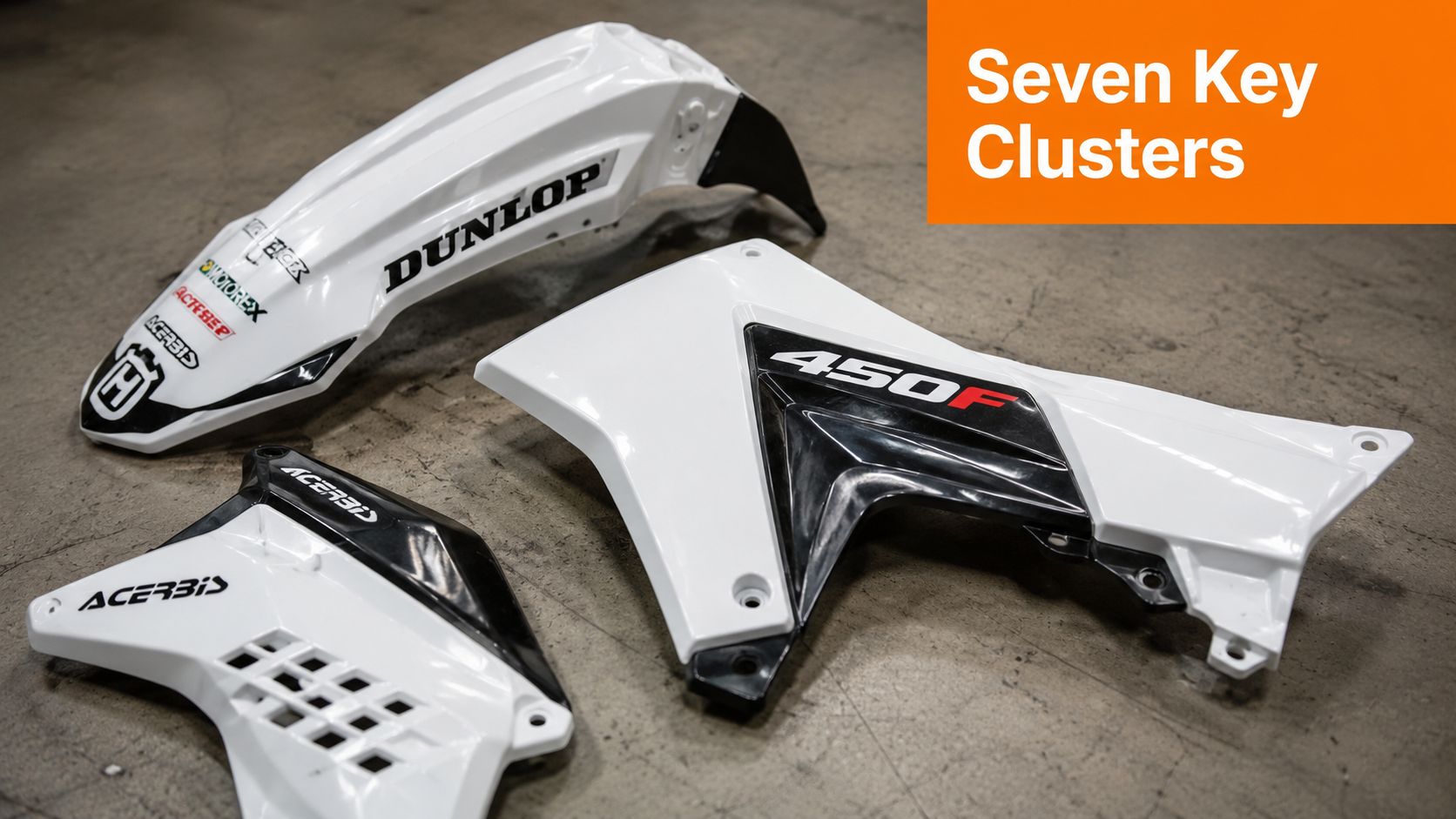
Plastics and graphics include the front fender, rear fender, radiator shrouds, side panels, airbox covers, number plates, and sometimes a headlight mask. They protect the motorcycle from roost and give you the visible part of the machine's identity. A plastic kit may contain several pieces, but it might not include graphics, seat covers, mounting bolts, or rubber grommets. Read the contents list before assuming it's a complete replacement set.
Cooling parts include radiators, radiator guards, hoses, caps, clamps, and sometimes recovery or overflow components. A bent radiator might still hold coolant, but restricted airflow or altered fan clearance can turn a small crash into an overheating problem. Match hose routing and mounting points, not just the engine size.
Protection and transmission
Protection parts take impact before the expensive components do. A skid plate shields the underside of the engine, frame guards protect painted or exposed frame sections, handguards help protect levers and hands, and axle sliders or fork protectors reduce damage during a fall. Aluminium protection usually prioritises stiffness and impact resistance, while plastic guards can keep weight and replacement cost down.
Transmission parts form the chain's working path. They include the front sprocket, rear sprocket, chain, chain guide, chain slider, and guide rollers. Changing sprocket tooth counts changes gearing, so don't order a chain or sprocket in isolation if the final-drive setup has already been modified. Confirm pitch, width, tooth count, mounting pattern, and axle adjustment range.
Suspension and exhaust
Suspension consumables include fork seals, dust seals, bushings, fork oil, shock seals, linkage bearings, and shock or fork springs. A seal kit must match the fork diameter and cartridge family. A linkage bearing kit must match the chassis, not merely the motorcycle brand.
Exhaust parts range from complete systems to slip-ons, silencers, springs, heat shields, and replacement packing. A full system changes more of the motorcycle's exhaust path, while a slip-on normally replaces the rear section only. Always distinguish road-homologated equipment from racing-only equipment before fitting it to a motorcycle used on public roads.
Modern motocross developed through milestones that helped create today's model-specific aftermarket. Torsten Hallman introduced motocross to the United States through a California exhibition in 1966, Suzuki secured a first world championship for a Japanese factory when Joël Robert won the 250 cc title in 1970, and the first stadium motocross event took place at the Los Angeles Coliseum in 1972. The history of motocross shows how the sport's international and technological growth created demand for increasingly specialised components.
How to Read Model Codes and Compatibility Lists
A compatibility line is a compressed instruction, not a marketing slogan. Take “YZ450F 2018-2022”. “YZ450F” identifies the model family, while “2018-2022” identifies the listed production years. The dash means the supplier claims coverage across that range, but you should still check whether a revision occurred inside it.
A line such as “KTM 350 EXC-F 2017-2019 EU/US” adds a regional field. EU and US versions can differ in lighting equipment, emissions configuration, exhaust construction, connectors, or other homologation-related details. A part that fits the chassis may still be unsuitable for the legal or electrical specification of your motorcycle.
Generation codes can appear inside manufacturer references. For example, “CRF450R ME” may identify a model generation or market-specific designation in a catalog. Don't decode a suffix by guesswork. Confirm how the manufacturer or supplier defines it, then compare the OEM number, diagram position, and physical mounting points.
| Field | Example | What it means |
|---|---|---|
| Model | YZ450F | The motorcycle family |
| Year range | 2018-2022 | The production years claimed by the listing |
| Region | EU/US | The market specification covered |
| OEM code | Manufacturer reference | The original component identifier |
| Aftermarket SKU | Supplier reference | The replacement maker's catalog code |
OEM numbers matter because two visually similar components can have different references. A radiator may use one number for a US motorcycle and another for an EU version, even when the core shape appears close. The difference can involve brackets, hose outlets, fan mounts, or the surrounding equipment.
Start with the catalog's make, model, year, and region filters. Then search the OEM number in the site search field and compare the returned listing with the compatibility table. A useful bike-parts compatibility guide can help you understand the logic, while AI product catalog automation provides broader context on how structured product data can keep model, code, and fitment fields organised.
For a worked cross-reference, suppose your parts diagram identifies an OEM radiator reference. Enter that reference, open the aftermarket result, and verify three things: the listing names the exact model and year, the mounting and hose arrangement match your original, and the aftermarket SKU is clearly tied to the OEM code. If one field is missing, ask the seller before ordering rather than treating a similar photograph as proof.
Choosing the Right Brand for Each Component
Brand selection makes more sense when you start with the component, not the logo. Evotech-Performance, Polisport, HP Corse, and Kayaba occupy different parts of the motorcycle ecosystem, so comparing them as if they made interchangeable products leads to wasted searches.
Evotech-Performance is the natural fit for machined-aluminium protection such as frame sliders, axle protectors, and engine covers. These parts are selected when stiffness, accurate machining, finish, and a secure mounting interface matter more than choosing the lightest possible material.
Polisport belongs primarily in the bodywork group. Look there for fenders, shrouds, side panels, number plates, and headlight masks. The key buying question is whether the kit is intended to match the original mounting points and the precise model generation. Plastic is a crash-wear item, so a replacement that fits cleanly and can be changed without drama has practical value for a rider who trains or races regularly.
HP Corse is associated with exhausts and slip-ons, but its listings can include different legal categories. A road-homologated or catalysed version isn't the same product choice as a racing-only system. Check the stated approval, included components, and vehicle application before assuming that a visually similar silencer has the same legal status.
Kayaba serves the suspension side, particularly KYB forks and shocks. Its components and rebuild kits belong with riders who are maintaining KYB equipment, while spring selection should follow rider weight, riding terrain, and the motorcycle's current setup. Don't order a Kayaba component just because the motorcycle is a Yamaha or Kawasaki. Confirm the fork or shock family first.
| Brand | Best-fit components | Material or homologation note |
|---|---|---|
| Evotech-Performance | Frame sliders, axle protectors, engine covers | Machined-aluminium protection, fitment remains model-specific |
| Polisport | Fenders, shrouds, side panels, number plates, masks | Plastic bodywork, verify generation and mounting points |
| HP Corse | Exhausts, slip-ons, heat-related exhaust components | Check road approval, catalyst details, or racing-only status |
| Kayaba | KYB fork and shock service components | Match the suspension family, then select spring or rebuild parts |
A buyer deciding between OEM and aftermarket should compare fitment evidence, material, approval status, warranty handling, and replacement cost. The practical discussion in sourcing auto parts profitably is useful background for that comparison. For motorcycle-specific trade-offs, this OEM versus aftermarket motorcycle parts guide helps frame the decision without reducing it to price alone.
The important negative knowledge is just as useful. Polisport isn't a suspension supplier, Kayaba isn't a plastics brand, HP Corse isn't a radiator manufacturer, and Evotech-Performance isn't the place to search for graphics kits. Route the damaged component to the brand family that serves it.
Basic Installation and Maintenance You Can Do at Home
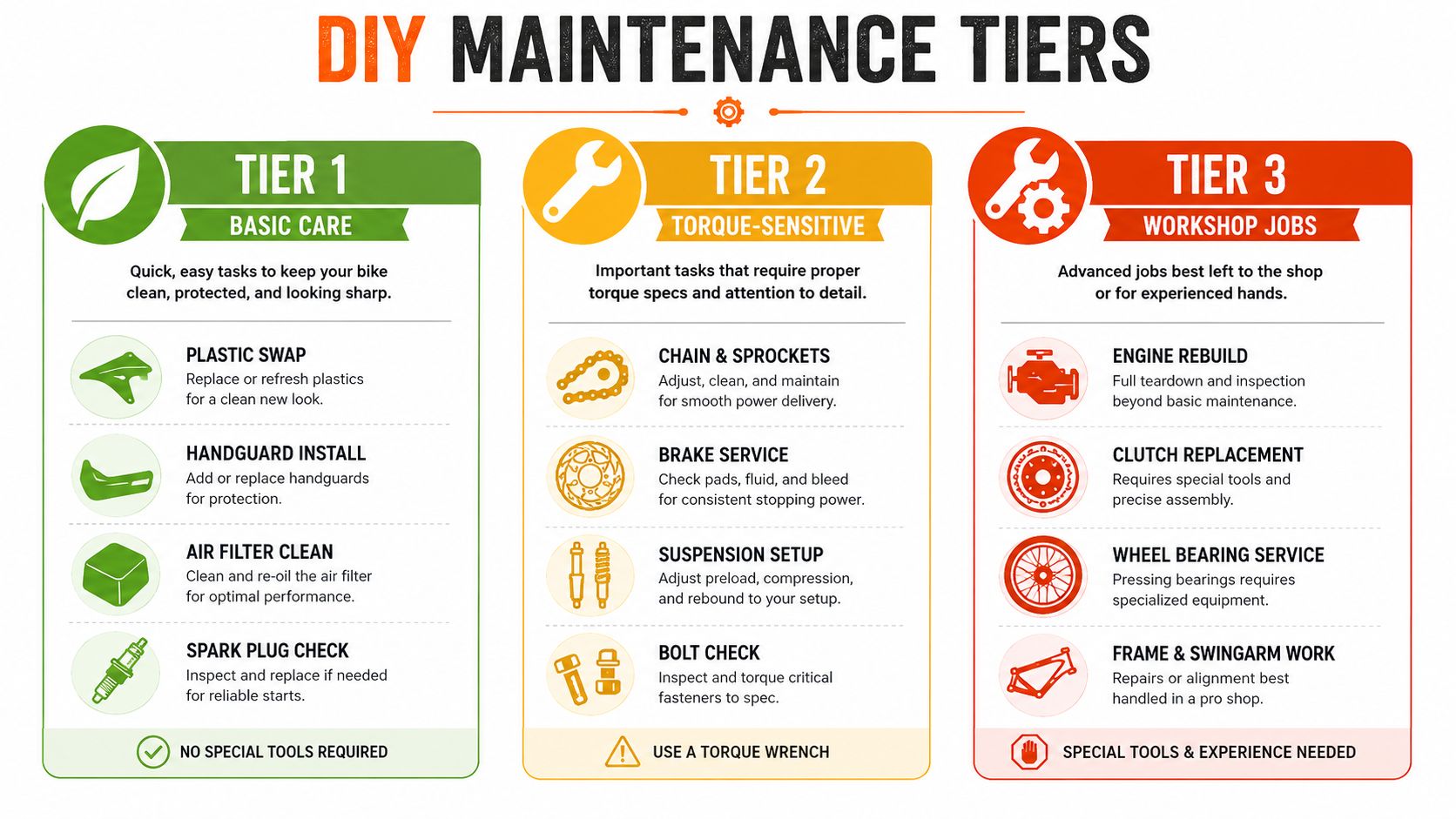
Home maintenance works best when you separate jobs by consequence. A plastic swap and a fork rebuild may both involve removing bolts, but a mistake on the first usually leaves a loose panel, while a mistake on the second can affect control and safety.
Green jobs with basic tools
The green tier suits a careful owner with sockets, hex keys, screwdrivers, pliers, a chain tool where needed, cleaning supplies, and a work stand. You can normally handle:
- Plastic replacement: Remove panels methodically, keep fasteners grouped by location, and transfer rubber grommets to the new bodywork.
- Handguard installation: Check lever movement after fitting. The guard must not hold the brake or clutch lever partially applied.
- Chain inspection and adjustment: Measure slack according to the motorcycle's workshop specification, align the rear wheel, and tighten the axle correctly.
- Air-filter service: Clean the filter with the correct cleaner, allow it to dry, apply filter oil evenly, and seal the airbox contact area.
- Brake-pad visual inspection: Look for remaining friction material, contamination, uneven wear, and a damaged pad spring.
A poorly fitted plastic panel usually reveals itself through rubbing or missing fasteners. A badly aligned chain can wear sprockets and create inconsistent adjustment, so don't rely on sight alone.
Yellow jobs that demand measurement
Brake-pad replacement requires cleanliness and a proper bedding process. Don't touch the friction surfaces with greasy fingers, don't force fluid past the reservoir, and check lever feel before riding. Brake rotors should be cleaned with brake-specific degreaser or isopropyl alcohol. If the surface is oxidised or glazed, light abrasion with Scotch-Brite or approximately 180-grit sandpaper is recommended in the dirt-bike brake maintenance guidance. The same guidance explains why contamination can reduce initial bite and increase lever travel.
Suspension sag measurement also belongs in this tier. Measure axle-to-fender distance with the bike unloaded, then repeat with you in full riding gear. Setup guidance commonly targets roughly 95-105 mm of rider sag on most full-size MX bikes, as described in professional suspension setup advice. Baseline sag before changing compression or rebound, otherwise clicker adjustments can hide an incorrect spring rate.
Red jobs for a workshop
Fork rebuilds, shock revalving, exhaust port matching, and work involving the subframe or steering head deserve workshop equipment and experience. A torque wrench matters on yellow-tier work, but torque values must come from the correct manual for your motorcycle. A workshop manual reference for Husqvarna FE 250 illustrates why model-specific documentation matters.
Service timing depends on use, mud, dust, and the manufacturer's schedule. Riders commonly inspect or service the air filter every few rides, clean the chain frequently during muddy use, and treat fork-oil service as a periodic maintenance task rather than waiting for a leak. Don't apply those intervals blindly. Set your schedule from the manual and the conditions you ride in.
A suspension catalog can include road-focused applications as well as cross and enduro parts. For example, Kit Abbassamento Moto Cf Moto 675 SR R 675 2025 METISSE is listed for CF Moto 675 SR R METISSE F60-075-35 2025, so it shouldn't be treated as a motocross suspension part merely because it appears in a suspension category.
Counterfeit Risk and Seasonal Timing Most Buyers Miss
A low price can hide a high replacement cost when the part is counterfeit or below the required standard. The highest-concern categories include brakes, electrical components, engine parts, branded exhausts, branded plastics, and radiators presented as OEM products. Research on the two-wheeler aftermarket identifies a counterfeit problem in Southeast Asia and Africa, and reports that counterfeit parts may represent 10% to 15% of the organised aftermarket by value in certain Indian categories. An aftermarket counterfeit-parts market report also cites OECD findings that the average value of counterfeit spare parts has risen above USD 300 per item.
Treat authenticity as part of compatibility. Inspect packaging quality, spelling, logos, serial or batch markings, approval marks where applicable, and the part-number prefix. A serial number that can't be verified through the manufacturer's normal channel deserves further investigation. Don't accept “OEM Japan” as proof of origin, especially when the listing gives no clear code, seller identity, warranty route, or documentation.
Seasonality changes the buying decision too. Search-trend analysis reports stronger dirt-bike and motorcycle-parts interest in late summer and early autumn, with brake-parts queries peaking around October in one dataset and broader motorcycle-parts interest rising during August and September. The same analysis describes grips as comparatively stable and handguards as a niche category with distinct peaks. Its market comparison places spare parts at about USD 18 billion in 2024 and accessories at about USD 12 billion, as documented in dirt-bike parts trend analysis.
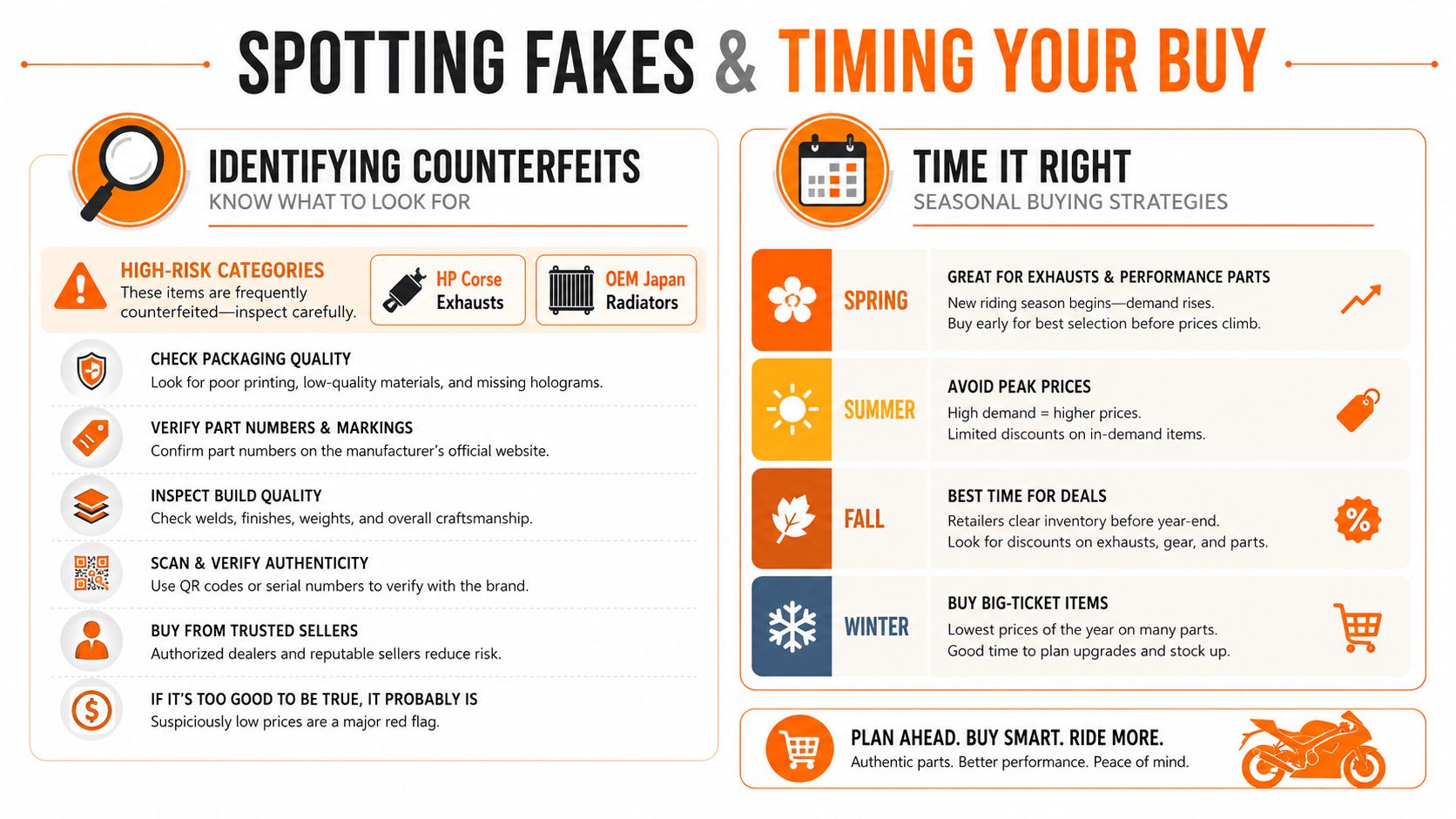
Use a simple planning calendar:
- Before the riding season: Verify plastics, filters, brake components, chain, sprockets, and protection parts.
- During peak riding: Replace wear items based on inspection rather than waiting for failure.
- Before winter training: Check suspension seals, cooling components, handguards, and lighting or exhaust compliance where relevant.
- At every purchase: Cross-reference the OEM code, inspect packaging, verify the seller, and save the invoice.
The practical strategy is to buy non-urgent bodywork during quieter periods and leave reactive crash replacements for when you have confirmed the exact part. A genuine part with clear traceability is worth more than an unverified bargain that creates a second failure.
Ordering Correctly on Sixrace and Shipping Within Europe
Use the product page as a technical document, not just a checkout screen. On Sixrace, start by selecting the make, model, production year, and chassis or frame variant where those fields are available. Pay special attention to sub-models such as KTM EXC-F versus EXC, because the shared brand and capacity can conceal different applications.
Search by the OEM reference or aftermarket part number when you have it. Then read the compatibility note in the product description before adding the item to your cart. A green “fits” indicator can support the selection, but it shouldn't replace checking the written model, year range, region, and sub-model fields.
Before paying, compare the listing with your own records:
- Select the exact application: Confirm model year, chassis code, frame variant, and region.
- Search two references: Use the OEM code and the aftermarket SKU where both are available.
- Read the complete product details: Check included hardware, approval status, quantity, and fitment notes.
For European delivery, the available method and timing depend on the destination and the order information shown at checkout. Remote locations and islands can require additional handling, so validate the postcode before confirming payment. If you're building a broader purchasing process for cross-border logistics, expand globally with SelfServe offers useful context on delivery operations beyond a single domestic shipment.
Keep the order confirmation, product reference, and delivery evidence. If a parcel arrives damaged, photograph the outer packaging before opening it, then photograph the internal packaging, labels, and damaged component. Don't fit a visibly damaged part and then discard the evidence. For warranty or return questions, consult the seller's current terms, especially regarding unused condition and original packaging.
Your final pre-order checklist is short:
- Bike identity: VIN or frame number, exact model, year, sub-model, and region.
- Code verification: OEM reference cross-checked against the aftermarket SKU.
- Physical fitment: Mounts, connectors, dimensions, hose routing, and included hardware.
- Order record: Saved confirmation, delivery address, and photographs if the package arrives compromised.
Sixrace offers model-specific motorcycle accessories and ricambi across areas such as protection, transmission, exhaust, suspension, and off-road equipment, with product pages that identify applications and codes. Visit Sixrace with your VIN or frame details ready, compare the OEM and aftermarket references, and confirm the compatibility notes before ordering your next cross part.
 Italiano
 Deutsch
 Français
 Español
 English
 Polski