

Motorcycle weight reduction is the process of shedding excess mass from your bike to improve its power-to-weight ratio, handling, and acceleration. The most effective approach targets rotating and unsprung mass first, as these components deliver the highest return for both handling and acceleration. Key upgrade targets include lithium-ion batteries, brake rotors, lightweight wheels, and sprocket sets. This motorcycle weight reduction tips guide covers which components to prioritise, how to carry out modifications safely, and how to balance weight loss with rideability.
Which motorcycle components offer the most effective weight reduction gains?
Weight reduction on a motorcycle falls into three categories: rotating mass, unsprung mass, and static mass. Rotating mass includes wheels, brake rotors, sprockets, and the chain. Unsprung mass covers everything not supported by the suspension, such as the wheels and brake assemblies. Static mass is everything else, from the battery to the bodywork.
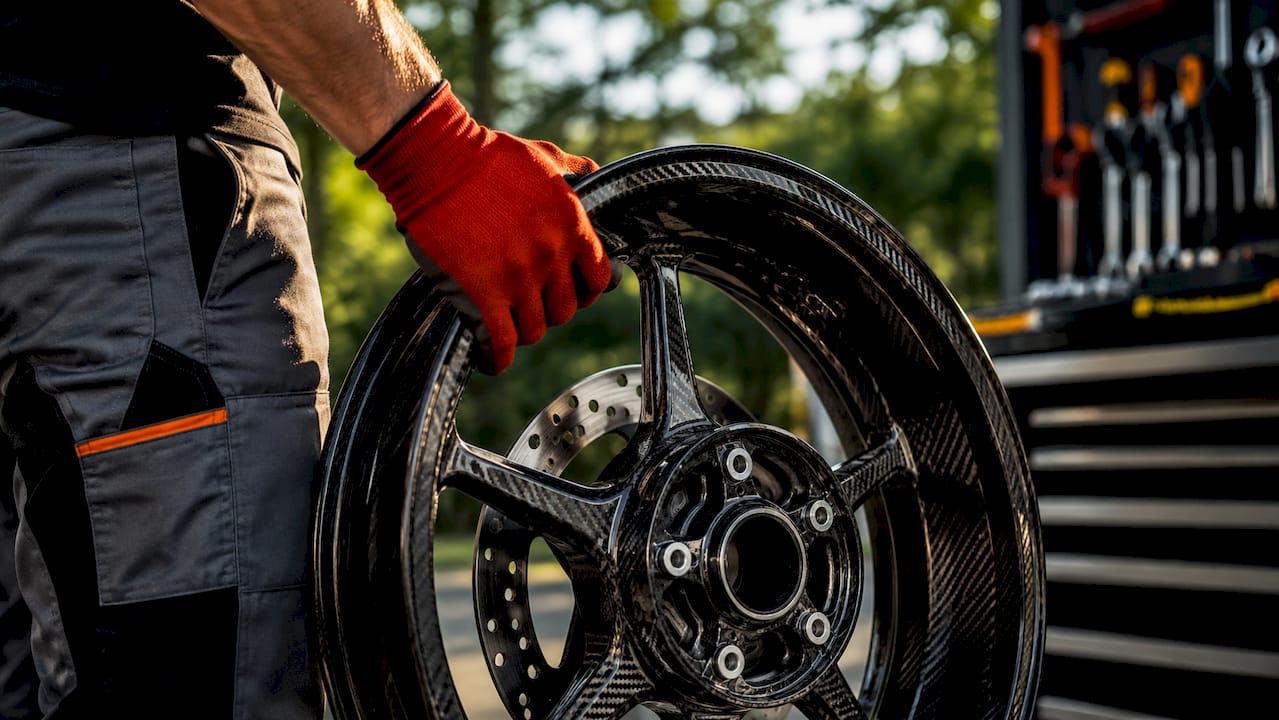
Rotating and unsprung mass should always be your first target. Reducing weight in these areas cuts the energy needed to accelerate, decelerate, and change direction, which means your engine works less for the same result. Professional racers prioritise the lightest wheels permitted precisely because the gains are felt immediately in cornering and braking.
Many critical components contribute to multiple weight categories at once. A wheel, for example, is simultaneously rotating mass and unsprung mass. That overlap makes wheels, brake rotors, and sprockets the most valuable targets in any lightweight motorcycle modification project.
Here is a summary of typical weight savings by component category:
| Component | Type | Typical saving |
|---|---|---|
| Brake rotors (floating or wave) | Rotating | ~8 lbs |
| Lithium-ion battery (vs. lead-acid) | Static | 4–8 lbs |
| Chain and sprocket set | Rotating | ~2.5 lbs |
| Billet aluminium or carbon wheels | Rotating + unsprung | Varies by model |
| Bodywork and fairings | Static | Varies by model |
Static weight reductions are secondary but still worthwhile. Removing non-essential parts such as the centre stand, passenger footpegs, or oversized mirrors contributes modest savings without compromising safety. These changes are low-cost and reversible, making them a sensible starting point for riders new to lightweight motorcycle modifications.
Pro Tip: Start with a weigh-in. Place your bike on a paddock stand and note the stock weight of each component before you buy a replacement. This prevents you spending money on parts that save less than you expect.
How to safely implement motorcycle weight reduction modifications
Carrying out weight reduction modifications requires preparation, the right tools, and a clear sequence. Rushing any step risks damaging components or creating safety hazards.
Step-by-step modification sequence
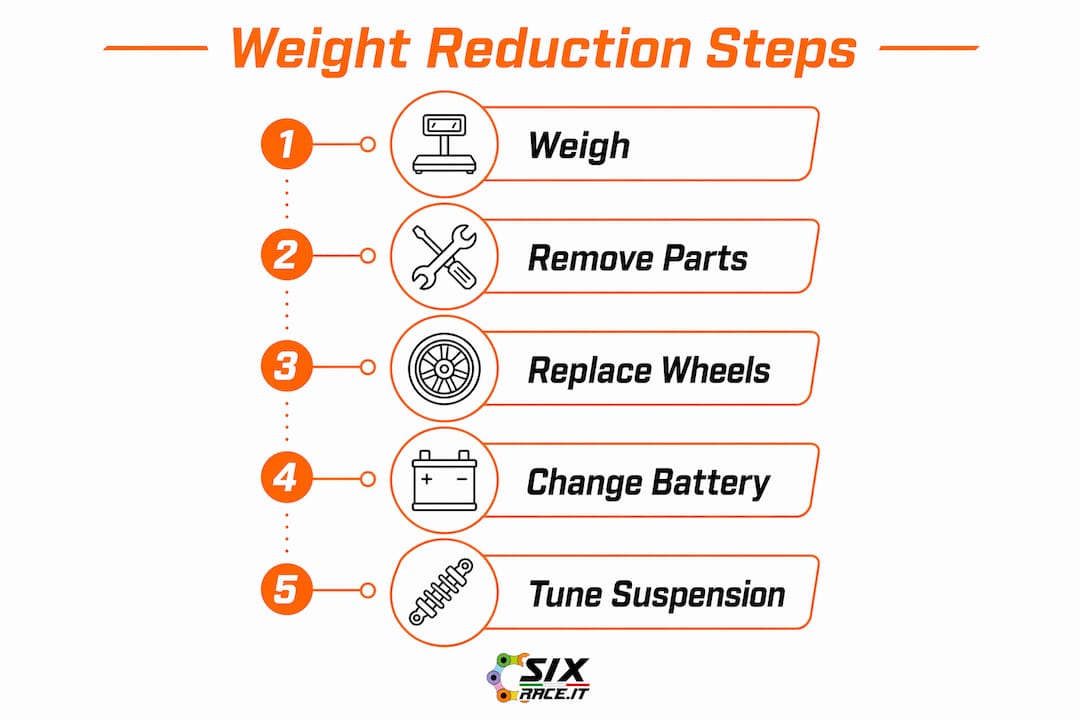
- Audit your current setup. List every component you plan to replace and note its stock weight. This gives you a baseline and helps you measure actual savings.
- Replace the battery first. Switching from a lead-acid unit to a lithium-ion battery saves 4–8 lbs depending on the model. It is the simplest modification with no structural implications.
- Upgrade brake rotors. Floating or wave rotors cut rotating mass by approximately 8 lbs compared to stock units. Always use rotors rated for your bike’s braking demands and torque specifications.
- Fit a lighter chain and sprocket set. A quality lightweight set sheds around 2.5 lbs of unsprung rotating weight. This transfers more horsepower to the rear wheel and sharpens throttle response.
- Upgrade to lightweight wheels. Billet aluminium wheels offer a better strength-to-weight ratio than cast wheels without sacrificing durability. Carbon fibre wheels save more mass but carry a significant cost premium.
- Swap bodywork and fairings. Aftermarket lightweight fairings in polypropylene or fibreglass replace heavier OEM plastic assemblies. The saving varies by model but is consistent across most sport and track builds.
- Remove non-essential accessories. Centre stands, heavy mirrors, and passenger pegs add static weight with no performance benefit on a solo riding machine.
Pro Tip: After any wheel or rotor change, always re-torque fasteners to manufacturer specification and bed in new brake pads over at least 20 braking cycles before riding hard. Skipping this step causes uneven rotor wear and reduced braking performance.
The tools you need for most of these modifications include a quality torque wrench, a paddock stand, a chain breaker and riveting tool, and a tyre removal kit if you are changing wheels. For exhaust swaps, add a set of oxygen sensor sockets and anti-seize compound to the list.
What are the trade-offs when you reduce motorcycle weight?
Weight reduction is not without limits. Aggressive lightening of certain components creates real risks that every rider must understand before proceeding.
The flywheel is the most misunderstood target. Downsizing the flywheel improves throttle response and rev speed, but it reduces low-end torque and can make the bike harder to control at low speeds or in traffic. This trade-off is acceptable on a dedicated track machine but problematic on a road bike used daily.
Reducing rotating mass is the most effective single action a rider can take to improve responsiveness. The gains compound across acceleration, braking, and direction changes. However, every gram removed from a flywheel or crankshaft must be weighed against the rideability cost in real-world conditions. The goal is a faster, more responsive motorcycle, not a difficult one.
Suspension behaviour also changes when the bike loses mass. A lighter front end loads the forks differently under braking, and a lighter rear affects how the shock absorbs bumps. Without retuning, the suspension that worked perfectly at stock weight will feel harsh or unpredictable after significant modifications.
Electronics and gearing deserve attention too. A lighter bike accelerates faster with the same gearing, which can push you into higher revs sooner than expected. Adjusting the front sprocket by one tooth or recalibrating a quickshifter or traction control system keeps the electronics matched to the bike’s new behaviour.
How to maintain and complement weight reduction with suspension tuning
A lighter motorcycle requires a recalibrated suspension setup. Upgrading or professionally tuning suspension after weight reduction is necessary to maintain handling characteristics. Without this step, the performance gains from lighter components are partially offset by a suspension that is no longer correctly sprung or damped for the bike’s new mass.
The key adjustments to make after significant weight reduction include:
- Spring preload. Reduce preload front and rear to match the lower overall weight. Too much preload on a lighter bike creates a harsh, skittish ride.
- Damping rates. Lighter bikes need less compression and rebound damping. Start with small adjustments of one or two clicks and test on a familiar road.
- Ride height. A lighter front end may sit higher than stock. Lowering the fork tubes slightly in the clamps restores steering geometry.
- Tyre pressures. Lighter bikes distribute load differently. Check manufacturer guidance and adjust pressures accordingly.
The suspension upgrade checklist from Sixrace covers these adjustments in detail for a range of models and riding styles. Sixrace also stocks suspension components from Kayaba and other established manufacturers, matched by make, model, and year for straightforward compatibility.
Pro Tip: Book a single session with a suspension technician after your weight reduction work is complete. One professional setup costs far less than replacing components worn out by incorrect damping settings.
Maintenance of lightweight components also requires more attention than stock parts. Carbon fibre wheels must be inspected for impact damage after any kerb strike or pothole. Lightweight rotors wear faster under track use and need more frequent measurement. Lithium-ion batteries perform best when kept above 20% charge and stored at room temperature during winter months.
Complementary performance tuning alongside weight reduction, such as fuelling maps and gearing changes, ensures the whole package works together rather than in isolation.
Key takeaways
Rotating and unsprung mass reduction delivers the greatest performance return of any motorcycle weight saving technique, and suspension retuning is mandatory after significant modifications.
| Point | Details |
|---|---|
| Prioritise rotating mass | Target wheels, rotors, and sprockets first for the highest handling and acceleration gains. |
| Battery swap is the easiest win | Switching to lithium-ion saves 4–8 lbs with no structural changes required. |
| Suspension retuning is mandatory | Adjust preload and damping after weight reduction to preserve handling and safety. |
| Flywheel reduction carries risk | Lighter flywheels improve throttle response but reduce low-speed control on road bikes. |
| Static weight is secondary | Removing mirrors, stands, and footpegs adds modest savings with minimal risk or cost. |
Matteo’s view: weight reduction done right
Most riders approach weight reduction the wrong way. They strip the bike of accessories, fit a loud exhaust, and call it done. The exhaust may save a kilogram. The accessories save a few hundred grams. Neither change touches the components that actually determine how the bike feels to ride.
The single most impactful thing I have seen riders do is swap to lightweight wheels and floating rotors in the same weekend. The difference in direction changes and braking feel is immediate and significant. It is not subtle. You feel it on the first corner.
What I advise against is chasing weight reduction beyond the point of reliability. I have seen riders fit flywheel inserts to sharpen throttle response, only to find the bike nearly impossible to ride smoothly in slow traffic. That trade-off makes sense on a closed circuit. On public roads, it creates a safety problem.
My consistent recommendation is to work in stages. Rotating and unsprung mass first. Suspension retuning immediately after. Static weight last, and only where the saving is meaningful. Gradual, measured modifications give you time to assess each change and ride the bike before committing to the next step. That approach produces a faster, more enjoyable motorcycle rather than a lighter one that is harder to live with.
— Matteo
Sixrace lightweight parts for your weight reduction build
Sixrace stocks a carefully organised range of aftermarket components suited to weight reduction projects across road, sport, touring, and off-road motorcycles.

The lightweight accessories catalogue at Sixrace covers lithium-ion batteries, sprocket sets, and other components matched by make, model, and year. The fairings and plastics section lists aftermarket bodywork from established manufacturers, offering a straightforward replacement for heavier OEM assemblies. All products ship with tracked delivery across Europe, and the Sixrace team provides multilingual support for compatibility queries. Visit the Sixrace discount page to access your reserved discount on performance and lightweight components.
FAQ
What is the most effective way to reduce motorcycle weight?
Targeting rotating and unsprung mass, specifically wheels, brake rotors, and sprockets, delivers the greatest performance return. These components affect acceleration, braking, and handling more than any equivalent saving in static weight.
How much weight can a lithium-ion battery save?
Switching from a lead-acid battery to a lithium-ion unit saves between 4 and 8 lbs depending on the motorcycle model. It is the simplest modification with no impact on the bike’s structure or suspension.
Do I need to retune my suspension after weight reduction?
Yes. Suspension tuning is necessary after significant weight reduction to maintain correct handling characteristics. Preload, damping, and ride height all need adjustment to match the bike’s reduced mass.
Is reducing flywheel weight safe for road use?
Flywheel reduction improves throttle response but reduces low-end torque and can make the bike harder to manage at low speeds. This modification is better suited to track use than everyday road riding.
What static weight reductions are safe to make at home?
Removing the centre stand, passenger footpegs, and oversized mirrors are safe, reversible changes that contribute modest weight savings without affecting the bike’s structural integrity or safety systems.
 Italiano
 Deutsch
 Français
 Español
 English
 Polski