
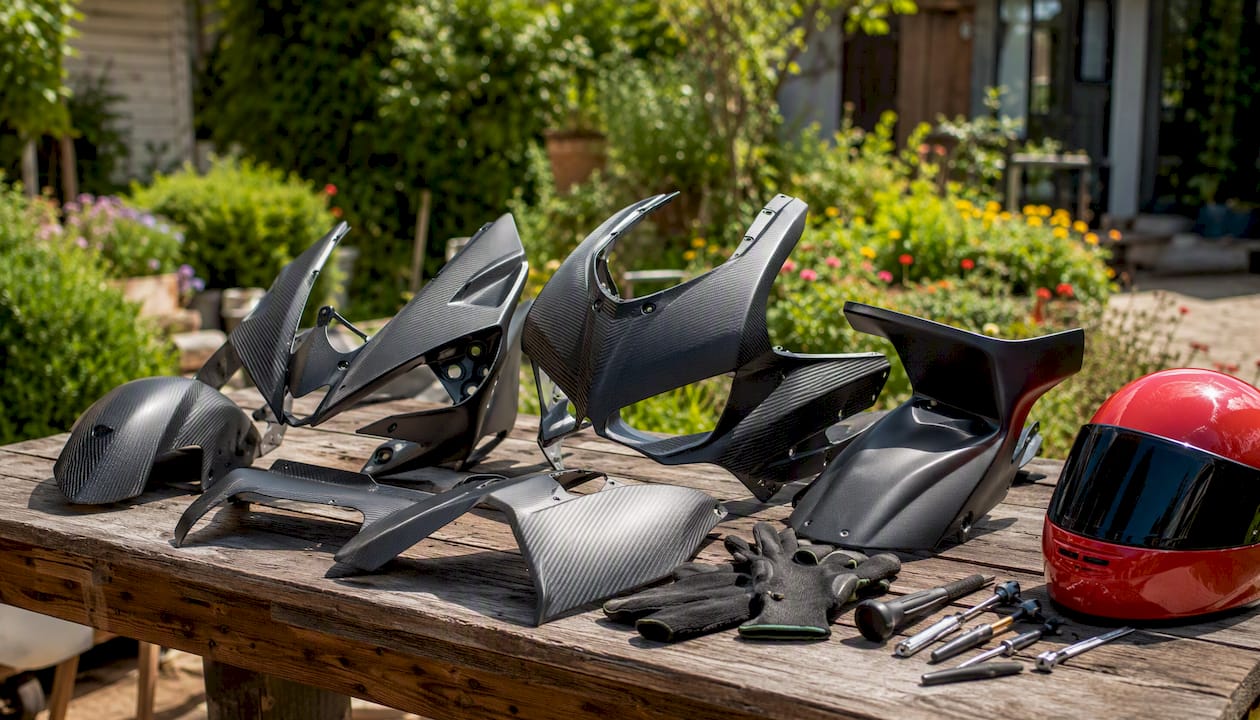
Every fairing type serves a distinct purpose, and matching the wrong style to your riding will cost you comfort, performance, or both. The main categories are: full fairing, half/three-quarter fairing, quarter/bikini fairing, handlebar or headlight fairing, belly pan, tail/rear fairing, and the historical streamliner (dustbin/nacelle). Naked bikes carry none of these, which is itself a deliberate choice.
Here is a quick decision map before we go deeper:
- Full fairing — sport replicas, touring bikes; maximum wind protection and aerodynamic efficiency at high speed
- Half/three-quarter fairing — sport-touring and standard bikes; balances airflow management with easier engine access
- Quarter/bikini fairing — café-racers and retro builds; minimal wind deflection, strong visual impact
- Handlebar/headlight fairing — commuters and adventure bikes; small, instrument-integrated, low weight penalty
- Belly pan — track days and race replicas; reduces aerodynamic lift and, on circuit, acts as a fluid catch pan
- Tail/rear fairing — seat cowls and tail tidies; cleans up the rear silhouette and reduces turbulence behind the rider
- Streamliner/nacelle — largely historical; full enclosure designs banned from FIM racing in 1958 due to crosswind instability
Motorcycle fairing types explained in detail are covered by Wikipedia’s fairing article, which also documents the FIM ban and the transition to dolphin-style designs. Sixrace stocks aftermarket fairings and plastics matched by make, model and year, so compatibility checks are built into the catalogue from the start.
Key takeaways
Matching fairing type to riding use is the single most important decision: full fairings suit sport and touring; bikini and handlebar fairings suit café-racers and commuters; belly pans are required for most track days.
| Point | Details |
|---|---|
| Match type to use | Full fairings for sport/touring; bikini/handlebar for café-racers and commuters; belly pans for track days. |
| ABS for most road riders | ABS balances cost, paintability and impact resistance — the practical choice for Central European conditions. |
| Verify fitment by VIN year | Mounting points change mid-production run; confirm the exact model year before ordering any panel. |
| Check colour codes | Pre-painted panels require a verified OEM colour code; primed panels suit bespoke paint jobs. |
| Sixrace for EU buyers | Sixrace’s catalogue filters by make, model and year, with tracked EU shipping and multilingual compatibility support. |
Table of Contents
- How fairing categories divide: front, rear, belly and full enclosures
- 1. Full fairing: maximum coverage for sport and touring riders
- 2. Half and three-quarter fairings: the practical sport-touring balance
- 3. Quarter/bikini fairing: style-led with selective wind deflection
- 4. Handlebar and headlight fairings: low-weight protection for commuters and adventurers
- 5. Belly pan: aerodynamic lift control and track safety
- 6. Tail and rear fairings: cleaning up the wake behind the rider
- 7. Streamliner and dustbin fairings: the historical designs that shaped modern rules
- What fairings are made from, and what that means for Central European riders
- Why riders fit fairings: aerodynamic gains, comfort and protection
- How to pick the right fairing for your bike and riding
- Fitment basics, common installation issues and routine maintenance
- European buyer checklist: ordering and fitting fairings through Sixrace
- What most guides get wrong about fairing choices
- Sixrace: premium fairings and accessories for European riders
- Sources
How fairing categories divide: front, rear, belly and full enclosures
Fairings and their subtypes divide cleanly into four structural categories, each defined by where it mounts and what it shields.
Front fairings attach to the frame, headstock, or handlebars and face the oncoming airstream directly. They are the most aerodynamically significant component on any faired motorcycle, shaping the pressure wave that hits the rider’s chest and helmet. A front fairing may be a full unit wrapping the engine and lower frame, a half unit covering the upper section only, or a small bikini panel around the headlight.
Rear fairings (seat cowls, tail units, tail tidies) sit behind the rider and reduce the turbulent wake that forms at the back of the seat. They contribute less to drag reduction than front fairings but improve high-speed stability and are the most common cosmetic modification on naked and sport bikes alike.
Belly pans mount beneath the engine, between the lower frame rails. Their primary job is to smooth airflow under the bike and reduce lift at the front wheel. On track, many circuit regulations require a belly pan that can contain leaked oil or coolant — a safety requirement, not just an aero one.
Full enclosures combine front, lower and sometimes rear panels into a single integrated shell. These are standard on sport replicas and most touring machines, where the aerodynamic and weather-protection gains justify the added weight and complexity.
| Category | Mounting point | Primary function | Typical bike type |
|---|---|---|---|
| Front fairing | Headstock / frame / handlebars | Wind deflection, aerodynamic drag reduction | Sport, touring, café-racer |
| Rear fairing / tail unit | Subframe / seat rails | Wake reduction, cosmetic finish | Sport, naked, adventure |
| Belly pan | Lower frame rails | Lift reduction, fluid containment (track) | Race replica, track bike |
| Full enclosure | Frame-integrated, multi-panel | Combined aero, weather and engine protection | Sport replica, tourer |
1. Full fairing: maximum coverage for sport and touring riders
A full fairing wraps the entire front end — from the upper headlight nacelle down to the lower engine panels — and usually integrates the windscreen as a single moulded unit. The result is a continuous aerodynamic surface that manages airflow from the front wheel arch to the rider’s shoulders.
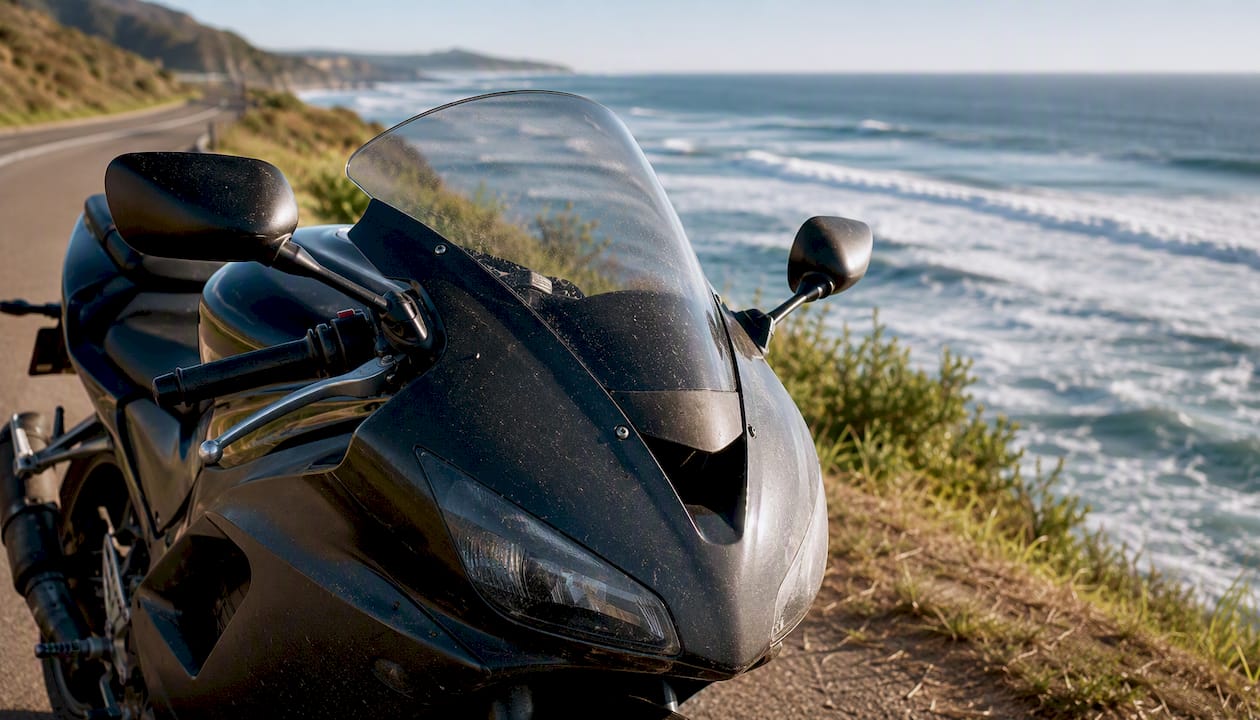
Sport replicas such as the Yamaha YZF-R series and Honda CBR range use full fairings as standard because the enclosed shape reduces frontal drag significantly compared with a naked frame. Touring machines like the BMW R 1250 RT take the same principle further, extending the side panels to protect the rider’s legs and knees from wind and rain — a genuine comfort advantage on long Central European motorway runs.
The trade-off is access. Removing a full fairing for routine maintenance requires unclipping multiple panels, which adds time and the risk of broken tabs if the plastic is cold and brittle. In Central European winters, ABS panels can become less flexible below 0 °C, so patience during removal pays off.
Pro Tip: When refitting a full fairing after winter storage, warm the panels gently with a heat gun on its lowest setting before pressing tabs into place — cold ABS snaps rather than flexes.
2. Half and three-quarter fairings: the practical sport-touring balance
Half fairings cover the upper portion of the front end, typically from the headlight down to just below the instrument cluster, leaving the lower engine and frame exposed. Three-quarter variants extend slightly further down the sides, offering more lateral wind protection without the full lower panels.
Three-quarter and half fairings are often chosen to balance aerodynamic efficiency with maintenance access — the open lower section means you can reach the engine, oil filter and exhaust headers without removing bodywork. Bikes like the Suzuki Bandit S series used this format successfully for years, and aftermarket lowers kits exist to convert a half fairing into near-full coverage when riders want more protection.
For commuters and sport-touring riders who cover mixed roads, the half fairing is often the most practical choice: enough wind deflection to reduce fatigue on dual carriageways, yet accessible enough for regular servicing.
3. Quarter/bikini fairing: style-led with selective wind deflection
The quarter fairing, widely called a bikini fairing, is a small panel that surrounds the headlight and extends only a short distance to each side. It mounts either to the handlebars or to the upper fork legs, and its aerodynamic contribution is modest — its real value is visual definition and a small degree of wind deflection at the rider’s hands and instruments.
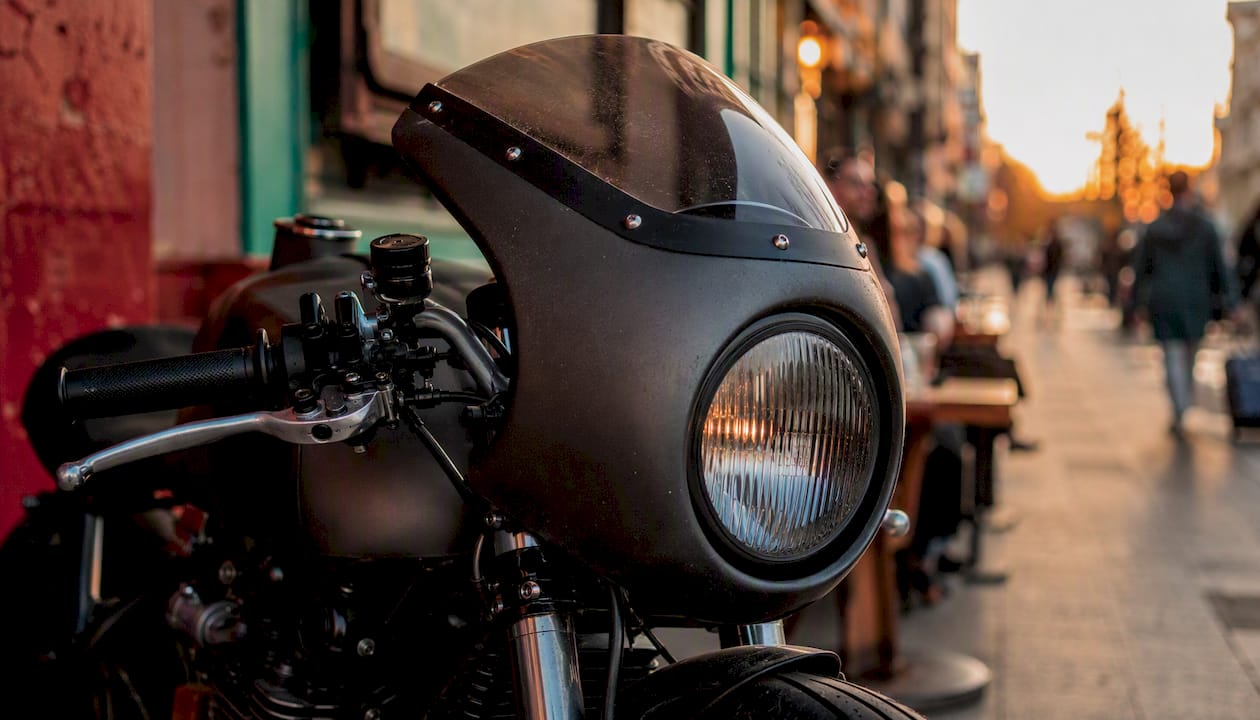
Café-racers and retro builds favour this style because it preserves the stripped-back aesthetic while adding a period-correct racing reference. The Triumph Thruxton and Royal Enfield Continental GT both use bikini-style front fairings as factory fitments, which shows how mainstream the look has become.
Because the panel is small and handlebar-mounted, steering clearance is the critical fitment check. The fairing must not contact the tank or frame at full lock — a test-fit at both steering extremes is non-negotiable before final installation.
4. Handlebar and headlight fairings: low-weight protection for commuters and adventurers
Handlebar fairings (sometimes called cockpit fairings or nacelles) mount directly to the handlebars and move with the steering. They typically integrate the instrument cluster and headlight into a single compact unit, which keeps the front end tidy without adding significant weight.
Adventure tourers and large-displacement commuters use this format frequently. The BMW R nineT Urban G/S and several Moto Guzzi V7 variants carry handlebar-mounted fairings that protect the rider’s hands and instruments from rain and wind without the visual bulk of a full front fairing. The protection is real but limited — at motorway speeds above 120 km/h, a handlebar fairing alone will not prevent significant wind blast on the chest.
Because these fairings move with the bars, cable and wiring routing requires careful attention during installation. Any harness that is too short will bind at full lock; any that is too long will snag.
5. Belly pan: aerodynamic lift control and track safety
The belly pan sits beneath the engine and closes off the underside of the frame. Its aerodynamic function is to prevent high-pressure air from building under the bike at speed, which would otherwise generate lift at the front wheel and reduce tyre contact. At track speeds, that lift is measurable and dangerous.
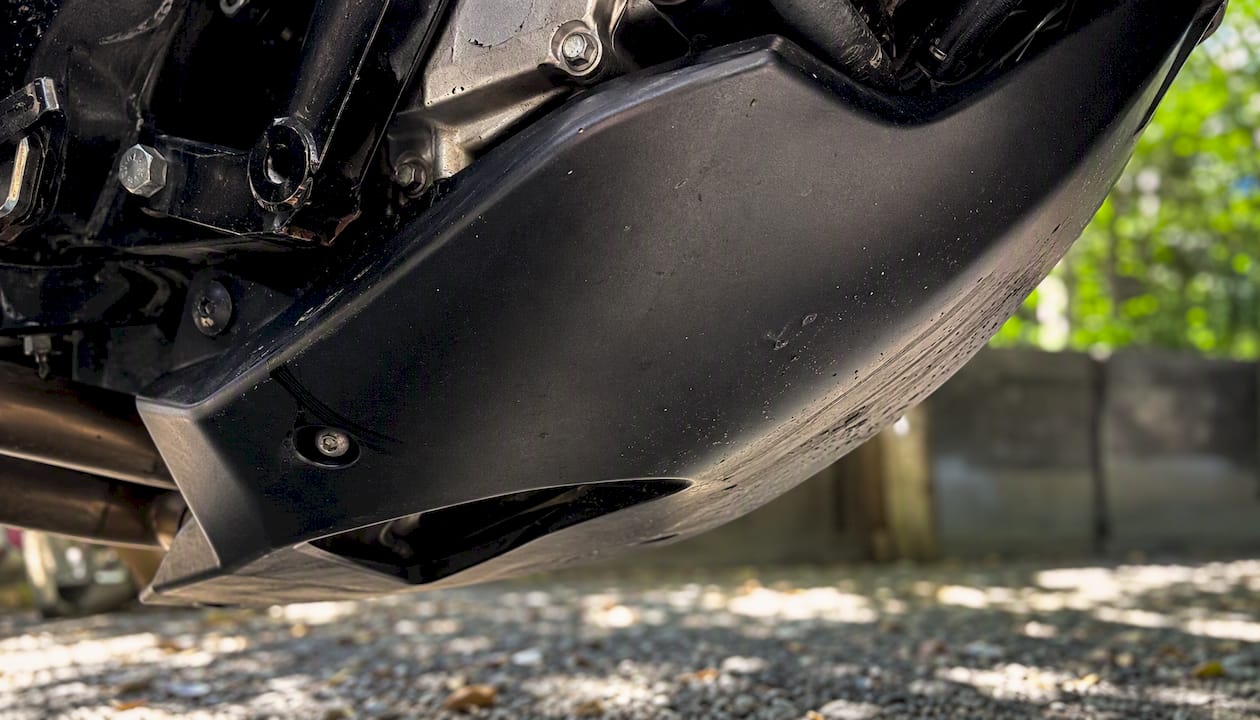
On circuit, belly pans serve a second, regulatory purpose: many track-day organisers and race series require a pan that can contain a minimum volume of leaked fluids, preventing oil from reaching the track surface. This is a safety rule, not a performance one, and it applies at most Central European circuits. Riders planning track days should verify the specific pan volume requirement with the organiser before purchasing.
For road use, a belly pan also protects the engine sump and exhaust headers from road debris — a practical benefit on the potholed secondary roads common across Central Europe.
6. Tail and rear fairings: cleaning up the wake behind the rider
Tail fairings, seat cowls and tail tidies all address the same aerodynamic problem: the turbulent wake that forms behind the rider’s back at speed. A well-shaped tail unit channels air smoothly off the rear of the bike, reducing drag and improving high-speed stability.
On sport bikes, the seat cowl fills the pillion seat and creates a clean tail line — standard on track-prepared machines and popular on road bikes for the same visual reason. Tail tidies replace the factory rear mudguard assembly with a compact bracket, reducing the visual mass at the rear. A motorcycle tail tidy guide covers the fitment considerations in detail, including lighting compliance, which varies by country within the EU.
Rear fairings are the easiest fairing modification to fit and the least likely to affect handling, making them a sensible starting point for riders new to bodywork changes.
7. Streamliner and dustbin fairings: the historical designs that shaped modern rules
The streamliner, or dustbin fairing, enclosed the entire front wheel in a smooth aerodynamic shell. In the early 1950s, these designs produced the lowest drag coefficients ever recorded on racing motorcycles, and they dominated Grand Prix racing briefly. The problem was crosswind sensitivity: the large enclosed surface acted like a sail in side gusts, making the bike unpredictable and dangerous at racing speeds.
The FIM banned dustbin and full streamliner fairings from competition in 1958, a decision that redirected fairing design towards the dolphin style — the open-wheel, sculpted front end that defines every modern sport fairing. That 1958 ruling is why no production motorcycle today uses a full wheel enclosure, and why modern aerodynamic development focuses on winglets, dive planes and underbody channels rather than enclosure.
The nacelle, a smaller streamlined housing around the headlight and instruments, survived the ban and remains in production use on classic-style bikes.
What fairings are made from, and what that means for Central European riders
ABS plastic is the dominant material for aftermarket fairings because it combines impact resistance, paintability and cost-effectiveness in a way no other material currently matches. For most riders in Central Europe — where wet roads, road salt and cold temperatures are seasonal realities — ABS is the practical default.
Fibreglass offers more flexibility in shaping and is easier to repair with standard materials, but it is heavier than carbon fibre and more brittle in cold conditions than ABS. Carbon fibre is significantly lighter and stiffer, which matters on track-oriented builds, but it shatters rather than deforming on impact and costs several times more than an equivalent ABS set. Polypropylene and composite thermoplastics sit between these extremes, offering good impact absorption and moderate weight.
| Material | Best for | Cost band | Impact behaviour | Paintability | Repairability |
|---|---|---|---|---|---|
| ABS plastic | Daily road use, aftermarket replacement | Low to mid | Deforms, resists cracking | Excellent with primer | Plastic welding, filler |
| Polypropylene | Off-road, adventure | Low | Flexes and recovers | Moderate (adhesion prep needed) | Plastic welding |
| Fibreglass | Custom builds, OEM replicas | Mid | Cracks and chips | Excellent | Fibreglass mat and resin |
| Carbon fibre | Race, track, weight-sensitive builds | High to very high | Shatters on hard impact | Possible but complex | Specialist repair only |
| Composite/thermoplastic | Sport-touring, OEM | Mid to high | Controlled deformation | Good | Varies by blend |
Road salt accelerates corrosion of any exposed metal mounting hardware, so stainless or coated fasteners are worth specifying when fitting aftermarket panels. UV exposure degrades unpainted ABS over time; a quality UV-stable topcoat or protective film extends panel life considerably in high-altitude or southern Central European locations with strong summer sun.
- Plastic welding with a hot-air tool is the standard repair method for ABS cracks — it is faster and stronger than filler alone.
- Fibreglass repairs require mat, resin and gelcoat; achievable at home but time-consuming.
- Carbon fibre damage beyond surface scratches requires specialist assessment — structural cracks in a carbon panel are not visible to the naked eye.
- Pre-painted fairings save time but require an exact OEM colour code match; primed panels give better results for bespoke paint jobs.
Why riders fit fairings: aerodynamic gains, comfort and protection
Fairings outperform standalone windscreens for aerodynamic efficiency because they shape the entire pressure field around the bike, not just the air reaching the rider’s face. Manufacturers use 3D scanning and prototyping to tune windscreen curves so they match the fairing’s geometry — a process that explains why an aftermarket screen cut to the wrong profile creates buffeting even when it appears to fit.
The practical benefits for riders:
- Reduced wind drag lowers the physical effort of holding position at motorway speeds, reducing upper-body fatigue on long rides.
- Wind and rain deflection keeps the rider’s chest and hands drier and warmer — a meaningful comfort gain on Central European autumn and spring rides where temperatures fluctuate sharply.
- Engine and electrical protection from road debris, stones and insects is provided by lower panels and belly pans; this is particularly relevant on fast rural roads.
- Fuel economy can improve modestly when a full fairing reduces the bike’s effective frontal area, though the gain depends heavily on speed and riding posture.
- Rider posture interaction: a full fairing encourages a forward-leaning tuck that reduces frontal area further; a half fairing provides less incentive to adopt that posture, which suits upright commuting but reduces the aerodynamic benefit at speed.
For touring riders, the role of fairings in comfort and aerodynamics is covered in depth in Sixrace’s dedicated guide, which addresses how fairing geometry interacts with windscreen height and rider height.
How to pick the right fairing for your bike and riding
The decision comes down to five practical questions, answered in order:
- What is your primary riding use? Track days demand a full fairing with belly pan; daily commuting suits a handlebar or half fairing; café-racer builds call for a bikini.
- What does your bike’s frame allow? Check OEM mounting points, fork travel clearance and handlebar sweep before selecting a style. A bikini fairing on a bike with wide bars may foul the tank at full lock.
- What is your budget? ABS aftermarket sets are the most affordable entry point; fibreglass OEM-replica kits sit in the mid range; carbon fibre race kits represent the top of the cost scale.
- Will you paint it yourself or buy pre-painted? Pre-painted fairings require a verified OEM colour code for an exact match; primed or raw panels give a skilled painter more control but add cost and time.
- How much maintenance access do you need? A full fairing restricts access to the engine; a half or quarter fairing leaves the lower end open.
Compatibility checklist before ordering:
- Confirm exact make, model and year — fairing mounting points often change mid-production run.
- Verify fork travel: a fairing that clears the forks at static height may contact them at full compression.
- Check heat sources: lower panels near the exhaust need heat-resistant materials or a heat shield.
- Confirm instrument and light fitment: some fairings require specific bracket kits for OEM instruments.
- Ask whether hardware (bolts, grommets, tabs) is included or sold separately.
Indicative price ranges vary widely by material and source: ABS aftermarket sets typically run from around €150 to €600 for a full kit; fibreglass OEM-replica sets from €300 to €900; carbon fibre race kits from €800 upwards, depending on the model and manufacturer.
Fitment basics, common installation issues and routine maintenance
A methodical test-fit before final assembly prevents most installation problems. Work through this sequence:
- Mounting point verification: offer each panel up to the frame without fastening and confirm all tabs, grommets and brackets align. Forcing a misaligned panel cracks tabs.
- Gap alignment: check panel-to-panel gaps are even before tightening any fastener. Uneven gaps indicate a misaligned bracket or a panel from the wrong model year.
- Handlebar sweep test: with the fairing loosely fitted, turn the bars to full left and full right lock. Nothing should contact the tank, frame or adjacent panels.
- Windscreen position: confirm the screen sits at the correct height and angle before tightening its fasteners — small adjustments here have a large effect on buffeting at speed.
Common installation issues and their fixes:
- Misaligned tabs: usually caused by a wrong-year panel. Check the part number against the bike’s VIN-confirmed model year.
- Wrong hardware: OEM fairings use specific thread sizes and grommet diameters. Substituting generic bolts risks stripping the plastic mounts.
- Heat deformation: lower panels near the exhaust can warp if there is insufficient clearance. A heat shield or ceramic wrap on the exhaust section solves this.
For seasonal maintenance in Central Europe:
- Wash salt residue from panel edges and mounting hardware after winter rides; salt accelerates corrosion of steel tabs and brackets.
- Apply a silicone-based protectant to rubber grommets and seals before winter storage to prevent cracking.
- Store removed panels flat or on a padded rack — stacking panels vertically under weight causes permanent deformation.
European buyer checklist: ordering and fitting fairings through Sixrace
Sixrace’s catalogue is organised by make, model and year, which means the compatibility check is built into the product search rather than left to the buyer to verify independently. Before placing an order, work through this checklist:
- Exact model and year: use the VIN to confirm the production year, not the registration year — these differ for bikes registered late in a model year.
- OEM colour code: locate this on the frame sticker or in the service manual. Pre-painted panels ordered without a verified code risk a visible colour mismatch.
- Hardware included: confirm whether the kit includes grommets, bolts and brackets, or whether these are sold separately.
- Pre-paint vs primed: decide before ordering — returning a painted panel for a primed one adds lead time.
- Return policy and lead times: Sixrace ships tracked across Europe; check the product page for current lead times, particularly for made-to-order or pre-painted sets.
- VAT handling: for EU buyers, VAT is included in the displayed price. Non-EU buyers should check the checkout for applicable import duties.
Pro Tip: Use Sixrace’s model-year filter on the fairings and plastics category to narrow results to panels confirmed for your specific bike — this eliminates the most common ordering error, which is selecting a panel from an adjacent model year with different mounting points.
For riders fitting sport bike aerodynamic accessories alongside new fairings, Sixrace’s catalogue covers winglets, dive planes and underbody aero components from brands including Evotech Performance and Powerbronze, all matched by model and year.
What most guides get wrong about fairing choices
Most fairing guides treat material choice as a simple hierarchy — carbon fibre at the top, ABS at the bottom — and leave it there. That framing misses the actual decision most riders face.
Carbon fibre shatters on impact rather than deforming. On a road bike that will eventually be dropped in a car park or clipped by a van mirror, a carbon panel becomes expensive debris. ABS deforms, which absorbs energy and often leaves a panel that can be reshaped or welded rather than replaced entirely. For a track-day machine that is transported on a van and never ridden in traffic, carbon makes sense. For a daily rider in Central Europe covering mixed roads in variable weather, ABS is not a compromise — it is the correct engineering choice for the use case.
The second thing guides understate is the FIM’s 1958 dustbin ban and what it actually means for modern design. That ruling did not just remove one fairing style from racing; it set the aerodynamic vocabulary every manufacturer has worked within ever since. The dolphin fairing, the seat cowl, the belly pan — all of these are responses to the constraint the FIM imposed. Understanding that history explains why modern race fairings use winglets and dive planes to generate downforce rather than enclosing the wheel: the rules prevent the most efficient solution, so engineers work around the constraint with surface geometry instead.
Sixrace: premium fairings and accessories for European riders
Riders who have worked through the fairing types and materials above know what they need. Sixrace makes the next step straightforward: a catalogue of premium aftermarket fairings, plastics and aero accessories matched by make, model and year, with tracked shipping across Europe and multilingual support for compatibility questions.

Whether you are replacing a damaged full fairing on a sport replica, fitting a bikini panel to a café-racer build, or adding a belly pan before a track day, Sixrace’s product pages confirm fitment before you order. Brands including Evotech Performance, Powerbronze, Acerbis and R&G cover the full range from cosmetic panels to performance aero components.
Claim your reserved discount and browse the full fairings and accessories range at Sixrace’s discount page — compatibility filters are built in, so you can confirm the right panel for your bike before checkout.
Sources
- Motorcycle fairing - Wikipedia
- How Motorcycle Windshields and Fairings Impact Riding Performance
- What Are Motorcycle Fairings?
- Maximizing Performance: The Importance of Aerodynamic Motorcycle Fairings - Summitfairings
 Italiano
 Deutsch
 Français
 Español
 English
 Polski