

You're in the garage before a weekend ride, one hand on a new lever set still in the box, the other on the old brake lever that's been with the bike since delivery. It's easy to think this is a styling job. It isn't. Leve freno e frizione affect how fast your fingers find the control, how much force reaches the master cylinder or clutch actuator, and whether the bike gives you clean, predictable feedback when the road gets messy.
A lever swap is a control-system decision. The wrong shape, the wrong ratio, or the wrong free play can make a bike feel vague, drag a brake, or leave the clutch half-disengaged at the worst time. The right set feels invisible, which is exactly what you want from a part that sits between your hand and the motorcycle's braking and drive systems.
Table of Contents
- Why Brake and Clutch Levers Matter More Than Riders Think
- The Three Main Lever Types and How They Ride
- Materials, Finishes, and What They Actually Mean
- Fitment Criteria That Decide Whether a Lever Will Work
- Installing Brake and Clutch Levers Without Losing Braking
- Track Days, Enduro, and Daily Riding How the Best Lever Changes
- Safety, Legality, and Common Buyer Mistakes
- Choosing Your Levers and Getting Them Fitted
Why Brake and Clutch Levers Matter More Than Riders Think
The first mistake riders make is treating levers as cosmetic trim. In the shop, the bikes that come back with complaints are rarely the flashy ones. They're the ones where the new lever looked right in the listing, but the reach was off, the pivot felt tight, or the brake side changed the way the master cylinder behaved.
The hand is part of the braking system
Brake and clutch levers aren't just handles. Their force, travel, and geometry shape what the rider can do under pressure. A 1983 Australian government investigation measured front-brake displacement gradients from 1.0 to 5.7 millimetres per metre per second squared of deceleration and front-brake force gradients from 17.5 to 76.7 newtons per metre per second squared. It also measured rear-brake displacement gradients of 1.6 to 12.9 millimetres per metre per second squared and force gradients of 25.8 to 84.6 newtons per metre per second squared. Those ranges show why lever design, adjustment, pivot condition, cable or hydraulic response, and rider hand strength all matter in real use. Australian braking investigation
Practical rule: if the lever changes how far your fingers travel before the brake bites, it changes the bike's feel whether the catalog says “race” or not.
That's why a replacement lever has to preserve the motorcycle's intended leverage and usable travel, not just bolt on cleanly. A part that fits the bar can still give poor control if it loads the system incorrectly or forces your hand into an awkward angle.
Emergency braking starts before the wheel slows
Emergency stops are often decided very early. In an NHTSA simulator study of 68 riders, initial speed reduction at two seconds predicted in-path collision with 95% accuracy, and most riders used both brakes with a front-brake bias during emergencies. That makes lever reach and angle part of crash-avoidance ergonomics, not styling. NHTSA simulator study
Clutch control matters too. In one Motorcycle Safety Foundation test, 35 runs with the clutch engaged produced a mean stopping distance of 41.51 metres, while 11 runs with the clutch pulled and the rear wheel disengaged from the engine averaged 39.95 metres. Across 298 tests, the mean braking distance was 41.7072 metres and the mean deceleration time was 3.1830 seconds. The numbers reinforce a simple workshop lesson, levers must be reachable, predictable, and adjusted for the rider who will use them. NHTSA braking study
The Three Main Lever Types and How They Ride
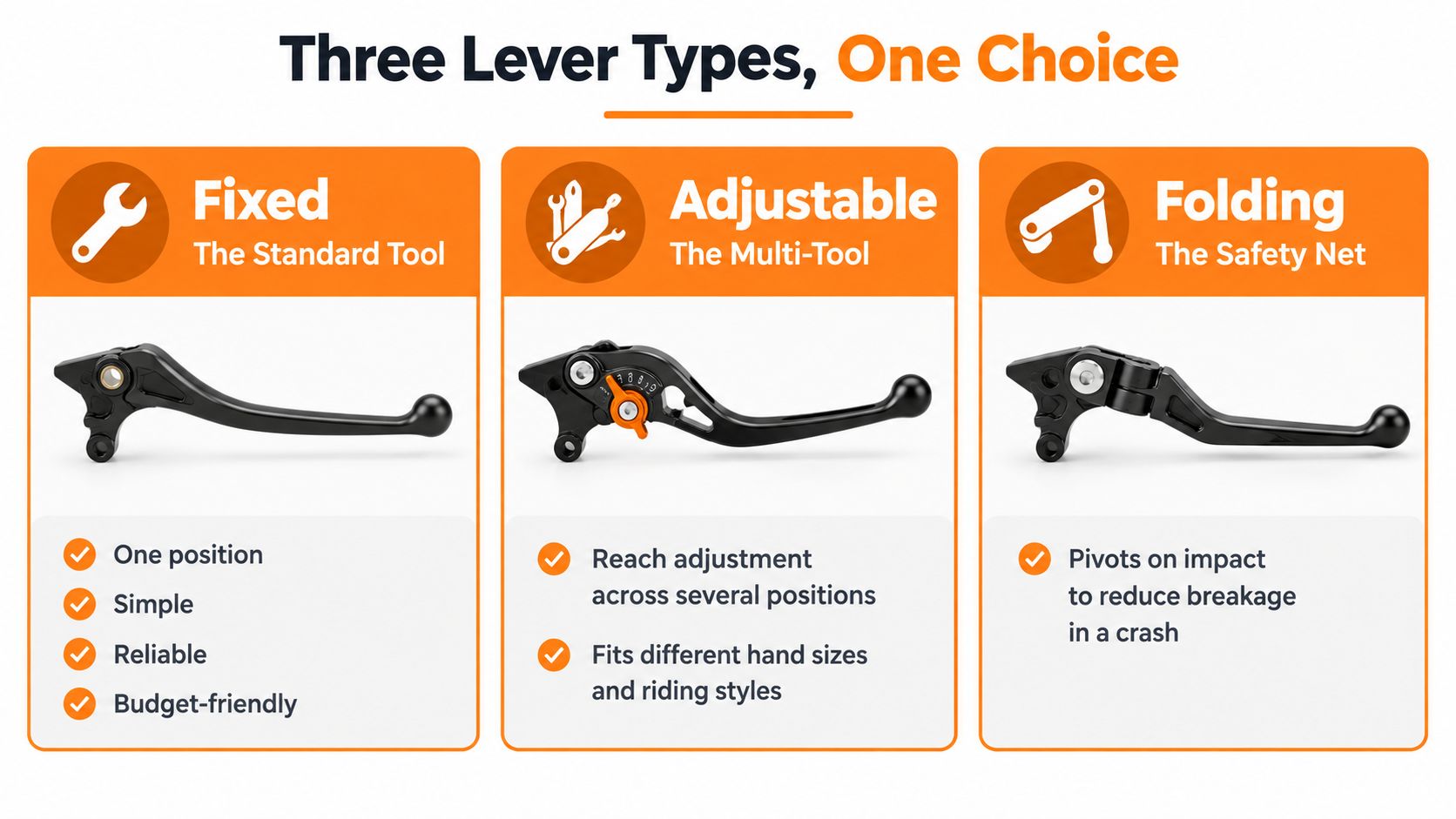
Think of lever choices the way you'd think about tools. A fixed lever is the standard wrench. An adjustable lever is the multi-tool. A folding lever is the breakaway design that tries to survive a knock without snapping off.
Fixed levers
Fixed levers give you one position and one shape. They're simple, predictable, and usually the least fussy choice when the original ergonomics already suit the bike and rider. If the factory geometry feels right, a fixed replacement often keeps the control feel closest to stock.
They're also the least forgiving for riders with different glove thicknesses or unusual hand size. If the lever sits too far from the bar, you end up reaching. If it sits too close, the fingers can feel crowded during a hard stop or a quick clutch pull.
Adjustable levers
Adjustable levers change reach, usually through a multi-position dial or a similar mechanism. That's useful on bikes shared by different riders, on track days when thicker gloves come out, or for riders with smaller hands who need the lever a little closer without changing the entire master-cylinder setup.
The danger is assuming more adjustment is always better. Too much inward placement can reduce usable travel, encourage over-application of the brake, or crowd the lever against the grip. Too much outward placement delays contact and invites late inputs. On a bike like the Yamaha YZF-R9 2025+ Set Griglia Radiatore listing snapshot for a Yamaha YZF-R9 2025 Evotech-performance setup, the point isn't the accessory itself, it's that model-specific control parts have to work with the bike's exact layout, not just with the handlebar tube.
Folding levers
Folding levers pivot on impact. That doesn't make them magic, but it can reduce breakage if the bike tips over or the bar takes a knock. They're popular where low-speed falls are common or where replacement convenience matters more than absolute originality.
A folding design still has to hold the correct reach and pivot smoothness. If the hinge feels loose or the folding section sits at a strange angle, the lever may survive a fall and still feel poor in normal riding.
Materials, Finishes, and What They Actually Mean
Material choice matters, but the workshop answer is never “lighter is always better.” A lever has to survive repeated use, keep a stable feel under load, and behave sensibly if the bike goes down. That's more important than the anodized color on the product page.
Cast, forged, and reinforced materials
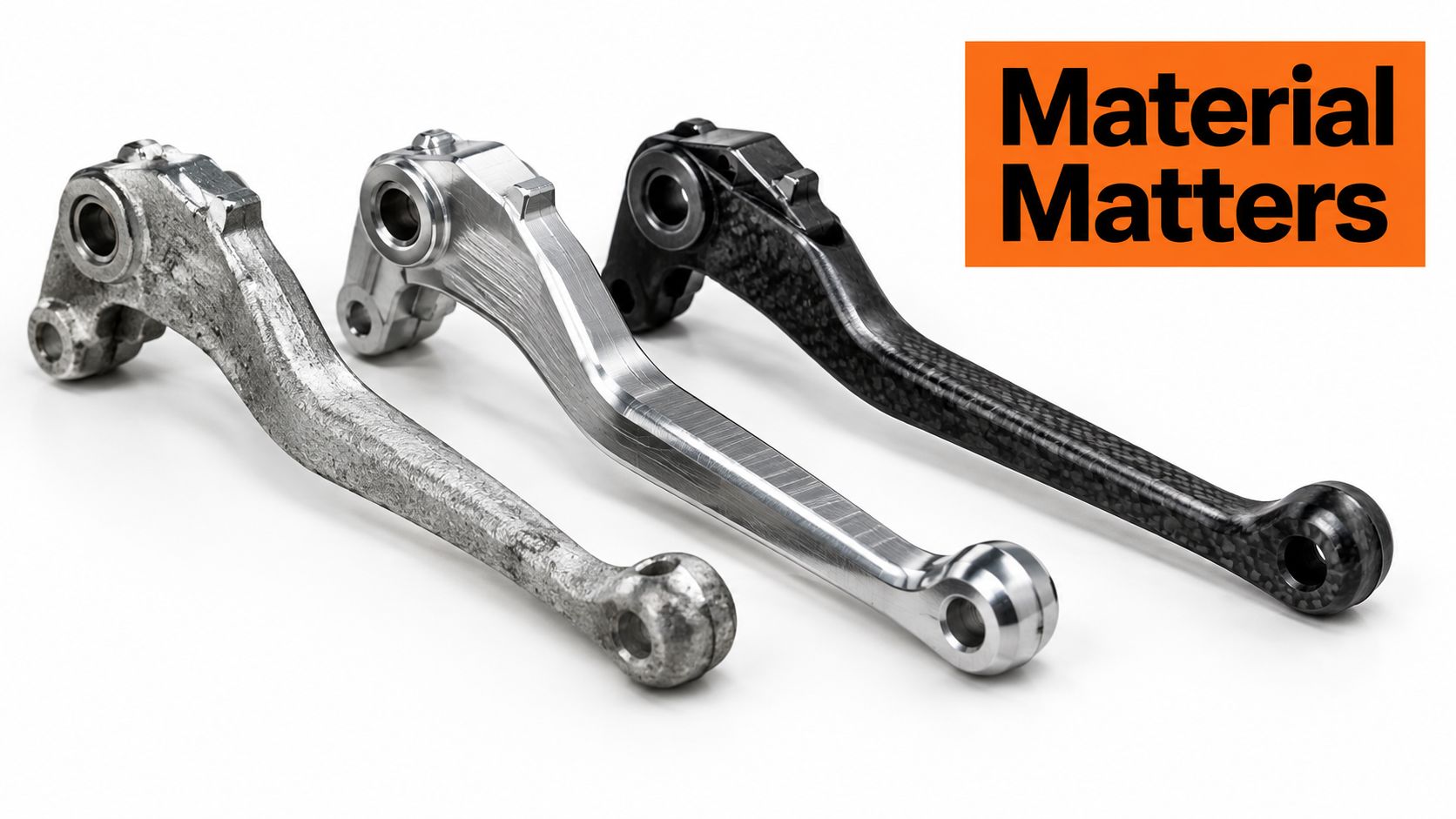
Cast aluminium is common because it's practical and cost-effective. It can work well, but the casting quality matters, especially around the pivot, the adjuster, and the narrow sections that see repeated loading.
Forged aluminium usually gives a more favorable structure for load-bearing parts. In lever use, that matters because the rider's hand loads the part thousands of times over its life. A lever that stays consistent under repeated flex is easier to trust.
Reinforced composites can make sense in some breakaway or weight-focused applications. They're not a shortcut to safety by themselves. In a low-side or tip-over, the question is whether the lever preserves usable control after impact and whether the hinge or body can keep functioning without sloppy movement.
Hardware is part of the system
Stainless hardware is worth paying attention to because a beautiful lever with poor fasteners is still a poor assembly. Threads that seize, bolts that back out, or pivots that pick up wear will ruin the feel faster than most riders expect.
Titanium hardware can make sense where corrosion resistance and weight reduction matter, but it doesn't fix a bad ratio, wrong fitment, or poor cable routing. The part still has to move cleanly, return properly, and match the motorcycle's master cylinder or clutch mechanism.
A good lever doesn't feel expensive in your hand. It feels calm, smooth, and boring when you use it hard.
Fitment Criteria That Decide Whether a Lever Will Work
“Fits my model” is the starting point, not the finish line. A lever can share the same mounting hole and still be wrong for the master cylinder, wrong for the switchgear, or wrong for the travel the system needs to work properly.
The checklist that matters in the workshop
| Criterion | Why it matters | What to check |
|---|---|---|
| Master-cylinder type | The lever must match the hydraulic system's geometry | Confirm the lever is designed for the exact master-cylinder family |
| Pivot geometry | Pivot location changes leverage and travel | Compare the old lever's pivot and pin arrangement with the new one |
| Lever ratio | Ratio shapes force and feel at the fingers | Look for model-specific compatibility, not generic handlebar fit |
| Adjustment range | Reach only works if the system still has full travel | Make sure the lever can be set for your fingers without blocking movement |
| Switchgear integration | Brake-light and starter or kill-switch functions can be affected | Check that the lever clears all controls and keeps switches usable |
| Cable or hydraulic free play | Free play prevents drag and incomplete release | Verify the lever doesn't preload the system at rest |
The hydraulic side matters most on the brake. In a representative setup with a 12 mm master-cylinder piston and a 24 mm caliper piston, the caliper-to-master piston-area ratio is 4:1, so pressure at the master cylinder multiplies at the caliper before losses are even considered. As rider force rises, hydraulic pressure rises too, but too much mechanical advantage can bring awkward travel and poor precision. Hydraulic lever geometry study
That same principle is why the Kit Abbassamento Moto Cf Moto 675 SR R 675 2025 METISSE product snapshot matters as a reminder of model-year specificity, even though it's a suspension item. Bike parts are rarely universal. The year, the platform, and the surrounding hardware determine whether a component works cleanly or only looks close enough.
For master-cylinder-specific planning, the fitment logic used in this master cylinder upgrade guide is the same logic you should apply to levers, choose by system, not by picture.
Installing Brake and Clutch Levers Without Losing Braking
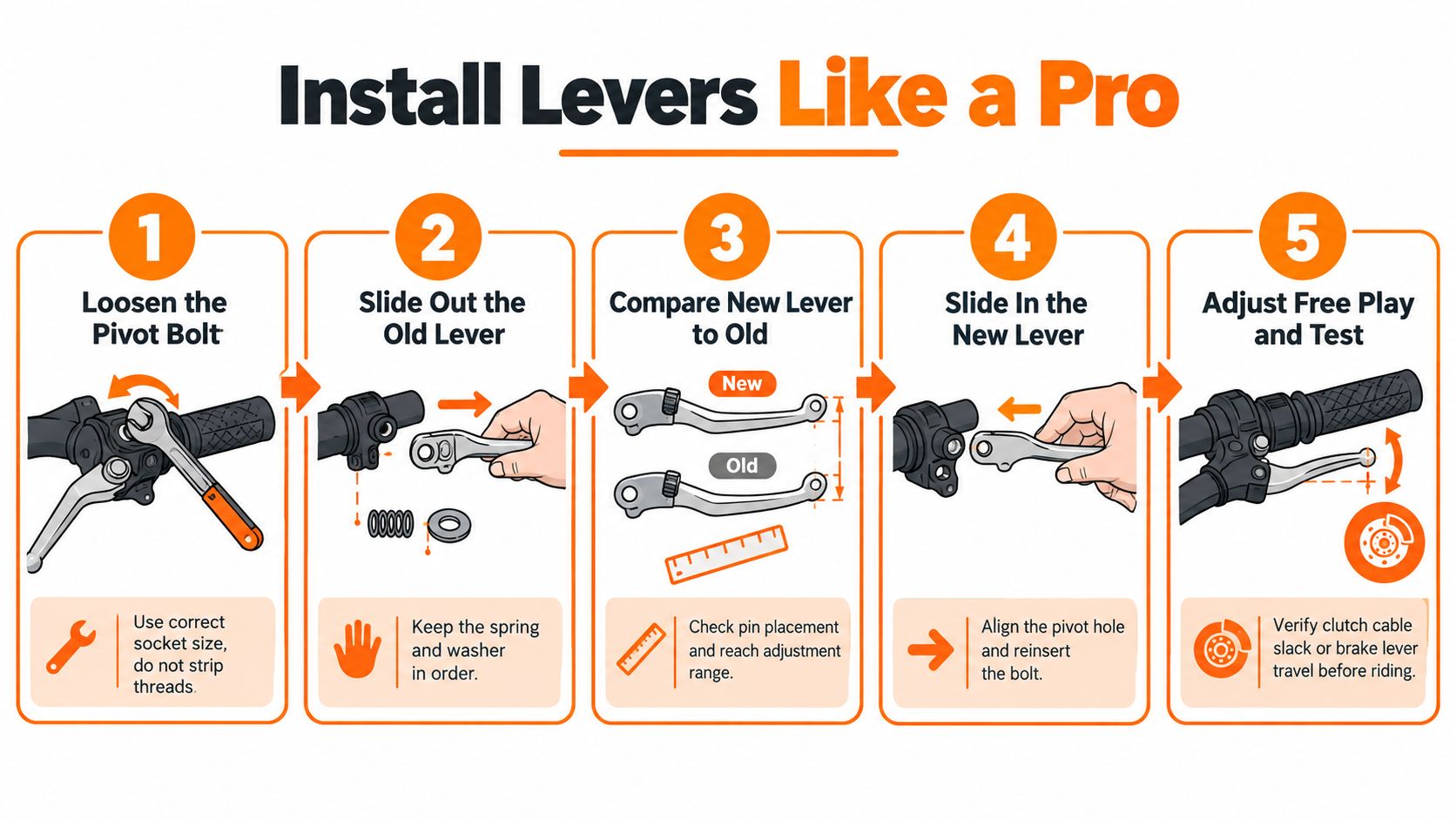
A clean install starts before the old lever comes off. Check the part number, compare the pivot pin, confirm the return spring arrangement, and make sure the new lever's arc matches the old one closely enough to preserve control. If the replacement is for the brake side, protect painted surfaces and keep brake fluid off anything you care about.
Brake side
Remove the pivot bolt with the correct socket, don't force it if the threads feel rough. Slide the old lever out, note every washer and spacer, then compare the new lever against the old one before it goes near the bike. On hydraulic systems, the critical point is free play, the lever must not keep the master-cylinder piston loaded at rest.
That's not an abstract warning. If the lever holds the piston in, fluid compensation can be blocked and the brake can drag as temperature rises. After installation, confirm the wheel rotates freely when cold, then apply the brake repeatedly and make sure it doesn't progressively bind. The lever also must not bottom against the handlebar at full pull. For brake-side hardware and fluid-routing context, this front brake master cylinder resource is the kind of component reference that helps you think in system terms, not just lever shapes.
Clutch side
Cable-clutch levers need correct routing and the specified slack. Excess slack delays disengagement, while too little can keep the clutch partially released and accelerate wear. Refit the lever, then with the engine warm, select first gear, pull the lever fully, and check that the motorcycle doesn't creep strongly with the brake released.
If the clutch feels lighter but won't fully separate, the setup is wrong. Lower effort never excuses incomplete disengagement.
Troubleshooting the common mistakes
- Lever bottoms against the grip: the reach or ratio is wrong, or the system is full of free play that shouldn't be there.
- Brake drags after a few pulls: the lever may be preloading the master cylinder, or the pivot is too tight.
- Clutch won't find neutral cleanly: free play is off, or the cable route is adding friction.
Track Days, Enduro, and Daily Riding How the Best Lever Changes
Daily riding wants comfort that disappears into the background. Track riding wants fast, repeatable inputs. Enduro asks for survival first, because the bike will hit the ground more often and the rider's hands may be fighting fatigue, mud, or awkward body position.
Commuting and touring
For street use, the best lever is the one that doesn't remind you it's there. A moderate reach, clean return, and good brake-light activation matter more than aggressive styling. If you ride in thick gloves or split time between city traffic and longer runs, a sensible adjustable lever can help, as long as it preserves free play and doesn't crowd the switchgear.
Track days
Track riders often prefer a lever that allows crisp two-finger braking and a consistent pull from lap to lap. That's where reach adjustment can help, because the glove, body position, and braking style are all more committed than on the street. Long lever shapes can make sense when you want mechanical advantage and repeatability, but they still need to clear the tank at full lock and work cleanly with the master cylinder.
Enduro and off-road
Off-road riders usually care most about folding behaviour and compactness. A shorter or folding lever can survive a fall that would otherwise leave you stranded with a snapped control. The trade-off is that shorter isn't automatically better. Too little usable length can make modulation harder with muddy gloves, and a lever that sits too close can become tiring during repeated corrections.
Model-specific fitment matters here, too. A Ducati Multistrada V4 S rider and a BMW F 900 R rider may both want better control feel, but the riding position, the glove use, and the surrounding cockpit aren't the same. The Ducati Multistrada V4 S lever listing shows how specific the application has to be when a bike is used for long road miles and occasional hard braking, while the BMW side has its own fitment logic and reach expectations.
Match the lever to the riding day, not to the bike photo.
Safety, Legality, and Common Buyer Mistakes
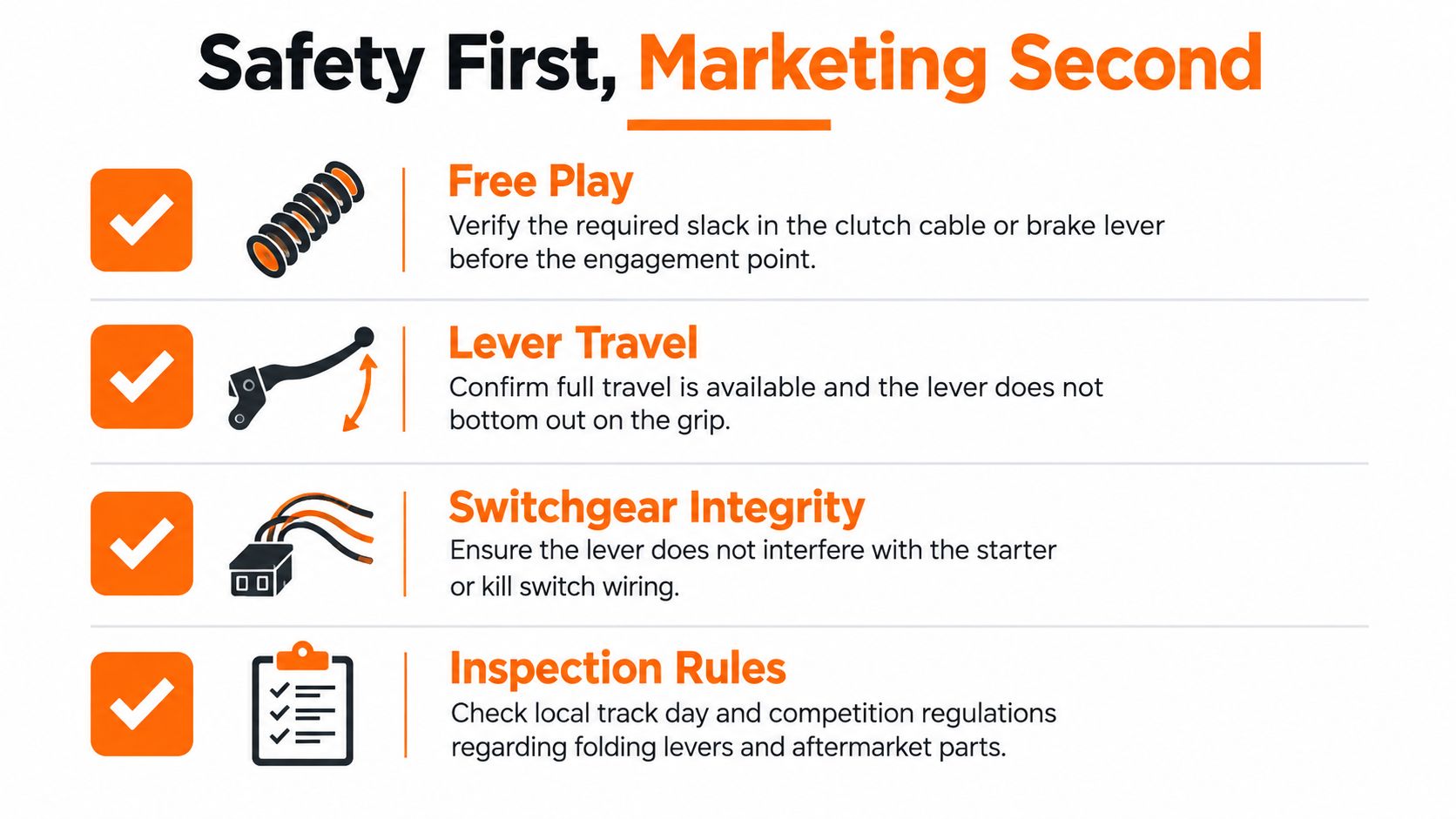
A lever can look race-ready and still fail the practical test. Proper safety checks are free play, travel, switchgear function, and legal compatibility with the way you ride and where you ride.
What actually matters
Current competition rules can demand specific lever dimensions and folding behavior, and some technical regulations require clearance between levers and surrounding bodywork at full steering lock. That's why “CNC” and “lightweight” are design claims, not safety evidence. The lever still has to preserve brake function, keep the brake-light switch working, and avoid preloading the master cylinder.
The biggest buyer mistakes are easy to spot. People choose anodized color before geometry. They ignore model-year revisions. They install the lever and ride off without checking return, clearance, or brake drag. Each one has a simple fix, but only if the rider treats the lever as a control part instead of a decoration.
For cleaning around newly fitted controls, a scratch-free motorcycle cleaning guide from SwiftJet is useful because a lever area full of grime makes it harder to spot early binding or fluid residue after installation: scratch-free motorcycle cleaning guide.
Pre-ride checklist
- Free play: confirm the clutch cable or brake lever has the required slack before engagement.
- Lever travel: pull it fully and make sure it doesn't bottom out on the grip.
- Switchgear integrity: check that nothing interferes with the starter, kill switch, or brake-light function.
- Inspection rules: verify local road, track-day, and competition requirements before you ride.
For brake-fluid reservoir and cockpit clearance considerations, the brake reservoir reference is another reminder that the lever doesn't live alone, it works as part of a system.
Choosing Your Levers and Getting Them Fitted
Start with fitment, then pick the lever type that suits your hand size and your riding context. A good choice is the one that preserves the motorcycle's control feel, clears the switchgear, and still gives you the reach you need without preload or drag.
If you want model-specific listings, compatibility years, and dedicated brake and clutch sets for bikes like the Ducati Multistrada V4 S or BMW F 900 R, Sixrace organizes the catalog in a way that makes system-matching easier. That matters more than color or a polished finish.
Get the part numbers right, install with the correct free play, then test cold wheel rotation, brake-light function, full steering lock, throttle return, and repeated brake applications before you call the job done.
If you want a lever set that matches the bike instead of just the handlebar, browse Sixrace for model-specific brake and clutch options and compare the fitment details before you buy. For workshop setups, the catalog makes it easier to check compatibility by model year and choose parts that work with the motorcycle's actual controls, not just the look you want.
 Italiano
 Deutsch
 Français
 Español
 English
 Polski