

Motorcycle suspension keeps your tyres in contact with the road by absorbing shocks through a combination of coil springs and hydraulic dampers. The springs compress to absorb energy from bumps, braking forces, and cornering loads, while the dampers convert that kinetic energy into heat through hydraulic fluid resistance. Without this system, every road imperfection would transmit directly into the chassis, making the bike uncontrollable. Understanding how suspension functions is the first step toward setting it up correctly for your weight, riding style, and the roads you actually ride.
The core principles at a glance:
- Springs support the weight of the bike and rider, allowing the wheel to move independently of the chassis
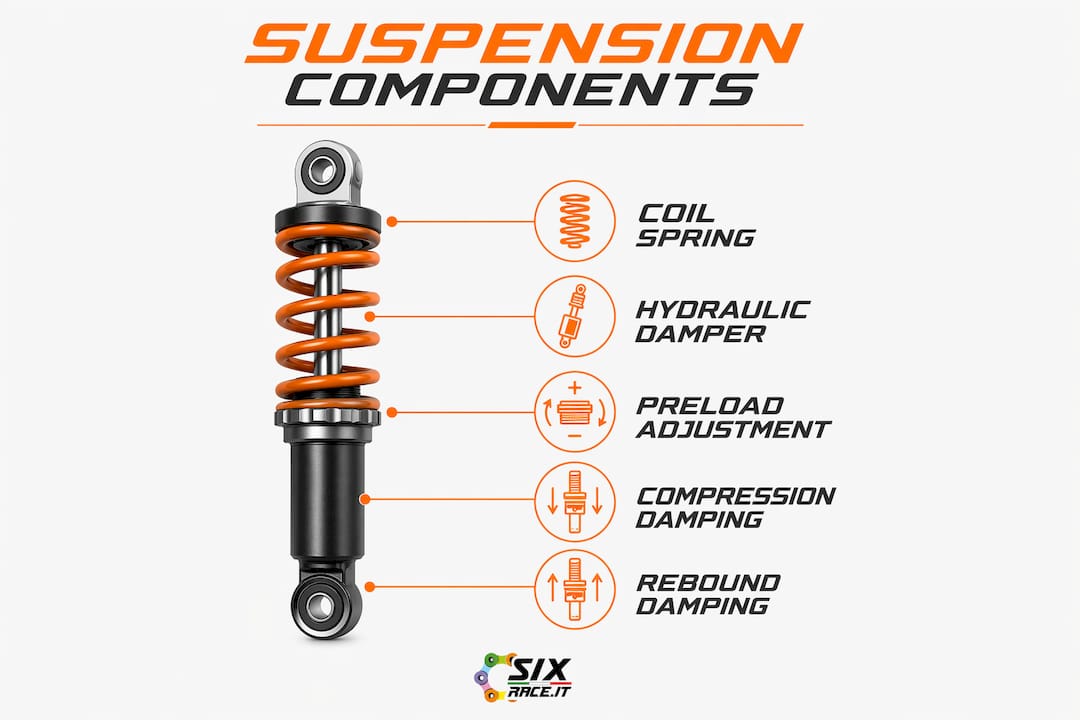
- Dampers control how fast the spring compresses (compression damping) and how fast it returns (rebound damping)
- Preload sets the initial spring tension, directly affecting sag and ride height
- Sag is the amount the suspension compresses under the bike’s static weight with a rider aboard
- Suspension reacts to bump shape more than size; a sharp, square-edged kerb challenges the system far more than a large, gradual swell in the road
What are the core components of a motorcycle suspension system?
Every motorcycle suspension system, regardless of price or complexity, relies on the same fundamental building blocks. Knowing what each part does makes every adjustment decision far more logical.
Springs are coiled steel that compress under load and return to their natural length when that load is removed. Two spring types exist:
- Linear-rate springs offer consistent resistance throughout travel; compressing one inch always requires the same force increment
- Progressive-rate springs require increasing force as they compress, effectively combining a softer initial response with a firmer end-stroke
Hydraulic dampers slow and control spring movement using fluid forced through calibrated passages. A piston moves through oil inside the shock body; the size of the orifice or shim stack determines how fast that piston can travel, and therefore how quickly the suspension moves.
| Component | Function | Adjustment available? |
|---|---|---|
| Coil spring | Supports weight, absorbs initial impact | Via preload collar |
| Hydraulic damper | Controls spring speed in both directions | Compression and rebound clickers |
| Preload adjuster | Sets initial spring tension | Yes, on most bikes |
| Shim stack (cartridge forks) | Fine-tunes damping across speed range | Workshop modification |
| Linkage (rear) | Provides rising-rate damping response | Fixed geometry |
Sprung mass refers to everything the suspension supports: the frame, engine, rider, and luggage. Unsprung mass is everything below the springs, primarily the wheels, tyres, and brake components. Reducing unsprung weight improves how quickly the wheel tracks road changes, which is why premium aftermarket wheels and lightweight brake discs genuinely improve handling rather than just saving grams.
How does front suspension work on a motorcycle?
The telescopic fork is the standard front suspension design on virtually every modern motorcycle. Two fork legs slide telescopically, with the upper tubes (stanchions) fixed to the frame via a yoke and the lower legs (sliders) carrying the front axle. Springs inside the legs support the bike’s front weight, while hydraulic damping controls movement speed.
Within that basic architecture, two damping systems exist:
- Damper-rod forks push oil through a fixed orifice. They are inexpensive to produce but compromise at both ends of the speed range: too soft at low slider speeds, too harsh at high speeds
- Cartridge forks use a separate internal cartridge with a shim stack that flexes to meter oil flow. This gives far more consistent damping across the full speed range and is the design found on most mid-range and premium motorcycles
Compression damping at the front controls brake dive, the forward pitch of the bike under hard braking. Too little compression damping and the forks plunge dramatically; too much and the front feels wooden and loses feel over mid-corner bumps. Rebound damping controls how quickly the forks extend after compression. Set it too fast and the front bounces; set it too slow and the forks “pack down” over successive bumps, progressively losing travel.
Preload on the front forks is typically adjusted by a collar or cap at the top of each leg. Increasing preload raises the front slightly and stiffens the initial response, which suits heavier riders or those carrying a tank bag.

How does rear suspension work on a motorcycle?
Rear suspension carries more weight than the front and must cope with drive forces from the rear wheel in addition to road inputs. Two configurations are common:
- Dual-shock setups use two separate shock absorbers, one on each side of the swingarm. This layout is typical on cruisers and classic-style machines, offering straightforward preload adjustment and a traditional aesthetic
- Mono-shock setups use a single shock absorber connected to the swingarm via a linkage system. The linkage geometry is usually designed to provide a rising rate of damping, meaning the shock becomes progressively firmer as it compresses, resisting bottoming-out under hard use
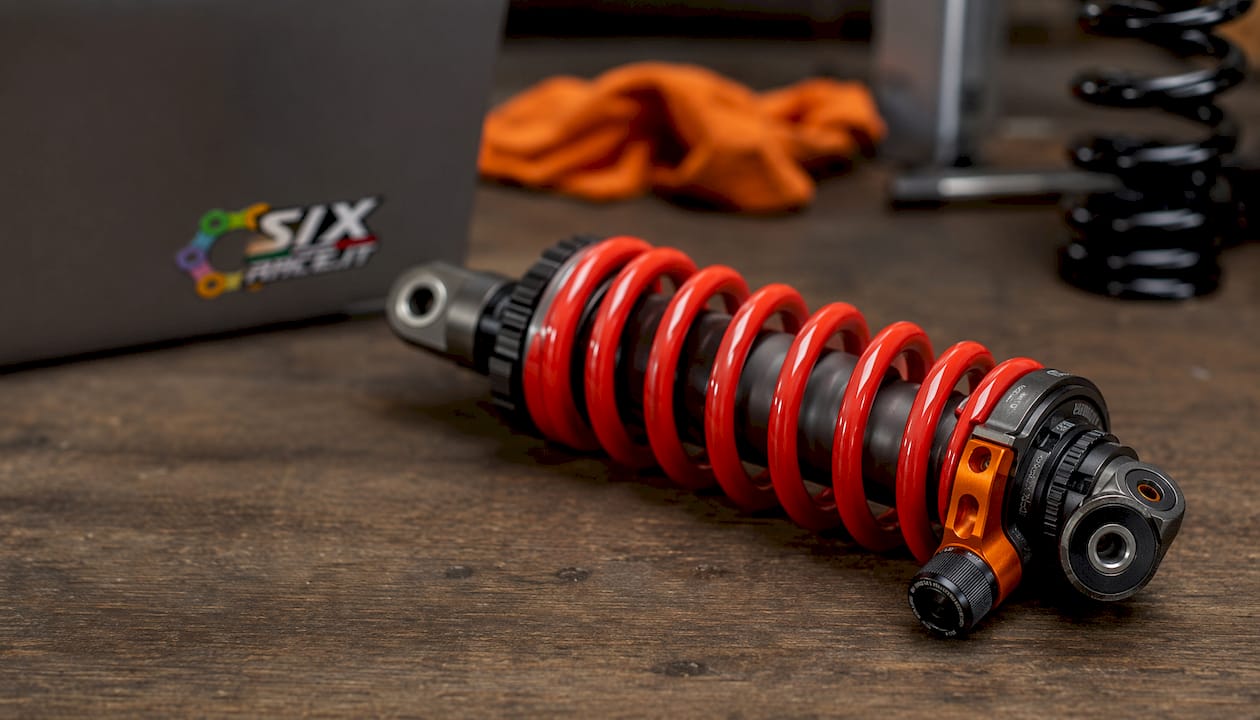
The rear shock on most road bikes consists of a coil spring wound around a hydraulic damper body. External adjusters allow preload changes via a spanner collar or stepped cam, while damping adjusters (where fitted) are typically accessible without tools. Wear patterns at the rear tend to manifest as oil weeping from the shock body, a loss of damping feel, or a tendency for the rear to wallow over undulating roads. Linkage bearings are a frequently overlooked wear point; when they corrode or seize, the rising-rate characteristic disappears entirely and the shock behaves as though it has no progression.
How do you adjust sag, preload, and damping?
Sag measurement is the correct starting point for any suspension setup, and MCN’s guidance is clear on this: most riders make the mistake of copying another rider’s clicker settings rather than first establishing their own sag baseline. Sag is the difference between the suspension’s fully extended length and its compressed length under the rider’s weight in full riding gear.
A general industry guideline proposes target sag around one-third of total suspension travel under static load. Adjusting preload changes sag directly: increasing preload decreases sag, which suits heavier riders or those adding a pillion and luggage.
Compression damping controls how fast the suspension compresses on a bump or under braking. Too soft causes excessive brake dive and a vague front feel; too hard produces a harsh, jarring ride over sharp-edged surfaces. Rebound damping governs how quickly the suspension extends after compression. Too fast and the bike bounces; too slow and the suspension packs down over repeated bumps, reducing available travel and grip.
Modern sportsbikes and quality aftermarket shocks often provide separate high- and low-speed compression adjusters. Low-speed compression affects cornering support and braking dive; high-speed compression deals with sharp, sudden inputs like potholes.
Pro Tip: Always set sag before touching damping adjusters. Sag determines the suspension’s working position in its travel; damping adjustments made on incorrectly set sag will never feel right regardless of the clicker position.
What are the signs that your suspension needs maintenance?
Fork and shock service every two years is the standard recommendation for maintaining optimal damping function. Oil degrades over time, losing viscosity and becoming contaminated with metal particles, which reduces damping effectiveness well before any visible external damage appears.
Common wear indicators to watch for:
- Oil weeping or streaking on fork stanchions or shock bodies, indicating seal failure
- Reduced damping feel, where the bike feels vague or wallowy despite correct sag settings
- Knocking or clunking from fork internals, often caused by worn bushings or a damaged damper rod
- Uneven tyre wear, which can point to suspension that is too stiff, too soft, or operating with incorrect geometry
- Bottoming out on bumps that previously caused no issue, suggesting spring fatigue or oil loss
Fork oil changes are a straightforward workshop task. The oil viscosity matters considerably: thicker oil increases damping, thinner oil reduces it. Sixrace stocks suspension service equipment including the tools needed for fork disassembly and oil changes, alongside Kayaba tools for precise setup work. Neglecting seal replacement when weeping is first noticed typically leads to stanchion scoring, which turns a £20 seal job into a far more expensive stanchion replacement.
Basic versus premium motorcycle suspension: what actually differs?
Entry-level suspension on budget and mid-range motorcycles typically offers preload adjustment only, with fixed compression and rebound damping. The damper-rod fork design used on many standard machines provides adequate performance for normal road riding but struggles at the extremes: too soft over sharp bumps at speed, too harsh when the damping is increased to control dive.
Premium systems differ in several meaningful ways:
- Multi-way adjustability: separate compression and rebound clickers, often with high- and low-speed compression as distinct adjusters
- Cartridge fork internals with shim stacks that provide consistent damping across the full speed range
- Lightweight construction using titanium springs, aluminium components, and shorter, stiffer spring designs that reduce unsprung mass
- External reservoirs on rear shocks, which separate the oil from the gas charge and maintain consistent damping temperatures during sustained hard use
- Öhlins components, available through Sixrace’s Öhlins spare parts catalogue, represent the benchmark for adjustable aftermarket suspension across road, touring, and track applications
The practical benefit of upgrading depends on the gap between your current setup and your riding demands. A touring rider carrying luggage across Central European mountain passes will notice a genuine improvement from a rear shock with proper preload range and rebound control. A commuter on smooth urban roads may find the stock setup entirely adequate.
Expert advice on suspension oils and upgrades for Central European riders
Suspension oil viscosity directly affects damping performance, and climate matters more than many riders realise. Central European winters bring temperatures that thicken conventional fork oils, increasing damping beyond the intended specification and making the front feel wooden in cold conditions. Using a quality oil with stable viscosity across a wide temperature range maintains consistent suspension behaviour whether you are riding an alpine pass in July or commuting through a cold November morning.
Sixrace carries a curated range of suspension components suited to the varied terrain and conditions across Central Europe:
- Suspension springs matched by bike make, model, and year for direct compatibility
- Shock absorbers from established manufacturers covering road, adventure, and off-road applications
- Suspension shims for riders undertaking fork revalving or cartridge upgrades
- Öhlins components for those seeking the highest level of adjustability and build quality
For riders exploring upgrade options, the 2026 suspension upgrade checklist on the Sixrace platform provides a structured approach to identifying where your current setup falls short and which components offer the most meaningful improvement for your riding style.
Protective riding gear matters alongside suspension performance. Chapeleyewear’s motorcycle eyewear range is worth considering for riders who spend extended time on open roads where suspension comfort and visual clarity both contribute to fatigue management.
What is the basic function of a motorcycle suspension system?
A motorcycle suspension system serves two purposes simultaneously: it keeps the tyres in contact with the road, and it isolates the rider from road-generated vibration and shock. These two objectives are related but not identical, and the suspension must balance them continuously.
Tyre contact is the safety-critical function. When a wheel hits a bump, the suspension allows the wheel to move upward without transmitting that movement directly to the chassis. Without this compliance, the tyre would momentarily lose contact with the road surface, eliminating braking, steering, and cornering grip at the worst possible moment. The suspension also manages the load transfers that occur during braking and acceleration: under hard braking, weight shifts forward and the front suspension compresses; under acceleration, weight shifts rearward and the rear suspension takes on additional load.
Rider isolation is the comfort function. Vibration transmitted through the frame and seat affects concentration and physical fatigue on longer rides, particularly on the rougher road surfaces common across parts of Central Europe. A well-set suspension absorbs the high-frequency vibration from road texture while still responding to larger, lower-frequency inputs from potholes and surface changes.
How do different suspension settings affect ride quality and handling?
Suspension settings create direct, predictable trade-offs between comfort and control. Understanding those trade-offs lets you make deliberate choices rather than guessing.
Stiffer compression damping reduces brake dive and body roll in corners, giving a more planted, controlled feel. The cost is a harsher response to sharp-edged bumps, which can unsettle the bike mid-corner if the road surface is imperfect.
Softer rebound damping allows the suspension to extend quickly after compression, which helps the tyre follow a dropping road surface. Too much softness, however, and the bike develops a bouncy, unsettled character over repeated bumps as the suspension overshoots its neutral position.
Increased preload raises the bike’s ride height slightly and stiffens the initial spring response. This suits heavier loads but can increase vibration transmission on rough roads, as the suspension operates higher in its travel with less room to absorb small inputs.
Reduced sag (via increased preload) improves cornering clearance and sharpens steering geometry. Increased sag lowers the bike, slows steering, and provides more initial compliance. The relationship between sag and geometry is why a correctly set sag figure matters as much for handling as it does for comfort.
How does rider weight and load affect suspension setup?
Rider weight is the single most important variable in suspension setup, and stock settings are typically calibrated for a rider of average weight without luggage. A lighter rider on a bike set for a heavier one will find the suspension too stiff, with insufficient sag and a harsh ride. A heavier rider on the same bike will experience excessive sag, potential bottoming-out, and reduced cornering clearance.
Preload adjustment addresses weight variation within a limited range. Adding a pillion passenger roughly doubles the additional load on the rear suspension, which is why rear preload adjusters exist on most bikes while front preload adjustment is less common. Luggage adds load too, and its position matters: a top box raises the centre of gravity and increases pitching tendency, while panniers add weight lower and further forward.
When the weight difference between rider and the bike’s intended specification is large, preload alone cannot compensate adequately. Spring rate becomes the correct solution. A rider who is considerably heavier than the bike’s target weight needs stiffer springs to achieve the correct sag figure without running the preload adjuster to its maximum, which reduces the adjuster’s useful range and can increase vibration transmission. Sixrace’s springs catalogue lists options by bike model, making it straightforward to identify the correct spring rate for a given rider weight.
Key takeaways
Motorcycle suspension works by pairing springs and hydraulic dampers to maintain tyre contact, absorb road energy, and give the rider control over comfort and handling through adjustable preload, compression, and rebound settings.
| Point | Details |
|---|---|
| Springs and dampers work together | Springs absorb impact; dampers control how fast the spring moves in both directions. |
| Sag is the starting point | Set sag to around one-third of total travel before adjusting any damping clickers. |
| Preload adapts to load | Increasing preload decreases sag, compensating for heavier riders, pillions, or luggage. |
| Oil viscosity affects damping | Cold Central European conditions thicken fork oil, so climate-appropriate oil maintains consistent performance. |
| Unsprung weight matters | Lighter wheels and brake components improve how quickly the tyre tracks road changes. |

Sixrace stocks the full range of suspension components, service tools, and premium oils needed to set up, maintain, or upgrade your motorcycle’s suspension. From Öhlins cartridges to fork seals and spring kits, every part is matched by make, model, and year. Claim your reserved discount and browse the complete suspension catalogue at Sixrace today.
 Italiano
 Deutsch
 Français
 Español
 English
 Polski