

Fork-oil weight labels borrow terminology from a classification with roots in June 1911, but that history doesn't make them a universal suspension-fluid scale: SAE International's engine-oil viscosity classification defines engine-oil grades, not interchangeable fork-oil specifications. For a rider comparing bottles, the useful question isn't which weight sounds right. It's which fluid has the measured viscosity your fork needs.
A useful fork oil weight chart therefore ranks products by kinematic viscosity at a stated temperature, then keeps the manufacturer's specification ahead of any tuning shortcut. That turns a shopping comparison into something a technician can measure, record, and repeat.
Table of Contents
- Fork Oil Weight Chart at a Glance
- Why Weight Labels Do Not Match Across Brands
- Reading Labels for Brands Not in the Chart
- Compare, Change and Log Each Fork Oil Setup
- Hot Oil Behavior and Viscosity Index
- Starting Weights by Riding Type and Bike Class
- Settings That Outweigh a Small Oil Change
- Confirm the OEM Fluid Before You Buy
Fork Oil Weight Chart at a Glance
Fork-oil weight is an approximate label, so this chart ranks fluids by kinematic viscosity in cSt at 40°C. Read down the viscosity column rather than treating the nominal-weight column as a conversion scale.
Fork oil weights and cSt at 40°C, sorted by viscosity
| Product | cSt at 40°C | Nominal weight | What the row shows |
|---|---|---|---|
| Castrol 5W | 15 | 5W | Lowest 5W value in this set |
| Castrol Synthetic Fork Oil 2.5W | 16.5 | 2.5W | Lightest 2.5W reference |
| Bel-Ray 5W | 19.1 | 5W | Thin end of the Bel-Ray range |
| Öhlins 19–20 cSt fluid | 19–20 | Approx. 7.5W | Öhlins labels this about 7.5W |
| Repsol 5W | 22 | 5W | Repsol 5W listing |
| Castrol Synthetic 5W | 28.1 | 5W | Synthetic product above Castrol's lighter 5W |
| Castrol Fork Oil 10W | 32 | 10W | Lower 10W reference |
| Bel-Ray 10W | 34.9 | 10W | Bel-Ray 10W listing |
| Öhlins 40 cSt fluid | 40 | Approx. 20W | Öhlins labels this about 20W |
| Repsol 10W | 46 | 10W | Repsol 10W listing, above Castrol's 10W |
| Repsol 15W | 64 | 15W | Repsol 15W listing |
| Castrol Fork Oil 20W | 68 | 20W | Castrol 20W listing |
These are published reference values, not an approved-fluid list for every motorcycle. Product identity matters, including whether the bottle belongs to a synthetic or another product family. Confirm the current technical sheet before purchasing, especially where a listing uses only a generic brand-and-weight name.
The important comparison is within the nominal-weight groups. The Castrol conventional and synthetic entries don't occupy the same position despite sharing a weight marking. Equally, the heavier-labeled Öhlins reference sits below Repsol's lower-labeled product.
Use the rows as comparison anchors
- Locate your current fluid. Identify the exact product and its published viscosity, not just the marking someone wrote on a service invoice.
- Find its nearest position. If it isn't listed, place its measured value between the surrounding entries.
- Choose a controlled direction. Consider the next suitable higher or lower reference only after checking the fork specification and available adjustments.
For a hypothetical example, a rider using a fluid around 28 cSt wants a modest increase in damping. A candidate around 32 cSt is a more intelligible experiment than buying an unfamiliar bottle marked 15W. The intended change is a nearby measured viscosity, not a jump in label terminology.
Practical rule: A chart row is a comparison point, not an instruction to install that oil.
The spacing between rows isn't uniform. Moving to the next entry can represent a small change or a much larger one, so inspect the actual gap before treating it as a tuning step. Nor does every row identify a complete purchasable product: the Öhlins descriptions are viscosity references that still require an exact product code.
Your starting point remains the OEM-specified fluid. Use the chart to understand an equivalent or a deliberate experiment, not to replace the service manual.
Why Weight Labels Do Not Match Across Brands
The mismatch begins with classification scope. Engine-oil terminology doesn't establish a common fork-fluid viscosity target, and manufacturers' nominal weights don't supply the missing equivalence. A matching label can therefore conceal a meaningful change in the fluid passing through the fork's damping circuits.
The manufacturer values summarized in the Bel-Ray fork-oil technical reference illustrate the problem: at 40°C, Bel-Ray lists its 5W at 19.1 cSt and 10W at 34.9 cSt, while the corresponding Repsol listings are 22 and 46 cSt, and Castrol's are 15 and 32 cSt. The same comparison places Repsol's 10W at 46 cSt above an Öhlins fluid described as approximately 20W at 40 cSt.

That reversal is the useful conclusion. A lower-labeled oil can be more viscous than a higher-labeled oil from another manufacturer. Sorting bottles by weight first and brand second can produce the wrong order.
Matching labels don't preserve a setup
Say a workshop replaces a familiar fluid with another brand carrying the same nominal weight. The invoice may describe an equivalent service, yet the rider may notice a different return speed or a less compliant response over broken surfaces.
That doesn't automatically mean the replacement oil is defective. The workshop may have changed a damping variable without recognizing it. An exact product name and viscosity record would make that change visible before the fork was filled.
For a cross-brand substitution, distinguish these questions:
- Does the label match? Useful for identifying a manufacturer's product family, but insufficient for equivalence.
- Does measured viscosity match? A stronger starting point for comparing flow behavior.
- Does the application match? Essential before treating a viscosity match as an acceptable replacement.
The fork design still sets the response
Cartridge forks, damper-rod forks, and different shim or bleed arrangements don't necessarily respond alike to the same fluid change. Oil passes through different restrictions, and the available adjusters influence different parts of the response.
Consequently, a successful change on another motorcycle isn't a transferable specification. Compare fluids within the same fork design and service procedure, with the mechanical condition held constant. Otherwise, the rider's recommendation combines fluid choice with hardware differences that the bottle label can't describe.
Reading Labels for Brands Not in the Chart
An absent brand isn't a problem if its manufacturer publishes usable technical data. The problem is an unidentified viscosity hidden behind a familiar weight marking.
Start with the technical data sheet, not the safety data sheet or a retailer's short description. Safety documentation addresses handling and hazards; the technical sheet is where you should look for the performance properties needed for comparison.
Place an unfamiliar fluid on the scale
- Find kinematic viscosity at the comparison temperature. Look for cSt or mm²/s. Those units express the same property, so the unit notation alone doesn't require conversion.
- Check the temperature beside the value. A hot-temperature figure doesn't belong in the main comparison column. Don't place it beside a cooler-temperature value because both use cSt.
- Locate the neighboring anchors. Use the nearest lower and higher entries in the chart rather than assigning the unfamiliar oil a new weight.
- Mark incomplete products as unverified. If the manufacturer publishes only a nominal weight, you haven't established a cross-brand equivalent.
For a hypothetical bottle listing 28 cSt at 40°C, the appropriate neighborhood is the Castrol synthetic reference near that position. It doesn't belong beside every product labeled 10W, and it doesn't need to be renamed to fit the chart.
The point is placement, not conversion. You're retaining the manufacturer's product identity while comparing a measurable property.
An unlisted oil with clear technical documentation is easier to evaluate than a familiar label with no viscosity information.
Keep identification details with the value
Record the full product name, product code where available, and technical-sheet revision. Similar packaging or a shared brand name doesn't prove that two listings describe the same formulation.
If the sheet omits the required viscosity, request the current technical specification from the oil manufacturer. Don't estimate it from color, a hand-pouring comparison, or a weight label.
After establishing the initial match, examine hot-temperature viscosity and viscosity index. Those fields help distinguish candidates that occupy a similar starting position but may not retain the same relationship as operating conditions change.
Compare, Change and Log Each Fork Oil Setup
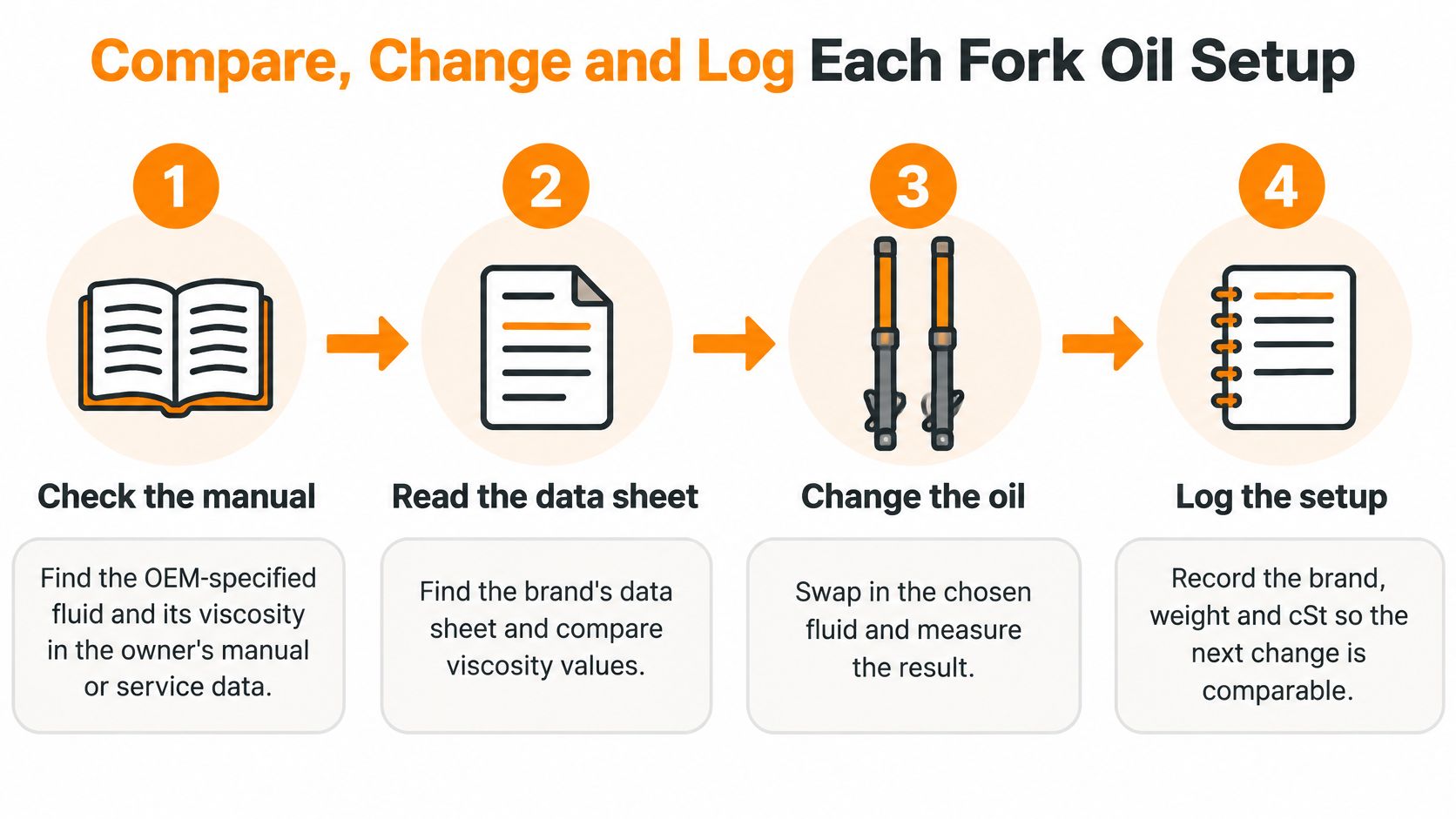
Compare exact bottles and exact setups, not remembered weights. The useful outcome is a maintenance record that lets another technician reproduce the fill and understand why you selected it.
The Castrol Synthetic Fork Oil technical data sheet provides reference values including 16.5 cSt for Synthetic Fork Oil 2.5W and 28.1 cSt for Synthetic 5W at 40°C. Use published kinematic-viscosity measurements, preferably reported under ASTM D445, rather than assuming the label expresses a standardized suspension-fluid grade.
Establish a traceable baseline
- Check the service information. Identify the specified fluid for the motorcycle and the fork installed. An aftermarket cartridge or replacement front end may require its own documentation.
- Read the product sheet. Match the name and product code to the bottle. Record the viscosity and its test temperature together.
- Reject unsupported equivalence. Mark a weight-only candidate as unverified for cross-brand comparison. Don't fill the information gap with a retailer's claim that the weights are interchangeable.
- Position the existing setup. Locate the current fluid on the chart, then identify a nearby candidate in the intended direction. Inspect the size of the gap rather than assuming adjacent rows are equally spaced.
- Define the expected effect. Higher measured viscosity generally raises damping and slows fork movement; lower viscosity generally reduces damping and may improve compliance. State which behavior you're trying to change.
- Preserve the other variables. Follow the fork's filling and bleeding procedure, retain the specified oil level, and leave springs and adjusters unchanged for the comparison.
- Retest deliberately. Use a familiar, appropriate road or track section and evaluate the same behavior under comparable conditions. Stop the test if the motorcycle feels unstable or the fork behaves abnormally.
A viscosity change can influence both compression and rebound behavior. If the complaint concerns only a particular part of the stroke or a specific damping circuit, an available adjuster may be the more targeted tool. Our motorcycle suspension adjustment guide provides context for separating an adjustment task from a fluid-selection task.
Record what another technician would need
A useful log contains more than the oil's weight and a verdict of better or worse. Keep these fields together:
- Fluid identification: Brand, complete product name, nominal weight, product code, and technical-sheet revision.
- Measured properties: Kinematic viscosity with its stated test temperature, plus hot-temperature information when available.
- Fill details: Oil level, measurement method, and any service work that could affect the comparison.
- Hardware: Fork model, spring rate, and cartridge or valving changes.
- Adjustments: Compression and rebound positions, using the manufacturer's counting convention.
- Conditions: Date, ambient temperature, route or circuit, surface character, rider load, and ride type.
- Observation: A short description of the behavior you tested and any trade-off elsewhere.
Count clicks gently from the reference position specified by the manufacturer. Don't force an adjuster against its stop, and don't assume that every fork uses the same reporting convention.
For a hypothetical log entry, write: “Selected fluid installed to the manual's oil-level procedure; springs unchanged; adjusters recorded separately; dry track session. Front settled more slowly during braking, but return over closely spaced bumps felt restricted.” That describes both an apparent benefit and a reason not to keep increasing viscosity.
Workshop discipline: Change a variable only when you can identify what stayed unchanged.
Review a small run of comparable sessions rather than judging an unfamiliar fluid from the first impression leaving the workshop. Temperature, surface, and pace can complicate the comparison, so note them before attributing every difference to oil.
A repeatable result is a recorded product and measured viscosity attached to a complete setup. A weight label alone can't preserve that result.
Hot Oil Behavior and Viscosity Index
Matching the initial viscosity doesn't guarantee matching behavior as the fork warms. Two candidate oils can start close together and separate as temperature changes, making thermal information relevant to a substitution.
The Castrol fork-oil technical reference lists the following hot-temperature properties and viscosity indices. Kinematic viscosity is measured using ASTM D445, while ASTM D2270 is used for viscosity index.
Hot-temperature viscosity and viscosity index for listed fluids
| Product | cSt at 100°C | Viscosity index | Reading |
|---|---|---|---|
| Castrol Fork Oil 32 | 5.26 | 100 | Lowest viscosity index in this set |
| Castrol Synthetic 5W | 5.7 | 150 | Highest viscosity index listed |
| Castrol Fork Oil 20W | 10.4 | 140 | Higher hot-temperature viscosity with a strong index |
| Bel-Ray listed fluids, range | 4.03–12.0 | 104–118 | Range across the published Bel-Ray fluids |
The Bel-Ray row describes a product range, not a single oil. Its endpoints mustn't be combined into an imaginary product specification.
Read the fields together
Hot-temperature viscosity is another measured point on the fluid's viscosity-temperature relationship. It isn't a statement that your fork normally runs at the laboratory test temperature.
Viscosity index describes how viscosity changes with temperature. A higher index generally indicates less temperature-related change, but it isn't a standalone quality score or a guarantee of better damping.
The distinction matters during repeated hard braking, track use, or sustained off-road riding. If a rider reports that the fork feels acceptable early in a session but different later, the candidate oils' thermal properties deserve attention alongside the mechanical setup and test conditions.
Use the fields in this order:
- Initial comparison: Establish the required viscosity at the chart's reference temperature.
- Thermal comparison: Examine the hot-temperature value and viscosity index.
- Application check: Confirm that the complete fluid specification suits the fork.
Don't turn viscosity index into a verdict
Choosing the highest index without matching the starting viscosity can solve the wrong problem. Likewise, a fluid that retains viscosity differently may still be unsuitable for the fork's intended damping calibration.
Oil height, air-spring volume, cartridge design, shim architecture, seal friction, spring rate, and damping adjusters can influence feel more than a small viscosity shift. Thermal data help narrow a fluid comparison; they don't isolate those other variables or diagnose a mechanical fault.
Starting Weights by Riding Type and Bike Class
Riding type can organize a comparison, but it cannot specify the fluid. The bands below are editorial search windows assembled from chart entries, not manufacturer recommendations or validated settings for a bike class.
Starting viscosity band by riding type and bike class
| Riding type | Typical bike class | Starting cSt at 40°C | Adjust when |
|---|---|---|---|
| Road commuting | Naked and standard road bikes | OEM target within the thinner chart references | Start at the OEM specification and adjust only for a defined complaint |
| Sport and track | Supersport and race bikes | OEM target within the middle chart references | Assess damping and thermal behavior before considering a heavier candidate |
| Enduro and motocross | Off-road and dual-sport bikes | 32–46, editorial comparison window only | Evaluate landing control, rider load, and rough-ground compliance |
| Heavy touring | Large touring bikes and cruisers | 32–68, editorial comparison window only | Check springs and load settings before using viscosity to alter dive speed |
| Scooters and small bikes | Scooters and small-displacement machines | OEM specification | Use the manufacturer's specification only |
The numerical windows identify positions available in the chart. They don't establish that an enduro or touring fork belongs within them. If the specified fluid sits elsewhere, the manufacturer's requirement takes precedence.
Road and track priorities differ
For a hypothetical middleweight naked bike used for commuting, start with the documented fill and identify the actual complaint. Sharp-edged bumps, excessive movement, and slow return aren't interchangeable symptoms, so a broad preference for a softer or firmer front end isn't enough to select oil.
On a hypothetical large-capacity supersport at a track day, repeated braking makes thermal consistency relevant. It doesn't prove that the fork needs a thicker fluid. Check the damping adjustments, spring support, and behavior across the session before choosing a candidate.
A heavier rider also doesn't automatically require a higher nominal oil weight. Rider load belongs in the spring and setup assessment, not just the bottle selection.
Off-road and loaded touring need separate judgments
For a hypothetical competition enduro, large landings can draw attention to end-stroke control, while closely spaced bumps can reveal restricted return. Increasing viscosity to address the first complaint may compromise the second. Inspect the spring, oil level, and valving requirements before making a fluid experiment.
A loaded touring motorcycle presents another distinction: slowing dive isn't the same as supporting load. More damping can slow movement during a braking transition, but it doesn't replace a spring and preload arrangement suited to the rider, passenger, and luggage.
For a scooter, don't infer the required fluid from engine size or vehicle weight. Use the model-specific instruction, including the filling procedure, rather than borrowing a motorcycle class band.
Choose the comparison window from the documented fork setup, not from the riding-style label.
If a controlled experiment is justified, begin near the established baseline rather than automatically at the bottom of a broad band. Record the symptom, select a nearby measured viscosity, and preserve enough of the original setup to return to it. The useful classification is ultimately the fork's requirement, not the motorcycle's marketing category.
Settings That Outweigh a Small Oil Change
An uncomfortable or poorly controlled fork doesn't necessarily need a different oil weight. Before ordering a replacement fluid, separate support, progression, damping, and friction so you aren't asking viscosity to correct a different problem.
Our guide to how motorcycle suspension works gives the mechanical context for that distinction. The practical checks below help identify what belongs in the setup record before a fluid comparison begins.
Check the variable behind the symptom
Oil level controls the trapped air volume. Follow the service procedure with the fork in the specified position and the required internal components removed or installed. An inconsistent measurement can change end-stroke behavior even when the bottle is unchanged; record the method alongside the fluid entry.
Spring rate provides mechanical support. Assess the spring against rider and carried load before using oil to compensate for excessive movement. If the spring changes during the same service, treat the result as a combined setup change rather than evidence that the new chart position worked.
Air-spring volume shapes progression. It is connected to oil level, not an unrelated adjustment to make casually. Alter it only within the fork manufacturer's procedure and limits, and preserve the measured setting in the fill record.
Compression and rebound adjusters target damping behavior. Record their starting positions before service, then use them deliberately after confirming the fill. If you alter a clicker and the fluid together, the chart alone can't explain the outcome.
Cartridge design and shim configuration define the damping system. A fluid substitution doesn't turn a damper-rod fork into a cartridge fork or reproduce a different shim arrangement. Keep hardware identification with the thermal and viscosity information rather than transferring another rider's oil choice without context.
Seal friction affects initial movement and smoothness. Inspect seals, bushings, alignment, and general condition when the fork feels reluctant to move. Don't assume all worn seals create the same friction symptom, or that thinner oil will correct binding.
Diagnose before substituting
A fork that moves freely but returns too slowly presents a different task from one that sticks before moving. Likewise, excessive travel under load requires a different assessment from harshness near the end of the stroke.
Describe when the fault occurs: initial movement, braking transition, repeated bumps, or deep travel. That description helps distinguish a service issue from an adjustment issue and gives a suspension technician something more actionable than “the oil feels wrong.”
Check the spring requirement and oil level before blaming nominal weight. Once those are verified, the viscosity chart becomes a cleaner tool because fewer uncontrolled variables remain.
Confirm the OEM Fluid Before You Buy
Confirm the specified fluid first, then evaluate a replacement by measured properties and application. The closest number on a chart is a candidate for checking, not automatic permission to install it.
Keep the motorcycle's service information beside the product sheet while making the decision.

Apply the purchase checks
Identify the correct OEM requirement. Match the manual to the model, year, and fitted fork. If the front end or cartridge has been replaced, use the documentation for the installed equipment rather than assuming the original motorcycle specification still governs it.
Verify the candidate's technical properties. Compare the published viscosity at the same temperature, then check the additional properties relevant to the application. A familiar weight marking or a retailer's compatibility summary doesn't replace the exact product sheet.
Confirm suitability for the fork design. Check the fork or cartridge manufacturer's fluid requirements and service instructions. A close viscosity match alone doesn't establish complete equivalence between formulations.
When a candidate passes those checks, save the technical sheet with the maintenance record and retain a clear photograph of the bottle identification. That makes the next service less dependent on memory or an abbreviated invoice.
If hardware changes are also planned, our motorcycle fork upgrade best practices can help keep fluid selection within the wider service decision. Don't treat a new cartridge, spring, and oil as an isolated viscosity test.
Make the retest part of the purchase decision
Buy with a defined target and a baseline you can restore. Before the service, write down the behavior you want to change and what you'll hold constant.
After filling and completing the required checks, log the new setup and evaluate it over several comparable rides. Record benefits and compromises separately, especially if improved braking control comes with worse response over bumps.
The chart supplies reference points, not guarantees. The successful choice is the documented fluid that suits the fork and produces repeatable behavior under your riding conditions.
We offer fork and shock oils, suspension components, and model-specific motorcycle parts to support a properly planned service. Visit Sixrace with your fork specification and target viscosity in hand, then check the exact product identification and application before buying.
 Italiano
 Deutsch
 Français
 Español
 English
 Polski