
Two hours into a Sunday ride, you're no longer enjoying the scenery. You're shifting from one cheek to the other, lifting yourself slightly over bumps, and wondering why a seat that felt fine in the showroom is now pressing into your tailbone. Your right thigh may be going numb, while engine buzz and expansion joints add a steady layer of fatigue.
A cuscino gel moto can help, but it isn't a universal cure. The useful question isn't whether gel feels soft when you press it with your hand. It's whether it distributes your weight, stays stable under braking, manages heat, and fits the shape of your motorcycle seat throughout a full ride.
Table of Contents
- When a Cuscino Gel Moto Is the Right Fix
- What Gel Padding Actually Does on a Motorcycle Seat
- Main Types of Gel Cushions for Motorcycles
- How to Match a Gel Pad to Your Bike and Riding Style
- Installing and Securing a Cuscino Gel Moto
- Comfort, Pressure, and Long-Distance Riding Trade-Offs
- Care, Lifespan, and Rider FAQ
When a Cuscino Gel Moto Is the Right Fix
Gel works best when the problem is concentrated pressure rather than a unsuitable saddle. A short, firm seat can load the sit-bone area heavily, creating a hot spot that becomes painful after sustained riding. A gel layer can deform around those contact points and spread the load across a broader area, which may delay numbness and localised soreness.
It can also help with vibration-related fatigue. Research on motorcycle seating connects non-uniform pressure during riding with discomfort and local fatigue, while separate seat-foam testing found that seat structure affects vibration acceleration (motorcycle seat vibration research). That makes a properly selected gel-and-foam layer relevant on motorcycles with a firm seat, stiff suspension, or a noticeable buzz through the chassis.
A third good use is reducing the break-in pain of a new aftermarket seat. If the underlying foam is sound but feels unforgiving, a reversible pad gives you a way to test pressure relief before cutting into the upholstery.
Three problems gel can address
- Localised pressure: The pad spreads load away from a hard contact point.
- Vibration fatigue: A compliant layer can soften some road and engine input.
- Short-term seat adjustment: A removable cushion can make a new seat more usable while you decide whether permanent reshaping is necessary.
Gel is the wrong tool when the saddle is too narrow for your pelvis or places your sit-bones on the edge. It also won't restore a foam base that has collapsed. In that case, reupholstering or reshaping the seat is the proper repair, because adding gel over damaged foam often preserves the original problem underneath.
The rest of the decision comes down to pressure distribution, fitment, stability, and heat retention. Thickness alone tells you very little about how the pad will behave after several hours.
What Gel Padding Actually Does on a Motorcycle Seat
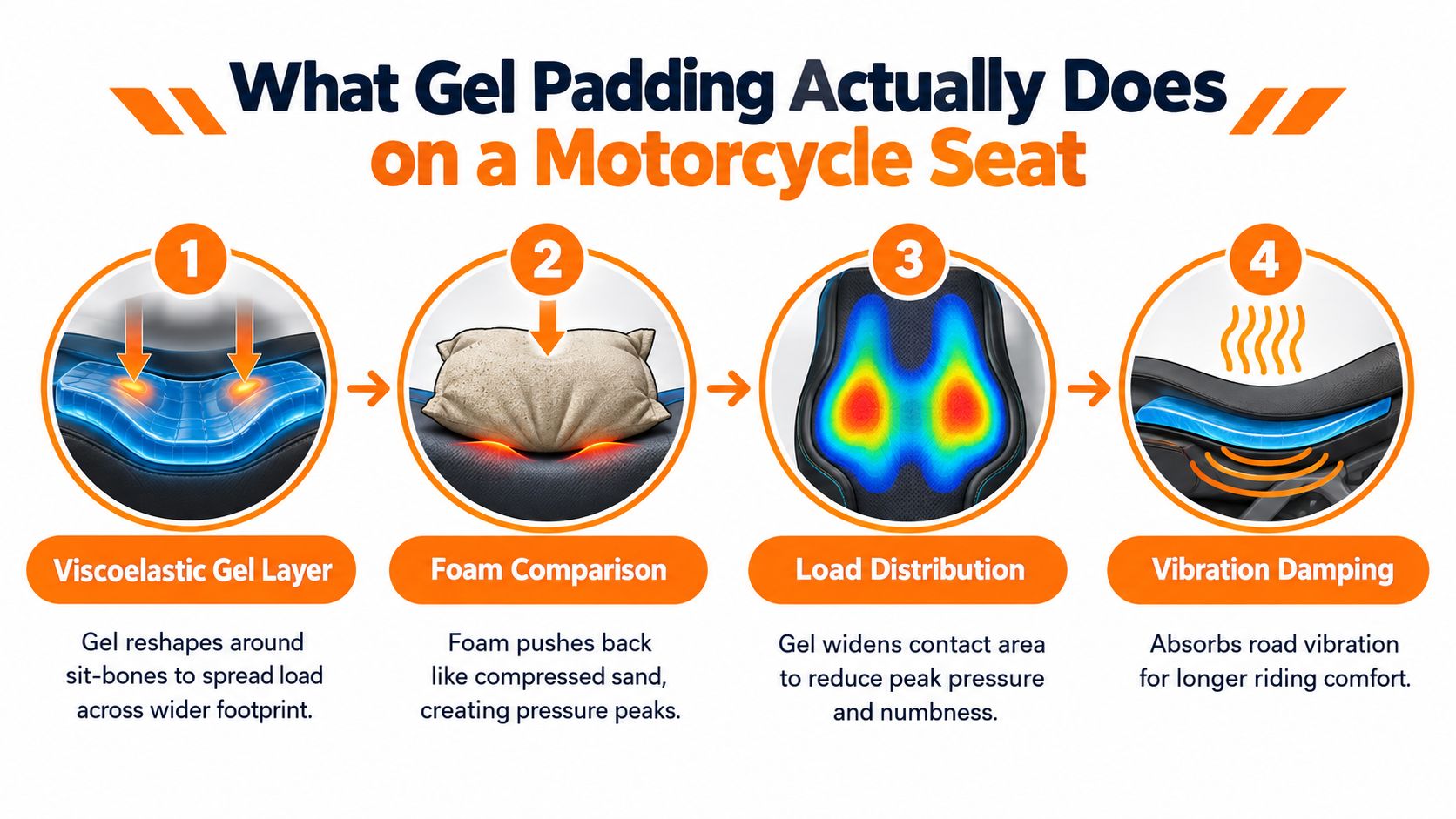
Motorcycle gel padding is generally a viscoelastic layer made from silicone- or polyurethane-based material. Instead of behaving like a simple block of foam, it deforms around the rider's sit-bones and shifts some load toward less heavily loaded areas.
A useful workshop analogy is a sandbag. Foam pushes back as it compresses, much like compacted sand under weight. Gel behaves more like a heavy fluid-filled bag, reshaping itself around a pressure point rather than resisting every part of the body equally. The result should be a wider effective contact area and lower peak loading, not merely a softer first impression.
Pressure-distribution research supports that distinction. A peer-reviewed study found that measuring how pressure spreads across a seat is an effective way to assess static seating comfort, while a motorcycle-seat fitting model used pressure data to predict perceived fit during design (seat pressure-distribution research). For riders, that means a pad should be judged by how evenly it supports the pelvis, not by how thick or plush it feels in a shop.
Construction matters more than the word gel
- Gel-only pads feel dense and stable in the hand, but they can be heavy, warm, and less forgiving if the material is too soft or too thick.
- Gel over foam is usually the most balanced arrangement. Foam maintains the basic seat shape, while the gel handles peak pressure and smaller vibration inputs.
- Gel with memory foam can feel more contoured, although slow-rebound foam may not suit riders who move frequently between braking, cornering, and standing positions.
The practical effects you're looking for are reduced tailbone pressure, fewer hot spots after the first hour, and less harshness over broken surfaces. Gel doesn't correct a narrow saddle, and it doesn't lower seat height. A thick layer may even make your reach to the ground feel less secure.
The suspension still matters because the seat only receives the forces the chassis sends into it. Before choosing a cushion, it's useful to understand how motorcycle suspension works. Riders also sometimes use Eazi-Grip tipo 2 x Tank Grip Sheets NERO (305mmx155mm) UNIVERSAL 2X SHEETS (305M to reduce the need to brace against the tank, which can change how much load reaches the seat during acceleration and braking.
For a removable option, compare the construction and attachment method of a shop gel bike seat cover rather than assuming every universal cover will behave identically.
Main Types of Gel Cushions for Motorcycles
The aftermarket falls into three useful formats. Choosing among them is less about marketing language and more about whether you need broad support, precise pelvic relief, or a small correction to one uncomfortable area.
| Format | Construction | Best For | Main Trade-Off |
|---|---|---|---|
| Full-coverage gel seat pad | A removable gel layer with a fabric cover, straps, or a zippered shell | Commuters, touring riders, and riders who change motorcycles | Can shift during braking and may alter the original seat feel |
| Anatomical or cut-out gel insert | A shaped insert with a central relief channel and contoured support zones | Sport-touring and ADV riders who hold one position for long periods | Requires accurate alignment and careful upholstery work |
| Gel strip or zone pad | A smaller gel section placed beneath the sit-bones or passenger area | Seats with one isolated hard spot, or pillion use | Fixes one pressure zone while leaving the rest of the seat unchanged |
Full coverage for reversible comfort
A full pad is the simplest route when you want to preserve the stock seat. It covers most of the rider's seating area and normally attaches without cutting the upholstery. That makes it practical for a rider who swaps between bikes or wants to remove the accessory for short trips.
The drawback is movement. A loose cover can creep forward under braking, especially when the seat slopes toward the tank. Bulk can also interfere with body position on a sportbike or during off-road riding.
Anatomical inserts for controlled support
An insert with a relief channel can take pressure away from the tailbone and central soft tissue while keeping support beneath the sit-bones. This format works best when the seat is being rebuilt, because the upholsterer can recess the insert and preserve the original seat height.
Alignment is critical. If the densest gel zone sits behind the rider's actual contact area, the pad can create a new pressure ridge rather than solving the old one. A shaped insert should be selected alongside the seat pan and rider posture, not in isolation.
Zone pads for one bad spot
A strip beneath the rider's sit-bones or passenger area makes sense when the rest of the saddle already works. It adds less bulk and can target a single hard section without changing the whole seat. The trade-off is limited coverage, so it won't address broad vibration or a seat that is too narrow.
Gel products are often discussed alongside other heat and pressure-relief accessories. For general information about temperature-oriented gel materials, see this explanation of gel pack therapy for neck discomfort. It isn't motorcycle-specific, but it illustrates why material behaviour and body contact matter more than the word “gel” alone. For unrelated motorcycle fitment hardware, the Supporto targa Italia fissaggio a 4 punti is a universal plate-holder product specific to Italy, not a seat-comfort component.
As a rule, commuters and tourers usually benefit from full coverage, sport riders need a thinner anatomical design, and pillion comfort is often best addressed with a zone pad under the rear seating area.
How to Match a Gel Pad to Your Bike and Riding Style
Start with the seat, not the product photograph. Measure the usable length and width where your sit-bones contact the saddle. A pad that extends beyond the seat pan can crease at the edge, lose support, and bottom out when you load it during braking.
Check the physical fit
Hold the candidate pad over the seat before installing it. Look for a clean perimeter, enough room for the straps to sit flat, and no interference with the tank, grab handles, seat latch, or passenger step. On a two-level touring seat, a two-piece arrangement may fit better than one long cushion because the rider and passenger zones have different shapes and movement patterns.
| Bike Type | Recommended Format | Key Fitment Check |
|---|---|---|
| Touring or ADV | Full-length insert or two-piece pad | Confirm the rider section follows the seat contour without blocking passenger access |
| Sportbike | Thin, narrow anatomical pad | Preserve ground reach and freedom to move across the seat |
| Scooter | Broad full-coverage pad | Cover the main seating area without interfering with the step-through layout |
| Commuter motorcycle | Reversible full pad or modest gel-over-foam insert | Check that daily mounting and removal won't loosen the straps |
| Passenger seat | Rear zone or strip pad | Match the gel area to the pillion's actual contact zone |
Match the pad to posture and load
An upright riding position shifts more pressure toward the rear of the saddle. A pad with a tailbone relief channel can help there. A tucked sport position loads the front edge more heavily, so a narrow pad with reinforced support near that area may be more appropriate.
Rider weight also changes the choice. Heavier riders should favour a denser silicone or layered construction over a soft polymer that compresses completely. The issue isn't comfort. Once a pad reaches the limit of its travel, it stops distributing pressure and begins transmitting the seat pan directly.
Weather is just as important. In hot climates, choose a breathable cover and a construction that allows some ventilation. Dense, closed materials can retain heat against riding gear, turning initial softness into discomfort later in the day.
Fitment rule: If the pad changes your reach to the ground, restricts your movement, or shifts when you brake, it isn't correctly matched, even if it feels excellent while parked.
Before ordering any motorcycle accessory, verify dimensions, mounting points, and model-specific clearance using a bike parts compatibility guide. The same discipline applies to a gel pad. Universal fit usually means adaptable attachment, not identical comfort on every seat.
Installing and Securing a Cuscino Gel Moto
Most complaints about a removable pad aren't caused by the gel itself. They come from movement. A cushion that slides forward under braking changes the pressure pattern, creases its cover, and can make the rider feel less planted.
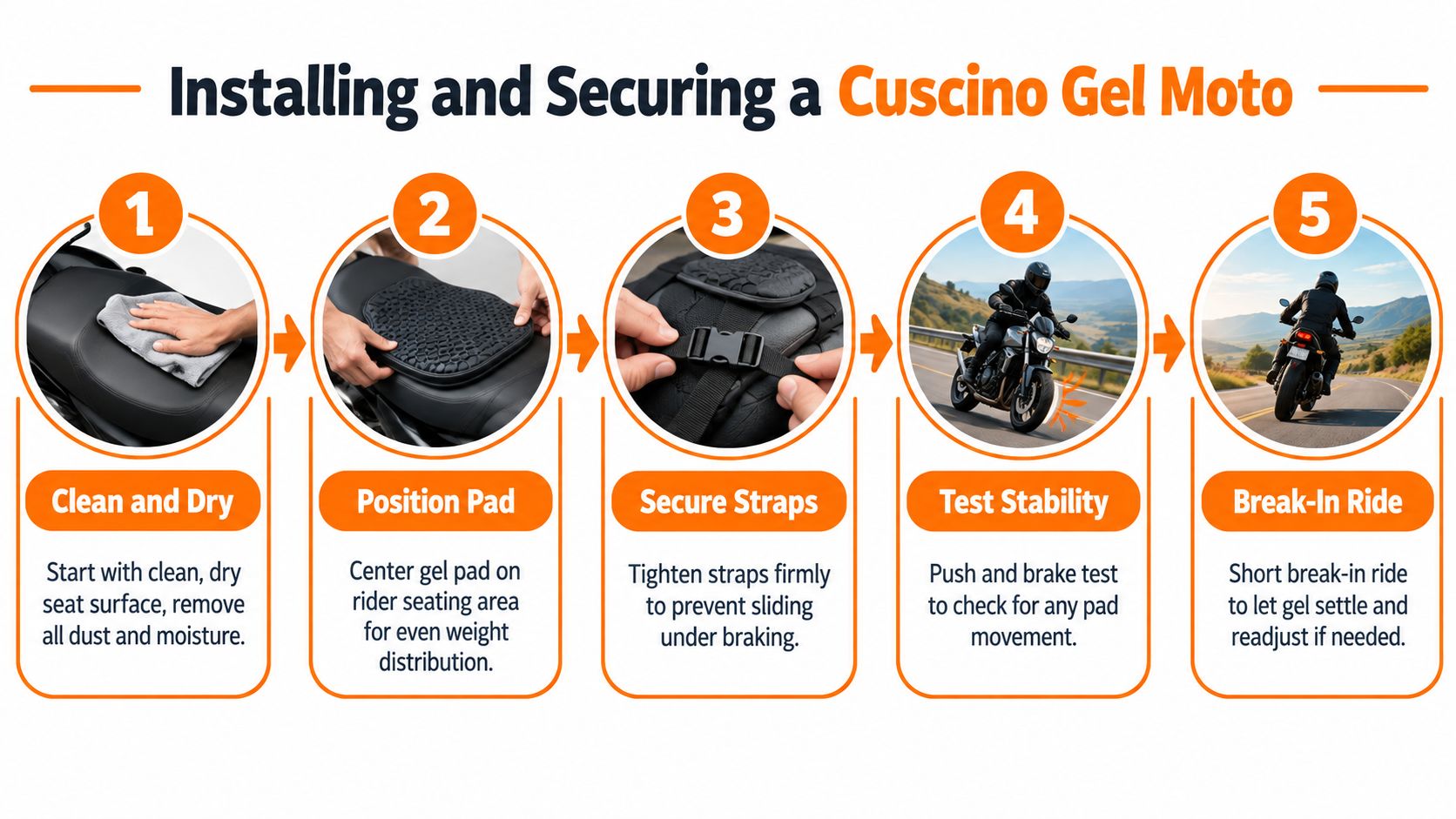
Start with a clean, dry seat. Dust and moisture reduce friction between the pad and upholstery, and body heat can make a marginal fit feel even less secure. Remove the pad's cover if the design allows it, then check that the base is free from grit before positioning it.
Use this installation sequence
- Dry-position the pad. Place it on the seat without fastening anything. Sit in your normal riding position and identify whether your sit-bones land over the pad's main support area.
- Centre the seating zone. Keep the pad square with the seat pan. Don't align it by the rear edge alone, because many seats taper or rise toward the passenger section.
- Anchor the rear straps first. The rear attachment resists the forward pull created during braking. Keep the straps flat and clear of the seat latch.
- Tension the front straps evenly. Tighten both sides gradually. If you overtighten the front, you can lift the rear edge and create a hinge that moves downhill.
- Test the bike while stationary. Push your weight forward, apply the brake, and simulate the posture you use on a descent. The cover shouldn't crease or lift.
For a touring setup, route bungee cords through suitable pad eyelets and beneath the passenger seat if the design provides that option. The aim is to prevent lateral shift without crushing the cushion or obstructing the seat lock.
Break it in progressively
Don't make the first test ride an all-day trip. Use a short loop, check your position after braking and cornering, then increase distance gradually. If the rear lifts, the cover wrinkles, or the pad migrates, stop and re-tension it rather than trying to compensate with your posture.
The straps and cover may settle after use. Recheck the attachment after 200 km, following the installation guidance in the supplied product instructions or your own maintenance schedule. That check catches movement before it wears the cover or creates a new pressure point.
Comfort, Pressure, and Long-Distance Riding Trade-Offs
A gel pad can feel immediately better and still disappoint after several hours. That apparent contradiction comes from the difference between peak pressure relief and whole-ride comfort.
Gel can flow laterally under load, increasing the contact area beneath the pelvis and reducing concentrated loading. That's why a hard saddle may feel noticeably better during the first part of a ride. But the same dense material can retain heat, especially when the cover and base leave little room for air movement. Once heat builds between the rider and seat, the original pressure benefit may no longer dominate the experience.
Foam has the opposite trade-off. It can breathe and rebound more naturally, but it may not redistribute pressure as effectively at a hard contact point. A layered construction often makes more sense than a pure gel slab because the foam supplies shape and support while the gel manages localised loading.
Use duration as the decision filter
For a short daily commute, a gel-dominant pad can be a sensible upgrade. It provides quick pressure relief without requiring a permanent seat modification, and heat retention may be manageable when the riding period is limited.
For touring, the priorities change. Look for a shaped gel layer over supportive foam, a breathable or heat-vented cover, and a stable underside that won't migrate. The right pad should feel supportive rather than excessively plush when you first sit on it. Pressure-mapping evidence points toward contour and load distribution, not thickness alone, as the more meaningful design criteria.
| Riding situation | More suitable approach | Main concern |
|---|---|---|
| Short urban commute | Gel-dominant removable pad | Avoiding unnecessary bulk |
| Mixed daily riding | Gel over foam | Balancing pressure relief and stability |
| Full-day touring | Layered, shaped gel construction | Heat retention and fatigue |
| Hot-weather extended riding | Ventilated cover and breathable structure | Managing trapped heat |
| Track-adjacent road use | Thin anatomical insert | Preserving movement and feedback |
Riders comparing seat accessories sometimes encounter guidance about when to use a donut cushion. The principle is relevant here, even though the application differs: relieving a specific contact zone only works when the opening or relief area lines up with the anatomy being unloaded.
For long-distance setup decisions, include seat shape, suspension condition, riding posture, and luggage load in the calculation. A practical touring motorcycle setup guide can help put the cushion into that wider context. If the base seat is wrong for your pelvis, no gel layer will turn it into a properly shaped touring saddle.
Care, Lifespan, and Rider FAQ
A cuscino gel moto lasts longer when you treat it as a fitted motorcycle component rather than a loose pillow. Remove the cover according to its care instructions, wash it at 30°C with no spin when that method is specified, and let it dry away from direct sunlight. Sustained heat can affect the cover, adhesives, and gel behaviour, so don't leave the pad exposed on a hot parked seat when you're not riding.
Inspect the pad every 3 to 6 months for permanent compression, split seams, damaged straps, or a base that has started to curl. Touring riders should check more often if the cushion sees frequent rain, luggage contact, or high summer temperatures. A gel pad that has migrated repeatedly may show wear before the gel itself fails.
Practical answers to common questions
| Question | Practical Answer |
|---|---|
| Will the pad slip after weeks of use? | It can, especially if straps stretch, the cover becomes polished, or the seat surface collects dust. Reposition and retension it as soon as movement appears. |
| Can I cut it to size? | Don't cut a gel insert unless the manufacturer specifically permits it. Cutting can expose the material, damage its load pattern, or weaken the cover. |
| Does it work with a heated seat? | Check the product instructions first. Added layers can change heat transfer and may interfere with the heating element or temperature control. |
| What happens in rain? | The gel itself may tolerate moisture, but the cover, seams, and underside need drying before storage to prevent odour and material deterioration. |
| Does it noticeably raise the seat? | A thin pad may make little practical difference, but any added layer can affect reach, leg angle, and the relationship between rider and tank. Test your footing before riding away. |
| Should I repair or replace it? | Replace it when the gel has a permanent flat area, the seams split, the straps no longer hold tension, or the pad changes position during normal braking. |
Published buying guidance places high-quality gel seats at 5 to 7 years under regular use, while lower-quality or heavily used foam can compact within 1 to 2 years (gel seat durability and pricing guide). Those figures describe broad product categories, not a guarantee for every removable motorcycle pad. Daily commuting, rider weight, climate, storage, and cover quality all affect the result.
Replace rather than repair when the cushion no longer returns to its original shape, when pressure relief has become uneven, or when securing it requires improvised straps. A pad that stays comfortable but can't remain fixed is still a fitment failure.
Sixrace offers motorcycle accessories, protection parts, suspension components, and model-specific fitment information that can help you address the wider causes of seat fatigue, not just the cushion itself. Visit Sixrace to compare compatible motorcycle parts and build a more stable, better-matched riding setup before choosing your next cuscino gel moto.
 Italiano
 Deutsch
 Français
 Español
 English
 Polski