
The most common advice about a motorcycle steering damper is also the least useful: every sportbike needs one. That isn't true. A damper can control a specific steering instability, but it can't repair a worn tire, incorrect suspension settings, loose steering-head bearings, or poor chassis alignment. Fitting one to hide those problems can make the bike heavier, less communicative, and harder to diagnose.
The right question is more precise: does your motorcycle, geometry, and riding environment create a genuine need for extra resistance to rapid steering movement? An aggressive track bike, a machine with a history of headshake, or a motorcycle using a fork-mounted fairing at high speed may benefit substantially. A standard road bike used for commuting may need nothing more than fresh tires and a properly adjusted fork.
Table of Contents
- Do You Actually Need a Steering Damper
- The Physics of Wobble and Weave Explained
- Mechanical vs Hydraulic vs Electronic Dampers
- Choosing the Right Damper for Your Riding Style
- Tuning Your Damper for Real-World Conditions
- Track Day and Off-Road Scenarios
- Maintenance and Integration with Suspension Setup
Do You Actually Need a Steering Damper
A steering damper becomes relevant when the front end can move faster than the chassis and rider can comfortably control. That situation depends on geometry, speed, surface quality, aerodynamic loading, suspension condition, and throttle or braking inputs. It doesn't depend solely on whether the tank says sportbike, naked, or adventure.
An Australian government road-safety report observed that fork-mounted fairings could trigger wobble oscillations above 100 km/h, while adding a steering damper virtually eliminated the wobble in those tests (Australian road-safety report on motorcycle wobble). The same report noted that mounting the fairing to the motorcycle's main frame could remove the need for a damper, which shows why the component became particularly important as high-speed motorcycles adopted fork-mounted aerodynamic loads.
Start with the chassis, not the accessory
Before buying an ammortizzatore di sterzo moto, check the causes that commonly create unstable steering:
- Tires: Inspect pressures, wear patterns, squaring, damage, and age. A worn or incorrectly inflated front tire can create nervous feedback that no damper should be asked to disguise.
- Suspension: Verify sag, preload, compression, rebound, and fork condition. An incorrect rear ride height can alter steering attitude and weight transfer.
- Bearings and alignment: Check steering-head bearings, wheel alignment, fork-tube position, axle installation, and triple-clamp alignment.
- Load and aerodynamics: Luggage, a tall screen, a fork-mounted fairing, or a change in riding position can alter the forces acting on the front end.
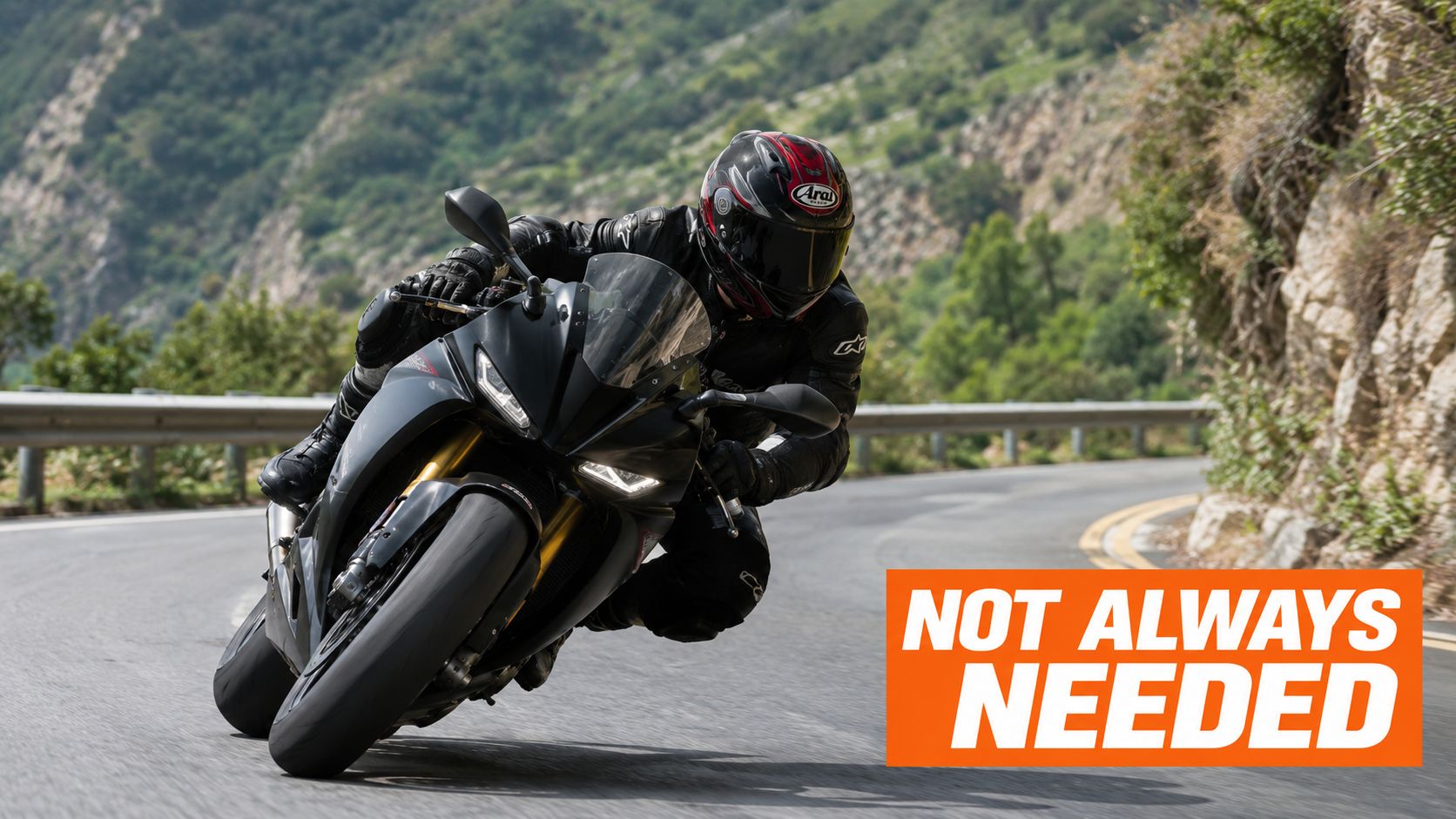
A damper deserves serious consideration when the bike produces repeated, rapid handlebar movement after a bump, crest, landing, aggressive acceleration, or fast direction change, and the mechanical checks are sound. It's also more relevant for aggressive steering geometry, track-day use, rough high-speed roads, and motorcycles carrying aerodynamic equipment that moves with the fork.
Practical rule: If the bike is unstable because something is worn, misaligned, or badly adjusted, fix that first. A damper should control a known instability, not conceal its source.
The strongest use case is a motorcycle that already behaves well but shows a repeatable tendency toward headshake under a defined condition. If the bars feel heavy everywhere, the steering won't return naturally, or the motorcycle resists tight turns, the setting is probably excessive, the installation is wrong, or the damper isn't the correct solution.
The Physics of Wobble and Weave Explained
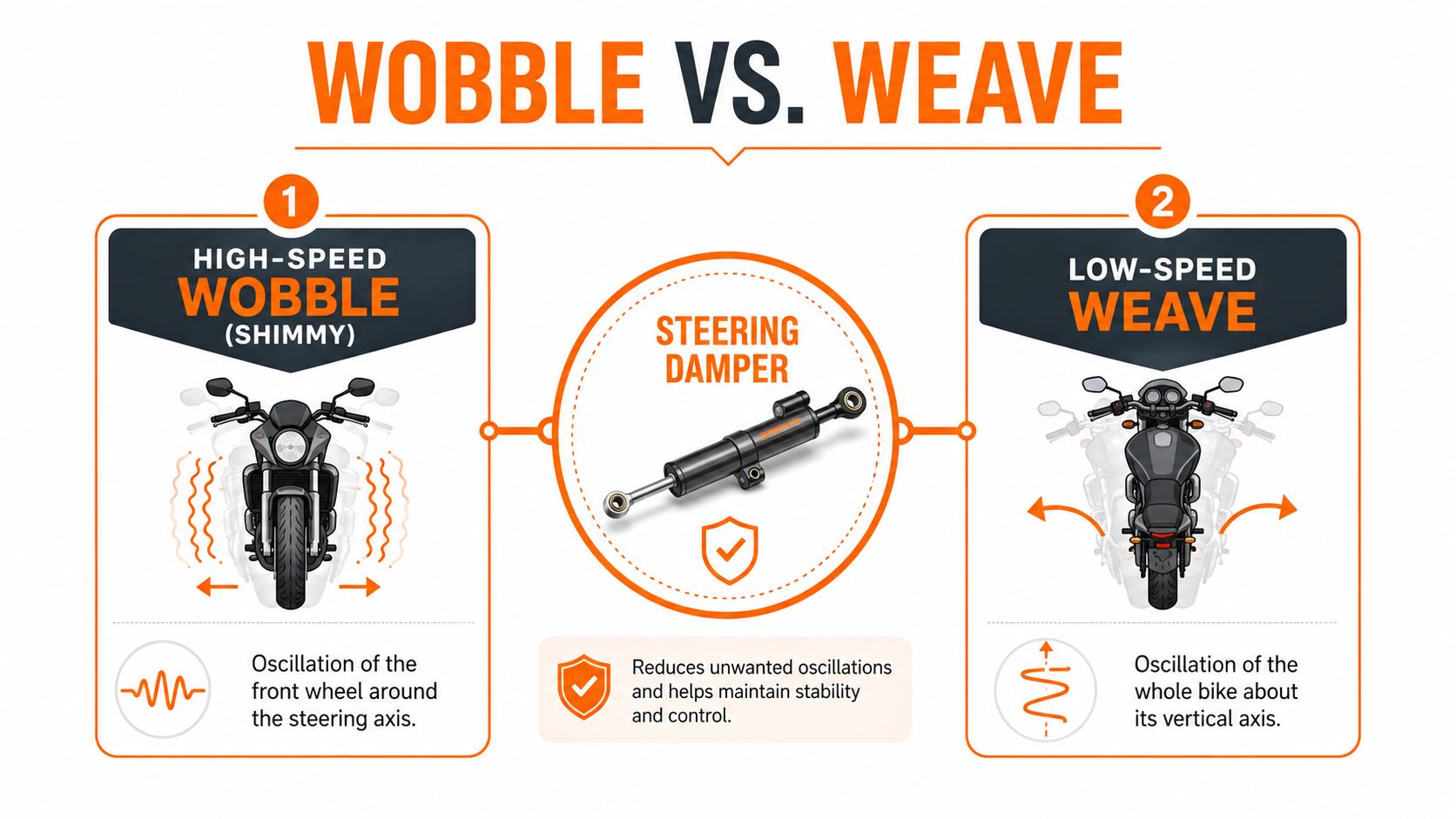
A steering damper does not cure every unstable feeling. It addresses a specific part of the motorcycle's response, and understanding that distinction matters before adding resistance to the bars. Wobble, also called shimmy or headshake, is a rapid oscillation of the front assembly around the steering axis. Weave is slower and involves the chassis moving about its vertical axis. The rider can experience both as a loss of composure, but they arise from different modes and respond differently to setup changes.
A damper works like a controlled resistance in the steering system. It applies a moment opposite to rapid handlebar angular velocity, slowing unwanted movement without steering the motorcycle for the rider. Motorcycle stability literature describes this effect as a way to increase steering and yaw stability while suppressing high-speed shimmy (motorcycle stability and steering damper dynamics).
Why damping changes the feel
A disturbance at the front contact patch sends forces through the tire, steering geometry, fork, handlebar, and rider. In a rapid oscillation, energy can return through that chain and reinforce the movement. Too little damping may allow the wobble mode to become unstable at high speed. More damping generally reduces that oscillation, but it can also restrict the steering response associated with weave, so maximum resistance is not automatically the safest setting.
The trade-off is easy to feel. A motorcycle may become calmer during hard acceleration yet feel reluctant in a tight turn when the damper is set too firm. At parking-lot speed, the bars must move freely. On a rough straight or during a hard corner exit, the unwanted rapid movement should be slowed while ordinary steering input remains available.
Wobble and weave in practical terms
- Wobble: The bars or front wheel oscillate quickly. It may appear after a bump, landing, crest, or forceful throttle application.
- Weave: The entire motorcycle seems to wander or flex from side to side. This is a chassis-level motion rather than a simple bar vibration.
- Tank slapper: A severe steering oscillation in which the bars move violently from side to side. It describes an outcome, not a separate damper adjustment category.
Development work on motorcycle stability also examines semi-active systems that vary damping torque according to riding conditions, balancing steering control with comfort (research on semi-active motorcycle steering dampers). A model-specific cockpit change provides another useful reminder: the Triumph Tiger 900 GT Pro 2024+ Evotech-performance handlebar risers alter handlebar position, so their effect should be judged within the motorcycle's complete steering and chassis setup.
Mechanical vs Hydraulic vs Electronic Dampers
The right damper depends on the instability you are correcting, not on the technology label. All three types slow rapid steering movement, but they differ in feel, adjustment range, service needs, and how easily they suit a particular motorcycle.
A mechanical friction damper presses loaded surfaces together to resist steering movement. Its construction is compact and straightforward, with no hydraulic seals or fluid to service. The trade-off is a narrower and less progressive response. It can work on an older motorcycle, a basic custom build, or a road bike where the rider wants simple assistance rather than fine adjustment.
A hydraulic damper moves a piston through oil, forcing fluid through an orifice or valve. This produces a more controlled resistance curve, and many aftermarket units provide click adjustment. Some designs offer 20 to 30 positions, as described in Monash University research on motorcycle steering dampers. The setting still matters less than the usable force range, correct stroke, and sound mounting. A high number of clicks cannot compensate for a damper that is too strong, too weak, or poorly aligned.
Electronic and semi-active dampers vary resistance through sensors, control software, and an actuator or electronically controlled fluid system. Research into semi-active motorcycle steering dampers examines changing damping torque with riding conditions, rather than relying on one fixed setting (semi-active steering damper research). The practical advantage is adaptability. The costs are greater complexity, diagnostic requirements, and compatibility limits when fitting the system to a motorcycle that was not designed for it.
| Technology | Adjustability | Maintenance | Cost Range | Best Use Case |
|---|---|---|---|---|
| Mechanical friction | Usually basic or limited | Inspect friction surfaces, fasteners, and mounts | Lower to moderate | Older motorcycles, simple builds, basic road use |
| Hydraulic piston | Commonly adjustable through clicks or valves | Check seals, fluid condition, rod, and mounting hardware | Moderate to high | Street, sport, naked, adventure, and track-day use |
| Electronic or semi-active | Variable through control software and sensors | Requires system diagnostics plus mechanical inspection | High or integrated with the motorcycle | High-performance motorcycles and applications needing adaptive control |
What works and what doesn't
Hydraulic units suit many aftermarket installations because they provide useful adjustment without depending on the motorcycle's electronic architecture. They still require accurate alignment, adequate clearance, and a stroke that does not restrict normal steering.
Mechanical dampers make sense when the rider accepts a smaller tuning window and wants uncomplicated hardware. Electronic systems provide the broadest range of automatic control, but their integration and compatibility make them poor universal retrofits. A simpler damper set correctly can preserve handling better than an advanced unit adjusted too firmly.
Choosing the Right Damper for Your Riding Style
Choose the damper only after defining the behavior you want to control. Start with the motorcycle's geometry and the conditions that produce the instability, then select the hardware around that diagnosis.
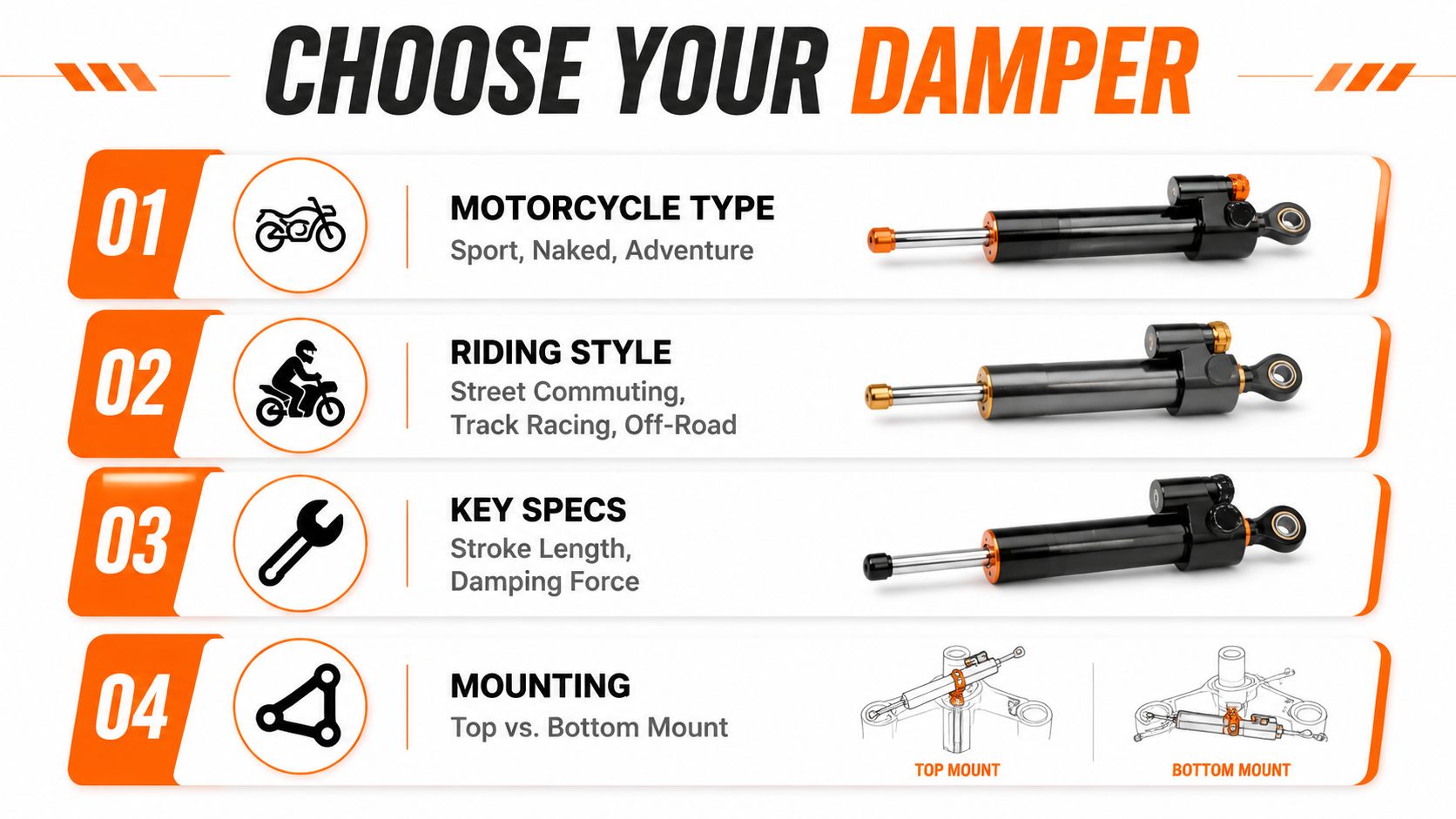
Four decisions that matter
Motorcycle type comes first. A short, aggressive sportbike steering package may need a different damping range from a relaxed naked motorcycle. An adventure or supermoto machine must also cope with loose surfaces, sudden impacts, and larger handlebar inputs.
Riding style determines the operating window. A commuter needs light steering in traffic and during low-speed turns. A track rider may accept more resistance during hard acceleration and rapid direction changes, but the setting still has to preserve precise rider input.
Stroke length must match the steering movement. The damper needs enough travel for the motorcycle's steering range without bottoming out or limiting the bars before the steering stops. Confirm the specified stroke and the clearance around the tank, fairing, cables, ignition, and controls.
Mounting position changes the installation. Frame-to-fork and fork-to-triple-clamp layouts use different brackets and load paths. Top-mounted systems are often easy to inspect, while lower arrangements can offer a clean package but may be exposed to impacts or contamination.
A practical decision tree
Ask these questions in order:
- Does the motorcycle show repeatable headshake? If not, don't assume a damper will improve it.
- Have tires, bearings, alignment, and suspension been checked? If not, diagnose those items first.
- Does the use case include track riding, aggressive geometry, rough high-speed surfaces, or fork-mounted aerodynamic loading? If yes, a damper may be justified.
- Do you need low-speed freedom? If yes, prioritize a broad, usable adjustment range instead of maximum resistance.
- Can the kit be fitted without interference? A correct model-specific bracket is more important than a universal part that compromises clearance.
For a Yamaha MT-10 or a Triumph street platform, the correct answer depends on actual symptoms, wheel and tire condition, suspension setup, and riding pace. For an off-road motorcycle, focus on controlled impact resistance and freedom of movement rather than copying a stiff road-racing setting. The damper should support the chassis, not replace a proper setup.
Tuning Your Damper for Real-World Conditions
A damper that feels impressive in the workshop can feel awful on the road if it's too firm. At low speed, the bars must respond naturally to steering input, body position, camber, and tight-radius turns. The correct setting is the lightest one that controls the unwanted movement you can reproduce safely.
Begin with the manufacturer's installation instructions and set the adjuster to its softest usable position. Don't treat the click count as a universal formula. One click on one damper won't necessarily produce the same steering feel as one click on another.
Use a repeatable test
- Start soft: Confirm that the bars move freely from lock to lock and that the damper doesn't interfere with the steering stops.
- Inspect before riding: Check bracket bolts, rod alignment, cable routing, tank clearance, and full suspension movement.
- Test on a familiar road: Use a controlled route and pay attention to the exact condition that previously caused headshake.
- Add resistance gradually: Increase the setting in small increments, such as one or two clicks where the adjuster provides that resolution.
- Repeat the same test: Compare steering effort, bar feedback, stability, and the motorcycle's response to bumps.
- Finish at low speed: The bars should remain manageable during U-turns, parking, and traffic maneuvers.
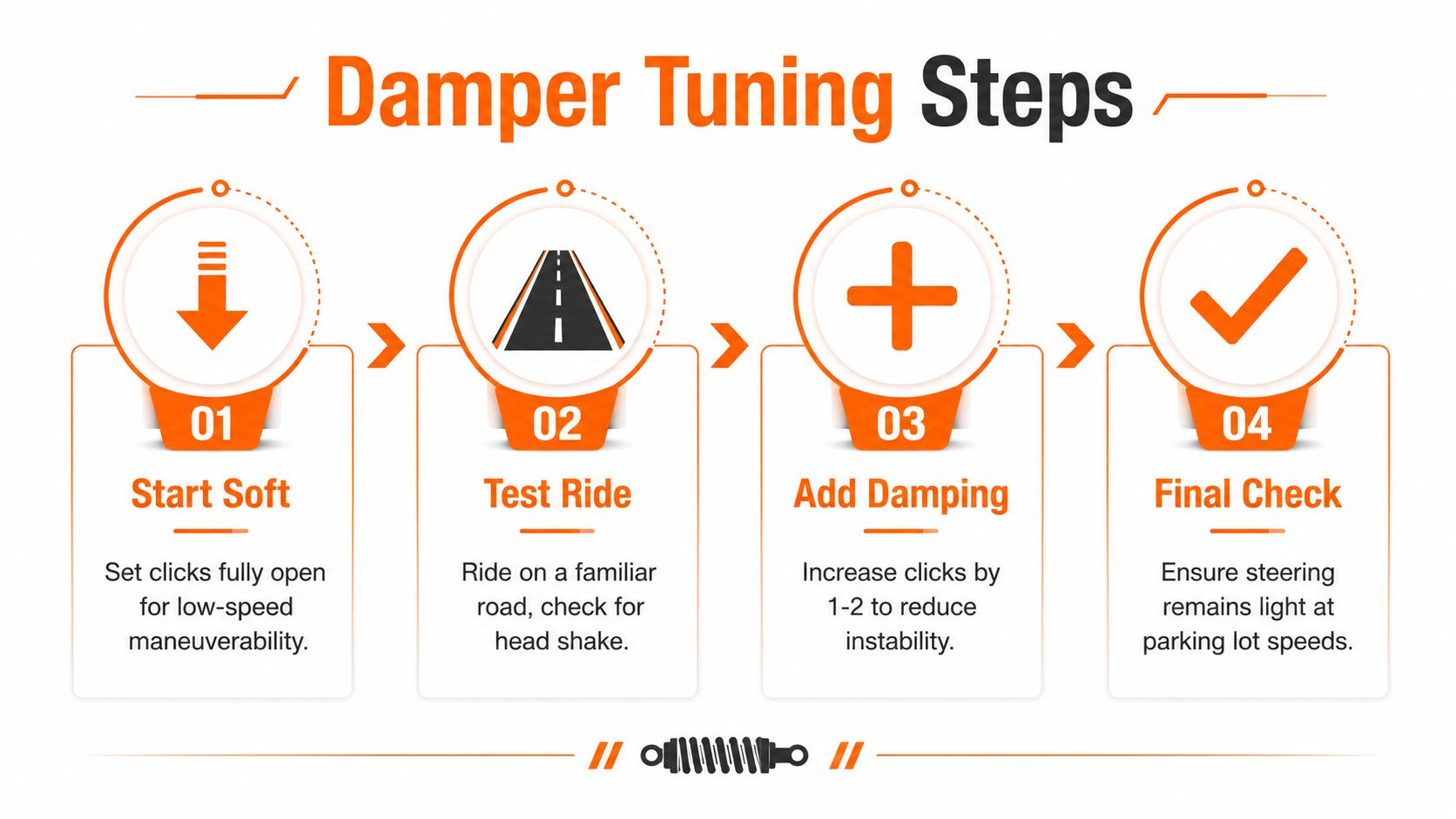
The best setting isn't the one that makes the bars hardest to move. It's the one that removes the unwanted spike in steering movement while preserving useful feedback.
If the motorcycle feels numb, reluctant to turn, or tiring in slow corners, back the damping off. If the original instability remains after the adjustment, stop increasing force and return to diagnosis. A damper can reduce the speed of a steering oscillation, but it can't correct a bent component, a bad tire profile, or a suspension error.
Keep a written note of the setting, tire pressures, load, temperature, and riding conditions. When you make suspension changes, use the motorcycle preload adjustment guide as part of the same methodical process rather than changing several variables at once.
Track Day and Off-Road Scenarios
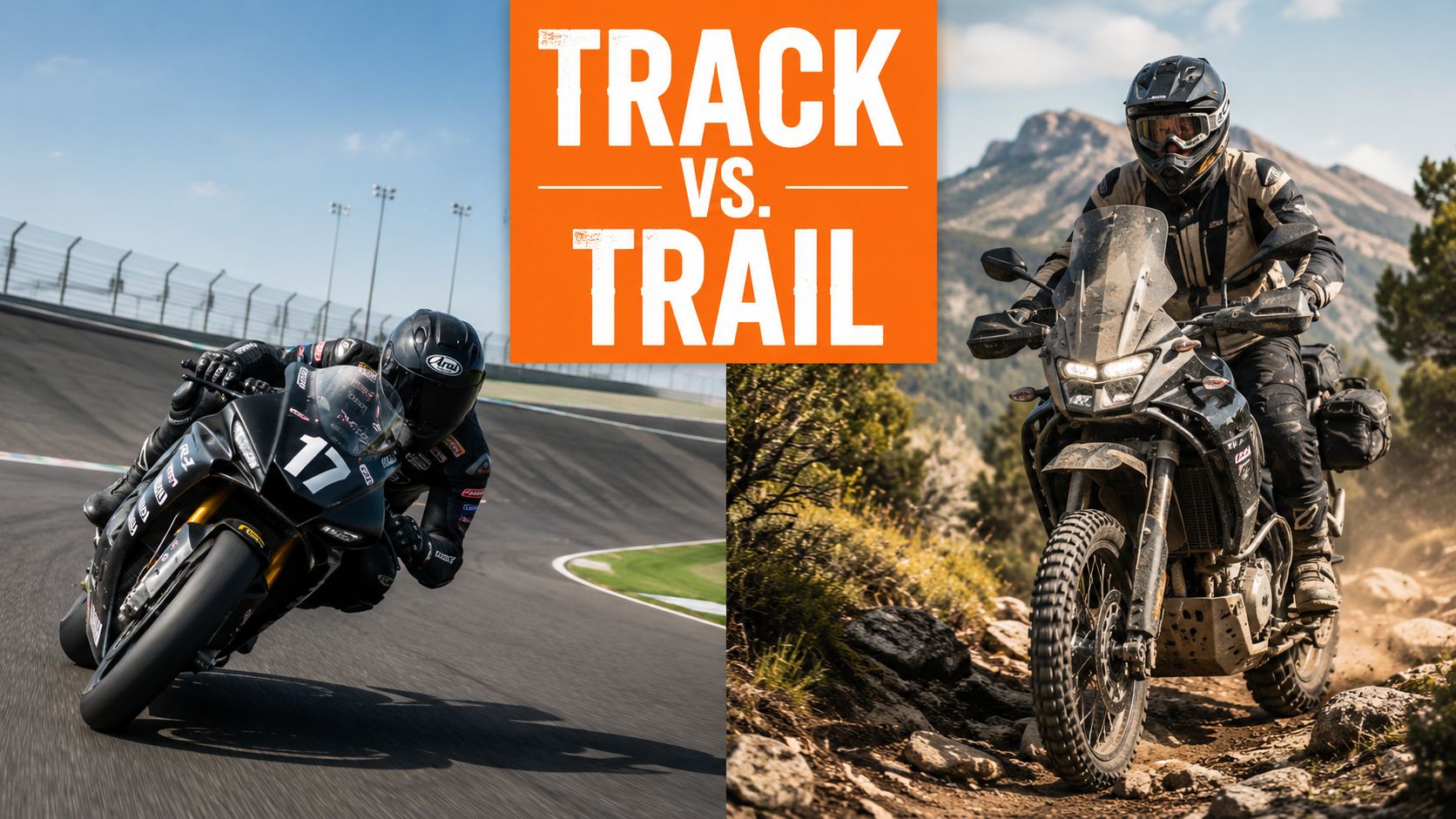
A track-day motorcycle often loads the front end differently from a road bike. Hard acceleration can unload the front tire, curb strikes can disturb the steering, and rapid changes of direction can expose a setup that feels completely calm during ordinary street riding. A damper may add useful control during those moments, but it shouldn't be used to mask a rear ride-height problem or a suspension setting that makes the chassis pitch excessively.
On the circuit
A rider leaving a fast corner may feel a quick bar movement as the front tire crosses a bump while the throttle is opening. The useful damper setting slows that event without making the motorcycle resist the rider's steering input through the next change of direction. Track testing should happen only after tire condition, fork alignment, sag, damping, and steering-head condition are confirmed.
A damper adjustment can't compensate for entering a corner with an unstable chassis balance. Use the motorcycle track preparation and safety inspection guide to keep the mechanical inspection separate from the fine adjustment work.
On loose surfaces
Adventure, enduro, and supermoto riders face a different compromise. The front wheel needs to move around obstacles and follow changing terrain, so excessive resistance can make the motorcycle feel reluctant to correct its line. On a fast gravel road or rough landing, however, uncontrolled steering movement can still become tiring and difficult to catch.
For these bikes, test the damper over the actual terrain rather than copying a road-racing setting. A useful setup allows the rider to make quick corrections while slowing the sharp steering kick that arrives from an impact. If the bars feel locked against the terrain, reduce damping and inspect the mounting position, because exposure to rocks and mud can also affect service life.
Maintenance and Integration with Suspension Setup
A steering damper belongs to the chassis system. Its condition affects steering feel, but its presence doesn't prove that the rest of the motorcycle is healthy. A leaking seal, contaminated fluid, bent rod, loose bracket, or damaged mounting eye can create uneven resistance that feels like a geometry problem.
Inspect the unit whenever you service the forks or prepare for hard riding. Look for oil around the shaft, corrosion, play in the rod ends, damaged adjuster hardware, and contact marks showing that the body or linkage is touching another component. Move the bars slowly through the full steering range with the front wheel unloaded, then check for smooth resistance and confirm that the damper doesn't limit the factory steering stops.
Find the fault before changing the setting
A worn damper can hide problems in the steering head, triple clamps, axle alignment, or suspension. If the motorcycle has not been checked recently, inspect:
- Steering-head bearings: Look for notchiness, looseness, or excessive preload.
- Fork alignment: Confirm that the tubes, axle, and triple clamps are installed without binding.
- Wheel and tire condition: Check profile, pressure, balance, and damage.
- Suspension operation: Verify that the fork and shock move smoothly and return consistently.
- Damper hardware: Confirm correct torque, clearance, and bracket alignment.
The broader principles are covered in this guide to how motorcycle suspension works. That system view matters because changing damper resistance can alter the rider's perception of a problem without changing the force that caused it.
Service requirements depend on the damper design and manufacturer. Hydraulic units eventually need seal and fluid attention, especially when the rod sees dirt, water, heat, or impact. If adjustment changes produce little difference, resistance varies through the stroke, or fluid appears around the seal, remove the unit from service until it's inspected.
If you're deciding whether your motorcycle needs an ammortizzatore di sterzo moto, Sixrace offers model-specific motorcycle accessories and suspension-related components with compatibility information for individual applications. Visit Sixrace to compare the available equipment, verify fitment for your bike, and build the damper decision around a sound chassis setup rather than marketing advice.
 Italiano
 Deutsch
 Français
 Español
 English
 Polski