

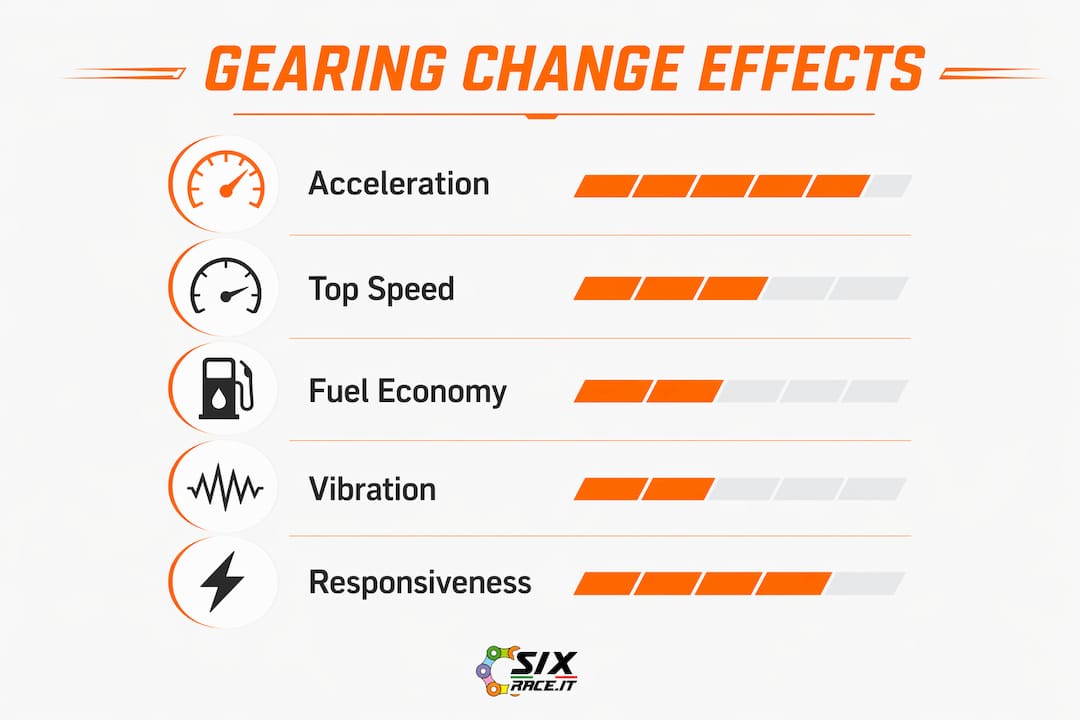
Changing your motorcycle’s gearing alters the final drive ratio, which directly changes how much torque reaches the rear wheel, how quickly the engine revs at a given road speed, and where the bike’s performance sits on the acceleration-versus-top-speed spectrum. The effect is immediate and measurable, even from a change of just one or two sprocket teeth.
Short (higher numerical) gearing — achieved by reducing front teeth or adding rear teeth:
- Stronger off-the-line acceleration and more low-end torque
- Lower top speed
- Higher cruising RPM, increased engine buzz on motorways
Long (lower numerical) gearing — achieved by adding front teeth or reducing rear teeth:
- Higher top speed and relaxed highway cruising
- Reduced acceleration and less low-end punch
- Lower cruising RPM, better fuel consumption
The practical rule: a change of ±1–2 teeth is typically all you need to feel a meaningful difference in ride character, without significant penalties to reliability or fuel efficiency.
Table of Contents
- How does final drive ratio actually work?
- What you will actually notice after changing gearing
- When does changing gearing actually make sense?
- How to plan a sprocket change before you buy
- Quick reference: estimated effect of common tooth changes
- Risks, maintenance and a note for Central European riders
- How to evaluate the change on the road
- Key takeaways
- Why incremental changes matter more than you might think
- Get your sprockets, chains and kits from Sixrace
- Further reading and sources used in this guide
How does final drive ratio actually work?
The final drive ratio is the relationship between your rear sprocket and front (countershaft) sprocket, calculated as:
Rear teeth ÷ Front teeth = Final drive ratio
A stock setup of 15 front and 45 rear gives a ratio of 3.0. Fit a 14-tooth front sprocket and the ratio rises to 3.21, a change of approximately 7%. That percentage translates directly to a 7% rise in engine RPM at any given road speed and gear. A more dramatic example: switching from 18/43 to 17/45 raises the ratio and increases engine RPM by approximately 10.9% at the same speed.
Why front sprocket changes hit harder: because the front sprocket is roughly three times smaller than the rear, one tooth on the front produces a proportionally larger ratio shift than one tooth on the rear. As a practical rule, one front tooth equals approximately three rear teeth in final-drive effect.
What you will actually notice after changing gearing
The mechanical shift in ratio translates into sensations and measurable outcomes that vary depending on which direction you go.
Shorter gearing (higher ratio) produces:
- Crisper throttle response and quicker launches
- A greater tendency to wheelie under hard acceleration
- Stronger engine braking when you roll off the throttle
- Higher RPM at motorway speeds, which increases vibration and fuel consumption on long runs
Longer gearing (lower ratio) produces:
- Smoother, more relaxed cruising at reduced RPM
- Reduced engine braking feel
- Slightly duller throttle response from low speeds
- Risk of engine lugging if the ratio moves the engine below its torque band in top gear
Fuel consumption and vibration are the two trade-offs most riders underestimate. A shorter setup that feels exhilarating on a Sunday morning can become tiring on a 400 km motorway run. Conversely, very long gearing on a mid-range parallel twin can leave the engine hunting for torque on inclines.
Pro Tip: Start with ±1 tooth on the front or ±2 teeth on the rear. Ride at least 200 km across mixed conditions before judging. If the engine feels strained or buzzy at your typical cruising speed, you have moved outside the torque band and should step back one tooth.
When does changing gearing actually make sense?
Factory engineers set stock gearing as a deliberate compromise between fuel economy, emissions compliance, and all-round street usability. That compromise suits most riders most of the time, but specific use cases justify a targeted change.
Track days and circuit riding: shorter gearing maximises acceleration out of corners. Race teams tailor final drive ratios to the specific circuit layout rather than applying a universal setting.
Canyon roads and twisties: a modest reduction in front teeth (or addition of one or two rear teeth) sharpens response through tight sequences without the extreme RPM penalty of a full track setup.
City commuting: shorter gearing suits stop-start traffic, making the bike feel more responsive at low speeds. The top-speed sacrifice is irrelevant in urban conditions.
Long-distance touring: longer gearing reduces cruising RPM, cuts vibration, and lowers fuel consumption. Adventure and touring riders in Central Europe covering motorway distances benefit most from adding one front tooth or removing two rear teeth.
Off-road and motocross: most dirt bikes leave the factory with fairly neutral gearing. Adding two rear teeth delivers stronger low-end torque for technical trail riding; removing rear teeth suits open desert or enduro stages where top speed matters.
The key principle: aftermarket gearing is a goal-specific tune, not a universal improvement. Define your primary riding environment before choosing a direction, and make only the smallest change that achieves your goal.
How to plan a sprocket change before you buy
A methodical checklist prevents wasted money and avoids compatibility problems.
Before ordering:
- Confirm your bike’s make, model, year, and current sprocket tooth counts (usually stamped on the sprocket face).
- Decide your target tooth change and direction (front or rear, or both).
- Check swingarm clearance for a larger rear sprocket; some frames have tight tolerances.
- Calculate the new chain length required — even a one-tooth change may need a link added or removed.
- Order a matched chain and sprocket kit rather than individual components; mismatched wear rates accelerate failure.
Workshop essentials:
- Torque wrench (refer to your model’s service manual for sprocket nut and axle torque figures)
- Chain breaker and rivet tool for sealed chains
- Chain alignment tool
- Correct chain size (520, 525, 530 — confirm against your model specification)
Pro Tip: Always replace the chain and both sprockets together. Fitting new sprockets onto a stretched chain, or a new chain onto worn sprockets, causes accelerated wear on all three components. If your ratio change is substantial, also consider an electronic speedo corrector to restore accurate speedometer and odometer readings.
Quick reference: estimated effect of common tooth changes
The table below uses a baseline of 15 front / 45 rear (ratio 3.00) as the stock reference. RPM change is approximate at a fixed road speed in top gear; exact figures depend on tyre size and transmission ratios.
| Change | New teeth | New ratio | Approx. RPM change | Effect |
|---|---|---|---|---|
| Stock | 15F / 45R | 3.00 | — | Baseline |
| −1 front | 14F / 45R | 3.21 | +7% | Shorter: more acceleration, less top speed |
| +1 front | — | — | — | Longer: higher top speed, lower cruising RPM |
| +2 rear | — | — | +4% | Shorter: mild low-end improvement |
| −2 rear | 15F / 43R | 2.87 | −4% | Longer: relaxed motorway cruising |
| 18F / 43R → 17F / 45R (example from research) | 17F / 45R vs 18F / 43R | Higher ratio | +10.9% RPM | Significant short-gearing shift |
Note: these are estimates for planning purposes. Always verify against your specific model’s geometry and tyre rolling circumference.
Mild changes of ±1–2 front teeth or ±2–3 rear teeth cover the vast majority of real-world tuning goals without requiring a new chain length in many cases.
Risks, maintenance and a note for Central European riders
The most common mistake is fitting new sprockets onto a worn chain. Mixing new sprockets with a stretched chain accelerates wear on all components and can cause chain skip under hard acceleration. Always treat chain and sprockets as a matched set.
Additional risks worth noting:
- Clearance issues: a larger rear sprocket may contact the swingarm or chain guard; check before fitting.
- Altered engine braking: shorter gearing increases engine braking, which changes corner-entry feel and can unsettle the rear on deceleration if you are not expecting it.
- Speedometer inaccuracy: many systems calculate speed from transmission rotations, so a ratio change throws off the reading. An electronic corrector restores accuracy.
- Tyre wear: higher cruising RPM and increased torque at the wheel can accelerate rear tyre wear.
Central Europe regulatory note: vehicle modification rules and periodic roadworthiness inspection requirements vary by country across Central Europe. Check with your national transport authority or a qualified workshop before making changes that alter the bike’s type-approval specification.
How to evaluate the change on the road
Before the first ride after fitting, run through these checks:
- Sprocket nut and axle torque confirmed against the service manual
- Chain tension set to the manufacturer’s specification
- Wheel alignment verified with a straight edge or alignment tool
- Brakes and tyre clearance unobstructed by the new sprocket
On the road, measure and note:
- Engine RPM at 100 km/h in top gear (your baseline reference point)
- Throttle response from a 30 km/h roll-on
- Engine braking feel when closing the throttle at speed
- Any unusual vibration or chain noise at sustained motorway speeds
Simple test template: ride a fixed 20 km loop that includes a motorway stretch and a section of mixed urban/rural road. Record RPM at 100 km/h before and after the change. A shorter setup should show a measurable RPM increase at that speed; a longer setup should show a reduction. If the figures match your calculation from the ratio formula, the change is working as intended.
A speedo corrector is worth fitting before this test if your ratio change is more than one front tooth or two rear teeth, so your recorded speed is accurate.
Key takeaways
Changing sprocket tooth counts alters the final drive ratio, shifting the balance between acceleration and top speed in a predictable, calculable way — and small changes of one or two teeth are usually all that is needed.
| Point | Details |
|---|---|
| Small changes, big effect | ±1–2 teeth typically delivers a meaningful performance shift without large reliability penalties. |
| Front tooth hits harder | One front tooth equals roughly three rear teeth in final-drive effect; plan front changes carefully. |
| Replace as a matched set | Always fit a new chain with new sprockets; mixing worn and new components accelerates wear on all three. |
| Expect trade-offs | Shorter gearing raises cruising RPM and fuel consumption; longer gearing risks engine lugging below the torque band. |
| Sixrace for compatible kits | Sixrace stocks matched sprocket and chain kits with make/model/year compatibility checks for Central European riders. |
Why incremental changes matter more than you might think
Most riders who regret a gearing change went too far in one direction. The appeal of dramatically shorter gearing is obvious on paper: more torque, quicker launches, a more aggressive feel. In practice, a bike that revs 15% higher at motorway speeds becomes genuinely unpleasant on a two-hour run, and the fuel consumption penalty compounds over distance. The same logic applies in reverse: very long gearing on a middleweight bike can make urban riding feel sluggish and unresponsive, undermining the confidence that good throttle feel provides.
The tuner consensus is consistent: one or two teeth is a reversible, low-risk experiment. Three or more teeth in one direction is a commitment that changes the character of the bike, and not always in the way the rider imagined. Factory engineers set stock gearing after extensive testing across multiple conditions; their compromise is usually closer to optimal than riders assume. The strongest case for changing gearing is a specific, well-defined goal: a track day where you know the corner speeds, a touring route where motorway cruising dominates, or an off-road setup for a particular terrain type.
Get your sprockets, chains and kits from Sixrace
Sixrace stocks a carefully matched range of sprockets, drive chains, and complete transmission kits for road, sport, touring, adventure, and off-road motorcycles across Central Europe. Every product in the catalogue is matched by make, model, and year, so you can confirm compatibility before you order rather than after you fit. Alongside sprocket and chain kits, Sixrace carries electronic speedo correctors and chain cleaners and lubricants so you can complete the job with the right consumables from a single order.

Buying a matched kit reduces the risk of mismatched wear rates and incorrect chain length, two of the most common and avoidable mistakes in a sprocket change. Browse the full motorcycle transmission kit guide on Sixrace to find the right combination for your bike and riding goal, then claim your reserved discount on your first order.
Further reading and sources used in this guide
- Motorcycle sprocket and gear ratios: the ultimate guide — core technical reference on RPM effects and the case for small tooth changes.
- Why should you change your motorcycle’s gearing? — factory compromise explained; chain and sprocket replacement advice.
- Understanding motorcycle gearing ratio — environment-based tuning and race team practice.
- Considerations for sprocket changes — numeric RPM example (18/43 to 17/45); incremental change advice.
- Guide to changing your gearing — tech tip — front vs rear sprocket effect and the one-tooth equivalence rule.
- Motorcycle chain and sprocket guide — speedometer and odometer inaccuracy after ratio changes; speedo corrector options.
- The ultimate motorcycle sprocket and chain guide — practical mild change ranges (±1–2 front, ±2–3 rear) for different bike types.
 Italiano
 Deutsch
 Français
 Español
 English
 Polski