
Most advice about a scarico Transalp 750 starts with sound. That's the wrong place to start. The Honda XL750 Transalp isn't a superbike waiting to be uncorked. It's a middleweight adventure twin designed around usable torque, manageable mass, touring range, and emissions compliance. The right exhaust can make it feel lighter and more responsive, but the wrong one can add noise, compromise fueling, reduce clearance, and create paperwork problems without delivering worthwhile performance.
Honda revived the Transalp name in 2023 after a ten-year gap, moving from the original V-twin era to a 755 cc liquid-cooled parallel twin with a 270-degree crank. The engine produces 67.5 kW, about 92 hp, at 9,500 rpm, and 75 Nm at 7,250 rpm, according to the model history documented by MotoFomo's Transalp overview. That makes the exhaust a tuning decision, not merely a styling accessory.
Table of Contents
- Why the Transalp 750 Exhaust Question Is About More Than Sound
- Slip-On Terminals Vs Full Systems Explained
- Brands That Actually Fit the XL750 Transalp
- Homologation, Noise Rules, and Street Legality in Europe
- What Changes in Power, Torque, and Weight
- Ground Clearance, Off-Road Risk, and ECU Trade-Offs
- How to Verify Compatibility Before You Buy
- Choosing the Right Setup for How You Ride
Why the Transalp 750 Exhaust Question Is About More Than Sound
The right scarico Transalp 750 is not the loudest one. It is the system that preserves the bike's road legality, keeps the catalyst strategy intact, avoids losing useful clearance, and removes weight without turning the XL750 into an expensive noise project.
The 755 cc Unicam parallel twin already delivers the broad, usable character adventure riders need. Honda pairs it with a six-speed gearbox, a 459 lb curb weight, a 16.9-liter fuel tank, and suspension travel of 200 mm at the front and 190 mm at the rear, according to the 2023 XL750 Transalp launch specifications.
That specification changes the buying decision. On a motorcycle used for commuting, touring, luggage, and gravel roads, a small reduction in high, rearward mass can matter more than a small peak-power gain. A lighter silencer makes the bike react more readily when you lift it from a lean, turn tightly, or correct a line on loose ground. A dyno improvement near the top of the rev range is less relevant in those situations.
Weight matters, but catalyst retention and clearance matter just as much. A system that removes roughly 1.5 kg can make the Transalp feel more willing without changing its basic character. A decatted or poorly routed system can create greater problems: extra tuning work, more exposure to enforcement, and reduced protection on rough terrain.
Honda's original exhaust is calibrated for emissions compliance. The manufacturer lists WMTC CO2 output of 102 to 103 g/km on its official specifications page. The exhaust, catalyst, oxygen sensors, and ECU operate as one system. Removing a restriction does not automatically improve the result.
Workshop rule: If a pipe only gives you more volume, it has not automatically given you more performance.
Four choices decide whether the swap makes sense:
- Slip-on or full system: A slip-on replaces the rear silencer and preserves much of the factory layout. A full system changes gas flow and routing more extensively.
- Homologated or race-only: Road approval provides documentation and a clearer path through inspections. Race hardware prioritizes flow and sound over street use.
- Catalyst retained or removed: Keeping it supports the original compliance strategy. Removing it adds legal and fueling complications.
- Factory map or corrected fueling: A mild, catalyst-retaining slip-on may suit the standard calibration. A decatted system requires proper tuning.
For most owners, choose a homologated slip-on with a retained catalyst and intact dB-killer. Choose a full system only after confirming its approval, checking ground clearance, and budgeting for any required fuel calibration.
Slip-On Terminals Vs Full Systems Explained
A slip-on is the practical choice for most XL750 owners. It replaces the rear silencer and connecting section while leaving the stock headers, sensors, and factory catalytic arrangement in place. You change the parts that affect weight, appearance, and sound without rebuilding the exhaust path or creating unnecessary compliance and fueling problems.
HP Corse's SP-1, SP-3, and SP-2 products illustrate this approach. The SP-2 SHORT BLACK TITANIUM Honda XL750 TRANSALP 2023+ HP CORSE is listed as HP CORSE HOSP2750HC-AB SP-2 SHORT BLACK TITANIUM Honda XL750 TRANSALP 2023-2026. Check the application, supplied hardware, and approval documents before ordering. The label on the silencer matters less than the exact fitment and paperwork.
A full system replaces the exhaust from the cylinder-head flange rearward. It can change the headers, link-pipe routing, catalyst arrangement, silencer position, heat shielding, and luggage clearance. Evotech and GPR are names worth checking for XL750 applications, but the kit number decides compatibility. A part made for an XL700 or Africa Twin does not become a Transalp 750 system because the manufacturer also supports Honda adventure models.
What you give up and gain
Choose a slip-on when your priorities are:
- Simpler installation: The factory headers and sensor layout remain in place.
- Lower compliance risk: Retaining the original catalyst gives the road-use case a stronger foundation.
- Less tuning demand: The engine sees a smaller change in exhaust flow.
- A controlled change in character: You can sharpen the tone without making long-distance riding tiring.
A full system suits a performance-focused build, provided you accept more checks and possible tuning work. Published supplier data for homologated Transalp 750 systems indicates about 1.6 kg less weight and approximately 1.2 to 1.3 Nm more torque, with the reported improvement concentrated around 5,200 to 5,700 rpm. These figures come from the published Akrapovic fitment data. They describe that system, not every aftermarket pipe.
| Factor | Slip-On Terminal | Full System |
|---|---|---|
| Components changed | Rear silencer and link section | Headers, link pipe, catalyst arrangement, and silencer depending on kit |
| Catalyst strategy | Usually retains the factory catalyst | May retain, replace, or delete catalyst |
| Installation | Relatively straightforward | More involved, with sensor and routing checks |
| ECU demand | Often limited with a compliant design | More likely to need fuel correction |
| Legal position | Easier with E-mark, certificate, and dB-killer | Depends heavily on catalyst and approval configuration |
| Best use | Road, commuting, touring, mixed use | Performance-focused builds and carefully planned touring setups |
The stock 2-into-1 layout also limits what a full system can deliver. The replacement must match the engine's pulse timing, sensor feedback, frame space, heat protection, and luggage position. A larger outlet changes volume and appearance. It does not solve those engineering requirements or guarantee useful power.
Brands That Actually Fit the XL750 Transalp
The first filter is not titanium, carbon, or logo. It's confirmed XL750 fitment. The modern Transalp uses a different platform from the older XL700 and isn't interchangeable with the Africa Twin, even where the exhaust appears visually similar.
HP Corse has the clearest Transalp-specific presence among the names commonly considered. Its SP-1, SP-3, and GP-07 styles are offered across titanium, stainless, and carbon finishes, with EC type-approval documentation available for relevant road configurations. The brand's strength is application coverage and a broad range of shapes, from compact adventure-oriented silencers to more distinctive short designs.
Evotech Performance takes a more restrained approach. Its compact trapezoidal slip-on is built around a tidy visual footprint and reduced mass, with separate street and race configurations. Don't assume the race version carries the same approval status as the road version. The part number and supplied certificate decide that.
GPR is another name worth checking, particularly for riders considering a broader system change. Akrapovic and LeoVince also appear in aftermarket searches, but universal or loosely worded compatibility claims need scrutiny. Confirm XL750 Transalp, correct model year, correct emissions version, sensor provisions, and approval documentation before ordering.
The internal catalog reference for the HP Corse application is also available through Sixrace's Transalp exhaust listing. Use the listing as a fitment reference, then verify the exact supplied equipment with the seller.
| Brand | Product Lines | Build and Finish | Sound Character | Homologation | Price Tier |
|---|---|---|---|---|---|
| HP Corse | SP-1, SP-2, SP-3, GP-07 | Titanium, stainless, carbon options | Focused twin-cylinder tone, varying by body style | EC-approved versions available | Mid to premium |
| Evotech Performance | Compact trapezoidal slip-ons | Compact road-focused construction | Controlled and relatively discreet | Street and race configurations differ | Mid |
| GPR | Slip-ons and broader system options | Multiple materials and shapes | More varied, depending on insert and catalyst setup | Must be checked per exact kit | Mid to premium |
| Akrapovic and LeoVince | Model-specific and broader aftermarket ranges | Premium finishes on relevant products | Refined, with configuration-dependent volume | Confirm exact XL750 Euro 5+ application | Premium to mid |
My preference for a road Transalp is a documented HP Corse or Evotech street configuration, not because branding creates power, but because fitment, mounting, sensor clearance, and paperwork are the primary quality indicators. Any system that requires you to guess about the catalyst or dB-killer is unfinished business.
Homologation, Noise Rules, and Street Legality in Europe
A road-legal exhaust needs more than a polished body and a removable insert. Start with the E-mark stamped on the silencer. That marking should correspond with the approval certificate supplied for the exact motorcycle application and exhaust configuration.
The certificate matters because an approval mark without matching documentation leaves you with an incomplete compliance trail. The dB-killer should remain installed in the approved road configuration. Removing it may change the noise output and invalidate the conditions under which the system was approved.
European approval also depends on the catalyst. Some systems retain the original catalytic converter. Others use an optional catalytic element, while race-only versions may omit it. Product documentation from Roads Italia's Transalp 750 exhaust range illustrates why buyers must read the configuration details carefully. A system approved for sound alone isn't automatically approved for emissions compliance.
What to check before fitting
Ask the seller for four items before payment:
- The approval number, printed on the silencer body.
- The matching certificate, showing the XL750 Transalp application.
- The catalyst status, including whether a catalytic converter is supplied or required.
- The road configuration, including the dB-killer and any restrictions on its removal.
National enforcement varies. Italian, German, and French authorities may approach roadside checks and inspections differently, but the practical principle is consistent: an E-marked silencer, matching paperwork, intact dB-killer, and correct catalyst configuration give you a defensible road setup. A race-only system does not become legal because it fits perfectly.
For a useful explanation of the approval terminology, consult this guide to motorcycle exhaust approval in Europe. It's especially useful when a listing uses vague language such as “homologated” without saying whether the approval covers noise, emissions, or both.
| System Type | E-Mark and Approval | Static Noise Limit | Catalyst Status |
|---|---|---|---|
| Road slip-on | Required for approved road use, certificate should match | Must remain within the applicable approved limit | Usually retained |
| Homologated full system | Depends on the exact configuration and certificate | Applies only in the approved configuration | May be retained or supplied as an approved component |
| Race-only full system | Not intended for normal public-road approval | Not a road-use compliance solution | Often deleted or altered |
| Modified approved system | Approval may no longer apply | Changed by insert or internal modification | Can compromise emissions compliance |
The attractive sound of a de-catted pipe lasts until an inspection, a warning light, or a tuning problem appears. For a touring motorcycle, legality is part of reliability.
What Changes in Power, Torque, and Weight
Peak-power claims make exhaust upgrades sound more dramatic than they feel. On the XL750 Transalp, the useful question is whether the system improves the bike's everyday response while retaining the catalyst, keeping road legality intact, and removing weight from the rear. The dyno number matters less than those trade-offs.
A lighter silencer reduces effort during direction changes and low-speed manoeuvres. The effect is most noticeable when filtering through tight bends, correcting a line on a rough road, or moving the motorcycle around a campsite. Less mass behind the rider also reduces the penalty of loaded panniers.
The weight saving is valuable because it sits high and rearward:
- Easier direction changes: The bike feels less reluctant to move from one lean angle to the next.
- Less rearward inertia: Small steering corrections require less effort.
- Better low-speed balance: Parking, turning around, and handling the bike off the stand become easier.
- Reduced luggage penalty: A lighter exhaust offsets some of the extra mass carried by touring equipment.
Midrange torque gains matter for a different reason. This is the part of the rev range used for overtaking, climbing, exiting bends, and rolling on with luggage. A modest improvement there gives the throttle a cleaner response and reduces the need for a downshift. It does not change the Transalp into a faster class of motorcycle, and it will not replace correct gearing or a well-set-up engine.
Honda's published model specifications list 75 Nm peak torque at 7,250 rpm and 67.5 kW peak power at 9,500 rpm, figures documented in this Honda Transalp model history and specifications. Those peaks suit the bike's touring and mixed-surface role. A road-legal slip-on should sharpen how the existing performance arrives, not chase a radically different character.
Choose a catalyst-retaining, homologated system if the motorcycle is used on public roads. A de-catted full system may produce a larger change, but it also alters emissions control, can increase noise, and may require fueling corrections. That is a poor trade for riders who want dependable touring use.
The sensible target is lighter handling and cleaner roll-on response. Treat peak horsepower as a secondary benefit, not the reason to compromise approval, catalyst retention, or everyday usability.
Ground Clearance, Off-Road Risk, and ECU Trade-Offs
Sound and peak horsepower are poor priorities if the exhaust becomes the first part to hit a rock. Independent Honda Transalp 750 review coverage identifies the stock muffler and mid-pipe as relatively low and exposed, so routing matters more than outlet diameter for riders who leave the tarmac.
A replacement silencer may sit higher, but some designs hang lower or extend farther outward. Check the underside, outer edge, pannier line, passenger-peg area, and skid-plate clearance before fitting. A short can is not automatically safer. Its link pipe may still become the contact point in a rut or during a fall.
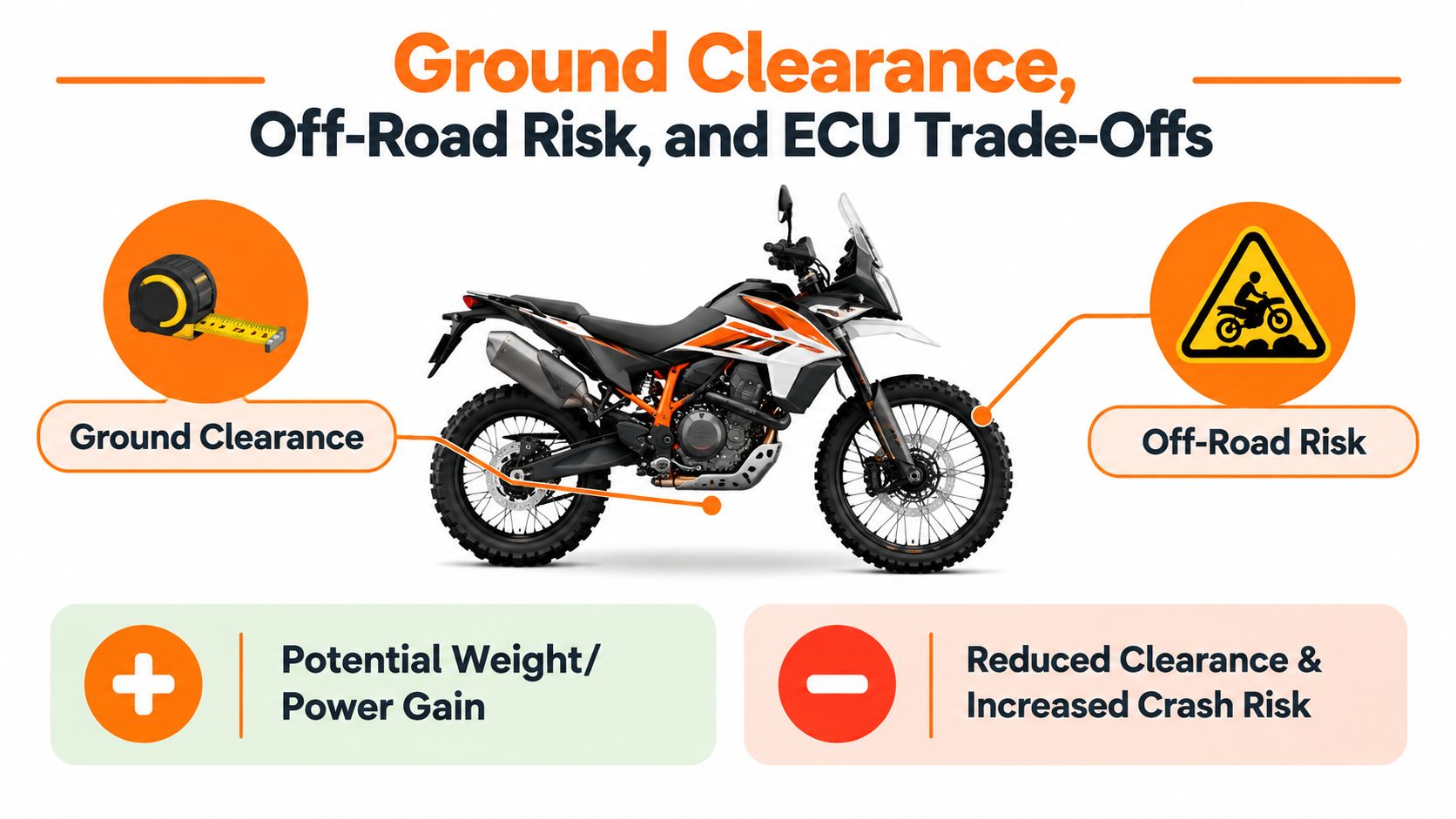
Fueling is the other compromise
The factory ECU calibration matches the original exhaust, catalyst, oxygen-sensor arrangement, and emissions hardware. As noted earlier, the stock engine produces 75 Nm at 7,250 rpm. The relevant question here is whether the replacement preserves the conditions under which that calibration works properly.
A catalyst-retaining, homologated slip-on normally creates a smaller fueling issue. A decatted system, modified insert, or open race setup can alter exhaust flow enough to cause hesitation, uneven pickup, or excessive heat. Do not solve that with an oxygen-sensor plug. Check the fueling with proper measurement and use a correction module or remap only when the hardware change requires it. This motorcycle fuel-tuning guide explains the relationship between exhaust changes and fueling.
The street-legal choice is usually the catalyst-retaining system. It protects emissions compliance and keeps the bike easier to live with, while a decatted full system trades those advantages for a change that may be modest outside controlled testing.
Off-road rule: Choose the exhaust that survives the route, not the one that wins the parking-lot sound test.
Before buying, inspect:
- Silencer height: Is it above the likely impact zone?
- Outer projection: Could a right-side drop crush the can or bracket?
- Link-pipe shape: Does it clear the skid plate and crash bars?
- Heat exposure: Does the routing direct heat toward luggage or the rider?
- Fueling requirement: Does the supplier specify a remap or correction module?
A tune can improve drivability, but it cannot fix poor routing or restore road approval after emissions hardware has been removed.
How to Verify Compatibility Before You Buy
Treat an online listing as unverified until the physical fitment details are clear. “Honda adventure bike” is not enough. You need a system listed for the XL750 Transalp, with the correct production application and emissions configuration.
Use this checklist:
- Match the model application. Confirm the listing names the XL750 Transalp rather than the XL700, Africa Twin, or another Honda twin. Check the stated model years and ask whether the lambda-sensor position is unchanged for your motorcycle.
- Verify the approval mark. Ask for a photograph of the E-mark on the silencer and compare its approval number with the supplied certificate. A generic certificate from another model doesn't prove compatibility.
- Inspect the mounting hardware. Confirm whether the kit uses the original rubber hanger or includes a replacement bracket, spacer, or bush. A hole that looks close enough can still place stress on the frame or silencer.
- Confirm oxygen-sensor provisions. The sensor should have a proper threaded boss and enough cable clearance. Don't unplug it casually, because an incorrect installation can trigger a fault indication.
- Measure the actual weight. Ask whether the quoted saving compares the complete fitted system with the original complete system, or only the aftermarket can with an isolated factory component.
Also check the supplied heat shield, passenger-footrest clearance, pannier compatibility, and skid-plate access. These details decide whether the installation remains practical after the first trip.
Purchase rule: Get the fitment guarantee and homologation statement in writing before paying. Verbal reassurance won't help when a bracket, certificate, or sensor boss is missing.
A proper seller should be able to identify the exact application, supplied parts, catalyst arrangement, and road configuration. If the answers are vague, choose another system.
Choosing the Right Setup for How You Ride
There isn't one universally correct exhaust for the Transalp. The right choice depends on whether your bike spends its life in traffic, loaded on motorways, on gravel, or away from public roads.
Daily commuter
Choose an E-marked slip-on, retain the catalyst, and keep the dB-killer installed. You'll get a more purposeful tone and may reduce rearward mass without making every journey louder than necessary. The compliance paperwork matters more than a race-style outlet.
Long-distance tourer
A durable, catalyst-retaining system is the sensible starting point. If you choose a full system, verify its approval status, luggage clearance, heat management, and fueling requirements before fitting it. The practical benefit comes from a lighter rear end and a cleaner midrange response under load, not from chasing maximum volume.
Weekend adventure rider
Prioritize routing and impact resistance. Compare the silencer and link pipe against the skid plate, crash bars, pannier frames, and likely drop points. A higher design may protect the muffler, but it can expose the header or move heat toward luggage, so inspect the whole system rather than judging the can alone.
Performance enthusiast
A race-only full system can make sense for private-road or track use when you're prepared to remap the ECU and accept that the motorcycle may no longer be legal for public roads. This is the only profile where catalyst deletion is remotely logical, and even then, the fueling plan should come before the exhaust purchase.
Sixrace offers model-specific exhaust listings and motorcycle parts across brands such as HP Corse and Evotech, which gives Transalp owners a practical place to compare dedicated applications. Visit Sixrace to check the XL750 fitment details, approval configuration, and supplied components before choosing a scarico Transalp 750 for your riding routine.
 Italiano
 Deutsch
 Français
 Español
 English
 Polski