
If a silencer bolts on, sounds deeper, and weighs less, does that automatically make it a better exhaust for road use? For a Scarico HP Corse Transalp 750, the honest answer is no. Fitment is only the first gate. The catalyst arrangement, dB-killer, approval marking, model year, and market decide whether that same part is a legal upgrade or an expensive problem. I would judge this purchase as a chain, not a single product. One weak link, such as a removed catalyst or a certificate for the wrong year, breaks the whole setup.
Table of Contents
- Which HP Corse Exhaust Fits Your Transalp
- Homologation and Catalyst Rules Before You Buy
- High-Mount and Low-Mount SP-2 Short Compared
- Three Riding Scenarios and the Right Setup
- What the Claimed Gains Mean
- How to Check Fitment, Catalyst and Ride Behaviour
- Confirm Fit, Approval and Price Before You Buy
Which HP Corse Exhaust Fits Your Transalp
The HP Corse SP-2 Short is built for the 2023 to 2026 Honda XL750 Transalp, not for older V-twin Transalp models. That's the direct answer. If your bike isn't an XL750 from that range, don't try to make the nameplate do the compatibility work.
Honda introduced the original Transalp publicly in 1986, and the line evolved through 583 cc, 647 cc, and 680 cc V-twin versions before returning as the XL750 in 2023, according to the Honda Transalp history and specifications. The modern motorcycle uses a liquid-cooled, eight-valve, 755 cc parallel-twin engine with an 87 mm bore, 63.5 mm stroke, and 270-degree crank configuration. Those details matter because the exhaust ports, collector layout, mounting points, and pulse timing have nothing in common with the earlier V-twin bikes.
The Three Identifiers That Matter
Use three checks before you look at finish or sound. First, confirm XL750 on your registration document. Second, confirm the model year is 2023 onward. Third, confirm your engine is the parallel twin, not a V-twin.
The generic word Transalp isn't enough. Sellers, used listings, and forum posts often shorten names, and that shorthand creates ordering mistakes. A search result for Scarico HP Corse Transalp 750 should lead you to a specific part for a specific generation, not to anything that carried the Transalp badge over several decades.
| Transalp generation | Engine | HP Corse SP-2 fitment |
|---|---|---|
| XL600V (583 cc generation) | 583 cc V-twin | Not compatible |
| XL650V (647 cc generation) | 647 cc V-twin | Not compatible |
| XL700V (680 cc generation) | 680 cc V-twin | Not compatible |
| XL750 Transalp, 2023-2026 | 755 cc liquid-cooled parallel twin | Designed for this model range |
Some listings show 2023 to 2025 while others show 2023 to 2026. Don't guess from the page title alone. Your registration document gives you the bike's identity, and the chosen variant's part number tells you whether HP Corse intends that exact silencer for your year.
Practical rule: Match model, year, and engine layout before you compare price, finish, or sound clips.
If those three identifiers don't line up, stop there. A discounted silencer for the wrong generation isn't a bargain. It's a return, a resale problem, or worse, a part someone tries to adapt with brackets and link pipes that were never approved for the bike.
Homologation and Catalyst Rules Before You Buy
A homologated silencer is approved as one configuration, for one motorcycle, in one market, with its catalyst and dB-killer installed as supplied. Change that package and you may no longer own the approved product you paid for, even if the muffler still bolts on.
Honda's European documentation sets the factory baseline. The Honda XL750 Transalp European press information lists a WMTC CO2 figure of approximately 103 g/km, measured noise of 79.4 dB under the relevant wide-open-throttle test and 75 dB for the urban test, while market-specific specifications can list a 95 dB stationary sound limit. Those figures come from different test conditions. Approval for one market, or one catalyst arrangement, does not carry over to another.
What Changes the Legal Status
Removing or bypassing the catalytic element can raise emissions and can void the approval marking, even when the muffler physically fits. The same applies if you remove a dB-killer that formed part of the certified setup. The silencer body can stay identical while its legal status does not.
A louder or freer-flowing silencer is not a performance gain on its own if it deletes emissions hardware or leaves the certified configuration. The parallel twin was calibrated around the original header, catalyst and lambda strategy. A homologated slip-on that keeps that hardware stays closer to those conditions. A de-catalysed full system moves further from the factory emissions calibration and needs its own certificate for the complete system. Without that document, I would not treat it as a road choice.
| Configuration | Road use in the EU | What to verify |
|---|---|---|
| Homologated slip-on with original catalyst and dB-killer | Designed for road approval | Approval marking, part number and model year match |
| Slip-on with catalyst removed | Usually not road legal | Not recommended for road use |
| Catalyst or dB-killer removed or bypassed | Likely invalidates approval | Certificate no longer applies |
| Full system with different header | Only if a certificate covers the complete system | Certificate must cover the complete system |
Check the approval before you pay. A sound clip will not answer an inspection or a resale question.
- Find the approval marking: Look for it on the product and check that it corresponds to the part you're buying.
- Match the part number: Confirm it against your XL750 model year and intended market.
- Check the supplied configuration: Verify that the catalyst and dB-killer are present and installed as approved.
- Keep the certificate: Store the documentation with the bike for inspection or a future buyer.
The marking and the certificate must show the same part number, the same model and the catalyst and dB-killer in the installed position. For how European type-approval treats that chain, read the guide to motorcycle exhaust approval in Europe.
High-Mount and Low-Mount SP-2 Short Compared
Which SP-2 Short suits your Transalp depends on where the pipe sits relative to your riding, luggage and heat-protection needs. The high-mount and low-mount versions have different configurations, so don't assume specifications for one apply to the other.
HP Corse lists the high-mount version with a 300 mm oval titanium-sleeved muffler, a 0.8 mm titanium wall and an AISI 304 stainless-steel link pipe with a three-dimensional pipe guard in its Transalp XL 750 product information. The manufacturer claims a 1.5 kg reduction compared with the original exhaust. Treat this as a manufacturer figure, not an independent measurement.
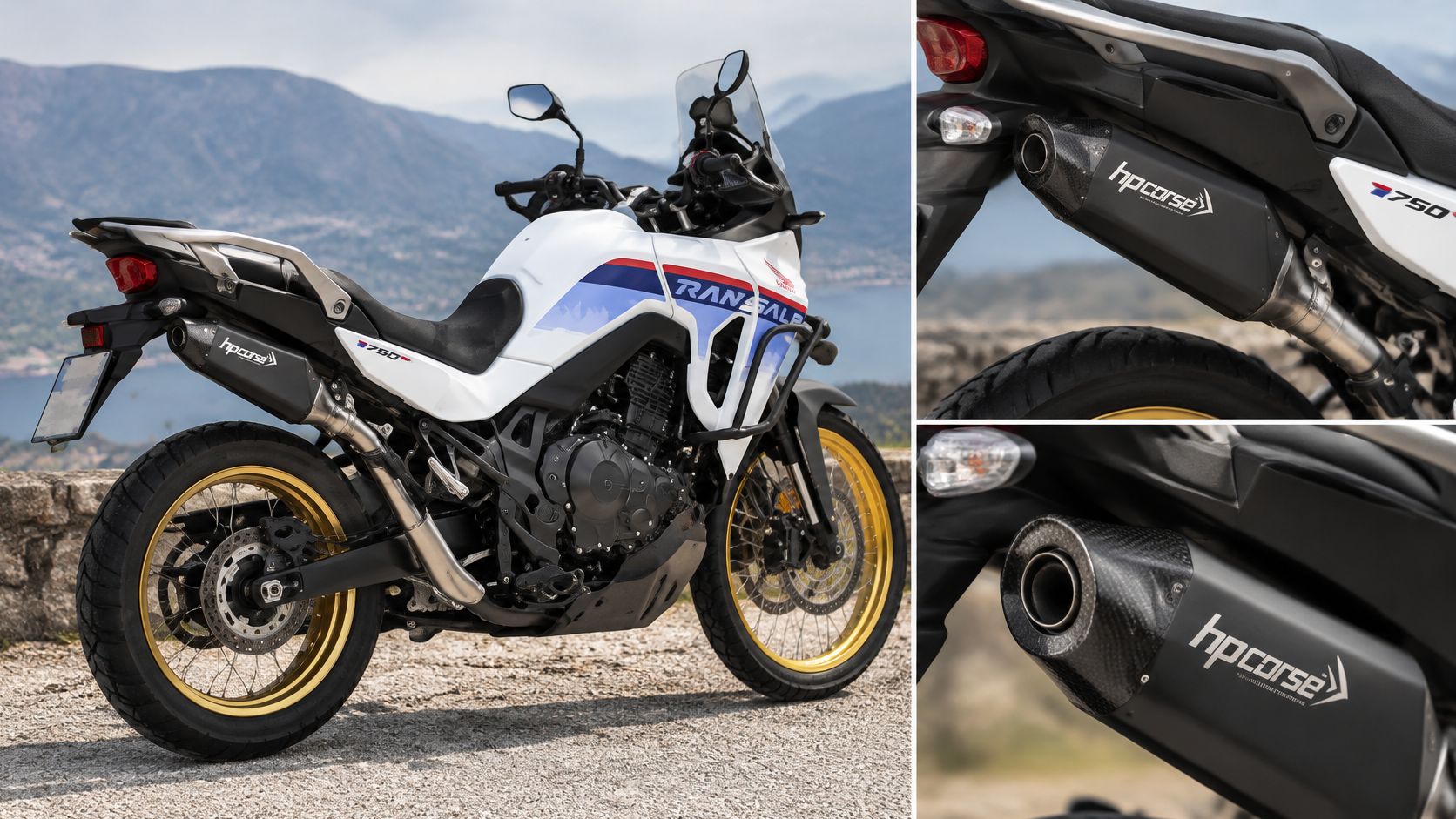
Verified High-Mount Construction
| Feature | High-mount |
|---|---|
| Muffler | 300 mm oval, titanium-sleeved |
| Wall thickness | 0.8 mm titanium |
| Link pipe | AISI 304 stainless steel |
| Heat protection | Three-dimensional pipe guard |
| Claimed weight saving | 1.5 kg versus original (manufacturer claim) |
The low-mount version has its own construction details. Check the HP Corse low-mount product page for the listed configuration and model-year compatibility; don't carry over the high-mount dimensions, pipe guard or weight claim.
The catalog names one option SP-2 SHORT BLACK TITANIUM Honda XL750 TRANSALP 2023+ HP CORSE. Compare that exact name with the listing and confirm the fitment details for your motorcycle before ordering.
For rough-ground use, the high-mount position may put the pipe farther from some impacts, but the three-dimensional guard is the specific protection listed by HP Corse. On tarmac, compare the two layouts for heat shielding, pannier clearance and access for cleaning. Choose based on your bike's setup and riding conditions, not appearance alone.
Three Riding Scenarios and the Right Setup
A weekday start on a quiet residential street asks for a different exhaust than a border crossing or a gravel loop. The rider who parks outside an office and covers the same city route every morning does not need the loudest slip-on on the shelf. The right setup is a quiet, road-approved unit that leaves the original catalyst and the supplied dB-killer in place.
Manageable noise with a still-certified layout is what that commute requires. A change of tone is fine. Chasing volume by removing parts that formed the approved configuration is not. The pipe may sound freer, yet the flow change is not a performance gain once the certified hardware is gone.
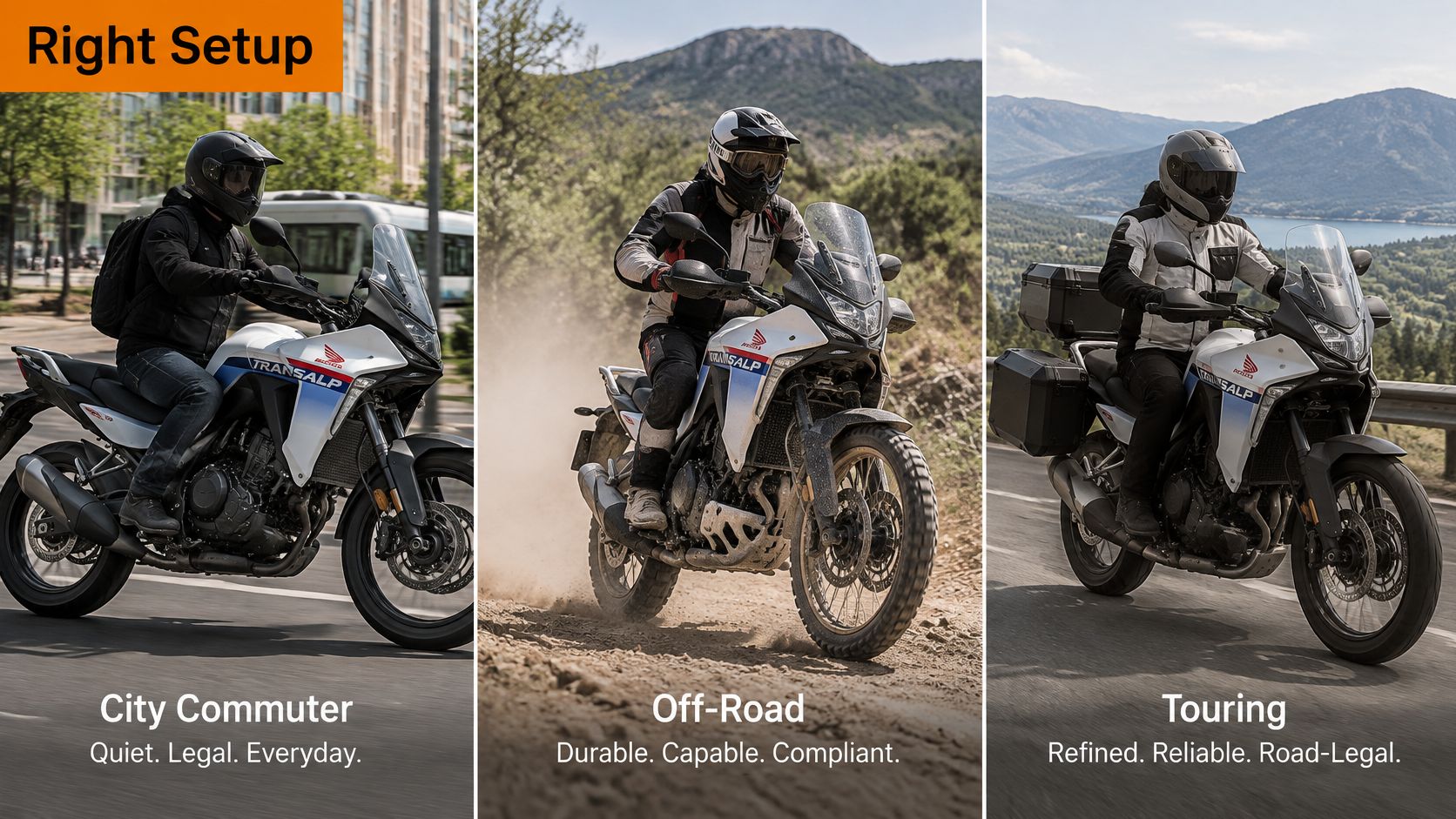
The Touring Rider Crossing Borders
Friday evening, panniers loaded, and several EU countries between home and the Sunday turnaround. A roadside officer will not assess the exhaust by listening to a seller's video. The check can turn on a marking and on whether the parts fitted match the approved layout.
Approval has to describe the bike as it stands, not the bike as it left the workshop. Pull the dB-killer for one mountain road and the original approval no longer covers that installation. I would leave the killer in for the whole trip. A louder note on a single pass is a poor exchange for a configuration you can no longer call certified, and it still is not measured power.
The Off-Road and Closed-Circuit Rider
Hours on rough tracks and closed-circuit days put stones, boots, and low-speed drops in the normal risk list. Ground clearance and pipe protection then matter more than a neat low line, so the high-mount layout fits that use.
Use decides the configuration. A race setup without a catalyst can belong on a closed course. It does not become acceptable for the ride home because it felt stronger away from public roads. If the exhaust is not approved as installed, it stays off the street. Stripping emissions hardware ends the certified configuration. It does not turn the silencer into a proven gain.
The same XL750 can serve all three riders and still need three answers. Daily usability, a layout that survives a border check, and a clear line between circuit and road are different jobs. Match the variant to the riding you do.
What the Claimed Gains Mean
HP Corse lists +1.4 hp, +1.5 Nm, and a 1.5 kg weight reduction for the high-mount SP-2 Short in its product information for the Transalp 750 exhaust. These are claimed gains, not a guarantee of the same result on every motorcycle. Against the stock engine's output, the power increase is modest: useful context, but not a transformation. Fuel load, luggage, wind, and tyre condition can make small changes difficult to distinguish on the road.
The Honda XL750 Transalp specifications give output as 67.5 kW at 9,500 rpm and 75 Nm at 7,250 rpm. That is roughly 90.5 hp, making the claimed 1.4 hp increase about 1.5 percent.
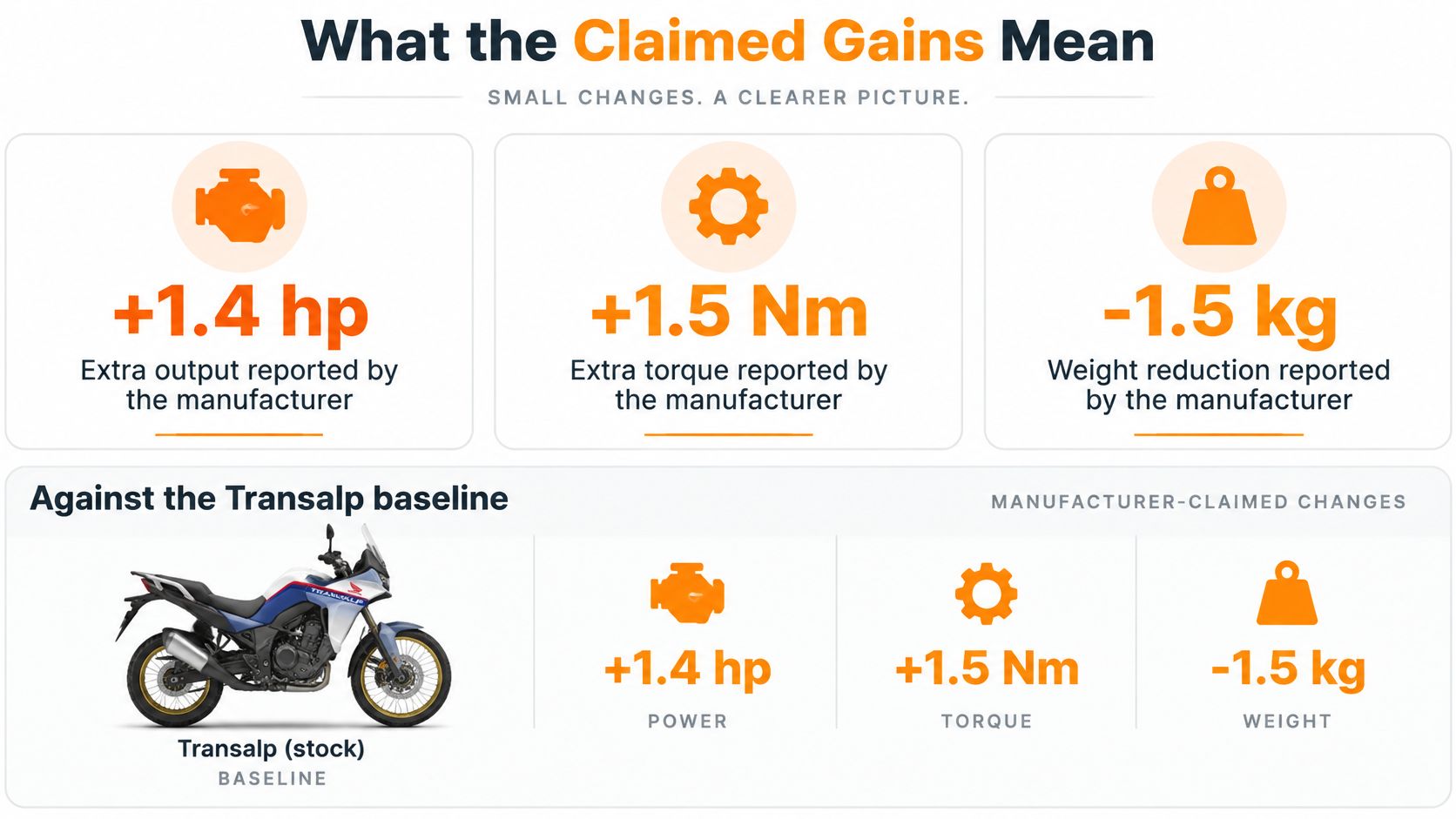
| Measure | Baseline | Claimed change |
|---|---|---|
| Power | 90.5 hp (67.5 kW at 9,500 rpm) | +1.4 hp, about 1.5 percent |
| Torque | 75 Nm at 7,250 rpm | +1.5 Nm, about 2 percent |
| Weight | Original exhaust | -1.5 kg (high-mount version) |
With the 270-degree crank configuration described earlier, the exhaust's collector volume, silencer length, and outlet restriction can affect pulse scavenging, low-rpm response, and sound. Peak power is only one part of the riding experience. A freer-flowing terminal may sharpen response at higher revs, while excessive reduction in restriction can weaken low-speed response. More noise alone does not mean more usable power.
A terminal change and a complete system change are not equivalent. Altering the catalyst or other emissions hardware can affect fueling and the certified configuration, so a claimed output gain must be considered alongside the parts retained and the approval documents. A motorcycle dyno tuning process explained for riders can help clarify what a before-and-after comparison measures.
Judge the sound at the midrange you will use on ordinary rides, as well as at full throttle. The approved configuration matters: a satisfying exhaust note does not establish that the motorcycle still meets its certified limits.
How to Check Fitment, Catalyst and Ride Behaviour
Check the parts before you remove anything from the bike. Most installation trouble starts with a part number that nearly matches, a bracket forced into place, or a joint leak nobody notices until the first ride. Work in order and stop when something doesn't align.
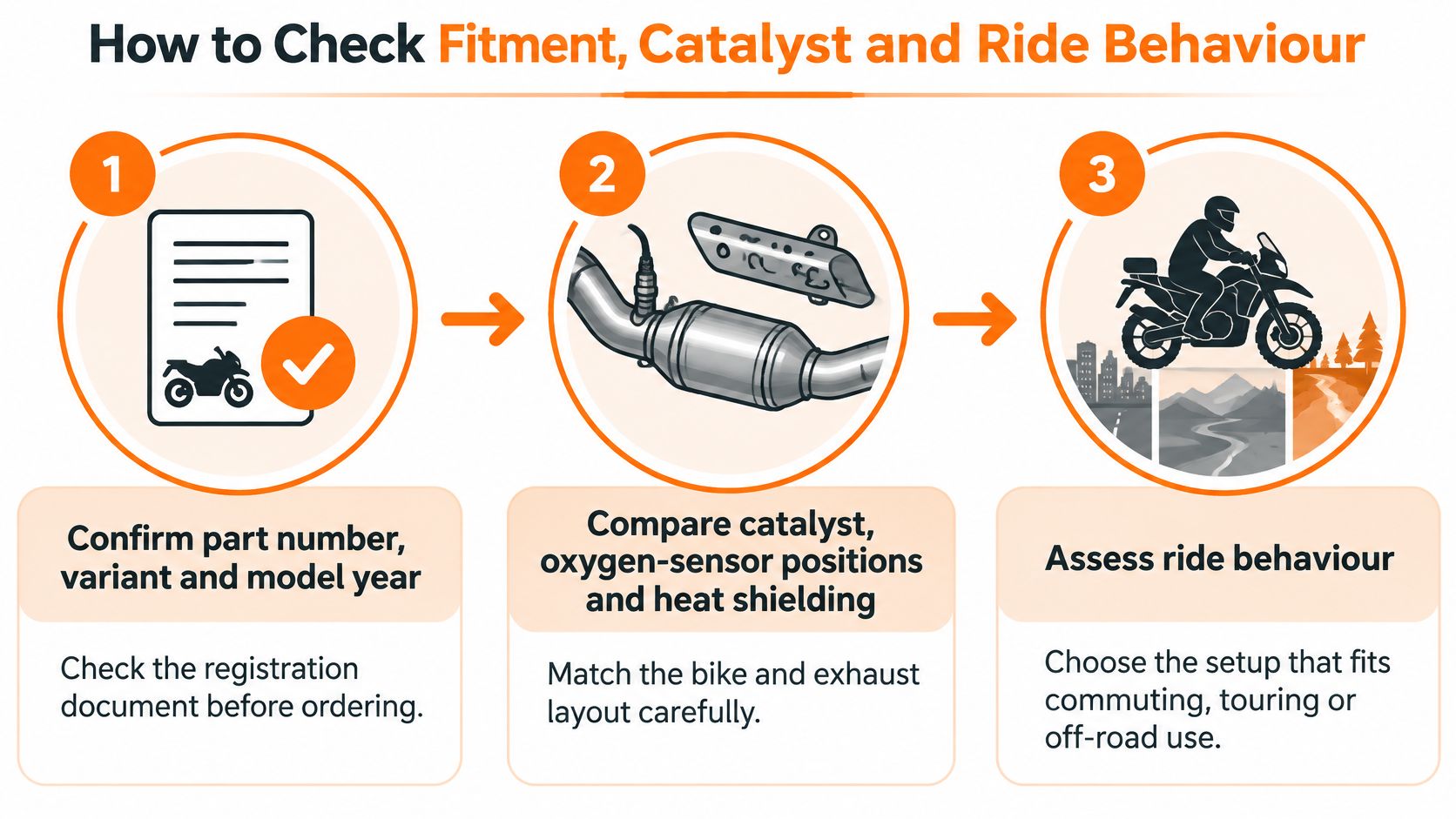
Confirm part number, variant, and model year: Check them against the registration document before you open the packaging. A mismatched part number is the most frequent avoidable mistake, and the notes on why motorcycle year model matters for parts fitment explain why close model years still can't be treated as identical.
Compare catalyst, sensor positions, and shielding: Lay the new parts beside the original layout and confirm what stays, what changes, and where each oxygen sensor sits. Don't remove heat shielding just because the new pipe looks cleaner without it.
Offer up the link pipe and muffler: Check clearance to the frame, footrests, crash bars, swingarm, and any panniers through the suspension's normal movement. HP Corse states that no modification is required for installation, so brackets that need forcing are a warning sign.
Assembly and First Ride
Tighten mounts and inspect every joint: Start the engine and check the gasket joints for leaks while the system is still accessible. A leak near a sensor can distort readings and make a healthy setup look like a fueling problem.
Confirm the dB-killer and paperwork: Make sure the dB-killer is installed for road use and put the approval documents with the bike. This step is part of the installation, not administration you can postpone.
Take a short midrange ride: Use steady part-throttle openings and normal overtaking revs. Watch for hesitation, surging, a warning light, unusual popping, or a sudden change in idle behaviour.
A healthy first ride feels ordinary in the best sense: clean pickup, stable idle, no warning light, no exhaust smell from a leaking joint, and no new vibration from a stressed mount.
If the bike hesitates or shows a warning light, stop and inspect the basics before riding further. Recheck joint sealing, sensor connectors, bracket tension, and clearance. If those checks don't explain the behaviour, get diagnostics read rather than adding an arbitrary fueling change.
Confirm Fit, Approval and Price Before You Buy
Buy only when model year, variant, and approval all match your bike. I would make these three checks in order, because each one catches a different kind of mistake. Skipping to price first is how riders end up with the right silencer for somebody else's motorcycle.
First, confirm the XL750 model year on the registration document. That's the fitment gate. Second, match the high-mount or low-mount variant to its exact part number on the product page. Third, confirm the homologation marking and certificate for your intended market, with the catalyst and dB-killer supplied and installed as approved.
- Model year confirmed: Your document says XL750 and the year falls within the variant's stated range.
- Variant confirmed: The part number matches the mount, finish, and configuration you intend to use.
- Approval confirmed: The marking and certificate describe the exhaust exactly as it will be installed.
For price context, the HP Corse SP-2 Short High Titanium product listing gives a consumer price of €756.00 including tax in its 2026 product listing. An independent retailer's SP-2 Short Titanium listing shows $980.00 in its 2026 listing. Don't compare those figures directly without accounting for seller, currency, tax treatment, and whether they're the same variant.
Sixrace lists HP Corse SP-2 Short Titanium variants for the Transalp, so compare the variant description on the product page against the three checks before adding one to the basket. Sixrace accepts payment with Scalapay, PayPal and advance bank transfer (Bonifico bancario anticipato). After purchase, keep the approval paperwork with the bike. That's the final step that turns a correct order into a usable road setup.
Check the SP-2 Short variant, part number, and stated XL750 model years carefully, then choose the approved configuration that matches how and where you ride. You'll find HP Corse exhausts and model-specific motorcycle parts at Sixrace, where you can compare the product details against your registration document before you order.
 Italiano
 Deutsch
 Français
 Español
 English
 Polski