
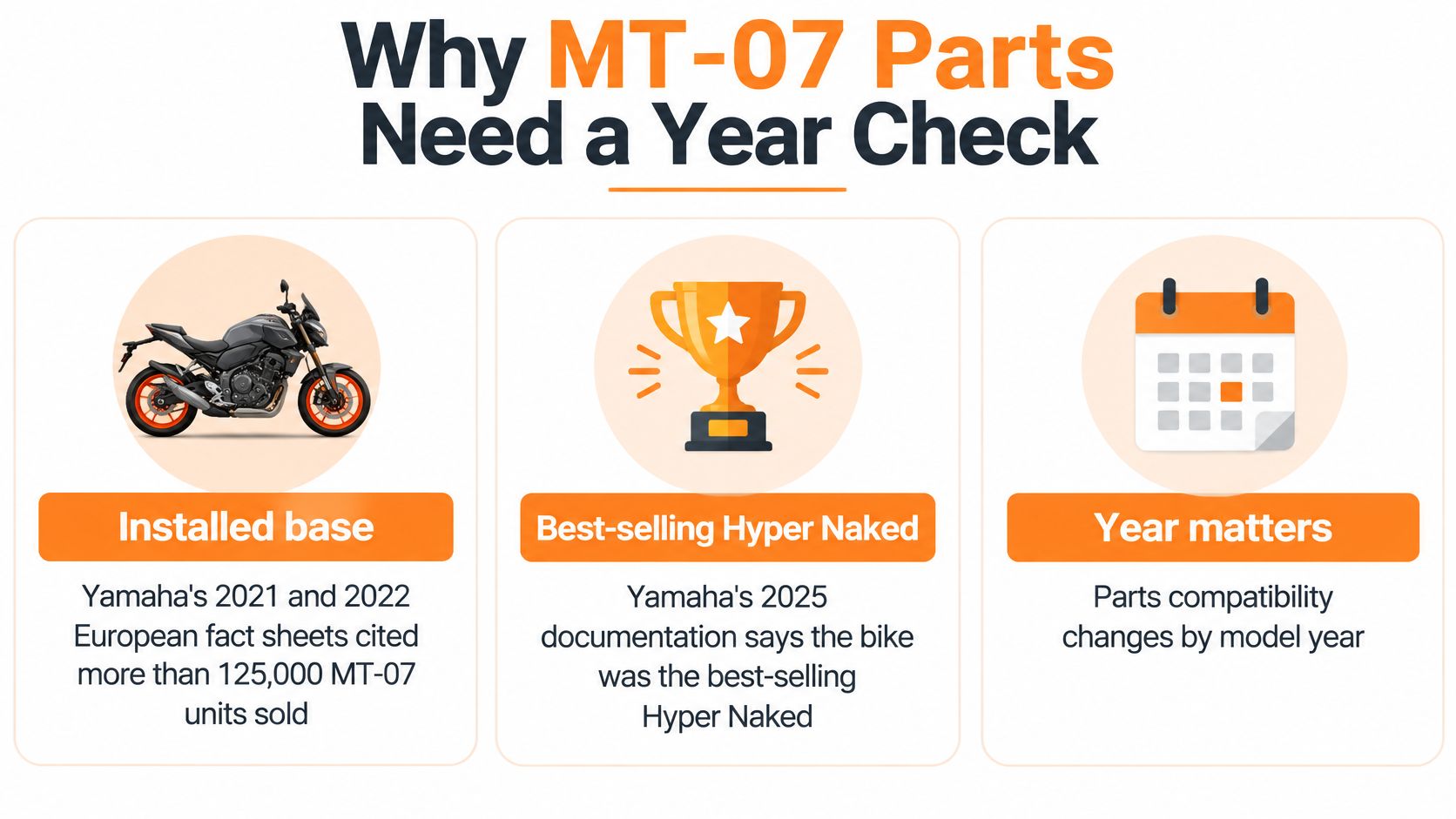
Yamaha's European MT-07 fact sheet reported more than 125,000 MT-07 units sold, a substantial installed base for replacement parts and accessories. That explains why you'll find so many listings, but it doesn't mean those parts fit every version.
Table of Contents
- Why MT-07 Parts Need a Year Check
- Wear Parts by Category and Model Year
- How to Read Codes for the CP2 Engine
- Fork and Brake Changes That Break Fitment
- OEM Versus Aftermarket for Common Jobs
- Road Legal Exhausts Versus Track Only Pipes
- Confirm the Year Then Order from Sixrace
Why MT-07 Parts Need a Year Check
Yamaha sold more than 125,000 MT-07s in Europe, so listings cover many versions of the bike. A shared model name and familiar appearance still do not guarantee a match: a replacement lever may miss the brake-light switch, while a radiator guard may not line up with the mounts.
The MT-07 has kept its liquid-cooled DOHC twin, manual gearbox and chain final drive across successive versions. Equipment around them has changed, so bodywork, electronics, brakes, suspension and exhaust parts need their own fitment checks.
A motorcycle can resemble a later version and still have different mounting points, controls or braking equipment. Check the specification before ordering.
Identify the motorcycle before the part
Searches for ricambi Yamaha MT-07 bring up everything from service items to race equipment. Start with the motorcycle's identity, then check the replacement part against it. The registration date may differ from the production specification, so use the VIN and manufacturer's model information to identify the bike accurately.
The motorcycle parts compatibility guide explains how to compare a product listing with your motorcycle.
Before shopping, note:
- Model year: Check the production specification, not just the first registration date.
- ABS status: Confirm which braking equipment is fitted.
- Fork type: Identify whether the bike has conventional or inverted forks.
Keep the details nearby while comparing listings. This gives you a clear basis for checking whether the part matches your bike.
Wear Parts by Category and Model Year
MT-07 parts families and the year check
| Family | Typical parts | Replace when | Year check |
|---|---|---|---|
| Drivetrain | Chain, sprockets, carrier and nuts | Tight spots or hooked teeth | Chain drive across the platform; confirm pitch and tooth count |
| Protection | Radiator guard, engine covers, axle sliders, lever guards | Drop, gravel strike or scraped slider | Radiator and body shape by generation |
| Controls | Brake and clutch levers, bar ends, oil cap | Bent lever or worn perch | Clutch type and switch layout by year |
| Exhaust | Slip-on, full system, catalyst | Failed silencer, weight or sound goal | Header, catalyst and approval by year and market |
| Suspension and brakes | Fork seals, springs, fork oil, pads, discs | Weeping seals, fade or lipped disc | Fork type and disc dimensions against the chassis specification |
Treat these as separate shopping categories. A useful compatibility statement for an oil cap won't tell you whether a brake lever operates the stop-light switch correctly. Likewise, an exhaust mounting photograph can't establish road approval.
Work through a chain-and-sprocket order
Start by inspecting the existing drivetrain. Rotate the rear wheel with the motorcycle securely supported and the engine off, checking for stiff links and changes in chain slack. Inspect sprocket teeth for hooking and uneven wear.
A worn chain and worn sprockets should normally be renewed together. A new chain running over damaged teeth won't restore a healthy drivetrain, and adjustment won't cure seized links.
Before ordering a matched kit, compare:
- Chain specification: Match pitch, width, length and joining method to the application.
- Gearing: Confirm front and rear tooth counts, particularly if a previous owner changed them.
- Mounting hardware: Check carrier compatibility, sprocket offset and whether replacement locking hardware is required.
Don't replace a sound carrier just because you're buying sprockets. Inspect its bearings, mounting surfaces, and cush-drive components, then replace what the job requires.
Separate wear from damage and upgrades
Protection parts usually need attention after an impact rather than at a fixed interval. Remove a damaged slider or guard and inspect the mounting point underneath; a fresh cover can hide a cracked bracket or distorted fastener.
A bent lever also calls for more than a cosmetic swap. Check the perch, pivot, master-cylinder contact and switch operation. An oil cap belongs in the controls-and-small-parts catalogue, but its thread and sealing arrangement matter more than its colour.
This catalogue image illustrates why model names must be read carefully.
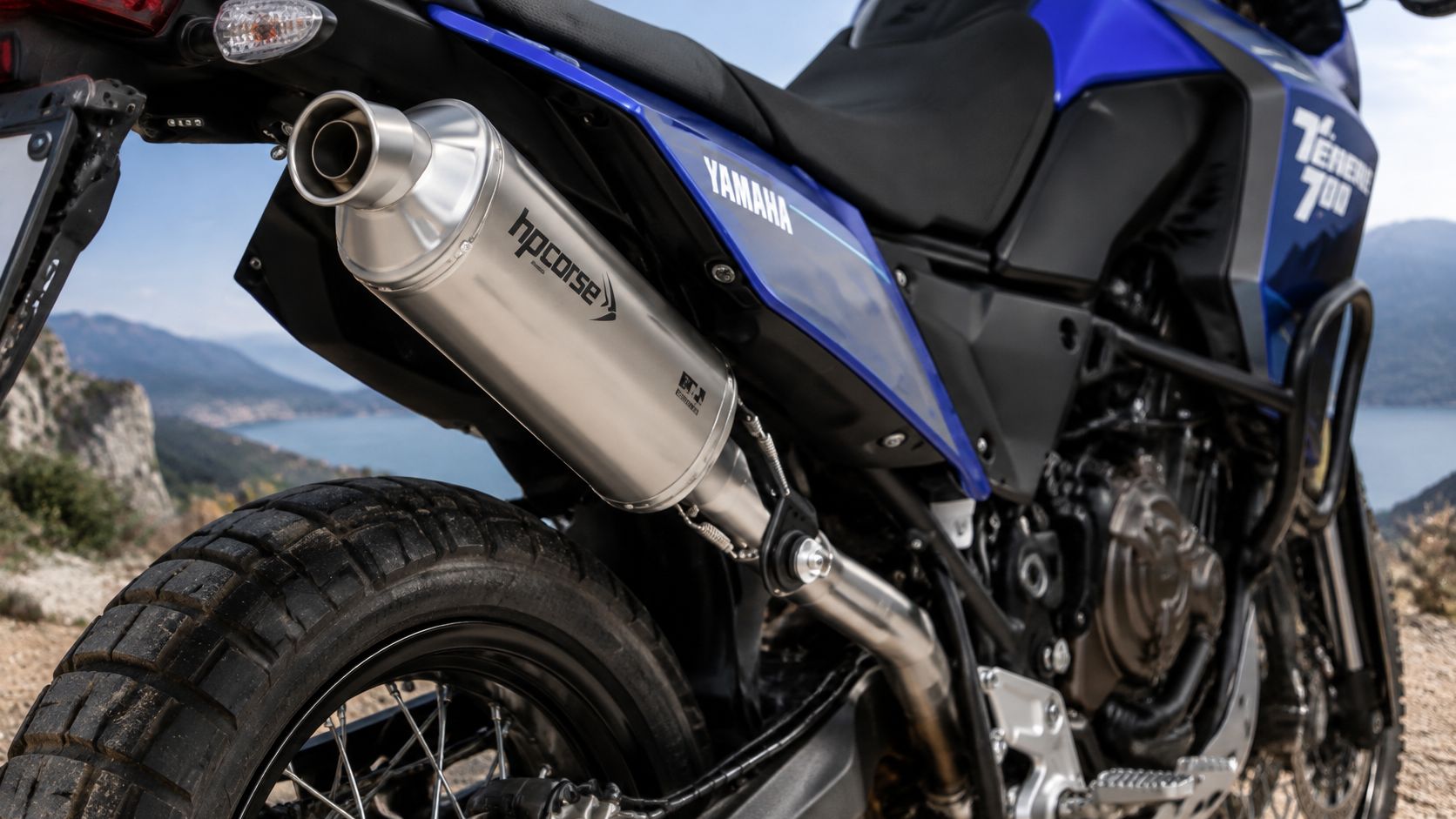
The SP-2 SHORT TITANIUM Yamaha TÉNÉRÉ 700 2019+ HP CORSE is identified for the Ténéré, not the MT-07. A related engine family isn't evidence that its exhaust routing, brackets or approval transfer to your motorcycle.
Choose the parts family first, then record the listing's application details before comparing product codes.
How to Read Codes for the CP2 Engine
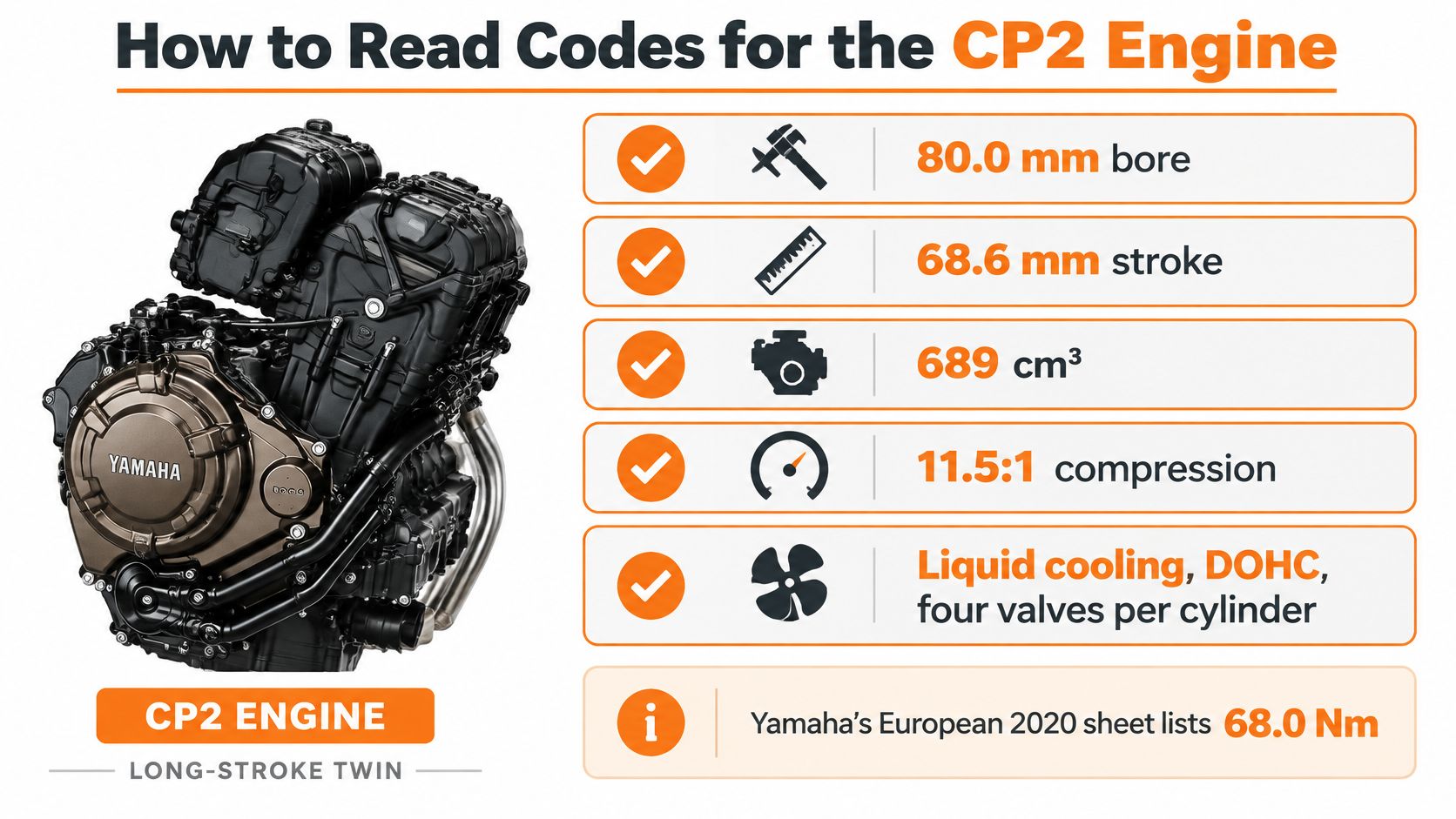
A listing that says “689 cc” identifies the engine's displacement, not the MT-07 model year or every component fitted to it. Yamaha's European 2020 engine specification gives the CP2 a 689 cm³ displacement, an 80.0 mm bore, 68.6 mm stroke and 11.5:1 compression ratio, plus liquid cooling, DOHC and four valves per cylinder. It lists 68.0 Nm at 6,500 rpm and 55.0 kW at 9,000 rpm for that European specification. These figures describe the engine; they do not identify a compatible replacement part.
Read application codes before ordering codes
A product code identifies the item in a catalogue. Its application details establish whether it suits your motorcycle. Check both.
CP2 versions can differ in throttle arrangement and clutch hardware. Earlier specifications use conventional throttle arrangements and a wet multiplate clutch; newer versions may use YCC-T electronic throttle and an assist-and-slipper clutch. An assist-and-slipper assembly can still be a wet multiplate clutch, so match the specific assembly and actuation arrangement rather than relying on the clutch label alone.
Use this sequence:
- Check the VIN and model information. As described in Section 1, use the bike's identifying details to establish its model year, especially if it was imported or registered late.
- Identify the market. Confirm the motorcycle's original homologation market before choosing emissions-related or electronic equipment.
- Confirm the throttle arrangement. Distinguish a cable-operated throttle from YCC-T before selecting throttle-side components.
- Identify the clutch assembly. Match the clutch and actuation hardware before ordering internal parts, cables or levers.
- Compare the application with the product code. A listing that gives displacement alone does not establish a usable model application.
Apply the check to a real purchase
An intake listing may say it fits a 689 cc engine, while the pictured component has a different sensor connector. That difference can point to a mismatch in the sensor, wiring or control arrangement, even if the mounting points line up.
Leave the harness intact. Check the sensor, wiring, control strategy and manufacturer's application before proceeding. An exhaust header also needs the correct application and emissions equipment for the motorcycle's specification, even if it clears the engine.
Workshop rule: Treat a matching bolt pattern as one fitment detail. Confirm the connected components and the motorcycle's application too.
Before buying clutch repair parts, check whether a campaign applies to the motorcycle. Uruguay's Ministry of Economy and Finance reported 31 affected Yamaha motorcycles, including MT-07 units, in a 2025 clutch recall covering vehicles sold from 2022 through 2025. The notice applies to a specific market, so ask the relevant Yamaha representative to check the VIN.
Fork and Brake Changes That Break Fitment
MT-07 chassis split for parts
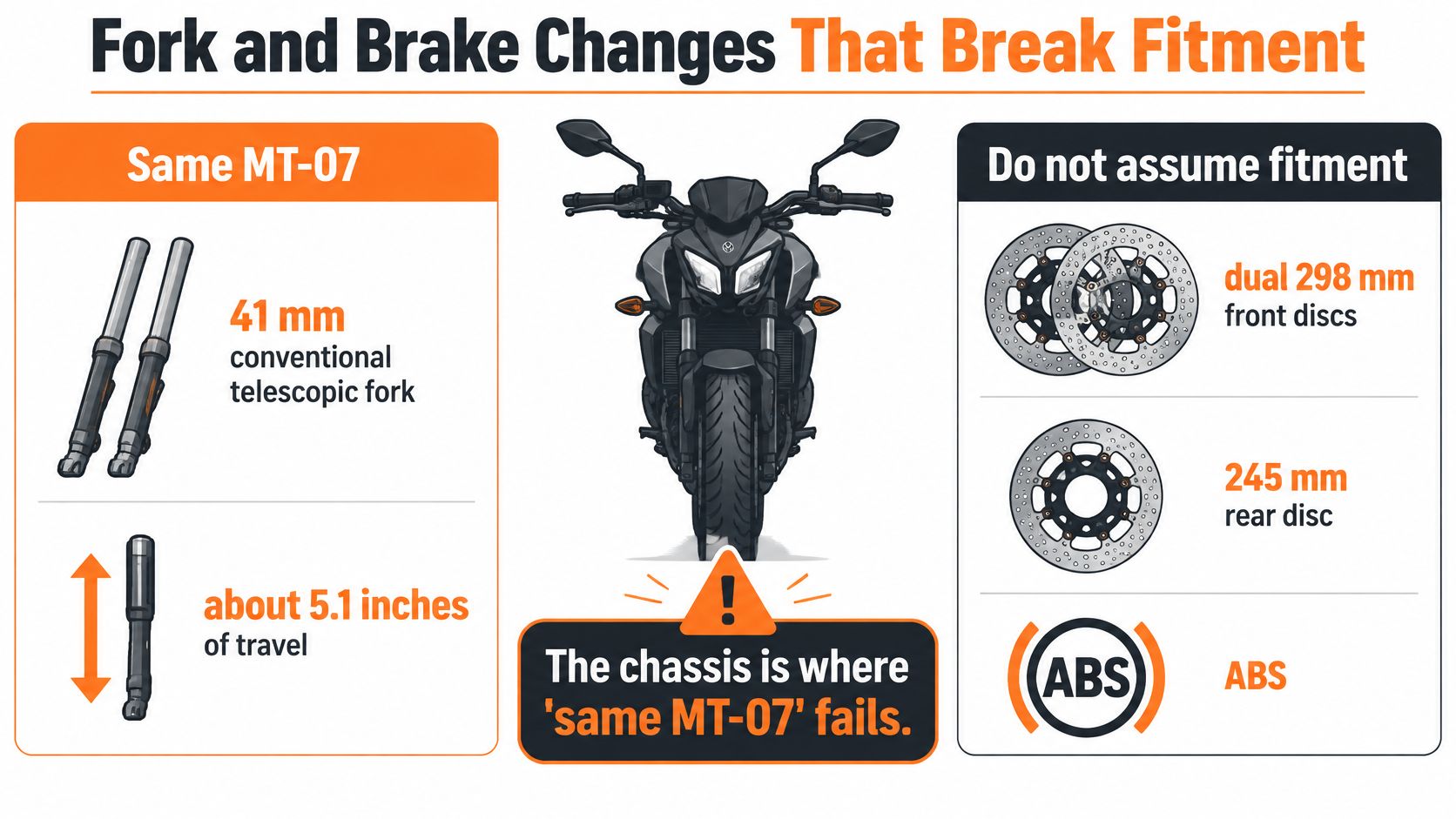
The following comparison uses Yamaha's chassis specifications: the 2024 model has a 41 mm conventional fork, approximately 5.1 inches of travel, dual 298 mm front discs, a 245 mm rear disc, ABS and 120/70ZR17 front and 180/55ZR17 rear tyres, while the 2025 specification changes to a 41 mm KYB inverted fork, retaining approximately the same travel and broad brake-diameter architecture.
| Item | Through 2024 | From 2025 | Parts that may not swap |
|---|---|---|---|
| Front fork | Conventional layout; verify exact earlier application | KYB inverted layout | Seals, springs, cartridges, axle hardware |
| Front brake | Conventional-fork installation; verify earlier disc specification | Confirm disc dimensions and mounting arrangement | Lines, calipers, lever perches |
| Rear brake | Match disc and carrier to the exact year | Confirm disc, carrier and mounting details | Lines and caliper hardware |
| Tyres | Match original size and wheel specification | Confirm approved size and wheel specification | Size alone doesn't establish wheel interchangeability |
| Protection and controls | Guards and levers for that body and control layout | Recheck radiator and handlebar layout | Radiator guards, lever kits, brake-line path |
The earlier column is a catalogue grouping, not a claim that every preceding model used identical brakes. In particular, don't carry a later conventional-fork specification backwards across every production year.
Similar dimensions don't establish interchangeability
A fork's nominal diameter doesn't describe its seal arrangement, cartridge mounting, axle location or caliper interface. Conventional and inverted forks place their components differently, so a seal kit or cartridge must explicitly match the fork assembly.
Brake discs need more than the correct outside diameter. Thickness, offset, bolt pattern and clearance also matter. Brake lines must reach without stretching at full steering lock or suspension extension, and they must remain clear of tyres and moving components.
A radiator guard can occupy the right general space yet miss the mounting brackets or interfere with nearby hoses. Lever kits require equal care because the relevant interface is at the perch and master cylinder, not at the fork leg.
Choose springs and install safely
Give a suspension supplier your riding weight with protective equipment, plus your normal luggage and passenger use. Choose a spring rate for that load, then select damping components to control it. A cartridge can't compensate for an unsuitable spring.
For home servicing:
- Support the motorcycle securely: Use equipment that leaves the component you're removing unloaded and accessible.
- Protect the hydraulic system: Hang removed calipers from a suitable support, never from their hoses.
- Preserve routing: Keep brake hoses and ABS sensor wiring in their specified guides.
- Use the correct manual: Tighten axle and caliper fasteners with a torque wrench and follow the assembly sequence for that model.
Restore a firm brake lever before moving the motorcycle, check for leaks and interference, then bed replacement pads according to their manufacturer's procedure. If you can't verify the assembly or hydraulic condition, have a qualified technician finish the work.
Catalogue entries should separate conventional-fork and inverted-fork applications, with exact years and ABS status stated explicitly.
OEM Versus Aftermarket for Common Jobs
Use OEM for specification-sensitive repairs and aftermarket parts for protection or adjustment. Either choice still needs to match the MT-07's year and version: an incorrect part can fail to fit even when a listing says “MT-07.”
OEM or aftermarket by job
| Job | Prefer | Reason |
|---|---|---|
| Gaskets, filters, clutch or throttle hardware | OEM or exact year match | Sealing, connectors and assembly details must match |
| Chain and sprockets | Matched kit, OEM-pattern or specialist | Pitch, tooth count, length and offset must agree |
| Levers, guards, sliders | Aftermarket specialist | Protection and reach adjustment are the purpose |
| Fork springs and oil | Generation-correct components, rate selected for riding load | Spring support and damping must suit the motorcycle and rider |
| Brake pads | Suitable road compound | Some race compounds need operating temperatures a commuter may not reach |
Where original specification helps
A gasket needs the correct passages and sealing surfaces. A filter needs the right dimensions and sealing interface. Throttle and clutch hardware must match the assembly's mechanical and electrical connections.
An OEM part still needs a VIN-based application check. A part made for the wrong version will not become compatible just because it is original.
The aftermarket versus OEM motorcycle parts guide explains the differences between the two categories.
Where a specialist alternative makes sense
Adjustable levers can change reach, while dedicated guards and sliders protect exposed components. Check the installation instructions before buying. They should identify any replacement fasteners or spacers and explain whether existing accessories need to be removed.
For sprockets, match the components to the chain and mounting arrangement. Steel is a practical option for routine road use; an aluminium rear sprocket offers a different balance of weight and service life.
For brake pads, read the manufacturer's road application and match the compound to your riding. Organic and sintered compounds have different characteristics, so check the product's stated use rather than relying on its name.
Two sensible combinations
A rider replacing a worn chain and bent lever could pair an OEM-pattern drivetrain kit with a correctly specified aftermarket lever. Once fitted, the lever should return freely, operate the switch and allow the brake or clutch to work throughout its adjustment range.
A full exhaust and an ECU-related component need to be specified as a combination for the motorcycle's market and version. Individually suitable parts may not work together as a package supported by their manufacturers.
Treat “MT-07” as a starting point, not a complete fitment description. If a listing omits the year or version, ask for confirmation before ordering.
Road Legal Exhausts Versus Track Only Pipes
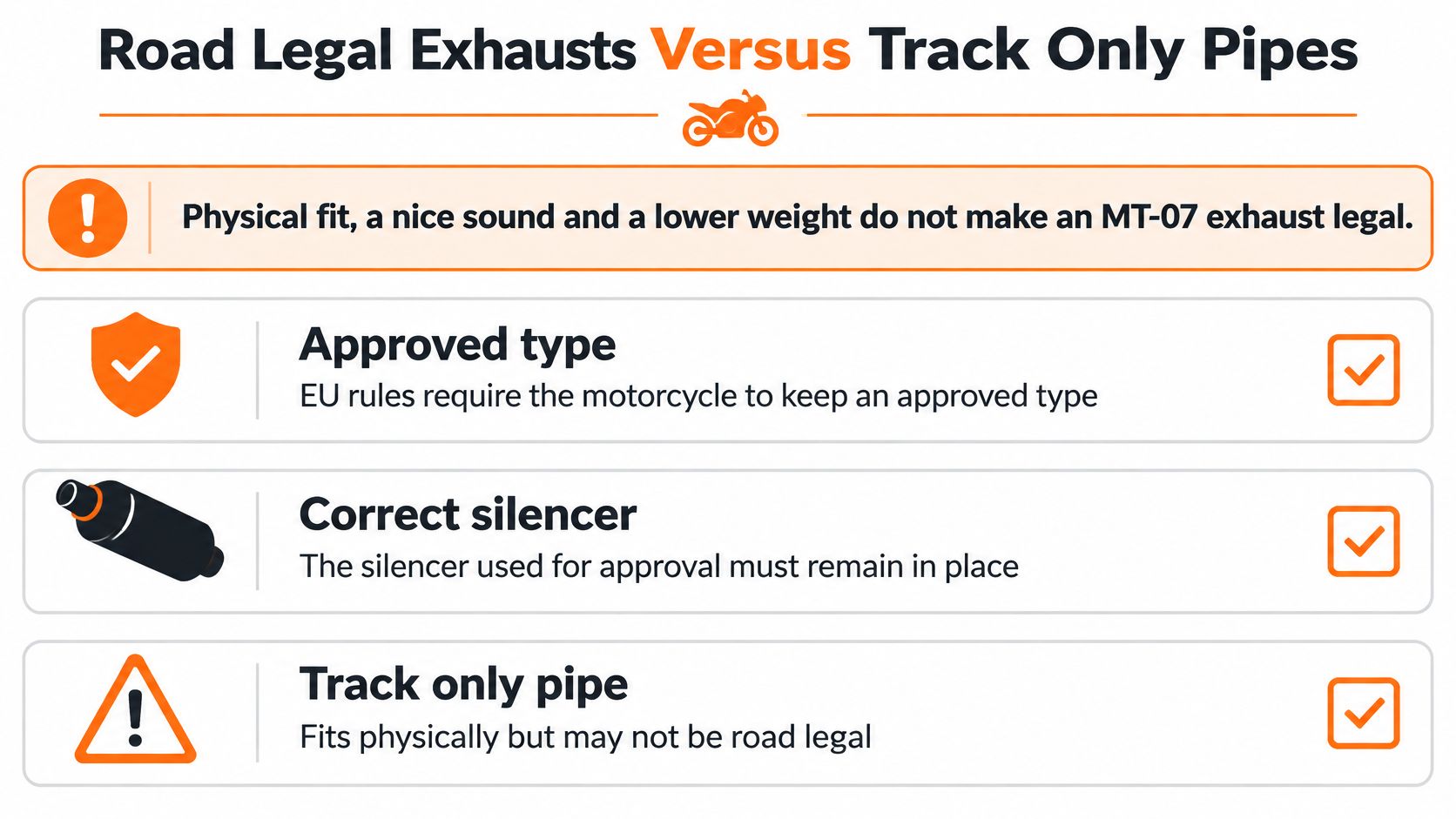
Road-legal in the EU, physically fits and track-only are different descriptions. Physical fit, a pleasant sound and reduced weight don't establish legal approval. An exhaust can bolt on perfectly and still be unsuitable for public roads.
The UNECE exhaust approval text published on EUR-Lex addresses approved replacement silencers within the type-approval framework, with Regulation No. 92 applying to aftermarket silencers and No. 41 to original motorcycles. The practical issue is whether the particular system preserves the motorcycle's approved configuration, not whether the seller describes it as a road exhaust.
Check documents before sound clips
Ask for the approval certificate and installation instructions before buying. Compare the certificate with the actual component and the complete proposed installation.
- Exact application: The approval must cover your motorcycle's relevant type and generation, not merely a Yamaha twin with similar engine architecture.
- Component marking: Find the E-mark or approval identifier and compare it with the paperwork. A generic statement on a product page isn't a substitute.
- Catalyst configuration: Establish whether the approved installation retains the original catalyst or requires a specified replacement.
- Sound-control hardware: Leave the approved inserts and other required components in place. Removing hardware required by the approval changes the approved configuration.
- Header arrangement: Confirm which headers the certificate covers. Approval for a silencer used with original headers doesn't automatically extend to a different full system.
Don't assume a removable insert is optional for road use. Removability describes construction; the certificate establishes the configuration in which the component was approved.
Understand what the product label promises
A physically compatible exhaust has the necessary routing and mounting arrangement. That statement alone says nothing about noise or emissions approval.
A road-approved replacement needs the applicable documentation and specified installation. A slip-on may qualify when used with the correct original equipment, but you must check what remains on the motorcycle.
A track-only system should be treated as unsuitable for public-road use unless separate applicable approval establishes otherwise. Removing a catalyst from a configuration that requires it doesn't become acceptable because the silencer carries an approval mark.
The guide to motorcycle exhaust approval in Europe offers a practical reference when comparing product descriptions and certificates.
Keep the approval paperwork with the motorcycle's documents and retain the installation instructions. Before purchasing a used exhaust, ask for photographs of its markings and confirm that its catalyst, inserts, brackets and connecting sections are present. Missing approval hardware can turn an apparently inexpensive purchase into an unusable road installation.
Confirm the Year Then Order from Sixrace
Once you have confirmed the bike's specifications in the earlier fitment checks, use them to assess each listing. A search result for the MT-07 alone does not establish compatibility.
Turn the specification into a safe order
Start by matching the product to the job: a repair may need only a replacement part, while an upgrade can require additional hardware. Record the exact product code and its stated application so you can distinguish the part from other versions by the same manufacturer.
Read the package contents before ordering. Check whether seals, brackets, spacers or replacement fasteners are included, and ask the seller for written compatibility confirmation if the listing leaves a detail unclear.
For drivetrain parts, check the chain and sprockets as one gearing combination. For controls, compare the installation drawing with the actual perch and switch arrangement. For an exhaust, keep the certificate with the order details.
Only a stated application counts as compatibility evidence. Save a copy of that description and compare the replacement's interfaces, mounting points and supplied hardware with the original before installation. If they differ, stop. Do not drill, bend or trim a safety-critical part to make it fit.
If the listing omits the applicable year range or road-or-track status, wait for the seller to clarify before ordering.
Sixrace offers motorcycle parts and accessories across protection, controls, drivetrain and exhaust categories. Visit Sixrace with your motorcycle's specification, then compare product codes, application details and approval information before choosing a replacement.
 Italiano
 Deutsch
 Français
 Español
 English
 Polski