
You've found a radiator guard that looks right, checked the photos twice, and ordered it for your Triumph. Then you open the box in the garage and discover that its brackets don't line up with the bike. The part may be well made, but that doesn't make it right for your exact model.
Searching for ricambi moto Triumph can bring up listings that look interchangeable at first glance. The reliable way to shop is to identify the motorcycle precisely, then check each part against its model, year, variant and, when needed, VIN.
Table of Contents
- Why Triumph Parts Depend on Exact Model and Year
- The Main Triumph Part Categories Explained
- Reading Part Codes and Using Your VIN
- Choosing Between OEM and Aftermarket Parts
- Real Fitment Examples from Street Triple and Bonneville T100
- Recalls, Legality and Safe Buying Checks
- Your Next Step Before Ordering Triumph Parts
Why Triumph Parts Depend on Exact Model and Year
Triumph has a 122-year production history. The company says its first production motorcycle went on sale in April 1902, and its timeline describes an early “No. 1” machine powered by a Belgian-made Minerva engine. Over the decades, Triumph's bikes have changed across engine families, chassis designs and regional specifications. That history is useful context when you're looking for Triumph motorcycle parts by model and year.
Think of the model range as a family tree. Two bikes can share a familiar name but sit on different branches. A radiator guard, lever or exhaust bracket designed for one branch may not attach correctly to another, even if the bikes look similar in a product photo.
The practical fitment details are the exact model, engine displacement, production year and sometimes market version. Market-specific equipment can affect parts such as exhausts, sensors or lighting, while changes within a model's production run can mean that a component fits only certain versions.
Triumph's production scale also changed dramatically over time. Annual output reached 1,000 motorcycles before the company moved to a larger Coventry site; the later factory covered approximately 500,000 square feet, employed more than 3,000 people and reached an annual output of 30,000 motorcycles. The 1959 T120 Bonneville 650 was another milestone, described by Triumph as destined to become the highest-selling British twin of all time. These shifts mean that “Triumph parts” isn't one uniform product line.
The aim is simple: confirm the branch before buying. You'll have a clearer way to sort parts by purpose, verify fitment from the motorcycle itself, compare OEM and aftermarket choices, and separate routine replacement from recall or legal issues. That small check can save you the frustration of a part that almost fits.
The Main Triumph Part Categories Explained
Start by naming the job the part needs to do. A product category helps you find the right kind of component, but it doesn't prove that it fits your bike.
- Protection: Radiator guards, engine covers and fork-end protectors shield exposed components from road debris or damage in a tip-over. A lever guard can act like a bumper on a car door: it helps protect a lever from contact, but its mounting point still has to match the handlebar and model.
- Controls: Brake and clutch levers, handlebar weights and oil caps are parts you touch or use during routine checks. Shape and mounting details matter. A lever that looks close may have a different pivot or switch contact.
- Drivetrain: Sprockets, sprocket carriers and their fasteners transmit engine power to the rear wheel. Check the exact motorcycle and listed fitment rather than assuming parts are interchangeable because the bikes share a name.
- Exhaust: Silencers and exhaust systems connect to the bike's engine and chassis, and can involve sensors, catalytic equipment and road-use requirements. A product listing should identify the model and applicable year range clearly. For example, the HP CORSE HYDROFORM SATIN Triumph Street Triple 675 exhaust is listed for the Street Triple 675, 2007–2012.
- Suspension: Fork and shock components, along with suspension fluids, help the suspension move as intended. Confirm the application before choosing a part or fluid.
- Maintenance consumables: Filters, fluids, brake components and chain-drive items need replacement as they wear or reach their service interval. Use the motorcycle's manual and the correct model information to guide the choice.
Triumph reported 134,635 motorcycles sold worldwide in 2024, the first year above 100,000 sales in the company's history, according to Motorcycle.com's report on Triumph's sales record. That global customer base includes different model families and versions, so riders may be searching for the same category of item while needing different actual parts.
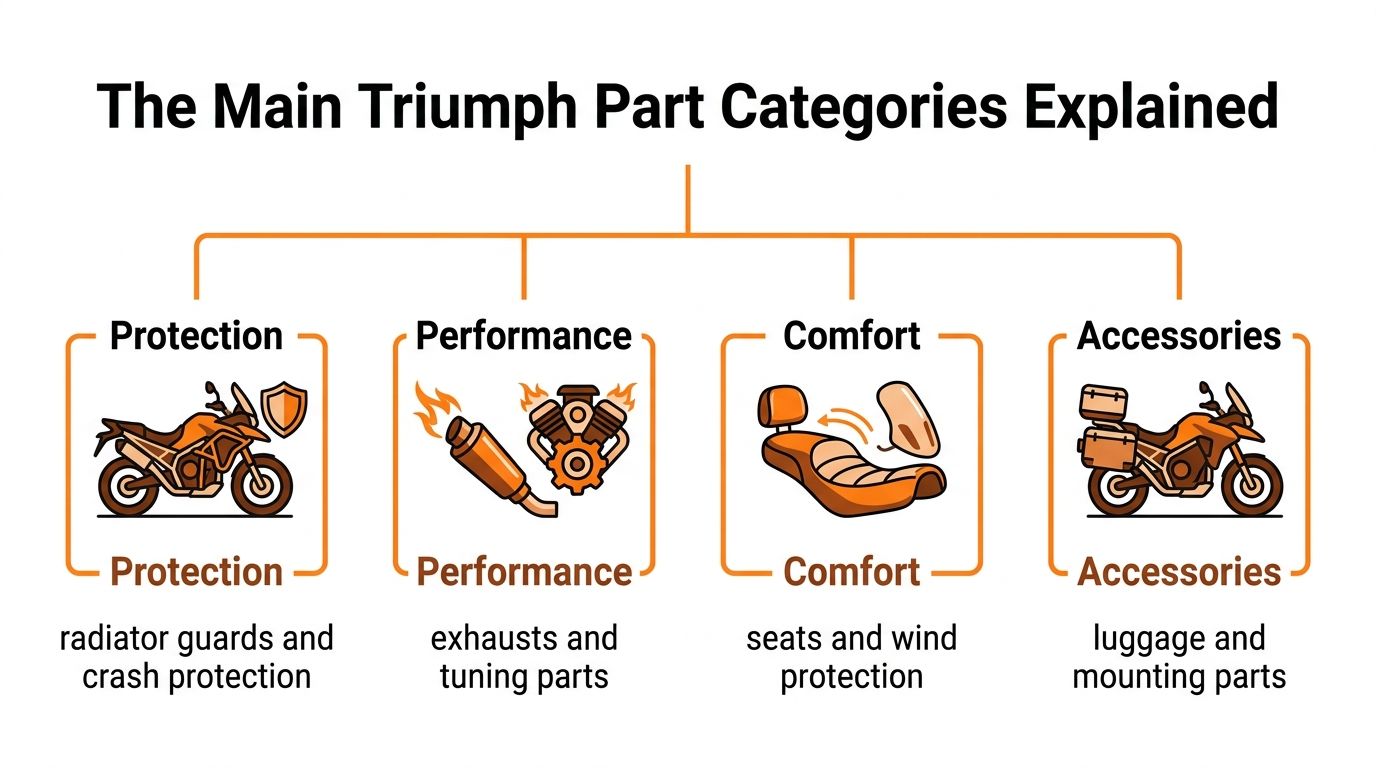
A useful catalogue needs both levels of information: what the part does, and which exact motorcycle it fits. Category alone is a starting point, not a fitment check.
Reading Part Codes and Using Your VIN
A model name is a useful clue, but it may not be enough to identify the right component. Triumph's official parts finder directs owners to use the VIN found on the handbook or the motorcycle's chassis plate. Use that vehicle-specific reference when a listing's model name or year range leaves room for doubt.
The VIN helps connect your motorcycle to its specific production details. A catalogue may group bikes under a shared name, while production changes or market versions create differences within that group. That's why a table showing a familiar model and year range can still be too broad to settle a close fitment question.
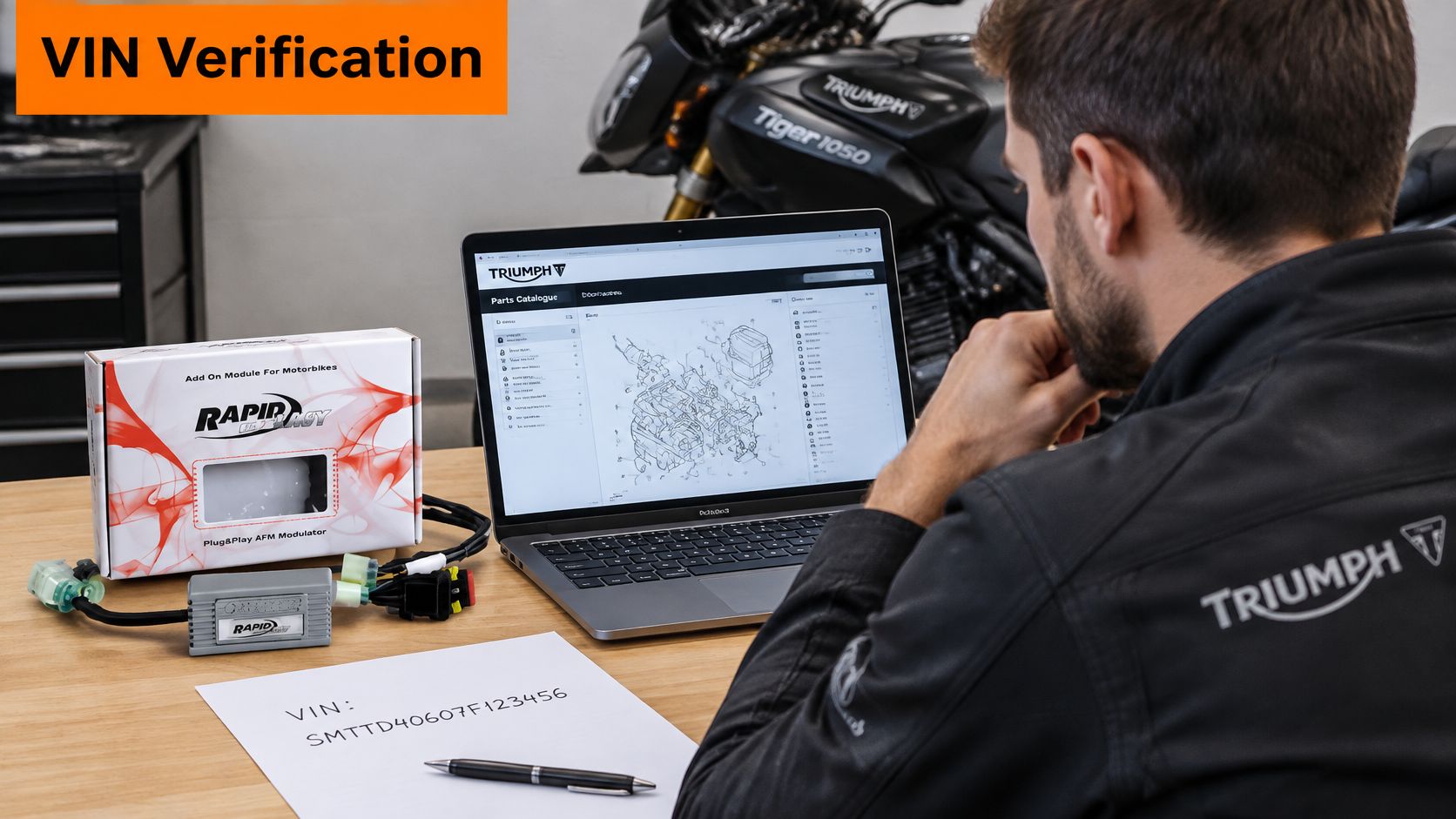
A practical three-step check
- Find the VIN. Check the handbook or chassis plate, as Triumph's parts finder advises. Keep the number to hand when checking a part or asking a seller for help.
- Match the listing to the bike. Compare the product's stated model, year range and variant with your motorcycle. Don't treat the engine size or model family alone as proof of fit.
- Read the notes carefully. Look for exclusions, variant details, market limitations or instructions to confirm the VIN with the seller or manufacturer.
A product code can help, but first determine what kind of code you're reading. A manufacturer's part number identifies a specific component in that manufacturer's parts system. An independent supplier's reference may identify its own product, sometimes listing several compatible motorcycles together. Neither type of code replaces the fitment details.
Pay particular attention to VIN ranges, production changes and superseded part numbers. A superseded number may point to a replacement part, but you still need to confirm that the newer component applies to your motorcycle. If a seller's table and the VIN appear to disagree, pause before ordering and ask for confirmation rather than choosing the more convenient answer.
Practical rule: Treat the VIN as the final check, especially for parts that attach to the frame, affect controls or connect to the engine.
Choosing Between OEM and Aftermarket Parts
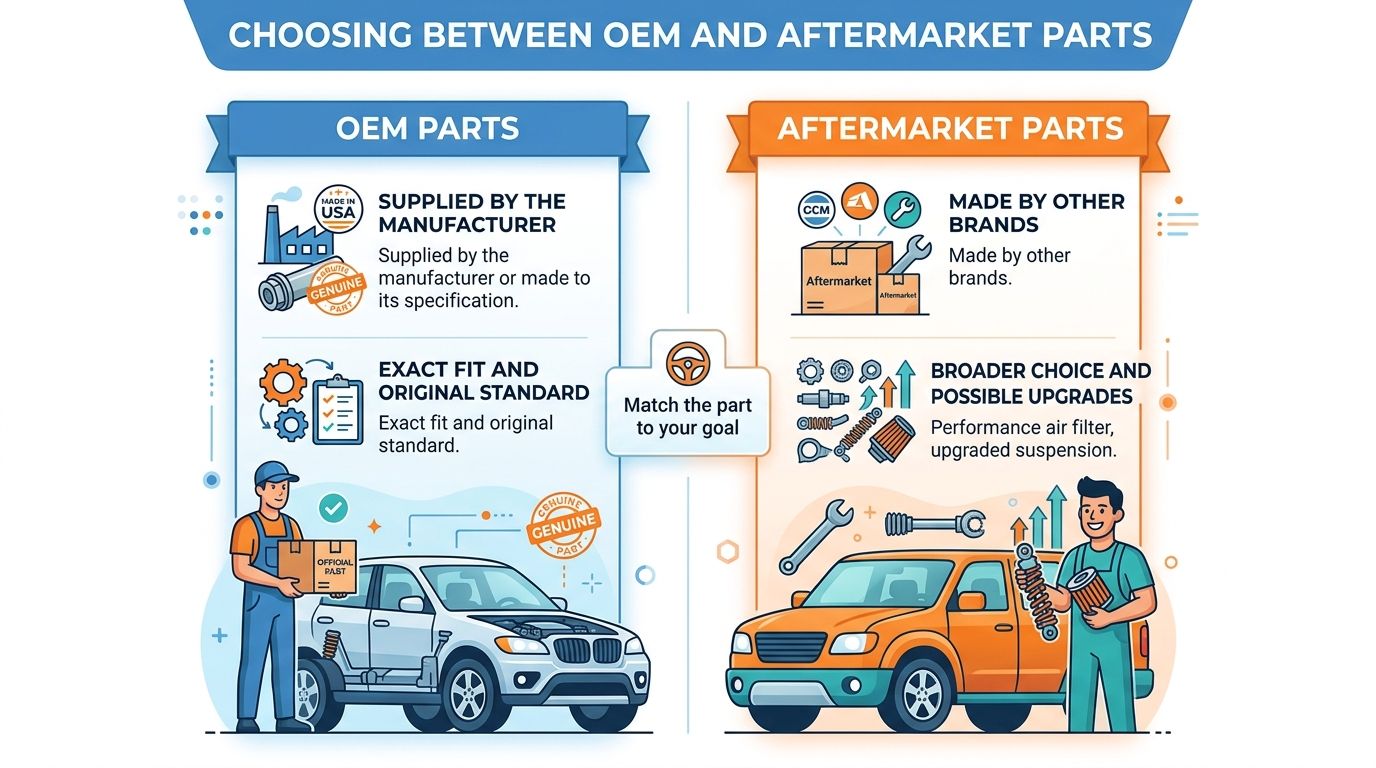
If two parts look alike in a catalogue, that does not make them interchangeable. OEM parts are supplied by the manufacturer or made to its specification. Aftermarket parts come from independent brands. Either type can serve the same purpose, so compare the fitment details, documentation and intended use before deciding.
| What to compare | OEM part | Aftermarket part |
|---|---|---|
| Fitment | Often a direct route when you know the exact original part number. | Check the listed models, years, variants and any VIN-related notes. |
| Documentation | Use the manufacturer's parts information and instructions. | Check for clear fitment details, installation instructions and any applicable certification or homologation markings. |
| Intended use | Suits riders seeking the original specification. | May have a different design or feature. Suitability depends on whether you ride on the road, track or off-road. |
| Cost of a mismatch | A wrong order can still mean returns and workshop time. | A physical fit alone does not confirm the part is suitable for your use. Check compatibility and documentation before ordering. |
A catalogue listing is a starting point, not proof of fit. Even when a part is described for a model family, confirm that the listed variant and VIN range apply to your bike. Choose by checking whether it matches the VIN, has the documentation you need, suits your riding use and avoids an expensive or unsafe mistake.
Protection parts and controls are common aftermarket choices for riders seeking a particular style or design. Consider what the component changes and how you plan to use the motorcycle, rather than choosing by appearance alone.
A part can bolt on and still be unsuitable for public roads if it changes a regulated feature, such as lighting, emissions or noise. Check the product documents and the rules that apply where you ride. Don't infer road legality from physical fit.
For a recall-related or safety-critical defect, follow the manufacturer's remedy instead of substituting an aftermarket workaround. For a broader comparison, read this guide to OEM and aftermarket motorcycle parts, then check the details for each part you plan to order.
Real Fitment Examples from Street Triple and Bonneville T100
Two Triumphs can share a displacement and still need different parts. The Street Triple 765 R and RS both use a 765 cc liquid-cooled, 12-valve DOHC inline-three engine, but the R produces 120 PS at 11,500 rpm and the RS 130 PS at 12,000 rpm. Both make 59 lb-ft of torque at 9,500 rpm, according to Triumph's Street Triple 765 specification. Those figures are a reminder that “765” alone is not a complete fitment description.
For parts affecting engine calibration, intake flow, exhaust restriction, sensors or throttle control, check the exact variant and model year. A listing for a Street Triple 765 may not cover the R, RS and Moto2 Edition equally. The difference is like choosing a key by its general shape: small details determine whether it fits.
A concrete example is this radiator guard for the Street Triple 765 RS 2023. Its description names both the variant and year, rather than relying on a broad “765” label.
Triumph lists the Street Triple's service baseline as 10,000 km or 12 months, whichever comes first. That can help when considering wear-sensitive items such as filters, fluids, brakes, chain-drive parts or suspension consumables. Follow the manual and service guidance for your own motorcycle; a product listing is not a maintenance schedule.
The 2023 Bonneville T100 belongs to a different model family. Its 900 cc liquid-cooled, eight-valve SOHC parallel-twin has a 270-degree crank angle and produces 59 lb-ft at 3,750 rpm, according to Triumph's 2023 Bonneville T100 information. Since its torque arrives at a lower engine speed than the Street Triple's, changes to exhaust back pressure, intake restriction or gearing can affect how it feels in a different part of the rev range.
What a good listing should say
Check that the product page identifies the exact variant, model year and generation. “Bonneville 900” may not specify whether a part suits your T100, including its brackets, sensors or calibration. If the listing leaves that unclear, use the VIN to confirm fitment before ordering.
Recalls, Legality and Safe Buying Checks
A part can fit and still be the wrong response to the problem. Keep three questions separate: is there a recall, is the part safety-critical, and is the aftermarket item legal for road use?
Recall status belongs to the motorcycle, not just its model name. One Triumph rear-turn-signal recall record covered 1,157 motorcycles, with 1,122 remedied by April 2026. That kind of repair status is tracked against affected vehicles, which is why a broad model label can't tell you whether a particular bike needs attention.
A separate example concerns the TF450 recall involving a rocker-arm and exhaust-valve risk in the 2025/2026 period. The prescribed remedy was a free cylinder-head replacement by an authorized dealer, not an aftermarket repair. If a suspected fault may be covered by a recall, contact the dealer and follow the manufacturer's instructions before choosing a replacement component.
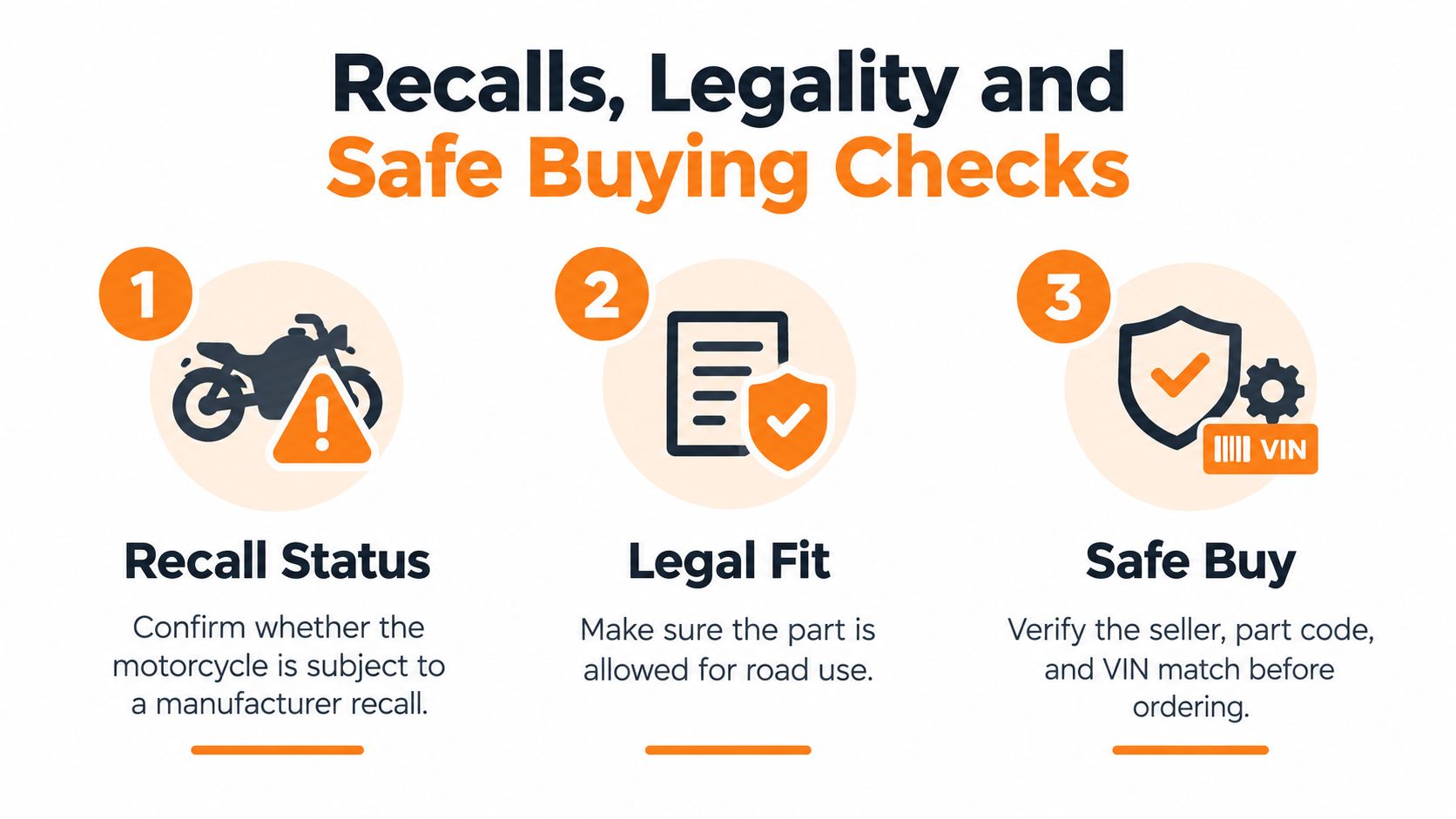
Use this sequence before placing an order:
- Check recall status. Search the official recall database or contact an authorized Triumph dealer with your motorcycle details.
- Use the proper remedy. If the issue is covered by a safety recall, follow the manufacturer's remedy rather than substituting an aftermarket part.
- Confirm road-use status. Check homologation or certification markings, installation instructions and local rules, especially for exhaust and lighting components.
- Verify the fitment. Match the part code and listing to the motorcycle's model, variant, year and VIN.
A guard or accessory can be mechanically compatible yet unsuitable for public roads if it affects lighting, emissions or noise. Treat fitment, safety and legality as separate checks. Passing one doesn't automatically mean the others are satisfied.
Your Next Step Before Ordering Triumph Parts
Before you add anything to the basket, collect the motorcycle's VIN and name the part category you need. Then confirm the model, year and variant, decide whether OEM or aftermarket makes sense for that item, and check recall or road-use status where relevant.
Keep the product listing open while you compare it with the bike. Check the product code, stated compatibility and installation information; when fitting the part, follow the supplied instructions for orientation and hardware. If the listing doesn't answer a safety or fitment question, stop and ask the seller or an authorized dealer before you begin work.
Sixrace's catalogue lists parts with product codes and compatibility information for specific models, including protection, drivetrain and exhaust products. Treat each listing as a candidate to verify, not as a replacement for checking the VIN and the product documentation. If you need help with the fitting or servicing work, motorbike servicing from local tradespeople is another practical resource to consider.
Before ordering: write down the VIN, identify the exact part and variant, compare the product code and fitment notes, and confirm safety and road-use requirements. Then open the catalogue, search for your Triumph model and year, and cross-check one part against the motorcycle before adding it to the basket.
Choose a Triumph part by matching its listed model, year and code to your motorcycle, then confirm fitment against the VIN. Visit Sixrace to browse model-specific motorcycle parts and accessories, and check the listing details before you order.
 Italiano
 Deutsch
 Français
 Español
 English
 Polski