
What you need to know before modifying your air box
The most important fact in any motorcycle air box modification guide is this: under current EU regulations, the air filter and intake noise absorber are classified as components of the silencing system. That classification has direct legal consequences for any modification you make on a road-registered motorcycle.
Here is what that means in practice:
- EU Regulation No. 41 treats the air filter as part of the silencing system when it is necessary for compliance with permissible sound levels. Unauthorised alterations to that system void the motorcycle’s type approval.
- Non-compliance can result in loss of homologation, insurance invalidation, and failed technical inspections across Central Europe.
- Performance gains from air box modifications are real but conditional. The stock air box manages airflow and sensor signals to stabilise ECU fuelling; altering that system without corresponding ECU recalibration causes erratic part-throttle fuel delivery.
- Modifications that work well on a track bike often reduce usable performance on a road machine, particularly in the mid-range where street riding actually happens.
The practical conclusion: any modification beyond a direct-replacement high-flow filter requires professional ECU calibration and, for road use, type-approval verification.
Basic modification options and their real-world impact
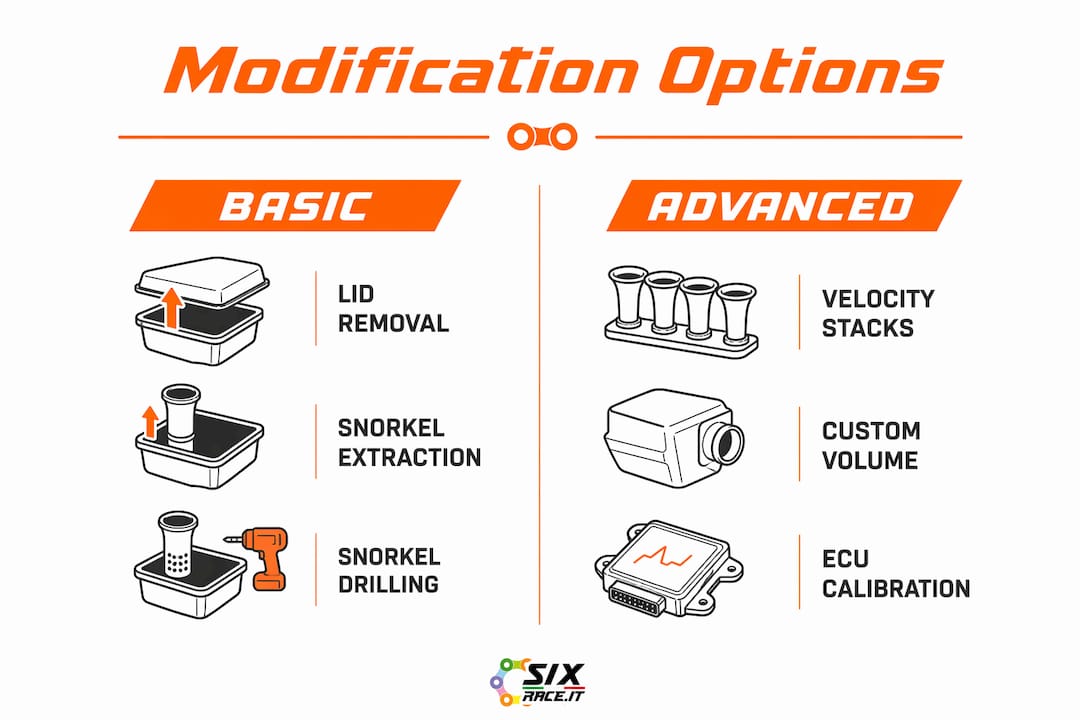
Most riders approach air box tuning through one of three entry-level methods. Each carries a different risk-to-reward profile.
Lid removal or snorkel extraction is the most accessible modification. Pulling the air box lid or removing the intake snorkel increases the volume of air available to the filter. The gains tend to be modest and concentrated at higher revs, while removing the lid without fuel compensation can create a lean condition that may cause surging, popping on deceleration, and long-term engine wear. An ECU reflash or a piggyback fuel controller such as a Power Commander V or Bazzaz unit is the minimum required response.
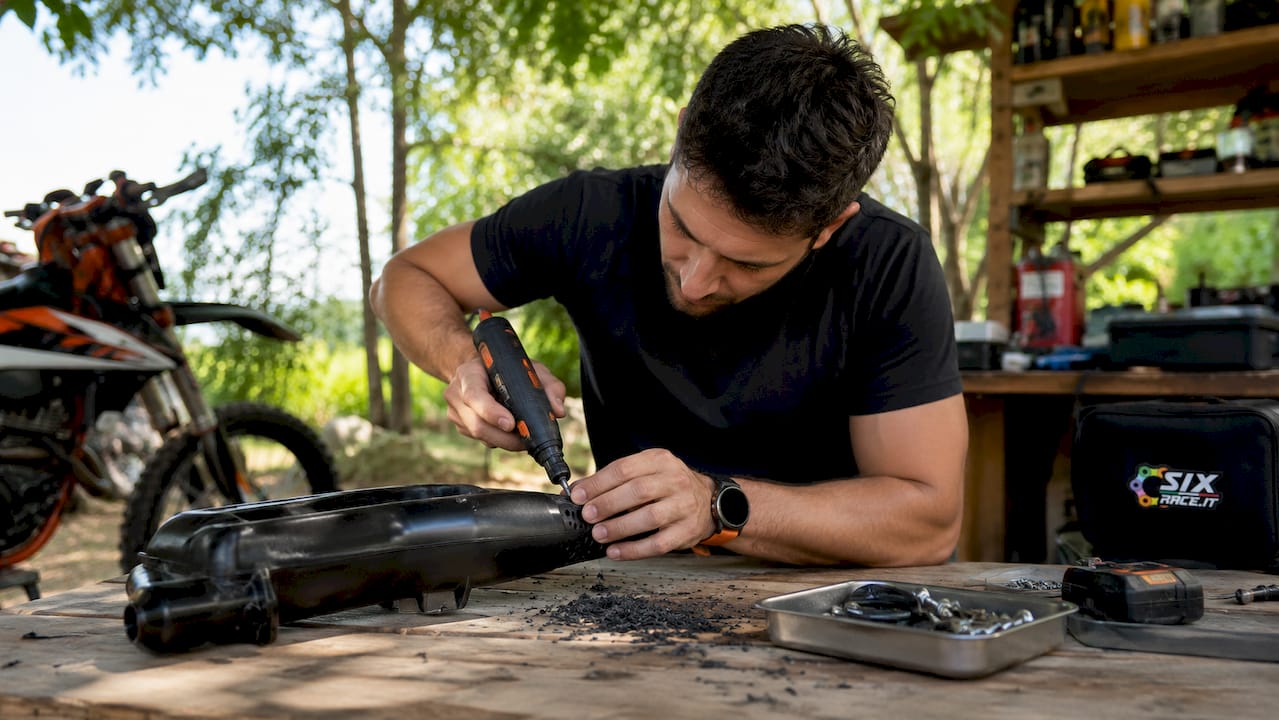
Snorkel drilling or cutting sits between lid removal and full structural modification. Increasing the snorkel cross-section raises the resonant frequency of the air box, which can improve top-end breathing but often reduces low-to-mid-range torque. The Helmholtz resonance principle explains why: the stock air box is tuned as a pressure chamber for a specific RPM band, typically 5,500–7,500 RPM on most road bikes, and altering the geometry shifts that tuning point.
High-flow filter replacement is the safest and most legally defensible option. Stock paper elements trap particles down to around 5 microns while flowing enough air to support rated horsepower with headroom to spare. A quality aftermarket filter from a brand such as Acerbis reduces pressure drop without compromising filtration integrity. For most road riders, this modification alone delivers the best balance of performance, reliability, and legal compliance.
Tools you will need for basic modifications:
- Torx and hex key set for air box fasteners
- Oscillating multi-tool or step drill for snorkel work
- Deburring tool to smooth any cut edges
- Replacement high-flow filter matched to your model and year
Pro Tip: Before cutting anything, remove the snorkel and ride the bike for a short session. On many models, snorkel removal alone produces noticeable low-end improvement. If the fuelling feels unstable, that is your signal that ECU work is required before going further.
EU legal frameworks and homologation: what Central European riders must know
The regulatory position in Central Europe is unambiguous. EU Regulation 2014/540 requires that any modification to the exhaust or silencing system, which includes the intake air filter, be notified to the Type Approval Authority. That authority then decides whether to extend or withdraw approval. For practical purposes, this means any structural air box modification on a road-registered motorcycle requires certification before the bike can legally return to public roads.
The consequences of non-compliance extend beyond a roadside check. Insurance policies in most Central European markets contain clauses that void cover when a vehicle is operated in a condition that differs materially from its type-approved specification. A modified air box that has not been certified falls squarely into that category.
Key compliance points:
- Euro 5 standards, which apply to all new motorcycles sold in the EU from January 2021, tighten both noise and emissions thresholds. Air box modifications that increase intake noise or alter the fuel-air mixture outside certified parameters breach these standards.
- Technical inspections (TÜV in Germany and Austria, STK in the Czech Republic and Slovakia) check for visible modifications to intake and exhaust systems. An uncertified modification will fail the inspection.
- Track-only modifications are legally distinct. Removing the air box entirely is acceptable for closed-circuit use but makes the motorcycle unfit for road registration until the original specification is restored.
Advanced modifications: why ECU calibration is not optional
Velocity stacks and custom air box volumes represent the advanced end of intake modification. Well-designed velocity stacks can significantly improve airflow capacity compared to factory components. However, the performance case collapses without matched ECU work.
Lean running conditions created by untuned intake modifications cause exhaust gas temperatures to rise, accelerating valve seat wear and increasing detonation risk. Skipping professional calibration after advanced modifications turns a performance upgrade into a reliability problem.
What a complete advanced modification requires:
- Fuel map adjustments across high-RPM, high-load cells to correct for increased airflow
- Ignition timing revisions to account for the faster flame front that cleaner airflow produces
- Part-throttle table corrections to compensate for lost plenum volume
- Professional dyno calibration, an ECU reflash, or a Dynojet Power Commander V with a custom map
Veteran tuners consistently warn against the “bigger is better” approach to air box volume. Increasing air box volume without engineering intake resonance often harms mid-range performance, which is precisely where street bikes operate most. The optimal approach focuses on intake resonance shaping for usable mid-range power, not maximum theoretical volume.
A stock air box paired with a well-developed ECU flash frequently delivers gains that match or exceed an unoptimised velocity stack installation, without risking engine contamination or failing to meet modern filtration standards.
Trusted brands and technical resources for air box modifications
Selecting the right components and suppliers is as important as the technical work itself. The following brands cover the main categories of air box modification parts available through specialist retailers in Central Europe.
- Evotech Performance produces precision-engineered intake and protection components designed to OEM fitment standards, with model-specific compatibility across a wide range of European and Japanese platforms.
- HP Corse specialises in performance exhaust and intake systems developed on the dyno, with particular strength in Italian sportbike applications where intake and exhaust tuning interact closely.
- Acerbis offers replacement and high-flow air filters across adventure, motocross, and road categories, with products designed to maintain filtration integrity while reducing pressure drop.
- Dynojet is the reference name for ECU calibration hardware in Central Europe. The Power Commander V and the Dynojet tuning platform are the tools most professional tuners use when mapping intake modifications on fuel-injected motorcycles.
Sixrace stocks components from all four of these manufacturers, with parts matched by make, model, and year to eliminate compatibility guesswork. For riders working through a complete air filter upgrade, the Sixrace catalogue covers high-flow replacement filters, velocity stack kits, and the ECU tuning hardware needed to support them. Understanding how fuel tuning works alongside intake modifications is the technical foundation for any advanced build.
Sixrace: a reliable source for EU-compliant air box parts
Riders who have worked through this guide know that the quality of the parts matters as much as the quality of the installation. Sixrace offers a carefully organised catalogue of air filters and intake accessories from Evotech Performance, Acerbis, Dynojet, HP Corse, and other established manufacturers, all matched to specific motorcycle makes, models, and years.

Every order ships with tracked delivery across Europe, and multilingual support is available for technical queries about compatibility and fitment. Pricing is competitive, and the platform covers road, sport, touring, adventure, and off-road categories from a single checkout. For riders looking to source valve and intake components alongside their air box build, Sixrace’s parts catalogue covers the full scope of what a modification project requires.
Claim your reserved discount on motorcycle accessories and performance parts at the Sixrace discount page.
Key takeaways
Motorcycle air box modification in the EU requires legal compliance first and ECU calibration second; hardware changes alone rarely deliver reliable performance gains.
| Point | Details |
|---|---|
| EU legal classification | Air filters are part of the silencing system under EU Regulation No. 41; unauthorised modifications void homologation. |
| ECU calibration is mandatory | Advanced intake mods without fuel map adjustments cause lean running, rising exhaust temperatures, and valve wear. |
| Velocity stack airflow gains | Well-designed velocity stacks improve airflow capacity by 20–30%, but require matched ECU remapping to deliver reliable power. |
| High-flow filter as safest option | A quality replacement filter reduces pressure drop while maintaining 5-micron filtration, with no homologation risk. |
| Sixrace for compatible parts | Sixrace stocks Evotech Performance, Acerbis, Dynojet, and HP Corse components matched by make, model, and year across Europe. |
 Italiano
 Deutsch
 Français
 Español
 English
 Polski