
Popular advice says upside-down forks are better. That's too neat, and it leads riders into expensive mistakes. Forcelle a steli rovesciati can be the right choice, but only when the bike, the rider, and the maintenance plan benefit from the added stiffness, tuning range, and packaging trade-offs.
The question isn't whether inverted forks look more serious. It's whether their advantages survive contact with your riding life, your roads, and your budget. A track bike, a weekend sport naked, and a commuter that lives outside in bad weather ask very different things from the front end.
Table of Contents
- Why Upside-Down Forks Are Not Always the Answer
- How Inverted Fork Architecture Works
- Performance Gains From Reversed Stanchions
- Choosing the Right Fork Type for Your Riding Style
- Maintenance Realities and Hidden Ownership Costs
- Compatibility Checks and Smart Purchasing Decisions
- Making Your Final Suspension Decision
Why Upside-Down Forks Are Not Always the Answer
The motorcycle world likes simple rankings, and USD forks usually get placed at the top of the list. That works fine until you ask a practical question, like whether the bike will spend more time on smooth asphalt, broken city streets, or a paddock stand. A fork that feels brilliant at the limit can be the wrong tool for daily use if the cost, exposure, and service burden don't pay back in real riding.
There's also a reason this design became common in performance machines so quickly. The documented timeline runs from 1980 with Steve Simons' off-road application, to WP in 1983, KTM's 495 in 1984, then street-bike adoption on the Cagiva C587/C588 in 1987–1988 and the Suzuki GSX-R 1100 in 1989. Another source places the USD layout's introduction in 1985, which reinforces how fast it moved from race use into road motorcycles, but that speed of adoption doesn't mean every rider needs it today. Dueruote's historical overview shows the pattern clearly.
Practical rule: if you won't use the stiffness and damping control, you're buying complexity without getting the payoff.
That's why I don't treat forcelle a steli rovesciati as an automatic upgrade. On a track day bike, the extra rigidity can be worth it. On a commuter that sees potholes, curb kisses, and cheap parking mistakes, a conventional fork can be the more sensible ownership choice because it's simpler to live with and often easier to protect from damage.
How Inverted Fork Architecture Works
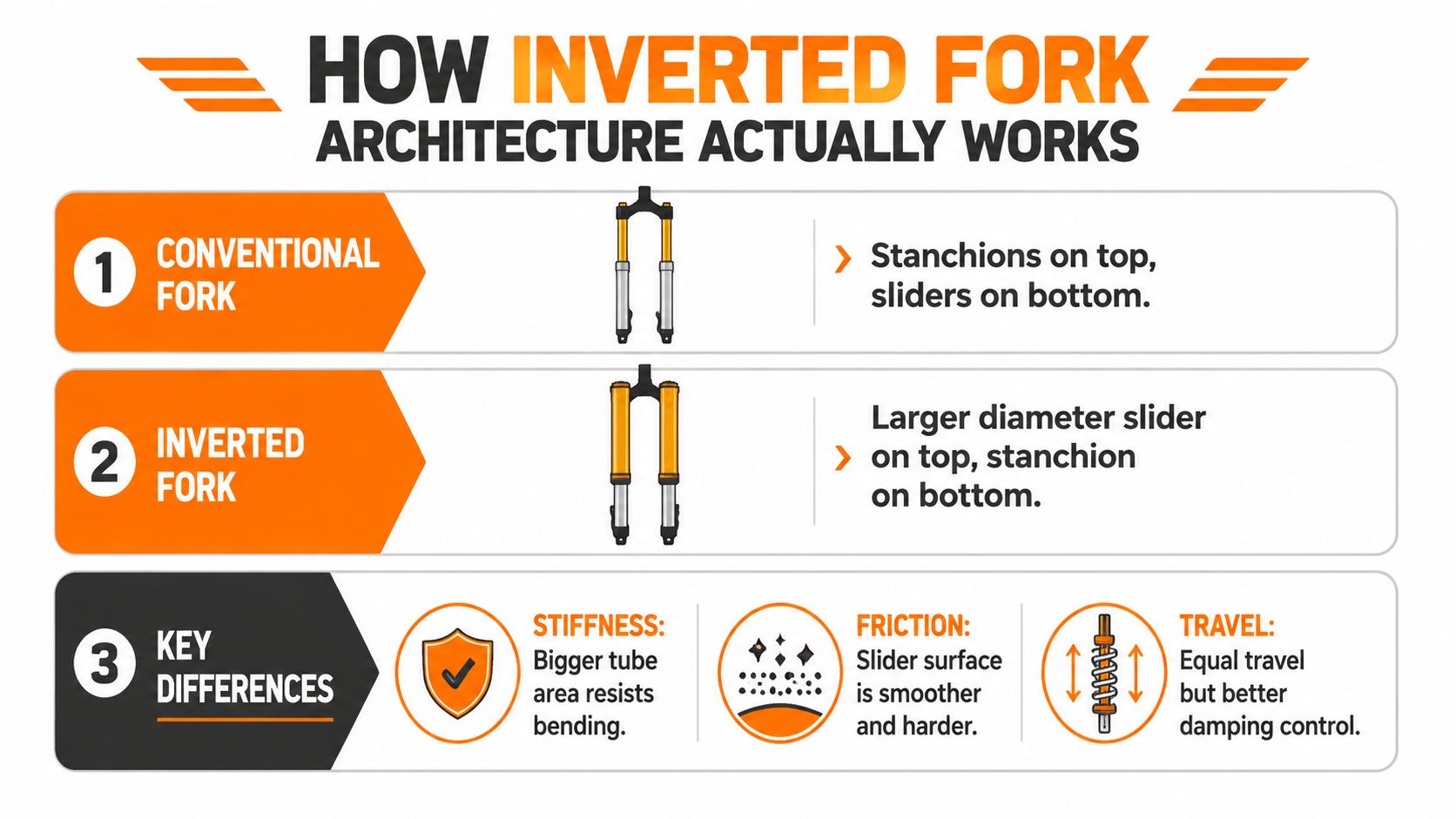
A telescopic fork has two jobs. It must guide the front wheel and absorb bumps without twisting itself out of shape. In a conventional fork, the thinner stanchions sit up top and the larger sliders move near the wheel. In an inverted fork, the layout is flipped, so the larger tubes are clamped in the triple trees and the lighter moving section sits lower.
Core layout and load path
A broom handle gives the same basic lesson. The thick end resists flex better than the thin end. BMW Motorrad's engineering explanation says the larger-diameter fork tubes are clamped in the upper triple clamps, which reduces twisting of the fork bridge and gives the front end a stiffer structural path under braking and cornering loads. Their explanation also points out that the highest bending moment sits near the steering-head and upper-clamp area during hard braking, so the thicker section belongs where the load is highest. BMW Motorrad's USD fork engineering page
That layout also changes how the fork is serviced and tuned. The cartridges sit inside the fork, and the system typically uses separate hydraulic circuits for damping, with preload, compression, and rebound adjustment. That gives the tuner more room to match spring and damping behavior to rider mass, tire load, and how hard the bike is being ridden, but it also means more parts to inspect and more settings to get wrong if the setup is rushed.
Internal damping and adjustment
The best part of the architecture is consistency. Longer bushing overlap between the inner and outer tubes can reduce friction and stick-slip, which helps the fork move more smoothly over small bumps and reduces binding when the chassis is loaded sideways. That matters when the front wheel is dealing with braking, steering, and bump absorption at the same time.
A practical fitment example makes the point clearer. The Kit Abbassamento Moto Cf Moto 675 SR R 675 2025 METISSE is listed for the CF Moto 675 SR R METISSE F60-075-35 2025, which is exactly why suspension buyers need to think in terms of model-specific geometry, not generic fork theory. Even a well-designed fork can feel wrong if the rest of the chassis is not matched to it.
For a broader technical breakdown of how motorcycle suspension works, Sixrace's suspension guide is a useful companion reference.
Performance Gains From Reversed Stanchions
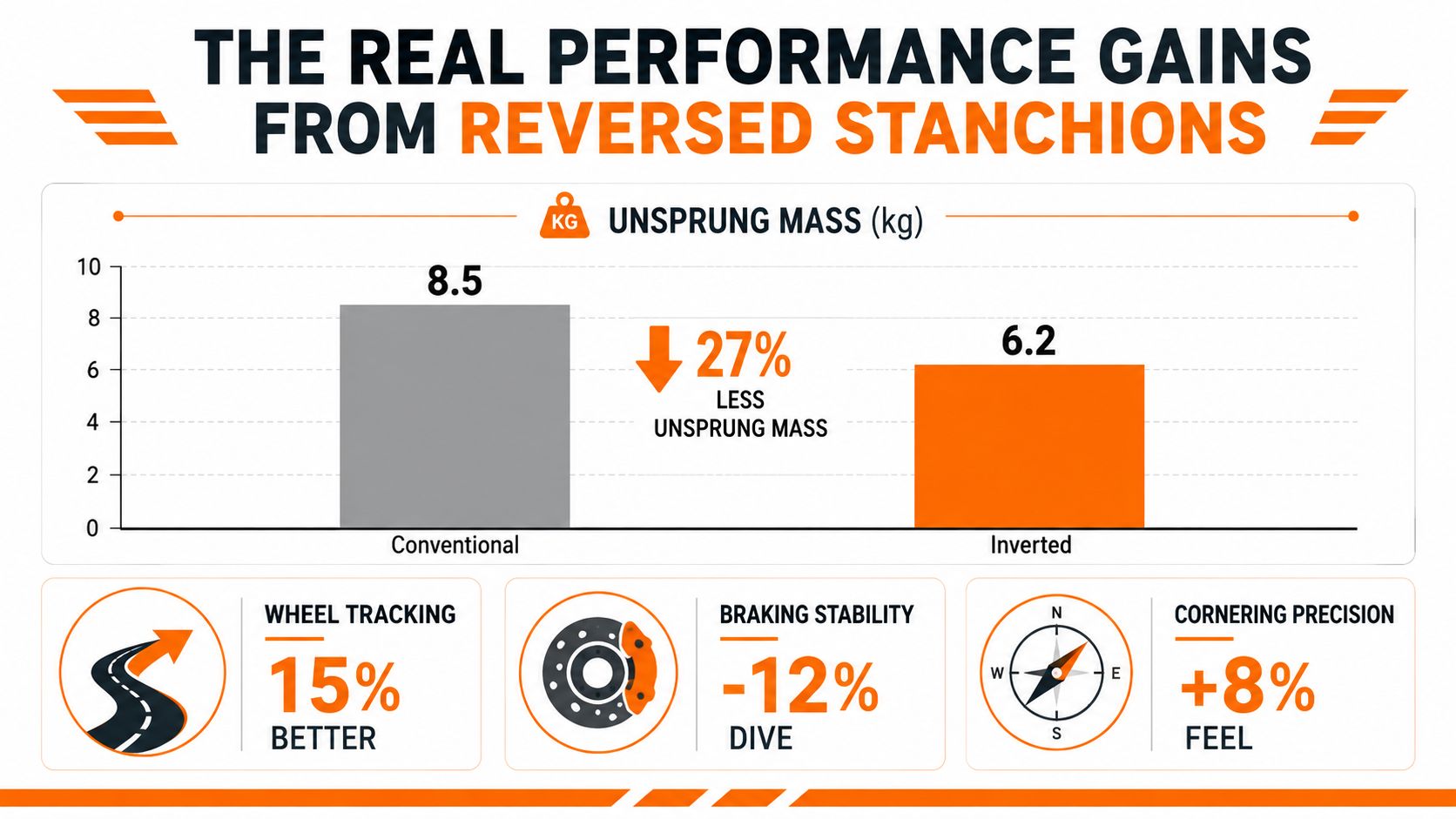
The clearest benefit of forcelle a steli rovesciati shows up when the front end is under real load. In a USD fork, the stanchions sit in the upper, more heavily loaded part of the assembly, while the outer tubes stay lower on the bike. That layout reduces unsprung mass at the wheel end and lets the front wheel react with less inertial penalty as it moves over bumps. Quimtb's technical explanation makes the same point and also notes that modern USD forks are chosen for a stiffer chassis and better damping control, not because they are softer. Quimtb's suspension explanation
Riding-Feel Improvements
On the road, the first thing you notice is a calmer front end. Under hard braking, the fork resists twisting better, so steering inputs stay cleaner and the chassis feels more settled. In fast direction changes, that extra stiffness can make the bike feel more exact, especially when the front tire is already handling load transfer and corner-entry grip.
The fork does not need to be softer to feel better. It needs to stay straighter, move more cleanly, and keep geometry more consistent when the load spikes.
Small-bump response is the other gain riders feel. Longer bushings and lower friction help the fork start moving without the sticky breakaway sensation that can blur the first part of travel. Riders often describe that as better feedback, but what they are really feeling is a front end that reacts more linearly to small inputs and binds less easily when the bike is loaded on one side.
Where The Gain Matters
These advantages matter most when the front tire is working hard. Track days, aggressive mountain roads, and repeated braking zones are where a stiffer fork and cleaner damping behavior earn their keep. On smooth roads, the difference can be subtle enough that the cost and service implications outweigh the feel improvement.
That is the dividing line. USD forks make sense when the chassis is asked to do serious work. They are far less compelling when the bike spends most of its life in gentle use, slow traffic, or rough daily commuting where the ownership burden matters as much as the handling gain.
Choosing the Right Fork Type for Your Riding Style
The fork choice makes the most sense when you separate riding profiles instead of talking about motorcycles in general. A superbike on slick tires doesn't live the same life as a commuter parked outside all year, and the front suspension should reflect that.
| Riding Profile | Inverted Fork Benefit | Conventional Fork Advantage | Recommendation |
|---|---|---|---|
| Track day and racing | High stiffness, cleaner steering, better support under braking | Less compelling here | USD forks make the most sense |
| Aggressive road riding | Better feedback, more precise front end, stronger feel in fast transitions | Simpler upkeep if the bike is also used casually | USD is often worth it if you ride hard often |
| Daily commuting and touring | Nice to have, but the gains can be hard to feel in normal traffic | Lower exposure, simpler living, often easier to accept rough-road abuse | Conventional forks can be smarter |
| Off-road and mixed terrain | Good when the chassis is being pushed hard | Some disciplines still avoid USD layouts because of structural and packaging constraints | Choose by discipline, not fashion |
Track-day riders are the clearest winners. They use braking force, corner entry load, and rapid direction changes in a way that exposes flex immediately. If the front of the bike feels vague in that environment, the fork is part of the problem, and an upside-down layout often solves more than it creates.
Aggressive road riders are close behind. If your routes include fast sweepers, hard trail braking, and repeated heat cycles in the front tire, the extra rigidity and damping control are real. If your “sport riding” is mostly casual weekend pace, though, the difference may be too small to justify the service and repair trade-off.
Daily commuters and touring riders need the coldest possible assessment. Urban riding brings curb scrapes, parking drops, road grit, and weather exposure. A conventional fork can be the more rational choice because the world risk profile is uglier than the brochure suggests.
Off-road is nuanced. The historical timeline shows that inverted forks came from dirt and race use, but modern application still depends on the discipline. Some riders in trial and other specialized off-road settings avoid USD layouts because structural and packaging constraints matter more than the prestige of the design. That's why use case beats ideology every time.
Maintenance Realities and Hidden Ownership Costs
The hidden cost of USD fork ownership isn't just the rebuild bill, it's the way small damage becomes service work faster than many riders expect. Exposed stanchions sit lower and take more abuse from grit, stones, boot scuffs, and the occasional parking mishap. Once the tube surface gets scratched or contaminated, seals and bushings start working harder, and the fork can lose smoothness long before a casual rider notices a big problem.
What owners miss
A fork that still moves can still be unhappy. Early signs are subtle, like oil mist near the seal, uneven rebound feel, or a front end that starts binding when the bars are turned and the bike is compressed. Riders often ignore that until the seals are already compromised or the bushings have picked up wear.
After track use or hard off-road riding, service needs to get tighter. Dust, heat, and repeated hard compressions put more stress on the oil and sealing surfaces, so maintenance has to follow use, not calendar optimism. The maintenance checklist in the suspension community often starts with seal inspection, oil change timing, and a quick air bleed after intensive riding. A practical workshop reference for seal and dust-cover work is the Vesrah fork oil seal kit page for Kawasaki ZX10R Ninja, which is exactly the kind of model-specific part sourcing that matters when a fork starts weeping.
Workshop habit: clean the stanchions before you blame the seals. A dirty tube can mimic a failed fork.
The ownership lesson is simple. Upside-down forks usually reward more frequent inspection and more exact service habits than many conventional forks, and that can be fine if you already treat suspension like a consumable performance system. If you want a fit-and-forget front end, the upside-down format can feel expensive even when the riding benefit is real.
What keeps costs from snowballing
Protective habits matter. Fork guards, careful washing, and early attention to surface damage help extend service life. Riders who spend time in mud, wet weather, or debris-heavy roads should be stricter about cleaning and inspection than riders who only see dry pavement. The point isn't to baby the hardware, it's to stop small wear from turning into a seal job and a revalve conversation.
Compatibility Checks and Smart Purchasing Decisions
Buying or upgrading forks goes wrong when riders shop by appearance instead of fitment. The front end has to match the steering head, triple clamps, brake hardware, wheel setup, and fender mounts. If any of those pieces are off, the fork may bolt in badly, steer poorly, or require extra parts that erase the value of the upgrade.
The checklist that saves money
- Steering head dimensions: verify the headstock and stem interface before you assume a swap will work.
- Triple clamp spacing: confirm that clamp geometry matches the fork legs and the bike's chassis.
- Brake line routing: check that hoses won't bind at full lock or full compression.
- Fender and guard mounts: make sure the lower fork and wheel area still accept the bodywork you need.
- Spring and oil setup: match spring rate and oil behavior to rider mass and intended use, not to the most aggressive spec you can buy.
That's where specialist fitment data matters. A model-specific catalog is more useful than generic advice because the right fork on the wrong bike is just a costly paperweight. Sixrace's motorcycle fork upgrade best practices guide fits into that mindset because it pushes the buyer toward checking compatibility instead of assuming one front end suits every chassis.
If you're protecting the investment, don't stop at the fork legs. Fork guards, spindle bobbins, and related protective pieces can save far more money than they cost if the bike lives in a crowded garage, sees track paddocks, or spends time on rough roads. The goal is not to build a museum bike, it's to keep expensive suspension hardware from taking avoidable hits.
The smartest purchase is the one that fits cleanly, tunes properly, and survives the riding environment you have. That's more important than choosing the most advanced-looking assembly on the shelf.
Making Your Final Suspension Decision
A rider on a track-focused superbike should lean toward forcelle a steli rovesciati because the front end will be stressed the way that architecture was meant to be stressed. A commuter on rough city streets may be happier with a conventional fork that's less exposed and easier to live with. A mixed-use sport rider sits in the middle, where setup, protection, and maintenance discipline matter almost as much as fork design itself.
Suspension is a system, not a trophy. If the bike already has a decent fork, fresh oil, correct springs, and clean seals, that can deliver more real-world gain than a flashy swap done badly. If you do need the extra rigidity and control, buy for fitment, protect the tubes, and plan the service interval before the first ride, not after the first leak.
Sixrace carries model-specific suspension parts, fork service items, and protection accessories that help you build a front end around the way you ride. If you're comparing an upgrade, replacement, or maintenance parts for your bike, visit Sixrace and check the exact fitment details before you buy.
 Italiano
 Deutsch
 Français
 Español
 English
 Polski