

Why does choosing motorcycle drive chains feel harder than choosing the chain itself appears to be? It looks like a simple metal loop, yet the wrong size, seal design, gearing, or maintenance routine can affect smoothness, sprocket wear, reliability, and safety. The sensible approach isn't to buy the most expensive-looking chain. It's to match the chain and sprockets to your motorcycle, riding conditions, and willingness to maintain them.
A street commuter, a track-day rider, and an enduro rider place very different demands on the final drive. This guide follows that decision from first principles to practical buying checks, with honest trade-offs instead of a universal recommendation.
Table of Contents
- Why the Right Motorcycle Chain Matters
- Main Chain Types Explained in Plain English
- How to Read Chain Sizes and Find the Right Fit
- Matching Chains and Sprockets to Your Riding Style
- Basic Mounting and Tensioning You Can Do at Home
- Maintenance, Lubrication, and When to Replace
- Model Compatibility and Smart Buying Decisions
Why the Right Motorcycle Chain Matters
What does a motorcycle chain endure on every ride? It transfers engine torque, bends around the front and rear sprockets, responds to swingarm movement, and faces rain, dust, road salt, heat, and cleaning chemicals. Its simple metal-loop appearance hides a demanding job, which is why choosing one requires more than checking whether it fits.
A chain belongs to a matched final-drive system. Its pitch and width must suit both sprockets, its length must allow the correct wheel position and gearing, and its construction must match the riding environment. A chain can fit physically yet wear quickly if it cannot handle the motorcycle's output or the rider's maintenance routine.
What wear costs you
A worn or incorrectly adjusted chain can change how power reaches the rear wheel, accelerate wear on both sprockets, and create uneven slack as the wheel turns. Too much tension loads the bearings and gearbox output shaft. Too much slack causes chain slap and harsh engagement, especially when rolling on the throttle after a slow corner.
For a commuter riding through rain and road grit, that wear may first appear as roughness during daily acceleration. On a track, repeated hard drive out of corners exposes weak adjustment or unsuitable construction sooner. Off-road, mud and fine dust can turn neglected lubrication into abrasive paste.
A chain breaking at speed can damage the engine casing, disrupt or lock the rear drive, or leave the rider without propulsion at an unsafe moment. The practical rule is simple:
A chain deserves the same fitment discipline as a brake component.
Motorcycle chains became dominant as manufacturers moved away from short-lived leather belt systems. By about 1912, rising engine output was pushing even belt-equipped manufacturers toward chains, or sometimes shaft drive, because chains handled higher power more effectively, as described in RideApart's history of motorcycle drive chains.
Chains remain one of the three major final-drive architectures. A market report estimates the worldwide motorcycle chains market at about USD 4.3 billion in 2024, projecting USD 6.1 billion by 2030 at a 5.9% CAGR (Data Bridge Market Research market report). That scale reflects how foundational the component remains, rather than treating it as a minor accessory.
Good selection therefore starts with matching. Confirm the size, choose a seal design suited to the riding conditions, select sprocket gearing deliberately, and maintain the complete chain-and-sprocket set.
Main Chain Types Explained in Plain English
Chain construction determines how well the chain retains lubricant and keeps contamination away from its internal bearing surfaces. The easiest way to understand the difference is to think of each design as a different kind of hinge or gasket.
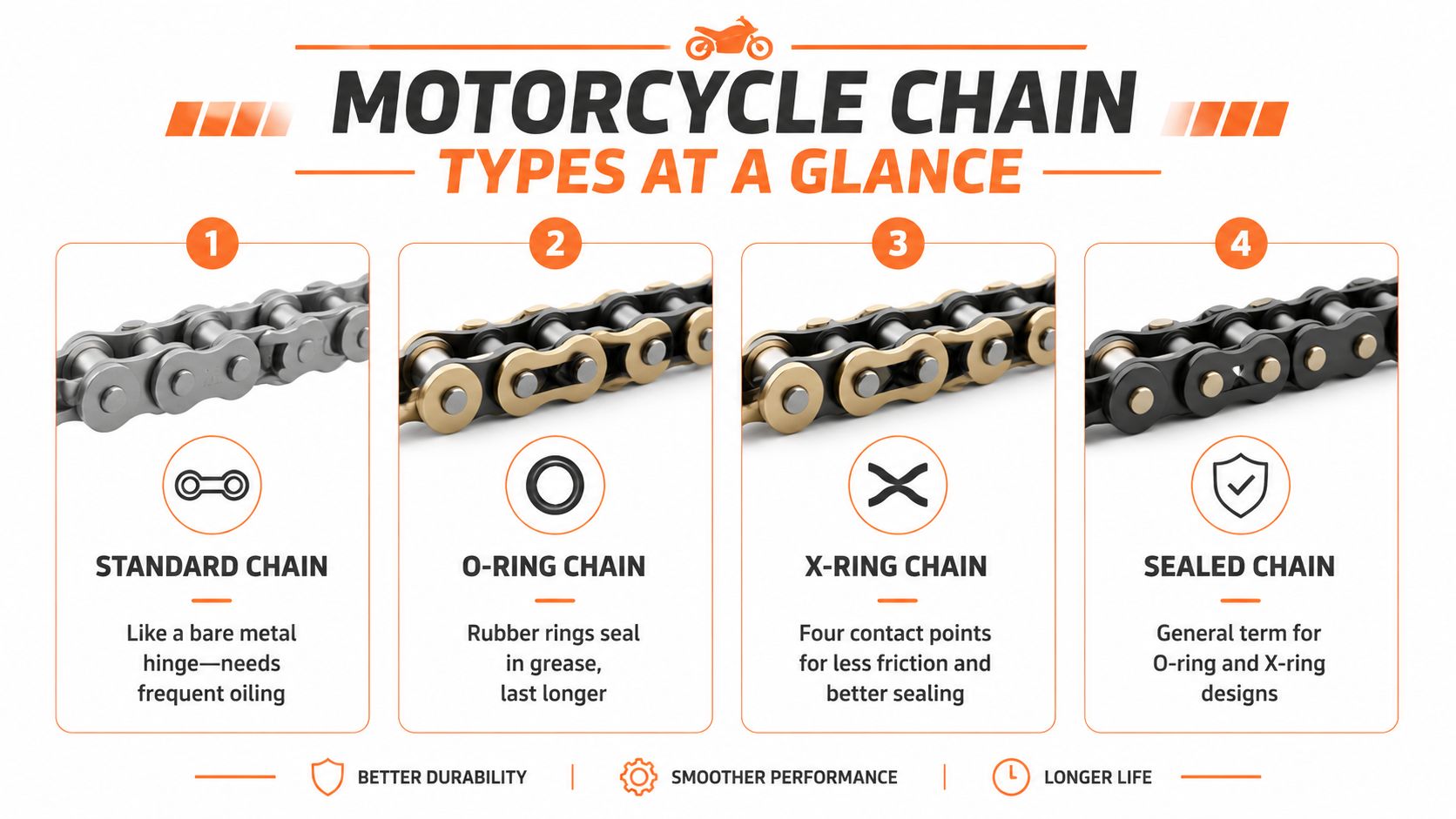
Standard chains
A standard chain is like a bare metal hinge. The pin and bushing surfaces depend heavily on regular external lubrication, and grease can be displaced by water, dirt, or repeated heat cycles. These chains can make sense where the rider can inspect and lubricate frequently, but they demand more attention than a sealed design.
They may also be chosen when reducing friction and weight matters more than long service intervals. That isn't automatically an advantage for every road motorcycle. A small friction saving has little value if the chain is neglected and wears rapidly.
O-ring chains
An O-ring chain adds small rubber rings between the inner and outer plates. Think of each ring as a miniature sealed bearing. It helps keep factory-applied grease inside the joint while limiting the entry of grit and water from outside.
For most road riders, this is the sensible baseline. It offers a useful balance between durability, contamination resistance, cost, and routine maintenance. The seals still need protection, so harsh solvents, aggressive brushes, and unsuitable cleaners can shorten their life.
X-ring chains
An X-ring chain uses a shaped seal with an X profile rather than a simple round profile. The seal forms several contact points while presenting a relatively small contact area, like a gasket designed to seal effectively without dragging across a broad surface.
This design is commonly selected by riders who want sealed-chain protection with a performance-oriented construction. It can suit spirited road riding, touring, and track use where the rider still wants less maintenance exposure than a standard chain provides.
Sealed chains as a category
“Sealed chain” is a general term that normally includes O-ring and X-ring designs, rather than identifying one unique construction. Some sealed chains prioritize strength and contamination resistance, while others emphasize reduced friction and lower mass.
A practical rule works well:
- Street riding: Choose an O-ring or X-ring chain that matches the manufacturer's specification.
- Performance riding: Consider an X-ring or another model approved for the motorcycle and intended use.
- Off-road riding: Favor a sealed design when mud, sand, or water exposure is high, while weighing durability against added weight.
The chain type isn't connected to engine tuning equipment. For example, the Power Vision kit AutoTune for HARLEY DAVIDSON Touring Twin Cam 1450 is listed for the Harley-Davidson Touring Twin Cam 1450 with Dynojet AT-110 fitment for model years 2002 through 2006. It belongs to a different category, so don't treat an engine-control product as evidence of chain compatibility.
How to Read Chain Sizes and Find the Right Fit
A motorcycle chain size tells you more than its overall length. You need to identify pitch, roller width, and link count, then confirm that all three agree with the motorcycle and sprockets.
Pitch comes first
Pitch is the distance from the center of one chain pin to the center of the next. Motorcycle chains commonly use codes such as 428, 520, 525, and 530, but the code isn't a universal strength rating. It identifies a dimensional family, and the chain must match the sprocket tooth spacing.
If the motorcycle uses a 520 chain, a 525 or 530 chain won't correctly engage the same sprockets. Replacing only the chain while leaving sprockets designed for another pitch is a basic fitment error, not a performance upgrade.
The middle portion of a chain code also relates to roller width and internal dimensions. The exact interpretation depends on the standard and manufacturer, so the service manual, existing part marking, and replacement-chain specification should be checked together.
Link count controls physical reach
Length is usually expressed as the number of links. A longer chain doesn't automatically fit every motorcycle. The correct count depends on the original specification, sprocket tooth counts, wheelbase adjustment range, and any gearing change.
Read the code on the side plate if it remains legible, but don't rely on that marking alone if the motorcycle has been modified. A previous owner may have changed the front or rear sprocket, and the current chain may already be the wrong length.
| Chain Code | Pitch | Typical Use |
|---|---|---|
| 428 | Smaller motorcycle chain pitch | Lightweight motorcycles and some smaller applications |
| 520 | Common performance-oriented motorcycle size | Road, racing, supermoto, and off-road applications where specified |
| 525 | Intermediate motorcycle chain size | Selected road and touring applications |
| 530 | Larger motorcycle chain size | Higher-load road and touring applications where specified |
The table describes common application patterns, not permission to substitute sizes. Your bike's service manual remains the authoritative source for the original chain specification, including pitch, width, link count, and master-link style.
A product listing for the Evotech-Performance EP M12 x 110 x 1.25mm Pitch Caphead 316 S/S bolt illustrates why precise dimensional reading matters in motorcycle parts, but the bolt's thread pitch has no relationship to motorcycle chain pitch. Similar-looking numbers can describe completely different dimensions.
Matching Chains and Sprockets to Your Riding Style
The same chain can be technically suitable yet practically wrong for how you ride. A commuter needs resistance to weather and neglected intervals. A racer may accept more frequent service to reduce rotating mass or friction. An off-road rider needs a drivetrain that tolerates contamination, impacts, and abrupt load changes.
Street commuting and touring
For daily road use, a sealed O-ring or X-ring chain is usually the logical choice. Commuters encounter rain, standing water, road grit, and stop-start acceleration, often without the opportunity to clean the chain immediately. Touring riders also benefit from a design that retains internal grease during long-distance use.
Sprocket gearing should normally remain close to the motorcycle's standard arrangement unless there's a clear reason to change it. Mild gearing preserves a useful balance between low-speed response and relaxed cruising. Replacing the chain and sprockets as a set helps the new chain seat correctly against unworn tooth profiles.
Track riding and racing
A track rider may prioritize rapid response, predictable drive, and reduced rotating weight. A standard or lightly sealed chain can be considered in tightly controlled conditions, but it demands disciplined inspection and lubrication. A sealed X-ring chain may be the more forgiving option for a rider who travels to the circuit or doesn't service the motorcycle after every session.
Gearing changes deserve careful thought. The final-drive ratio equals rear-sprocket teeth divided by front-sprocket teeth. Adding rear teeth or removing front teeth raises the ratio, increasing wheel torque and acceleration while reducing potential top speed. A published example for a 250cc motocross motorcycle uses 13/48 gearing with a 3.69:1 ratio (NHTSA technical bulletin example).
For a broader explanation of how sprocket changes alter motorcycle behavior, use this motorcycle gearing guide before ordering parts.
Off-road, enduro, and motocross
Mud and sand turn chain maintenance into a contamination problem. An off-road setup generally benefits from a sealed chain, suitable tensile strength, and sprockets that allow debris to clear instead of trapping it between the teeth. The best choice still depends on the motorcycle's original specification and the terrain, because a heavier chain isn't automatically the most efficient or durable solution.
Independent racing research found that efficiency can improve with more sprocket teeth at the same speed ratio, reduced chain pitch, and larger sprocket diameter across operating conditions (research on motorcycle chain transmission efficiency). That finding challenges the simple assumption that a larger, heavier-duty chain is always superior.
A lowering component such as the Metisse lowering kit for the CF Moto 675 SR R is listed for the CF Moto 675 SR R with Metisse reference F60-075-35 for 2025. It concerns suspension setup, not chain fitment, so any drivetrain change should still be checked separately for slack, alignment, and required length.
Basic Mounting and Tensioning You Can Do at Home
Chain installation is manageable at home when you follow the motorcycle's manual and use the correct master link. The job becomes risky when a rider treats slack as a universal measurement or adjusts one side of the axle without checking alignment.
Start with the motorcycle stable and the transmission in neutral. If the chain and sprockets are being replaced, position the rear wheel so the axle adjusters provide useful adjustment range rather than leaving the wheel at the extreme end of the slots.
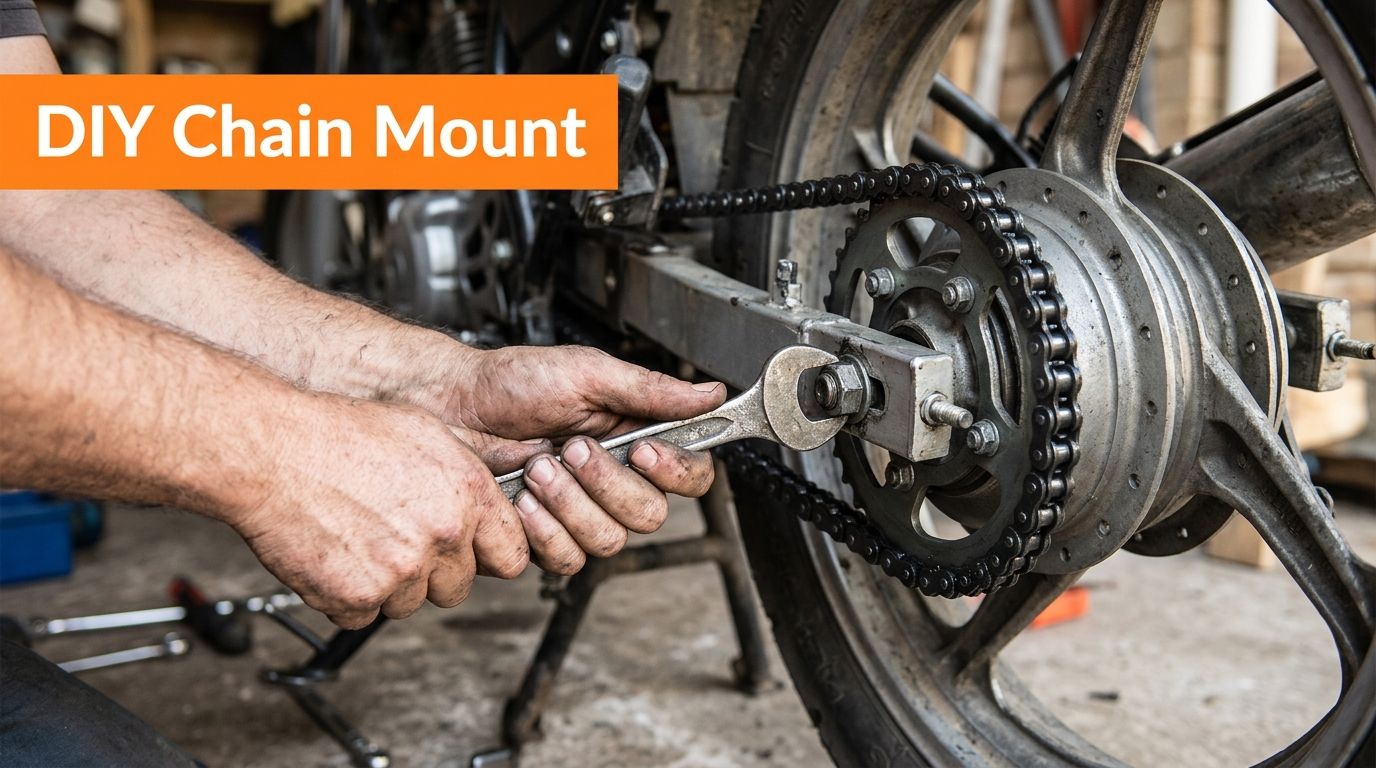
Fitting the chain
Route the chain around the front and rear sprockets, then bring both ends together on the rear sprocket. If the chain uses a rivet master link, install the side plate and flare the rivet heads with the specified tool. If it uses a clip-style link, fit the clip in the correct direction, with the closed end facing the direction of chain travel.
Don't improvise with a damaged master link or reuse a single-use rivet link. Check that every link flexes freely before setting tension.
Setting slack correctly
Measure slack at the midpoint of the lower chain run, but use the motorcycle's specified method and reference point. Many motorcycles use a slack range around 20 to 30 mm, yet that range is not universal and must not replace the service-manual specification.
Move the chain through several positions and find the tightest section. Set the measurement there, because adjusting slack at a loose section can leave the tight section dangerously tensioned when the wheel turns.
Alignment mistakes to avoid
Loosen the rear axle as required, adjust both sides in equal increments, and compare the alignment marks. Marks can be inaccurate, so a straightedge, alignment tool, or careful measurement from fixed swingarm points offers a useful cross-check.
- Too tight: Loads bearings, seals, and the output shaft, especially as the suspension compresses.
- Uneven adjustment: Misaligns the chain and sprockets, producing noise and irregular tooth wear.
- Unsecured master link: Can allow the chain to separate during riding.
- Wrong measurement position: Can hide a tight spot and create excessive tension.
After tightening the axle to the manual's torque specification, recheck slack and alignment. Spin the wheel, inspect the master link, and confirm that the chain still moves smoothly.
Maintenance, Lubrication, and When to Replace
Chain care should follow the motorcycle manufacturer's instructions first, then be adjusted for weather and use. One major OEM technical bulletin recommends lubrication at least every 250 mi, or 400 km, with more frequent service in high ambient heat or after long highway runs. The same technical guidance reports an average service life of about 20,000 km when maintenance follows the owner's manual (motorcycle chain maintenance guidance).
That figure is a reference point, not a promise. Rain, dust, commuting, high engine output, racing, and off-road riding can change the wear rate substantially. A chain used in mud may need cleaning and lubrication after a single ride, while a dry road ride may leave it comparatively clean.
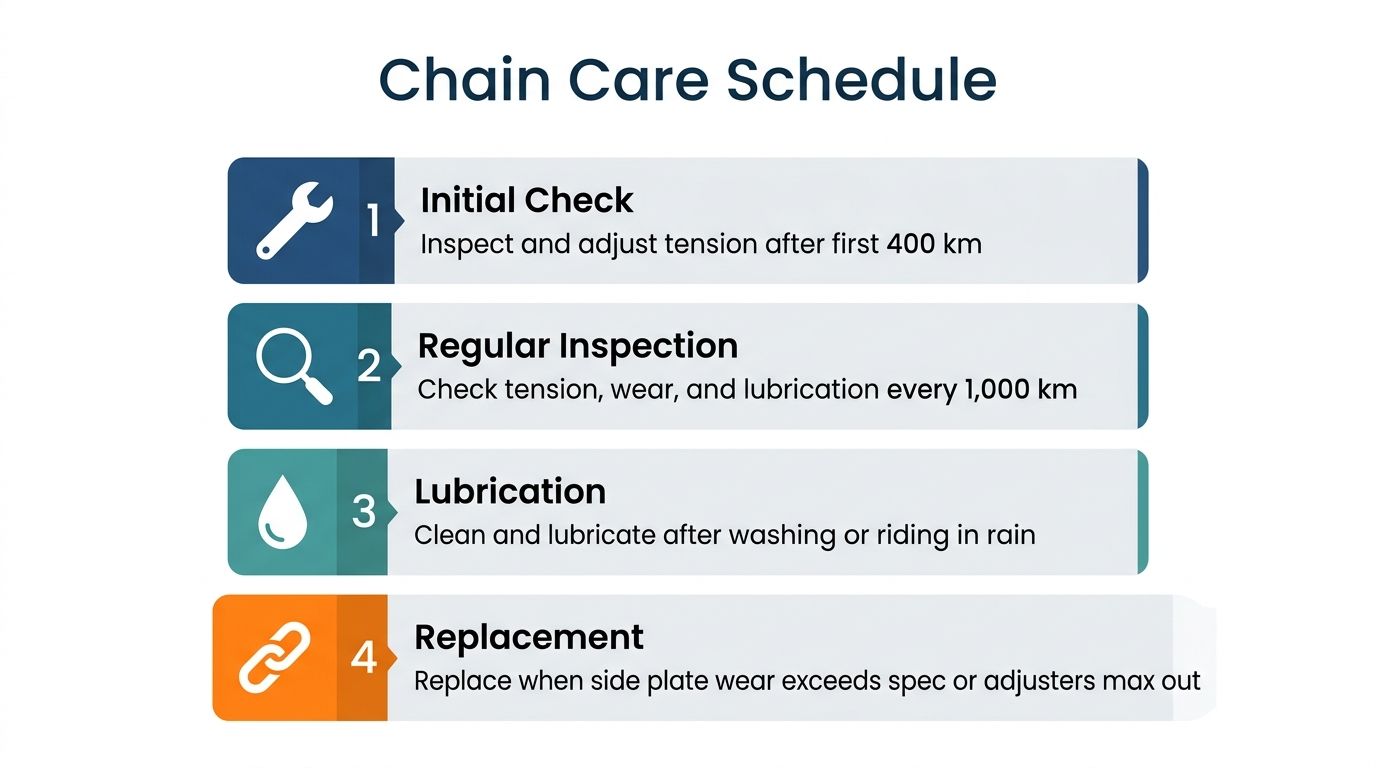
Clean before you lubricate
Use a motorcycle chain cleaner marked safe for O-ring and X-ring seals. Apply it to a cool chain, work dirt loose with a soft chain brush, and wipe away residue before applying lubricant. Avoid harsh solvents unless the chain manufacturer specifically approves them, because damaged seals allow the internal grease to escape.
Apply chain lubricant to the inside run, where the chain meets the sprocket and where centrifugal force helps distribute it. Give the lubricant time to settle before riding, especially if the product instructions call for drying. Overspray on tyres, brake discs, or pads is a serious contamination risk.
A rider who lacks time or suitable workspace can use a specialist service such as mobile motorcycle detailing in Lincoln for cleaning and detailing support. Chain lubrication and mechanical adjustment should still follow the motorcycle manufacturer's procedures.
Inspect the parts that reveal wear
Look for hooked or pointed sprocket teeth, stiff links, rust, damaged seals, and side-plate wear. Measure chain elongation with a suitable chain-wear indicator or the method specified by the manufacturer. If the chain has tight spots, repeated adjustment needs, or visible damage, don't wait for the adjusters to reach their limit.
A worn chain and worn sprockets should normally be replaced together. Installing a new chain on badly worn sprockets can create poor engagement and accelerate wear.
For a model-specific physical component, the Zieger stainless chainguard for Honda Dominator NX 650 is listed for the Honda Dominator NX 650 from 1987 through 2002. A chainguard doesn't replace inspection, correct slack, or lubrication, but it forms part of the protective area around the final drive.
Inspection rule: Replace the chain when measured wear exceeds the permitted limit, sprocket teeth are damaged, links remain stiff, or the adjustment range can no longer provide correct slack.
Model Compatibility and Smart Buying Decisions
The safest buying process begins with the motorcycle, not with a chain that looks strong or inexpensive. Record the exact make, model, engine version, and model year, then confirm the original chain code and link count in the service manual or a trusted fitment listing.
Codes such as 520, 525, and 530 identify different dimensional families. They aren't interchangeable labels for quality or engine power. The first filter is pitch compatibility across the chain, front sprocket, and rear sprocket. After that, verify width, length, tensile specification, seal type, and master-link construction.
Use fitment data as a filter
A model-specific catalog listing should identify compatible motorcycle makes, models, and years. Use that information as a starting point, then cross-check the listing against your manual, especially if the bike has aftermarket sprockets or a changed wheel position.
The bike parts compatibility guide is useful for organizing that check because compatibility is more than a brand name. It connects the part to the motorcycle application, which helps reduce errors caused by similar-looking products.
Before checkout, confirm:
- Chain type: Standard, O-ring, X-ring, or another sealed design suitable for your use.
- Chain size: Pitch and width must match both sprockets.
- Link count: Confirm the original length and allow for any tooth-count change.
- Master link: Check whether the kit uses a clip or rivet link and whether you have the correct installation tool.
- Sprocket set: Replace worn sprockets with the chain, and verify front and rear tooth counts.
- Gearing purpose: Know whether the change is intended to improve acceleration, alter cruising behavior, or suit a circuit or terrain.
- Riding environment: Rain, dust, mud, commuting, and track use determine how much maintenance the chain will need.
Don't assume that a longer chain fits any motorcycle. Don't mix chain pitch with a different sprocket pitch, and don't ignore gearing changes that alter required length. Brand matching can also help keep wear characteristics consistent, but dimensional compatibility and manufacturer specifications come first.
Sixrace's catalog covers motorcycle and scooter accessories and replacement components with model-specific compatibility information across categories such as transmission, protection, suspension, and performance parts. Visit Sixrace with your motorcycle's exact model and year ready, then compare chain type, size, sprocket ratio, link count, and master-link format before placing an order.
 Italiano
 Deutsch
 Français
 Español
 English
 Polski