

You've parked outside a café, the engine is still warm, and your full-face helmet is sitting in your hand. Carrying it inside is awkward, leaving it on the seat is an invitation, and hanging it from a mirror can put unnecessary strain on the strap or let the shell scrape against the motorcycle. This is the everyday problem a blocca casco moto, or motorcycle helmet lock, is meant to solve.
The useful way to think about a helmet lock isn't as a miniature safe. It's a controlled compromise between deterring casual theft, keeping the helmet from falling, and preserving the condition of equipment that still needs to protect your head. The lock, the motorcycle's anchor point, and the helmet's chin-strap hardware all have to work together. If one part is poorly chosen, extra security can create new damage.
Table of Contents
- Why a Blocca Casco Moto Exists in the First Place
- How Helmet Laws Shaped the Helmet Lock Market
- The Four Main Types of Blocca Casco Moto
- How to Choose the Right Blocca Casco for Your Helmet
- Installing a Blocca Casco Moto the Right Way
- Why Security Is Not the Same as Theft Proof
- Maintenance and Inspection to Protect Both Lock and Helmet
- Choosing, Installing, and Using Your Blocca Casco
Why a Blocca Casco Moto Exists in the First Place
A helmet lock exists because a helmet is difficult to store safely on a parked motorcycle. A full-face model is bulky, easily damaged, and often too valuable to leave exposed. Carrying it into a shop or office is inconvenient, but placing it loosely on the saddle or handlebar leaves it vulnerable to a quick grab.
The blocca casco moto is a retention and theft-deterrence device, not a certified protective component. It anchors the helmet to the motorcycle or to a fixed point, making casual removal harder. It doesn't preserve the helmet's impact protection while the helmet is hanging from the bike, and it won't make a damaged or poorly stored helmet safe to wear.
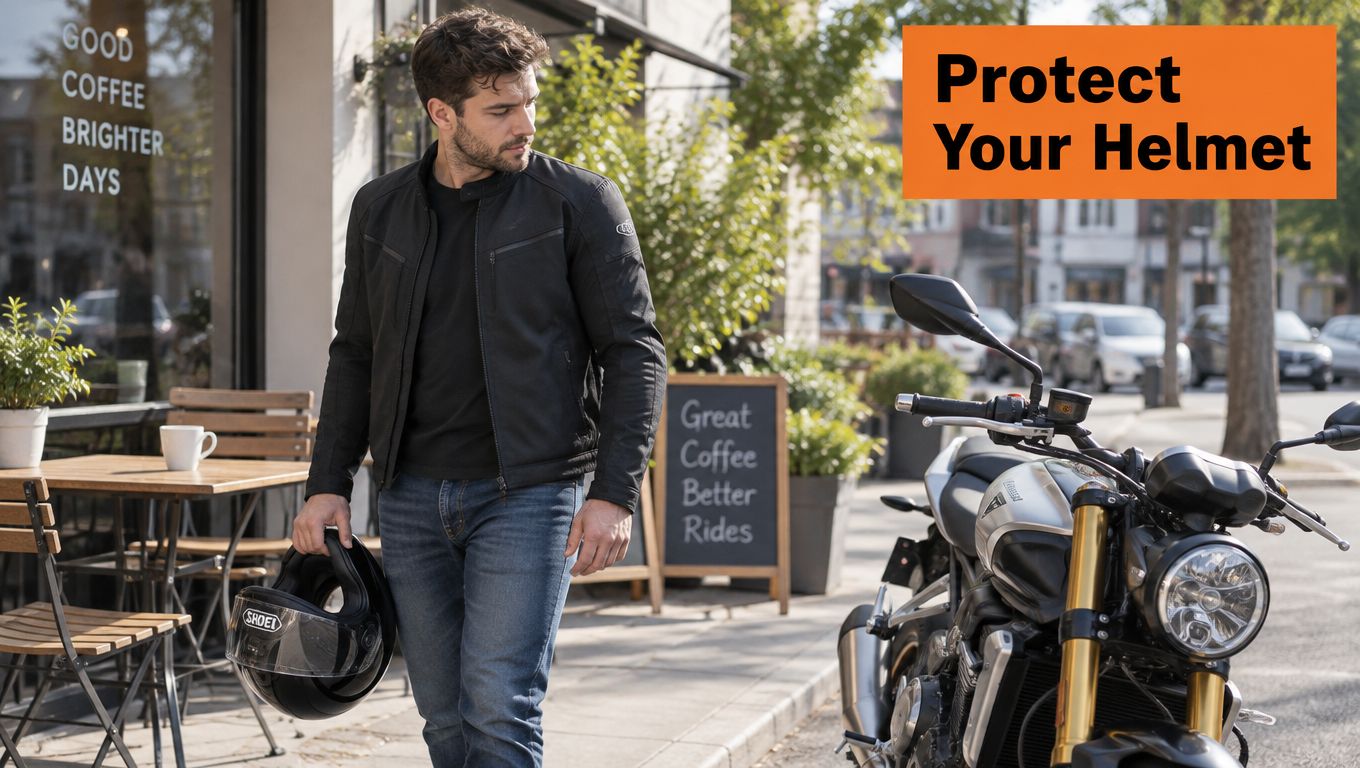
The practical compromise
A rider usually has three choices at a short stop:
- Carry the helmet: This offers the greatest control over heat, impact, contamination, and theft, but it's inconvenient.
- Leave it unsecured: This is quick, but anyone can remove it, and it may fall or be knocked onto the ground.
- Lock it to the motorcycle: This improves convenience and discourages opportunistic theft, provided the lock is attached correctly.
The third option only works when the load path is sensible. A cable fixed to a rigid frame-mounted point is more credible than one wrapped around a thin body panel. The attachment should pass through the helmet's chin-strap D-rings, not through a visor opening, ventilation port, or shell edge.
A helmet's availability matters because it remains essential safety equipment. U.S. government research estimates that motorcycle helmets reduce the likelihood of crash fatality by 37%, and a major crash-outcome study found helmets 67% effective in preventing brain injuries. The NHTSA motorcycle helmet safety research also estimates that helmets saved 19,230 motorcyclists' lives from 1984 through 2006. A lock supports continued possession of that equipment. It doesn't replace the helmet's certified function.
How Helmet Laws Shaped the Helmet Lock Market
Helmet locks became more relevant as helmets moved from optional equipment to something riders had to carry on ordinary journeys. In the United States, no state had a motorcycle helmet law in 1965. After the Highway Safety Act of 1966, federal policy encouraged states to adopt universal requirements by connecting compliance with access to certain transportation funds. By 1975, universal helmet laws covered 47 states and the District of Columbia, according to the NHTSA history of motorcycle helmet legislation.
That regulatory expansion changed the storage problem. Once a helmet became part of every ride, riders needed a practical way to manage it at fuel stations, workplaces, cafés, and shops. Improvised solutions followed, including mirror hooks, elastic cords, and basic cable restraints. Purpose-built products then developed around the parts of the motorcycle that could provide a stronger anchor.
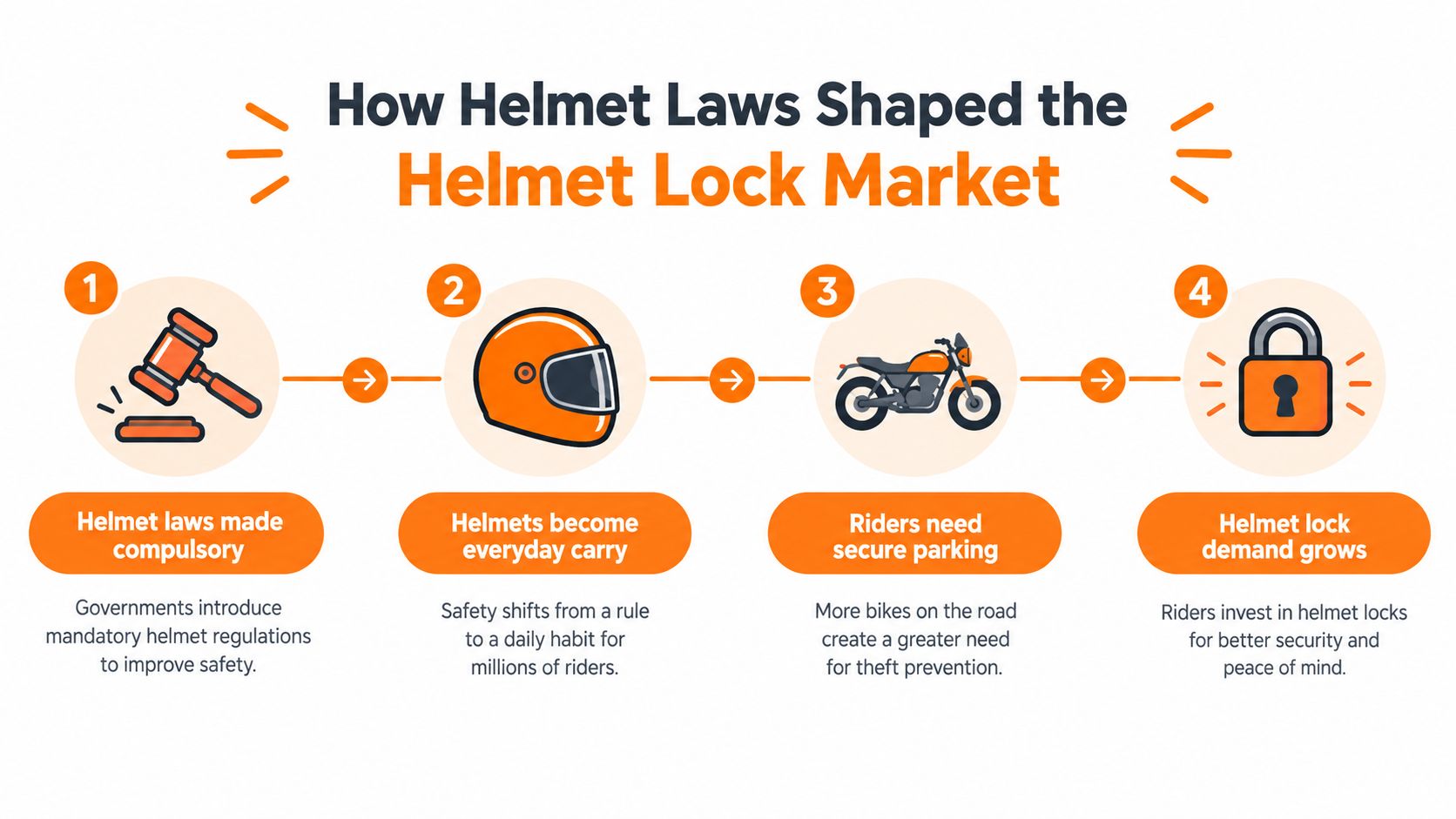
Regulation created a daily carrying requirement
The connection between helmet laws and lock demand isn't that legislation directly requires a helmet lock. It's that compulsory helmet use creates repeated storage moments. A rider who must wear a helmet also has to decide where it goes whenever the motorcycle is parked.
The history also shows why demand varies between markets. After federal penalties were removed in 1975, roughly half of U.S. states repealed or weakened their laws, creating a cycle of enactment, repeal, and reinstatement. The CDC reported observed compliant helmet use of 84% in states with universal laws in 2020, compared with 54% in states without universal laws. Those figures appear in the same NHTSA legislation and licensing reference, and they illustrate how regulation affects the practical presence of helmets in everyday riding.
Modern products therefore range from discreet under-seat hooks to model-specific brackets and frame-mounted rings. A rider looking at related motorcycle hardware should also distinguish storage accessories from road-legal visibility equipment, such as the approved motorcycle mirrors and related accessories. They solve different problems, but both depend on correct motorcycle-specific fitment.
The Four Main Types of Blocca Casco Moto
The four common designs differ less by their marketing names than by what they anchor, where they carry the load, and what the helmet touches. A flexible cable may suit several bikes, while a rigid bracket can provide a cleaner installation but concentrate force in one place.
Cable locks
A cable lock typically uses a steel cable that passes through the helmet's chin-strap D-rings and connects to a keyed or combination body. It may attach under the seat, around a frame point, or to a dedicated motorcycle bracket.
Its strength is flexibility. The cable can reach a full-face helmet on motorcycles with awkward subframe geometry, and it can often secure more than one piece of equipment. Its weakness is exposure. A cable remains vulnerable to cutting, especially if the anchor is easier to defeat than the lock itself.
Ring and D-ring locks
A ring lock uses a fixed metal loop or hook attached to the frame or subframe. The helmet's D-ring or strap hardware engages directly with that point, creating a short and relatively rigid connection.
This arrangement reduces loose cable movement and can look tidy under the seat. It only works well when the strap hardware and ring geometry match. A ring that forces the strap to twist, fold sharply, or sit half-engaged creates a false sense of security.
Under-seat locks
An under-seat blocca casco uses the seat area or a dedicated internal bracket as the anchor. It's discreet and keeps much of the hardware away from weather and casual attention.
The limitation is available space. The seat must close without crushing the cable, lock body, strap, or helmet lining. If the helmet shell or EPS liner is pressed against the hardware, the storage solution is too tight, regardless of how neat it looks from outside.
Fixed brackets and hybrids
Fixed brackets use a rigid plate, arm, or hook attached to a structural motorcycle point. Some designs combine helmet retention with another security function, but the helmet still needs to connect through an acceptable load-bearing strap point.
Rigid hardware can resist casual pulling better than a loose hook, but direct shell contact creates paint and abrasion risks. A bracket that grips the helmet shell may also focus load on a small area. That's why a soft sleeve or polymer coating matters.
| Type | Mounting | Security level | Typical weakness | Best for |
|---|---|---|---|---|
| Cable lock | Frame, subframe, or under-seat anchor | Moderate deterrence | Cable can be cut and may rub the helmet | Flexible daily use |
| Ring or D-ring lock | Fixed frame or subframe point | Moderate to strong deterrence | Requires compatible strap geometry | Clean, short connections |
| Under-seat lock | Internal seat or storage bracket | Moderate deterrence | Limited space and possible liner pressure | Discreet commuting |
| Fixed bracket or hybrid | Rigid frame-mounted plate or arm | Stronger casual retention | Paint contact and concentrated shell loads | Motorcycles with suitable mounting points |
How to Choose the Right Blocca Casco for Your Helmet
Start with the helmet, not the lock body. A product that fits the motorcycle but loads the wrong part of the helmet is a poor choice.
Check the anchor before checking the finish
Look for a rigid frame-mounted or subframe-mounted point. Avoid relying on a thin fairing, a flexible grab handle, or a luggage hook that moves when you pull it by hand. The lock should stay stable while the helmet hangs from it.
Then check clearance. The helmet and cable need to remain away from the exhaust, cylinder head, radiator, rear shock, swingarm, wheel, and steering movement. A perfect cable length is useless if the helmet rests against a heat source or enters the suspension's travel path.
Use the intended strap hardware
The preferred engagement point is the manufacturer-provided chin-strap D-ring or another designated load-bearing part of the retention system. Don't route a cable through the visor, ventilation openings, peak, or shell edge. Don't drill, clamp, or compress the helmet to create a new anchor.
A helmet standard stresses the importance of a correctly designed retention system that stays securely attached when fastened. The NHTSA guidance on identifying unsafe motorcycle helmets supports treating the strap and its attachments as safety-critical components, not as convenient holes for any accessory.
Match the lock to the helmet shape
Full-face helmets usually need enough cable reach to pass cleanly through both D-rings without pulling the shell against the motorcycle. Modular helmets can work with cable or ring locks, but the chin-bar mechanism and strap position must remain untouched.
Open-face helmets often have simpler strap geometry, yet a short ring can still slip if the buckle or D-ring isn't fully captured. Off-road helmets bring additional concerns, including peaks, goggles, and extended shapes. A lock should load the strap hardware, never the peak or goggle strap. For related fitment decisions, the enduro and motocross helmet guide is a useful reference point for understanding why off-road shapes need different handling.
| Helmet type | Best blocca casco | Engagement point | Watch out for |
|---|---|---|---|
| Full-face | Cable or ring lock | Both chin-strap D-rings | Cable length, heat, shell contact |
| Modular | Cable or model-specific ring | Chin-strap hardware | Moving chin bar and twisted strap |
| Open-face | Under-seat or fixed bracket | Designated strap ring or buckle area | Slippage around short or unusual straps |
| Off-road | Under-seat or protected frame mount | Chin-strap D-rings | Peak, goggles, and extended shell shape |
Installing a Blocca Casco Moto the Right Way
Treat installation as a small garage job, not a quick accessory fit. The lock only becomes useful after you verify the motorcycle's structure, movement, heat exposure, and the helmet's actual hanging position.
Find a real structural anchor
Begin with a subframe bolt, a frame-mounted eyelet, or another rigid mounting point intended to carry hardware. Pull it by hand. If the point flexes, shifts, or is attached only to decorative bodywork, reject it.
Fit the bracket with the supplied hardware and use the appropriate thread-retention method where the manufacturer permits it. Check the fasteners again after the first ride because vibration can settle a new installation. Don't assume that a tight-looking bolt has created a strong load path.
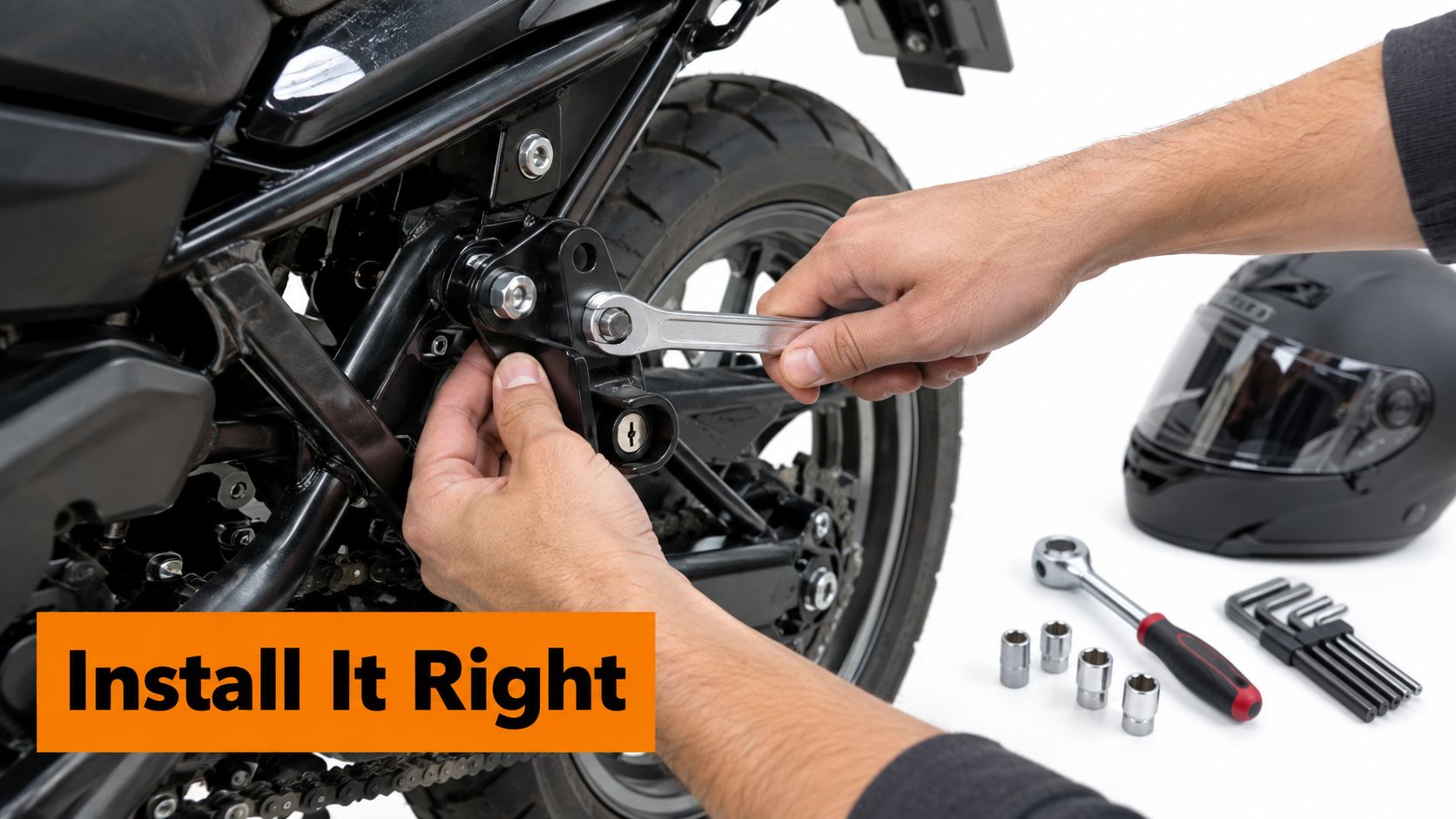
Route around heat and movement
Route the cable along an existing protected path where possible. Keep it away from the exhaust canister, headers, radiator, rear shock, chain, tyre, and every part that moves as the suspension compresses or the steering turns.
A good test is physical, not visual. With the motorcycle on its stand, move the suspension through its available range and turn the handlebars from side to side. The cable must not become tight, enter the wheel's path, or rub against a hot component.
Installation rule: If the helmet hangs in a position you wouldn't leave your hand, visor, or jacket, change the routing before using the lock.
Test the engagement
Pass the lock through the D-rings fully. The chin strap shouldn't be twisted, pinched, or trapped under the lock body. Give the helmet a firm hand tug. A connection that appears closed but releases when the ring rotates isn't properly engaged.
Finally, check the parked position with the motorcycle leaned on its side stand. Confirm that the helmet, bracket, and cable clear the ground, painted panels, exhaust, and rear wheel. The helmet should hang without being crushed, dragged, or forced into a sharp bend.
Why Security Is Not the Same as Theft Proof
A blocca casco moto is a deterrent, not a vault. Its realistic job is to make a quick removal inconvenient and to stop the helmet from sliding off the motorcycle. It isn't designed to defeat every thief carrying cutters or tools.
The practical guidance on motorcycle helmet locks describes the same basic limitation. Factory and aftermarket locks can discourage casual theft, but a determined person may still attack the cable, hook, bracket, or motorcycle anchor. The weakest part of the chain decides the outcome.
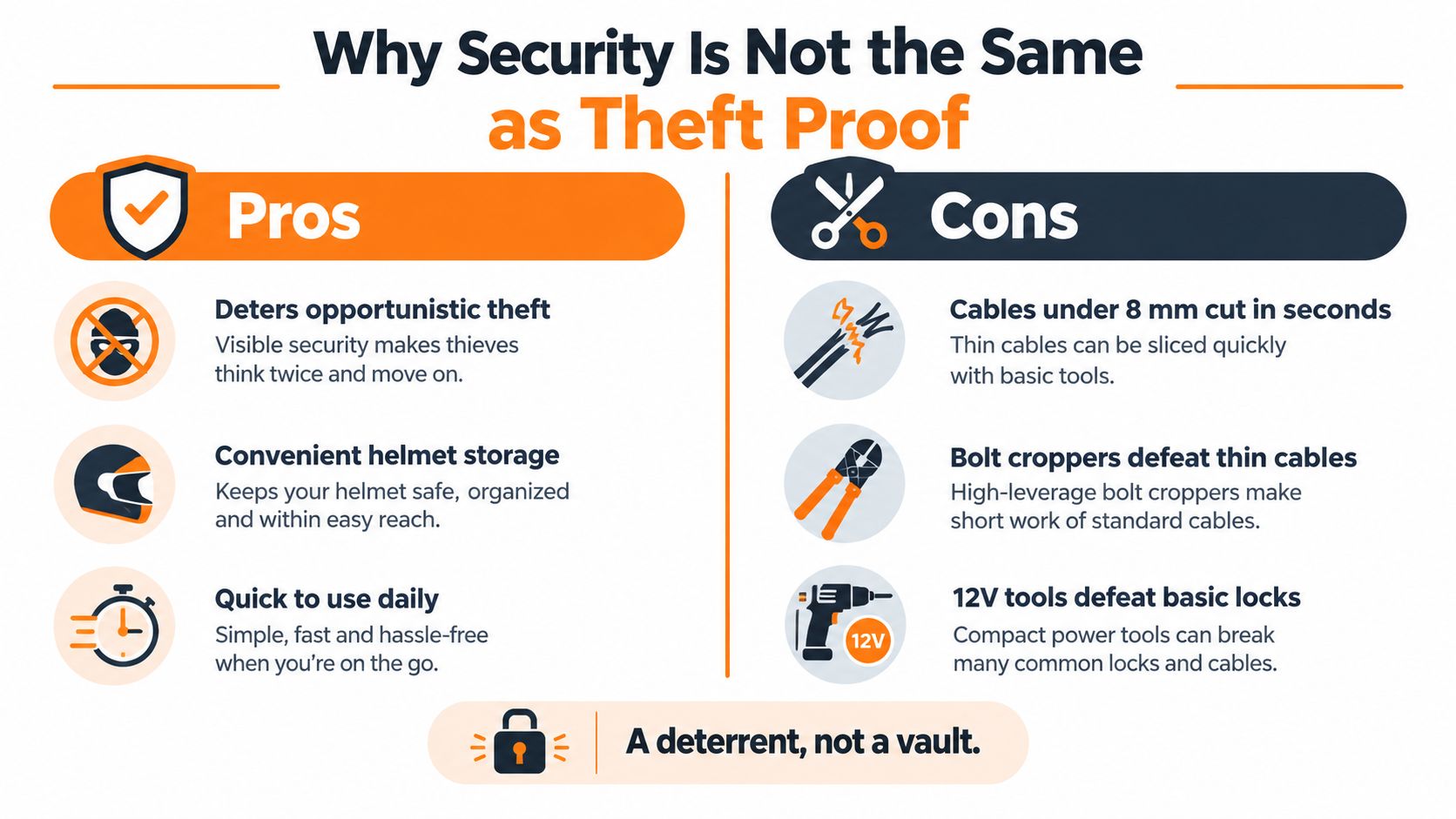
Decide according to the parking risk
A brief stop in a visible place is different from leaving a motorcycle overnight in an isolated area. In a high-risk location, carry the helmet if possible, use a lockable top case, or add another security layer to the motorcycle and helmet.
A wheel or disc lock protects the motorcycle, but it doesn't automatically secure the helmet. A second cable routed to a genuine frame point can add delay, while an alarmed device may attract attention. None of these options guarantees recovery.
The honest calculation is convenience and delay, not guaranteed recovery.
Don't buy a helmet lock on the assumption that its appearance proves strength. Check the anchor, cable protection, lock body, and helmet contact points. A cheaper device that you use correctly may be more useful than a heavy-looking bracket that damages the shell or attaches to weak bodywork.
Maintenance and Inspection to Protect Both Lock and Helmet
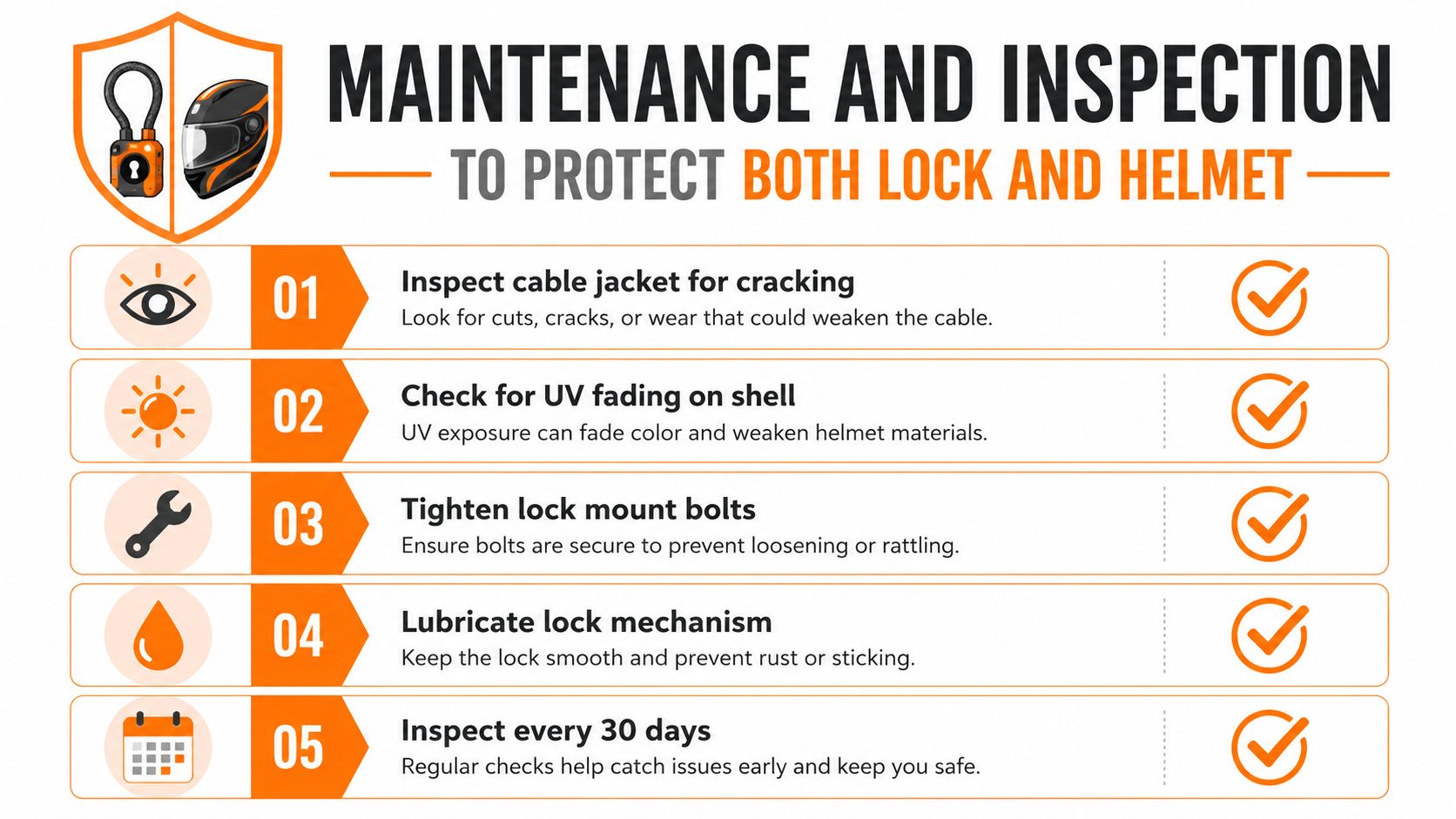
Treat the lock and helmet as one working system. Both experience vibration, weather, ultraviolet exposure, temperature changes, and repeated handling. A cable can look intact from a distance while its outer jacket cracks near the anchor, and a lock cylinder can become unreliable after dirt and moisture enter the mechanism.
The helmet deserves the same attention. Check the D-rings for deformation, the strap stitching for abrasion, and the shell and liner for marks caused by contact with the hardware. A lock that has been forced should be replaced even if the key still turns.
Use a simple inspection routine
- Inspect the cable: Look for cracking, flattening, exposed metal, fraying, or sharp bends near the anchor.
- Check the cylinder: The key should turn smoothly. Clean contamination according to the lock maker's instructions rather than packing the mechanism with heavy grease.
- Examine the helmet: Look for fresh scratches, pressure marks, strap wear, damaged stitching, and deformed D-rings.
- Review the mounting hardware: Check for movement, loosened fasteners, tool marks, and contact with painted surfaces.
- Inspect after an incident: If someone has tried to remove the helmet, stop using the system until the bracket, cable, lock, and helmet have all been assessed.
Protect the helmet from its storage environment
Temperature matters. A published EN 1078 helmet document warns that high temperatures beginning around 60 °C can seriously damage helmet construction and recommends cool, dry storage. It also cautions that aggressive cleaners, solvents, paint, and stickers may affect protective performance. The document's conditioning procedures expose helmets to approximately +50 ± 2 °C and −20 ± 2 °C, showing that temperature is a controlled helmet-performance variable, not a minor storage detail. See the EN 1078 helmet document for the specified warnings and conditioning context.
Keep a locked helmet away from exhaust outlets, hot engine parts, and sun-heated metal. Wipe contact surfaces clean, use soft cable protection where appropriate, and replace any component that has started to damage the shell or retention system. The motorcycle storage and preparation guide also provides useful context for protecting motorcycle equipment during storage.
Choosing, Installing, and Using Your Blocca Casco
Make the decision in this order: helmet type, engagement point, motorcycle anchor, clearance, then security level. Starting with the lock's appearance or cable thickness can lead you toward a product that doesn't fit the helmet you actually wear.
For a full-face or modular helmet with suitable D-rings, a cable or ring lock is often the most direct solution. An open-face helmet may suit an under-seat system or a fixed bracket, but only if the strap hardware can't slip free. An off-road helmet needs extra care because the peak and goggle strap must remain completely outside the load path.
A practical sequence
- Identify the correct helmet attachment: Use the D-rings or designated load-bearing strap hardware. Never use the visor, shell edge, vents, peak, or liner.
- Confirm the motorcycle anchor: Choose a rigid frame or subframe point and reject flexible bodywork.
- Check heat and movement: Test the cable near the exhaust, rear shock, swingarm, wheels, and steering.
- Install without forcing the helmet: The lock should engage cleanly, with no twisted strap, crushed liner, or shell pressure.
- Layer security when needed: In exposed or high-risk parking, carry the helmet, use a top case, or add another appropriate security device.
- Inspect the system regularly: Replace a lock, cable, bracket, or strap component that shows fatigue or damage.
For riders selecting model-specific motorcycle accessories, Sixrace offers motorcycle and scooter parts with compatibility information, including protection, control, exhaust, suspension, and other fitment-focused products. Visit Sixrace to review available motorcycle equipment and choose a solution that supports your bike's actual mounting geometry rather than relying on a generic attachment.
 Italiano
 Deutsch
 Français
 Español
 English
 Polski