
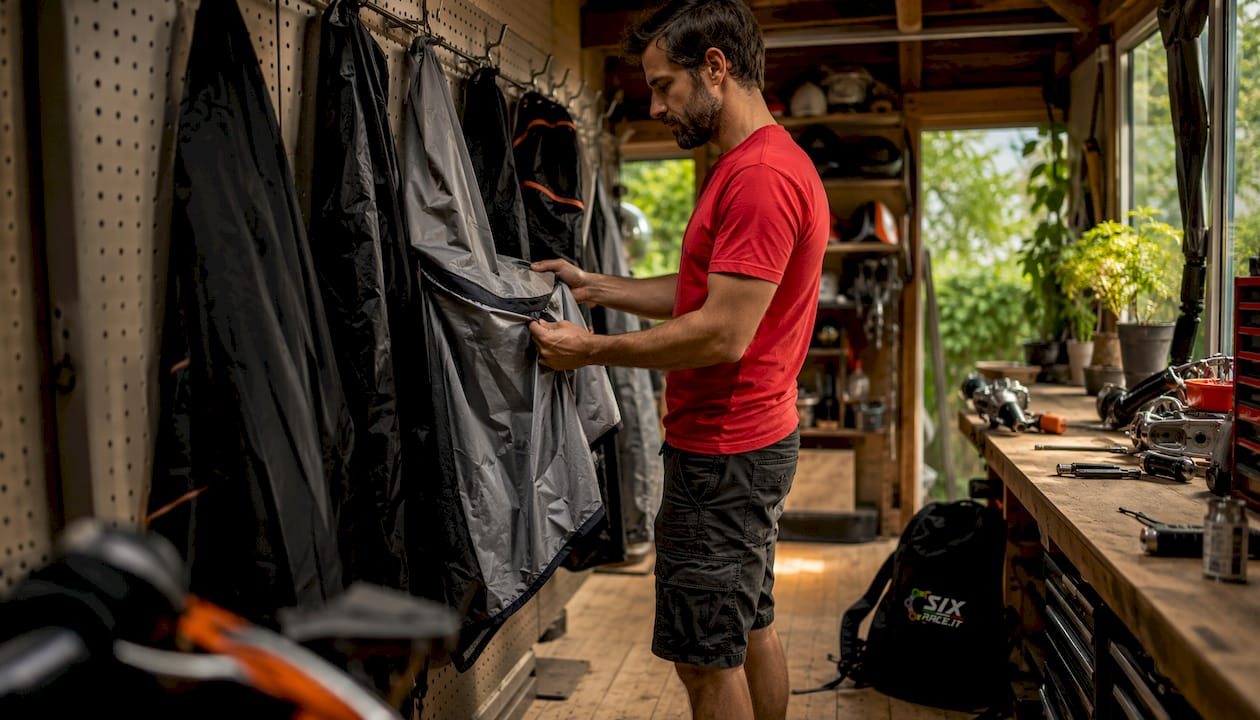
For most Central European riders, a breathable, weather-resistant polyester 300D outdoor cover is the single best starting point. It combines UV resistance, tear strength, and the ventilation needed to prevent condensation damage on bikes stored in variable climates. Measure your bike’s full length, maximum height (including screens and top boxes), and width across panniers before buying. For purchases, Sixrace stocks a broad range of compatible covers and accessories for European riders.
Quick-start checklist:
- Outdoor storage: choose a breathable, waterproof outdoor cover in 300D polyester minimum
- Indoor/garage storage: choose a breathable technical indoor cover, never an impermeable outdoor cover
- Sizing: account for windshields, top boxes, and panniers; allow 5–10 cm clearance from the floor
Table of Contents
- What are the main types of motorcycle covers?
- How do materials and construction affect cover performance?
- Which cover features suit Central Europe’s seasons?
- How do you measure and size a cover for a modified bike?
- What features should you look for on a product page?
- How should you clean and store a motorcycle cover?
- Buying checklist for Central European riders with modified bikes
- Where to buy quality covers in Central Europe
- Key takeaways
- Why this guidance holds up
- Useful sources and further reading
What are the main types of motorcycle covers?
Understanding cover categories is the fastest way to match your storage situation to the right product. Each type addresses a different combination of environment, duration, and threat.
- Fitted (direct-fit) covers are shaped to a specific make and model. They sit flush against the bodywork, minimise wind flap, and offer the best paint protection. Worth the premium if your bike carries aftermarket screens, side cases, or a top box that a universal cover would strain over.
- Semi-fitted covers follow a general silhouette (sport, tourer, adventure) without being model-specific. A practical middle ground for most riders.
- Universal/top covers are the most common and the most variable in quality. They fit a wide range of bikes but can pool excessively on smaller machines, collecting grit and abrading paint.
- Indoor/garage covers are breathable and lightly padded. Technical indoor covers are designed to balance light moisture resistance with airflow, protecting against minor impact scratches and condensation inside garages and storage boxes.
- Winter/storm covers use heavier, multi-layer construction to handle prolonged snow, frost, and wind. They are typically less breathable, so they suit open outdoor exposure rather than enclosed spaces.
- Transport covers (cycle or trailer covers) are lightweight and designed for short-duration protection during transit, not long-term storage.
Industry practitioners warn that choosing a cover for looks rather than environment is the most common mistake riders make. Poor ventilation in a damp garage causes more paint harm than rain exposure.
How do materials and construction affect cover performance?
The fabric specification on a product page tells you most of what you need to know, provided you know how to read it.
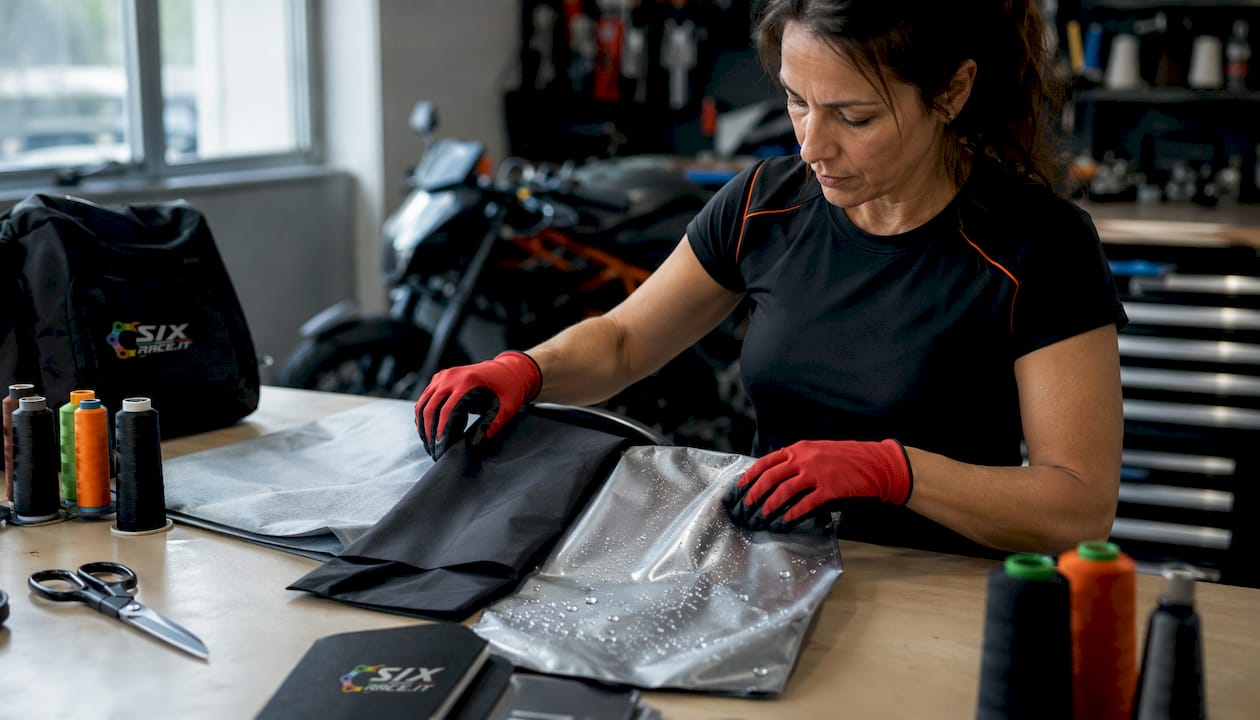
Fibre type is the starting point. Polyester is the recommended choice for outdoor covers: it resists tearing, degrades more slowly under UV exposure than polyamide, absorbs minimal moisture, and dries faster. Polyamide (nylon) is softer but less UV-stable. Polyethylene and other microfibres appear in budget products and typically underperform in prolonged outdoor use.
Denier (D) measures yarn thickness and fabric density. A 300D baseline gives notably better tear resistance than 190D or 210D fabrics, but denier alone is not a guarantee. Raw material quality and manufacturing precision change real-world durability significantly. Inspect seam construction and coating quality alongside the denier figure.
| Feature | What to look for | Why it matters |
|---|---|---|
| Denier rating | 300D minimum for outdoor use | Tear resistance and longevity |
| Outer coating | TPU or PVC; welded or taped seams | Waterproofing under sustained rain |
| Inner lining | Soft fleece or microfibre | Paint and lacquer protection |
| Vents/air ports | At least one vent port | Prevents condensation build-up |
| Hem and straps | Elastic hems, tie-down straps | Secure fit in wind |
Coatings and seam construction are where budget covers typically cut corners. Sewn seams without taping allow water ingress at the needle holes; welded or taped seams prevent this. For prolonged outdoor exposure in Central Europe, taped seams are worth prioritising.
Pro Tip: When reading a product spec sheet, look for an explicit breathability rating (measured in g/m²/24h) alongside the waterproof rating. A cover that states only “waterproof” with no breathability figure is likely impermeable, which creates condensation risk in enclosed storage.
Effective outdoor covers must combine waterproof capability with breathability. A cover that seals moisture out from above but traps humidity rising from the engine and ground is actively harmful to paintwork.
Which cover features suit Central Europe’s seasons?
Central Europe’s climate is genuinely variable: cold, damp winters with frost and occasional snow; warm summers with UV exposure and sudden heavy showers; and urban environments where pollution and temperature swings accelerate material degradation.
Seasonality dictates the choice: winter covers should prioritise insulation and protection against snow and frost, while summer covers focus on light weight, breathability, and UV resistance. A single all-season cover is a compromise; if your bike is stored outdoors year-round, consider two covers.
For winter storage in Central Europe, a heavier multi-layer cover with a soft inner lining protects against frost penetration and wind abrasion. For summer street parking, a lighter 300D breathable cover handles UV and rain without trapping heat beneath the fabric.
Pro Tip: In damp urban environments, even a brief period of trapped moisture under an impermeable cover can cause corrosion on exposed metal and staining on painted surfaces. Prioritise breathability over absolute waterproofing for any covered or semi-covered storage.
Coastal exposure adds salt to the equation. For coastal or salt-exposed environments, prioritise corrosion-resistant lower panels and clean the cover regularly to prevent salt crystals from abrading the fabric and the bike’s finish. Urban pollution similarly degrades coatings faster, so inspect your cover’s outer surface at the start of each season.
How do you measure and size a cover for a modified bike?
Sizing is where many riders make avoidable errors, particularly on bikes with aftermarket screens, panniers, or top boxes.
- Measure overall length from the front wheel contact point to the rear of the tail unit or top box, whichever extends furthest.
- Measure maximum height from the ground to the highest point, typically the top of a windshield or a tall top box.
- Measure maximum width across the widest point, usually the panniers or handlebar ends.
- Add clearance — the cover should sit 5–10 cm from the floor to promote airflow and prevent ground moisture wicking into the fabric.
- Choose the next size up if your measurements fall between sizes, but avoid excessive pooling: fabric that bunches heavily on the ground collects grit and abrades paintwork.
For bikes with bulky accessories, a direct-fit cover is worth the premium. Universal covers stretched over tall screens or wide panniers create pressure points that can mark bodywork over time. Secure the lower straps firmly to prevent wind flap, which causes its own abrasion damage.
What features should you look for on a product page?
When scanning retailer listings, these are the specifications that separate a functional cover from one that will fail within a season.
Must-have features:
- 300D polyester minimum (outdoor covers)
- Explicit UV protection rating or UV-resistant coating
- Breathability/vent ports stated on the spec sheet
- Sealed or taped seams for outdoor use
- Soft inner lining (fleece or microfibre) for paint contact surfaces
Useful extras:
- Reflective panels for street parking visibility
- Lock-through holes for chain or disc lock security
- Reinforced lower panels for coastal or abrasive environments
- Storage bag included (indicates the manufacturer expects the cover to be removed and re-fitted regularly)
- Brand warranty and return policy
Pro Tip: A cover with reflective panels and a lock-through hole adds a meaningful deterrent layer for street parking. Thieves prefer uncovered bikes; a locked cover adds time and visibility risk to any attempt.
Price is a reasonable proxy for material quality, but not a guarantee. A higher price from a reputable brand typically reflects better coating chemistry, more precise seam construction, and longer-term UV stability. Check the motorcycle accessories category for tie-down straps, lock cables, and supplementary protective items.
How should you clean and store a motorcycle cover?
A cover that is put away damp or dirty will degrade faster and can transfer mould and grit to your bike’s paintwork.
Cleaning steps: Remove loose grit with a soft brush before washing. Hand-wash with mild soap and lukewarm water; avoid aggressive solvents, bleach, or machine drying unless the manufacturer explicitly permits it. Rinse thoroughly and allow to dry completely in open air before folding.
Drying and airing: Never fold or store an outdoor cover while damp. Even partial moisture retention creates conditions for mould growth inside the folded fabric, and mould stains are difficult to remove from coated polyester.
Warning: Using an impermeable outdoor cover inside a garage creates a condensing microclimate. Moisture from the engine, exhaust, and ground cannot escape, and it settles on painted surfaces, causing staining and corrosion over time. A breathable technical indoor cover is the correct solution for garage storage.
For long-term winter storage, fold the cover loosely and keep it in a cool, dry location. Avoid tight compression of coated fabrics, which can crack the coating at fold lines. Consult the motorcycle storage preparation guide for a full seasonal storage checklist.
Buying checklist for Central European riders with modified bikes
Use this decision flow at the point of purchase.
Environment checkpoints:
- Outdoor street parking? → 300D breathable outdoor cover, taped seams, UV coating, lock-through hole
- Covered courtyard or carport? → Semi-fitted breathable cover; lighter weight acceptable
- Garage or storage box? → Breathable technical indoor cover; never an impermeable outdoor cover
- Coastal or salt-exposed location? → Reinforced lower panels; plan for frequent cleaning
- Winter storage (3+ months)? → Multi-layer winter cover outdoors; breathable padded cover indoors
Cover type vs. primary threat:
| Cover type | UV | Rain | Snow/frost | Condensation | Theft deterrence |
|---|---|---|---|---|---|
| Fitted outdoor (300D) | ✓✓ | ✓✓ | ✓ | ✓ (with vents) | ✓ (lock hole) |
| Semi-fitted outdoor | ✓✓ | ✓ | ✗ | ✓ (with vents) | ✓ (lock hole) |
| Universal outdoor | ✓ | ✓ | ✗ | Varies | Varies |
| Technical indoor | ✗ | ✗ | ✗ | ✓✓ | ✗ |
| Winter/storm cover | ✓ | ✓✓ | ✓✓ | ✗ | ✓ (lock hole) |
Budget guidance: For daily outdoor use, invest in a 300D fitted or semi-fitted cover with taped seams. For garage storage, a quality technical indoor cover costs less and protects better than repurposing a cheap outdoor cover. For modified bikes with panniers or tall screens, a direct-fit cover justifies the higher price through better fit and reduced abrasion risk.
Where to buy quality covers in Central Europe
Sixrace is a specialist European motorcycle retailer stocking performance parts, accessories, and protective products from established brands including Evotech Performance, Acerbis, R&G, and Powerbronze. The catalogue is organised by make, model, and year, so compatibility checks are straightforward even for modified bikes with aftermarket components.
For Central European customers, Sixrace offers tracked shipping, multilingual support, and secure payment across the region. The accessories category covers tie-down straps, lock cables, and protective add-ons alongside covers. For make-specific guidance, the Honda parts guide is a useful starting point for compatibility reference.
Claim your reserved discount on motorcycle covers and accessories at the Sixrace discount page before purchasing.
Key takeaways
A breathable polyester 300D outdoor cover, correctly sized for your bike’s full dimensions including accessories, is the most effective general-purpose choice for Central European riders.
| Point | Details |
|---|---|
| Best general-purpose choice | A breathable 300D polyester outdoor cover suits most Central European storage conditions. |
| Indoor vs outdoor | Never use an impermeable outdoor cover in a garage; it traps condensation and damages paintwork. |
| Sizing for modified bikes | Measure length, height, and width including panniers and screens; allow 5–10 cm floor clearance. |
| Key features to verify | Check for taped seams, UV coating, vent ports, and a soft inner lining before buying. |
| Sixrace for purchases | Sixrace stocks compatible covers and accessories for Central European riders with a reserved discount available. |
Why this guidance holds up
The conventional advice on motorcycle covers tends to collapse into two unhelpful extremes: “buy waterproof” or “buy breathable.” Neither framing is precise enough to be useful, particularly for riders in Central Europe’s variable climate or for those running modified bikes with aftermarket accessories.
The more productive question is where the bike actually lives. A cover that performs excellently on a street-parked adventure tourer in Warsaw will actively harm a bike stored in a damp Viennese garage. The impermeable outdoor cover in an enclosed space is one of the most consistent sources of preventable paint damage, and it is a mistake that costs far more to correct than the price difference between cover types.
For modified bikes, the fit question matters as much as the material question. A universal cover stretched over a tall windshield or wide panniers creates localised pressure points that mark bodywork over months. The premium for a direct-fit or correctly sized semi-fitted cover is modest compared with a respray.
Sixrace’s catalogue approach, matching products by make, model, and year, addresses exactly this problem. It removes the guesswork from compatibility and makes it practical to find a cover that actually fits your specific configuration, not just a generic silhouette.
Useful sources and further reading
| Source | Sections supported |
|---|---|
| MYCOVER® — cover consultant | Materials, denier, breathability vs waterproofing |
| MYCOVER® — premium covers guide | Sizing tolerances, floor clearance, fit best practice |
| NaplesMotorcycle — condensation guide | Indoor vs outdoor cover risks, garage condensation |
| SYM Italia — protective cover guide | Seasonality, coastal exposure, reflective panels |
| SicurMoto — cover features guide | Feature checklist, seam types, spec sheet reading |
| Sixrace accessories category | Tie-down straps, lock cables, protective add-ons |
| Sixrace storage preparation guide | Long-term storage and seasonal preparation |
 Italiano
 Deutsch
 Français
 Español
 English
 Polski