
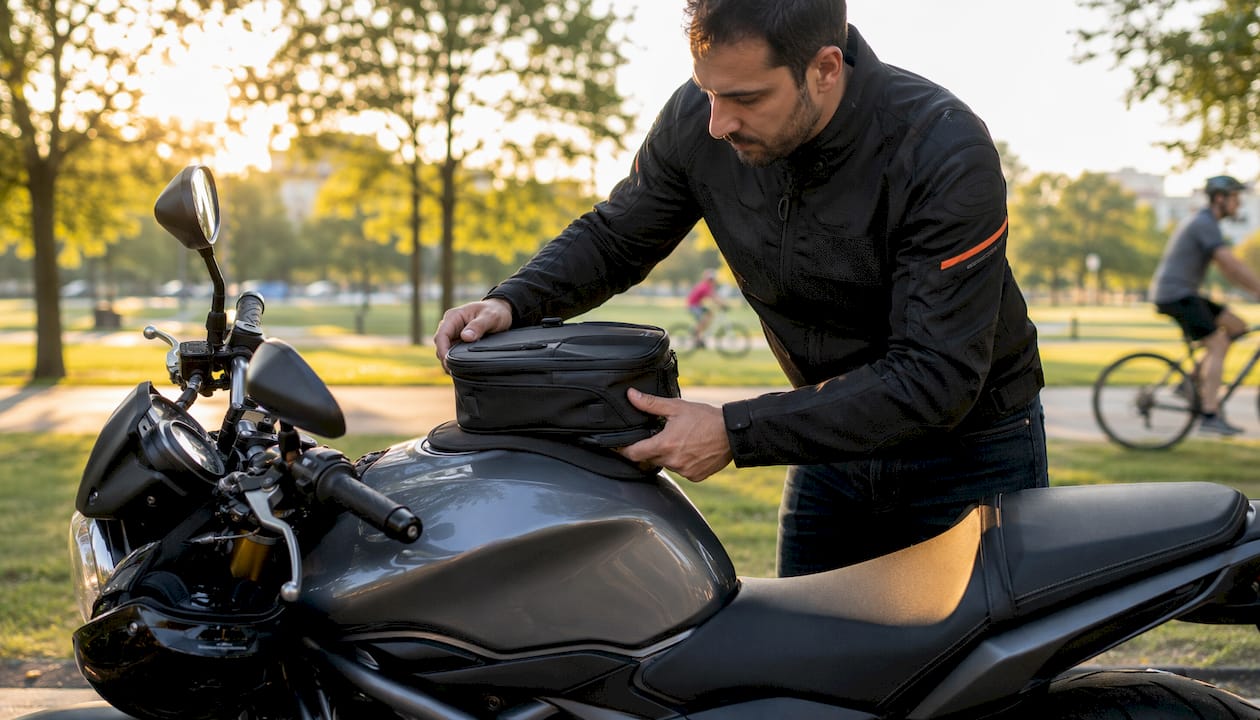
A motorcycle tank bag provides instant, ergonomic access to mission-critical items without dismounting, reducing fatigue on longer rides and keeping essential gear within arm’s reach at all times. Positioned centrally on the fuel tank, it sits close to the bike’s natural centre of gravity, which matters far more than most riders initially appreciate.
The core role is straightforward: accessible, low-profile storage for items you need during the ride, not just at the destination. Navigation, documents, a phone, snacks, and small tools all belong here rather than buried in a pannier. Three quick examples of what riders typically carry:
- Navigation device or phone in the clear top pocket
- Wallet, documents, and permits in an inner organiser
- Gloves, snacks, or a charging cable in the main compartment
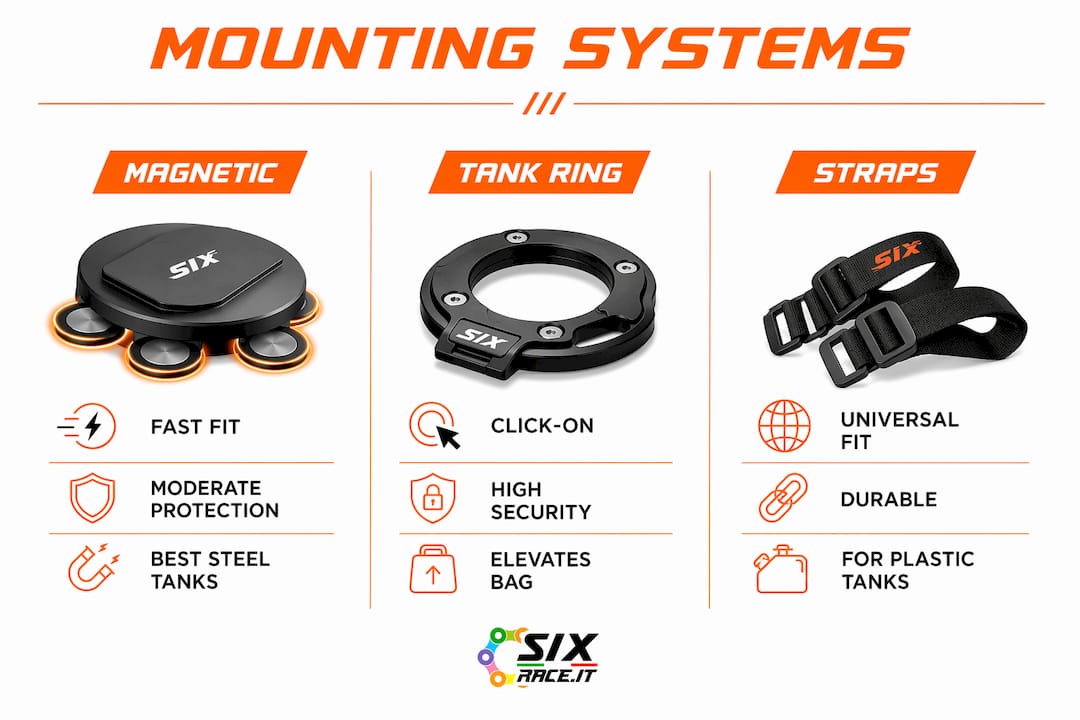
Mounting options fall into three families: magnetic systems for metal tanks, tank-ring systems for a raised, paint-safe fit, and strap or harness systems for plastic or complex tanks common on adventure bikes.
Table of Contents
- What is a tank bag and what does it consist of?
- Practical benefits and when a tank bag genuinely helps
- How do the three mounting systems compare?
- Choosing the right size and what to pack
- How tank bags affect handling and what to check before riding
- Care, waterproofing, and protecting your tank finish
- Pros and cons at a glance
- How to pick the right tank bag for your bike and riding
- Sixrace retailer perspective: what to prioritise when buying
- Key takeaways
- A practical note on tank bags from experience
- Sixrace: find the right tank bag for your motorcycle
- Useful sources and further reading
What is a tank bag and what does it consist of?
A tank bag is a soft or semi-rigid luggage item designed to sit on the fuel tank of a motorcycle, secured by magnets, a dedicated ring mount, or adjustable straps. Its position keeps weight central and low, close to the bike’s centre of gravity, which distinguishes it from tail packs or panniers that shift mass rearward.
Common components you will encounter across most models include a clear map or phone pocket on the top panel, a main compartment with internal organisers, side pockets for smaller items, a waterproof rain cover, and quick-release fittings or magnetic panels in the base. Many touring-oriented bags also feature a cable port for charging devices on the move, and a touch-responsive navigation pocket is now considered a near-universal feature for long rides.
Materials typically range from 600D to 1680D ballistic nylon for the outer shell, with a reinforced or semi-rigid base to maintain shape when empty. Compatibility constraints matter: a flat-based bag suits sport-tourers and standards, while a sloped base fits cruisers and adventure bikes with tanks that taper towards the seat. Instrument panel placement and tank width can also limit which bags physically fit your model.
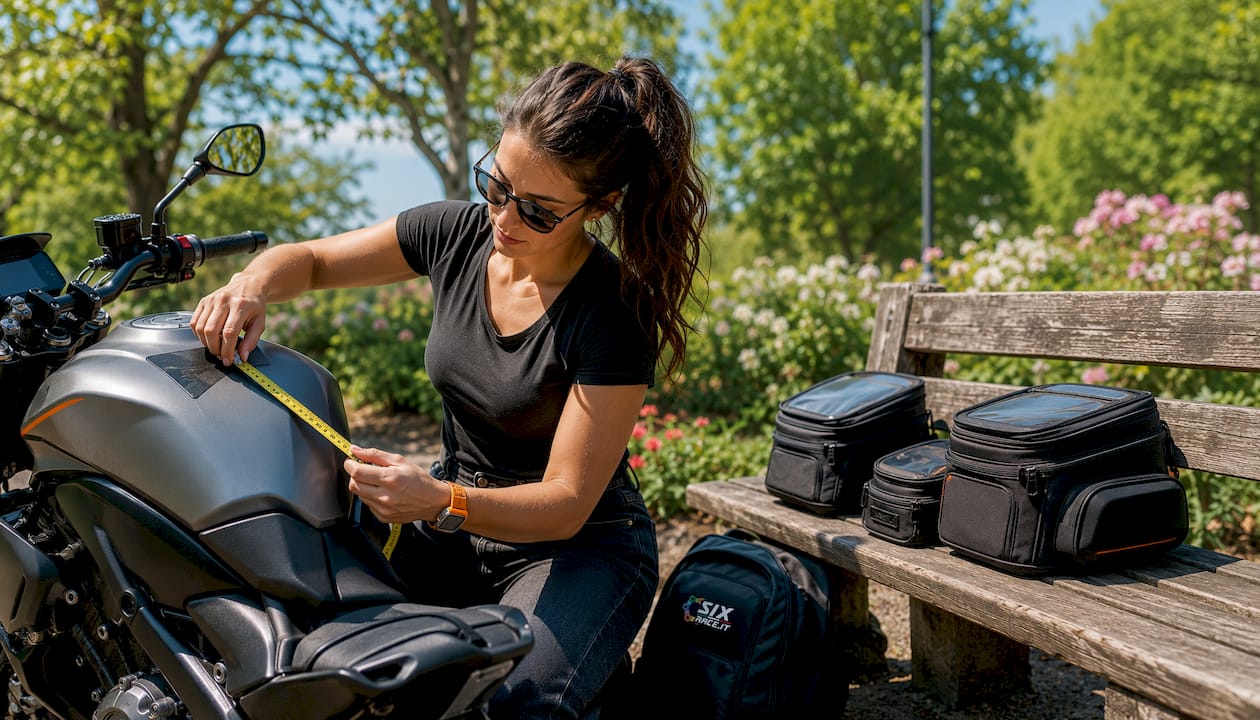
Pro Tip: Before purchasing, measure the usable flat area of your tank from the instrument panel to the fuel cap. Many riders discover their chosen bag is too long and crowds the dash only after it arrives.
Practical benefits and when a tank bag genuinely helps
The primary benefit is instant access without dismounting. On a multi-day tour or a long ADV day, every stop to retrieve something from a pannier adds time and fatigue. A tank bag eliminates that friction for the items you reach for most.
Key benefits matched to typical use cases:
- Commuting: carry a wallet, phone, and documents without a backpack; remove the bag in seconds when you park.
- One-day touring: navigation visible at a glance, snacks and sunglasses accessible at fuel stops.
- Long-distance adventure: adventure riders treat the tank bag as a command centre for navigation, permits, and communications, reducing dismounts over a full day in the saddle.
- Quick errands: a magnetic bag mounts and removes in seconds, making it practical for short trips where a full luggage setup is unnecessary.
Tank bags also avoid the back strain associated with rucksacks and keep the bike’s overall width unchanged, which matters when filtering through Central European city traffic. On heavily loaded touring bikes, shifting some mass forward into a tank bag can actively improve front-end feel and counteract a light front caused by large rear panniers.
Pro Tip: Match your bag’s features to your primary use. For touring and navigation, prioritise a touch-panel top pocket and a waterproof rating of at least IPX4. For commuting, a magnetic system with a quick-release handle is more practical than a ring mount.
How do the three mounting systems compare?
Three primary mounting families dominate the market, each with clear trade-offs for speed of removal, paint protection, and off-road security.
| Mounting type | Speed of removal | Paint protection | Off-road security | Best suited to |
|---|---|---|---|---|
| Magnetic | Very fast | Moderate (requires clean tank) | Low | Metal tanks, commuting, road touring |
| Tank-ring | Fast (click-release) | High (bag sits above tank) | Moderate | Road, sport-touring, multi-bike setups |
| Strap / harness | Slower | Moderate (requires clean base) | High | Plastic tanks, ADV, off-road |
Magnetic systems use large magnets sewn into the base to hold the bag against a steel tank. They mount and remove in seconds, leave no hardware behind, and transfer easily between bikes with metal tanks. The downside is that dirt trapped between the bag base and tank acts as an abrasive; myths about magnets scratching paint usually stem from neglected contact surfaces rather than the magnets themselves. They are also less suitable for naked bikes without a fairing, where wind can cause the bag to shift at speed.
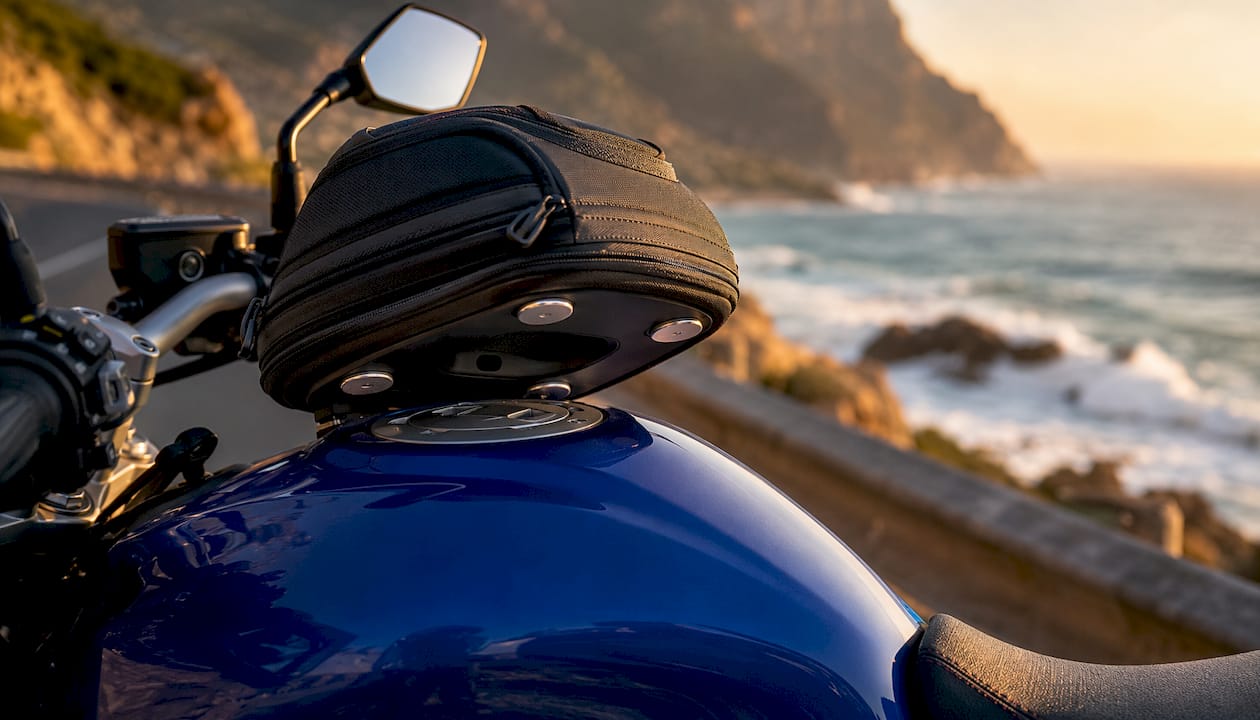
Tank-ring systems bolt to the fuel cap bolts and allow the bag to click on and off like a ski binding. The bag sits elevated above the tank surface, which protects paint and allows power pass-through options for charging devices. Rings are bike-specific but inexpensive, and a second ring lets you move the bag between two motorcycles instantly.
Strap and harness systems loop around the tank and are the only reliable option for bikes with plastic tanks, oversized aftermarket tanks, or complex tank shapes common on adventure motorcycles. They are the most secure under sustained vibration and off-road impacts, though removal at fuel stops takes longer.
Choosing the right size and what to pack
Capacity bands give a useful starting framework: micro bags under 4 litres suit canyon carvers and minimalists; commuter bags of 4–8 litres carry daily essentials; touring bags of 8–15 litres accommodate layers, documents, and electronics; and larger bags up to 26 litres suit long-distance riders who want clothing layers within reach.
Experienced ADV riders and practitioners consistently warn against oversizing: a bag that looks useful in the garage becomes a problem on rough terrain, where bulk interferes with body position and standing on the pegs.
Packing principles that protect handling and comfort:
- Place heavy or dense items low and central in the main compartment, not in the top pocket.
- Keep valuables and electronics in inner pockets or a dry bag liner.
- Avoid hard-edged tools in the main compartment; carry those lower on the bike.
- Never pack to a point where the bag profile rises above the instrument panel.
Pro Tip: Choose the smallest bag that covers your usual routine. A compact bag that stays out of your way on every ride is more useful than a large one you avoid fitting because it feels cumbersome.
How tank bags affect handling and what to check before riding
When properly sized and mounted, a tank bag has minimal effect on motorcycle stability. The risk comes from overpacking, incorrect positioning, or a bag that obstructs full handlebar movement. A bulky, high-profile bag can create a lever effect that destabilises steering if it prevents the bars from reaching full lock.
The most reliable pre-ride test is a static steering clearance check: sit on the bike, fit the bag as you would for riding, then turn the handlebars slowly from full left lock to full right lock. Any contact, resistance, or bag movement reveals a problem before you reach the road.
Additional checks: confirm straps are tight and buckles are secure, verify the bag does not block instruments, and on sportbikes, check that a full tuck is still possible. On adventure bikes, confirm you can stand on the pegs without the bag catching your jacket or thighs.
Care, waterproofing, and protecting your tank finish
Maintenance is the most frequent cause of paint damage, not the mounting system itself. Dirt and grit trapped under the bag base abrade the tank finish over time; the fix is straightforward but requires consistency.
Routine maintenance actions:
- Remove the bag after every ride in wet or dusty conditions and wipe both the bag base and the tank surface clean.
- Inspect magnets or rubber feet for embedded metallic particles before remounting.
- Apply a self-adhesive protective film to the tank contact area if you use the bag daily.
- Store the bag off the bike when not in use to prevent prolonged pressure on the finish.
For weather protection, use the integrated rain cover for short showers, but rely on inner waterproof pouches or a dry bag liner for sustained rain or creek crossings. Rain covers can detach at speed and offer inconsistent protection. A touch-panel top pocket keeps navigation accessible without opening the bag in wet conditions.
Do not mount the bag over loose grit or sand. Never leave fastenings partially tightened. Remove electronics and documents to a dry location when storing the bike for extended periods.
Pros and cons at a glance
Advantages:
- Instant access to navigation, documents, and essentials without dismounting
- No back strain compared with a rucksack
- Centralised weight placement, which can improve front-end feel on loaded touring bikes
- Does not increase the bike’s overall width
Disadvantages:
- Must be removed or repositioned to fill the fuel tank
- May obstruct a full tuck on sportbikes if oversized
- Magnetic and strap systems carry a paint-damage risk if contact surfaces are not kept clean
- Easy to steal if left unattended, particularly magnetic systems
Common mistakes to avoid: choosing a bag that is too large for the riding style, leaving straps loose, and skipping the clearance check after repacking.
How to pick the right tank bag for your bike and riding
A structured checklist prevents the most common purchasing errors:
- Tank compatibility: confirm the bag fits your tank’s shape (flat, sloped, or narrow) and that the base does not extend over the instrument panel.
- Mounting option: verify which system your tank accepts. Plastic or aftermarket tanks require straps; metal tanks can use magnets; ring mounts need a bike-specific ring.
- Phone and map pocket: check the top pocket fits your phone model and responds to gloved touch.
- Waterproof rating: match the rating to your typical conditions. IPX4 handles rain; fully sealed construction suits remote touring.
- Quick-release convenience: for commuting or frequent fuel stops, a one-handed release is worth prioritising.
Questions to ask a retailer: does this bag fit my specific model and year? What paint protection measures does the base include? Is there a conversion strap to carry it as a shoulder bag off the bike? What is the returns policy if the fit is incorrect?
Red flags: the bag contacts the instrument panel when mounted, the profile blocks a standing posture on an adventure bike, or the mounts feel flimsy under hand pressure before you even ride.
Sixrace retailer perspective: what to prioritise when buying
Sixrace, as a specialist European aftermarket retailer working with brands such as Acerbis and Evotech Performance, sees one pattern repeat consistently: riders who prioritise secure mounting and correct sizing for their primary ride type are satisfied; those who buy the largest available bag are not.
For riders browsing motorcycle bags and accessories, Sixrace’s catalogue is organised by motorcycle make, model, and year, which simplifies compatibility checks before purchase.
Key takeaways
A motorcycle tank bag’s primary value is ergonomic, centralised access to mission-critical items, but that value depends entirely on correct sizing, a compatible mounting system, and consistent maintenance of contact surfaces.
| Point | Details |
|---|---|
| Accessibility is the core function | A tank bag keeps navigation, documents, and essentials within reach without dismounting. |
| Size and fit determine handling impact | Oversized bags obstruct steering and body position; choose the smallest bag that covers your routine. |
| Pre-ride clearance check is non-negotiable | Turn handlebars lock-to-lock with the bag fully loaded before every multi-day trip. |
| Maintenance protects the tank finish | Clean bag base and tank surface regularly; inspect magnets for metallic particles before remounting. |
| Sixrace for compatible options | Sixrace lists motorcycle bags by make, model, and year for straightforward compatibility checks. |
A practical note on tank bags from experience
The moment a tank bag proves its worth is not on a long tour. It is on a two-hour commute when you reach the office and realise you never once thought about where your phone, wallet, or documents were. That absence of friction is the point. The recommendation that follows from that: fit the bag to the ride you do most often, not the ride you plan once a year. A compact, well-mounted bag you use every day delivers more value than a large touring bag that stays in the garage because it feels like too much effort to fit.
Sixrace: find the right tank bag for your motorcycle
Sixrace stocks a broad range of motorcycle accessories and luggage from established manufacturers, with the catalogue organised by make, model, and year so you can confirm compatibility before you buy. Whether you ride a road bike through Central European cities or an adventure motorcycle across mixed terrain, the right tank bag is listed with the mounting options and dimensions you need to make an informed choice.
Claim your reserved discount on motorcycle accessories and luggage at Sixrace and get the right tank bag for your bike at a competitive price. Visit the Sixrace discount page to access your offer and browse the full accessories catalogue.
Useful sources and further reading
| Source | Why it is useful |
|---|---|
| SW-MOTECH | Capacity guidance, mounting system specifications, and tank-ring compatibility for European models |
| Nomad Moto — ADV tank bag guide | Practical ADV sizing and fitment advice from adventure riding practitioners |
| Off Road Top Speed — steering clearance | Step-by-step lock-to-lock clearance test and handling safety checklist |
| MCNews — tank bag myths | Maintenance guidance and evidence-based correction of magnetic bag paint-damage myths |
| Viaterra Gear | Handling impact analysis and instrument clearance guidance for correctly mounted bags |
| Sixrace motorcycle bags | Compatible tank bags and luggage accessories matched by motorcycle make, model, and year |
| Sixrace accessories | Full accessories catalogue covering mounting hardware, gadgets, and complementary riding gear |
 Italiano
 Deutsch
 Français
 Español
 English
 Polski