

You're standing in front of a shelf of two-stroke oils, or scrolling through an online catalogue, comparing bottles marked 100% synthetic, ester, low smoke, and JASO FD. The prices differ, the claims overlap, and the practical question is simple: which oil will protect your engine without making you pay for marketing?
The phrase olio miscela 2t 100 sintetico points to a fully synthetic two-stroke oil, but the words alone don't tell you whether it suits your engine. A synthetic base can improve thermal stability and cleanliness, yet the more useful buying signal is the oil's performance certification, application, and compatibility with your mixing or injection system.
Table of Contents
- Understanding Two-Stroke Synthetic Oils
- Why JASO FD Certification Matters
- The Premix Ratio Formula
- Oil Injection System Compatibility
- Choosing the Right Oil for Your Bike
- Frequently Asked Questions
Understanding Two-Stroke Synthetic Oils
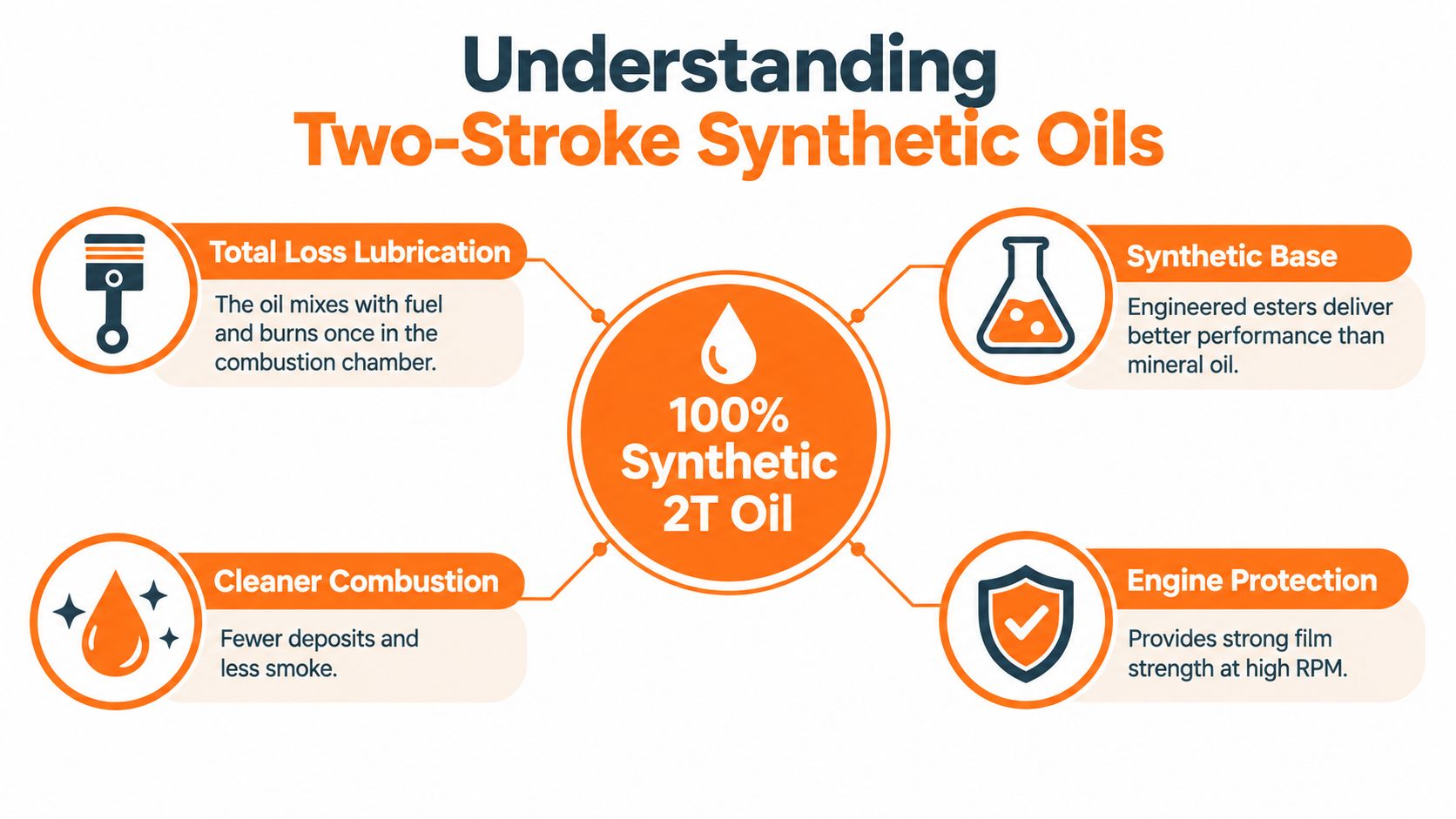
A two-stroke engine treats oil very differently from a four-stroke engine. In a four-stroke motor, lubricant circulates through the crankcase, passes through a filter, and remains in the engine for repeated service intervals. In a two-stroke, oil enters with the fuel or arrives through an injection system, lubricates the bearings, piston, cylinder, and rings, then much of it burns during combustion.
That makes combustion behavior part of lubrication quality. An oil that forms a strong film but leaves heavy deposits can still create problems around the piston crown, rings, spark plug, and exhaust port. A well-formulated synthetic aims to keep the lubricating film stable under heat while limiting the residue left after the oil burns.
What the synthetic label actually tells you
100% synthetic describes the formulation's base-fluid approach. It doesn't automatically describe the oil's certification level, its suitability for oil injection, or the correct premix ratio for a particular motorcycle.
Synthetic base stocks are engineered for more predictable behavior than conventional mineral oils. Ester-based formulations are especially valued in demanding applications because their polarity helps them maintain contact with metal surfaces, while their film strength supports boundary lubrication when the engine is operating at high speed or under heavy load. Those characteristics matter in a two-stroke because the lubricant has limited time to protect the moving parts before combustion carries it away.
A mineral, semi-synthetic, or fully synthetic oil can be formulated for a two-stroke engine, but they won't all deliver the same cleanliness or high-temperature behavior. The meaningful comparison is between the complete formulation and its verified performance claims, not between a single word on the front label.
For a broader look at motorcycle engine-oil products and applications, the Sixrace engine oil selection can be used as a catalogue reference, but your motorcycle manual remains the authority for specification and dosage.
Why deposits matter
Two-stroke deposits aren't merely cosmetic. Carbon around the exhaust port can restrict gas flow, while varnish around the piston skirt or rings can interfere with ring movement. Spark-plug fouling can make starting inconsistent, and excess smoke often signals that the oil, ratio, engine condition, or operating cycle needs attention.
Synthetic oil can help reduce residue and smoke when the formulation is designed for clean combustion. It can't repair a worn crank seal, incorrect jetting, a blocked silencer, or an oil ratio that doesn't match the engine. The oil is one part of the system, not a substitute for correct setup.
Workshop rule: Treat “synthetic” as a description of the base fluid. Treat the certification and application claims as evidence of how the finished oil is intended to perform.
Why JASO FD Certification Matters
A bottle can promise 100% synthetic oil while offering little evidence about how the finished lubricant performs. The useful distinction is base-stock description versus performance certification. “100% synthetic” describes the lubricant base. JASO FD identifies a performance class within the JASO M345 framework, giving you a defined standard to check against.
JASO FD is the highest category in that framework. Introduced in 2004 to supersede JASO FC as the top rating, it addresses the detergency and cleanliness demands of high-output small engines and motorcycles, according to the JASO technical summary.
FD is not a synonym for fully synthetic
JASO FD is a performance class, not a base-stock label. Fully synthetic, synthetic-blend, and mineral oils may qualify if their complete formulations meet the required criteria. Therefore, a bottle marked 100% synthetic without a clear JASO claim needs closer examination. Base-oil purity may support performance, but it does not prove that the oil passed the relevant tests.
FD sets tighter detergency requirements than FC and targets cleaner operation at high temperatures. Its specification includes a minimum kinematic viscosity at 100°C of 6.5 mm²/s, a minimum flash point of 70°C, and maximum sulphated ash of 0.18% by mass. These limits are only part of the assessment, yet they provide a technical baseline instead of relying on promotional wording.
The engine-test indices add another layer of evidence. JASO FD requires Honda Lubricity of at least 103, Initial Torque of at least 98, and Honda Detergency of at least 110, using the same M345 limits. In workshop terms, those tests assess lubrication and deposit control under specified conditions. They do not predict identical results in every modified, worn, or poorly tuned engine.
What the synthetic label tells you
A high-quality FD oil is formulated to control piston deposits, varnish, smoke, and wear more effectively than the older FC tier. Cleaner ring grooves help the rings maintain movement and sealing, while a cleaner exhaust port helps preserve gas flow. The rating remains a benchmark, not a guarantee that an engine will run correctly.
Low ash supports cleaner plugs, piston crowns, and exhaust components, but the final result also depends on oil dosage, fuel, carburation, engine wear, and riding conditions. The JASO FD technical overview from Lubrizol describes the category's focus on detergency, lubricity, smoke, and piston-deposit control.
Do not use an FD or fully synthetic label as permission to reduce the premix ratio on an older two-stroke. The oil may burn more cleanly and retain its film under severe use, but the engine still needs the lubricant volume specified for its design. Older clearances, bearings, crank seals, jetting, and cooling conditions can make a leaner oil ratio risky.
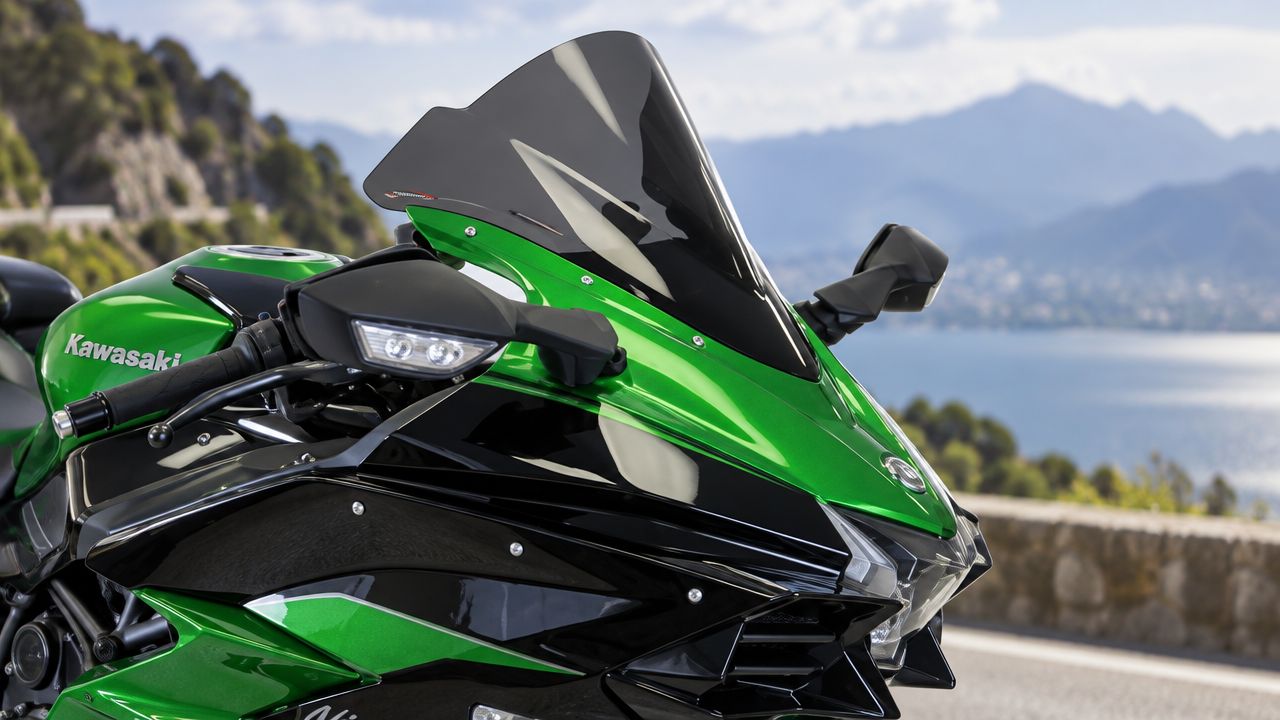
The same habit of reading specification data before buying applies to any catalogued part. For example, Cupolino Airflow Kawasaki Ninja H2 SX SE 1000 2018+ fume' scuro POWERBRONZE is identified for the KAWASAKI Ninja H2 SX SE POWERBRONZE 400-K142-002 fume' scuro, 2018-2022. Check compatibility separately from assumptions about performance.
The Premix Ratio Formula
The safest premix ratio is the one specified by the engine manufacturer. Oil quality doesn't cancel that instruction. A premium synthetic may burn more cleanly and maintain its film under demanding conditions, but using less oil than the engine was designed for can reduce the lubricant available to the piston, rings, bearings, and cylinder wall.
Start with the manual
First identify whether the engine uses manual premix or an oil-injection system. If it uses premix, find the manufacturer's stated ratio and keep it as the baseline. Some independent guidance continues to use 2%, or 1:50, for many street two-strokes, while other guidance warns that the correct ratio depends on engine design, age, load, and whether the motor was built for premix or injection this discussion of Vespa PX mixing guidance.
The calculation is straightforward:
- Read the specified ratio. Don't choose a leaner mixture because the bottle says 100% synthetic.
- Convert the fuel quantity. At 1:50, divide the fuel volume by 50 to find the oil volume.
- Measure accurately. Use a clean graduated container rather than estimating from the bottle.
- Blend before riding. Add the oil and fuel in a suitable container, then shake or stir until the mixture is uniform.
- Label the container. Mark the ratio and fuel date so you don't confuse it with another mixture.
For example, 5 litres of fuel at 1:50 requires 100 ml of oil. The same volume at 1:32 requires 156 ml, while 1:100 requires 50 ml. These are ratio calculations, not universal recommendations, so use the value required by your engine.
Why leaner isn't automatically safer
Riders often want to reduce smoke and plug fouling by reducing the oil content. That can work only when the engine manufacturer, oil specification, fuel system, and operating conditions support it. On an older engine, a high-load engine, or a motor running sustained high RPM, an arbitrarily lean ratio can leave insufficient oil at the exact moment the piston and bearings need protection.
There's another complication. Changing the oil quantity also changes the fuel mixture entering a carbureted engine. The result can affect the effective air-fuel balance, so a ratio change is not just an oil adjustment. If the engine is already marginally lean, reducing oil without rechecking the setup can increase risk rather than reduce it.
Practical rule: A low-smoke oil is a reason to choose a better formulation, not permission to reduce the manufacturer's oil ratio.
If you accidentally prepare the wrong mixture, don't guess based on smoke or throttle response. Stop and correct the fuel before high-load riding, especially if the mixture contains less oil than specified. When the engine has already run with a questionable ratio and shows unusual noise, heat, hesitation, or loss of power, have it inspected before continuing.
Oil Injection System Compatibility
An oil-injection motorcycle and a premix-only racing engine don't receive lubricant in the same way. An injector-equipped bike meters oil from a reservoir through a pump and delivery lines, while a premix engine receives oil already dispersed in the fuel. The oil must therefore be suitable for the system that delivers it.
Premix and auto-lube are different jobs
A premix oil needs to blend reliably with the fuel and remain effective after the mixture reaches the crankcase and combustion chamber. A racing product may be designed around the demands of manual mixing and high-load operation. That doesn't mean it belongs in an injector tank.
An injection-compatible oil must flow through the pump, hose, and metering system as intended. Viscosity, low-temperature behavior, additive compatibility, and the manufacturer's application statement all matter. Some products are explicitly suitable for both premix and injection. Others are marked for premix use only.
The common mistake is choosing by purity alone. “100% synthetic” doesn't tell you whether the oil is suitable for an automatic lubrication system, and “racing” doesn't mean it will behave correctly in a commuter scooter's injector circuit.
Check the system before buying
Look at the motorcycle handbook, the oil-tank instructions, and the product data sheet. If the product description doesn't clearly state injection compatibility, ask the manufacturer or choose an oil that does. Don't rely on a retailer's short title when the consequence of a mismatch can include poor delivery or lubrication failure.
A model-specific workshop manual can also help identify the architecture and service procedure. The KTM 250 and 300 EXC TPI workshop manual is an example of why system identification matters, since fuel and oil-delivery arrangements can differ substantially between two-stroke designs.
For an older injector-equipped bike, avoid a premix-only oil unless the manufacturer explicitly approves the conversion or application. If you've converted an injection engine to premix, follow the conversion instructions, not assumptions based on the oil label.
Choosing the Right Oil for Your Bike
A scooter used gently on the road, a high-revving enduro, and a track-focused two-stroke do not ask the same oil to do the same job. Choose by the engine, lubrication method, riding load, and required standard, not by the words “100% synthetic” on the bottle.
A practical buying filter
Use these checks in order:
- Confirm the delivery method. Establish whether the bike needs premix oil, injection-compatible oil, or a product approved for both.
- Read the manual. Follow the specified ratio and required standards before comparing brands or base stocks.
- Look for JASO FD. FD provides a useful cleanliness and performance benchmark. It carries more meaning than “100% synthetic” alone.
- Match the riding load. Sustained high RPM, racing, track days, hard enduro, and aggressive street riding place greater demands on film strength and deposit control.
- Check the technical sheet. Review viscosity, flash point, sulphated ash, application, and mixing instructions instead of relying on front-label language.
A pure synthetic base is only part of the decision. The finished formulation and its certification show more about service performance. Ester-based products can suit hard-use engines because they may provide strong boundary lubrication and stable film behavior, but correct dosage remains necessary. No oil compensates for an air leak, incorrect jetting, a failing pump, or a worn top end.
What technical data can reveal
A technical data sheet for a premium ester-based two-stroke oil, such as the Repsol Racing Synth 2T specification, reports kinematic viscosity around 10.0 to 10.8 cSt at 100°C, flash points around 165°C, and sulphated ash at 0.19% or below. Those figures come directly from the Repsol data sheet and illustrate why riders working engines hard pay attention to thermal behavior and residue. They do not make the oil universally correct for every motorcycle.
A street engine may prioritize reliable injection flow, clean starting, and compatibility with its original lubrication system. A race engine may prioritize film strength at sustained speed and a formulation intended for manual premix. An older engine still needs its specified oil quantity. A synthetic label does not authorize a leaner premix ratio, and reducing oil can compromise lubrication while changing the effective fuel mixture.
For a broader comparison of product requirements, use Sixrace's guide to choosing motorcycle engine oil alongside the model manual.
Keep the bottle and technical sheet after purchase. Record the product, ratio, fuel, and any changes to carburation or engine hardware. A documented match between engine design, delivery method, certification, riding conditions, and ratio produces reliable results. Price alone, unauthorized ratio reductions, and assuming FD covers every injector do not.
Frequently Asked Questions
Does 100% synthetic two-stroke oil produce more smoke?
Usually, a well-formulated synthetic intended for clean combustion can reduce visible smoke and deposits compared with a less suitable oil. Smoke also depends on the ratio, engine temperature, carburation, exhaust condition, fuel, and mechanical wear. More smoke doesn't automatically mean more protection.
Can synthetic oil let me use less oil?
Not by itself. Do not reduce the specified premix ratio solely because the oil is fully synthetic. Older engines and high-load motors may need the original oil quantity, and changing the ratio can affect both lubrication and the effective fuel mixture.
How often should I change the premix?
Prepare the mixture according to the fuel and oil manufacturers' storage guidance, and avoid keeping fuel around when it has become questionable or contaminated. Always shake the container before use if the mixture has been sitting, and don't use a can whose contents or ratio you can't identify confidently.
What should I do after mixing the ratio incorrectly?
If you've used too little oil, avoid high-load riding and correct the mixture before continuing. If the engine has already shown overheating, abnormal noise, or power loss, stop using it and arrange a mechanical inspection.
Is JASO FD enough to choose an oil?
It's a strong performance reference, but it isn't the whole decision. Confirm injection or premix compatibility, follow the manufacturer's ratio, and consider the engine's age and workload. The right oil is the one that meets the required performance level and suits the way the machine delivers and burns it.
The best protection still comes from disciplined maintenance. Correct ratio, clean fuel, sound seals, accurate carburation, a functioning injector, and a suitable oil matter more than a bold claim printed on a bottle.
Sixrace offers motorcycle parts, accessories, technical products, and model-specific catalogue information for riders working on road, racing, enduro, cross, and scooter applications. Visit Sixrace to compare compatible products and use the available fitment details alongside your motorcycle manual before choosing your two-stroke oil and related equipment.
 Italiano
 Deutsch
 Français
 Español
 English
 Polski