

You're standing beside the fuel pump with a can in one hand and a bottle marked 2T in the other. The label may show a ratio, a certification code, and words such as mineral, synthetic, premix, or injection. The easy mistake is to choose one familiar number and assume it works for every two-stroke engine.
It doesn't. The correct choice depends on the engine family, the oil specification, and the way that engine receives lubrication. A modern scooter, an air-cooled vintage bike, a high-revving off-road motorcycle, and an engine with an oil pump may all need different decisions. This guide gives you a practical way to choose olio 2 tempi per miscela, calculate the dose, and avoid the errors that cause poor running or expensive mechanical damage.
Table of Contents
- What Olio 2 Tempi per Miscela Actually Does in Your Engine
- Decoding JASO and ISO Ratings on the Bottle
- Mineral, Semi-Synthetic and Synthetic 2T Oils Compared
- How to Read a Premix Chart and Calculate Your Ratio
- Mixing Fuel and Oil Safely Step by Step
- Carburetor Engines, Oil Injection and Conversion
- Common Myths About Olio 2 Tempi per Miscela
- Storage, Shelf Life and Safe Disposal of Used Mix
What Olio 2 Tempi per Miscela Actually Does in Your Engine
A four-stroke engine normally stores lubricating oil in a sump. A traditional two-stroke doesn't use that same arrangement. Its crankcase forms part of the intake path, so the incoming fuel and air charge also carries the lubricant toward the moving engine parts. This is why two-stroke oil has historically been mixed with petrol and why the system is known as total-loss lubrication, because the oil eventually leaves through combustion and the exhaust in this explanation of two-stroke oil.
Follow one droplet through the engine
Start with a measured quantity of oil in the fuel can. Once the mixture enters the engine, the oil travels with the fuel-air charge through the intake and crankcase. From there, the charge reaches the cylinder, where the lubricant must leave a protective film on the crankshaft bearings, connecting-rod area, piston, rings, and cylinder wall.
That film has several jobs:
- Reduce friction: It keeps metal surfaces from rubbing directly against one another.
- Protect under heat and load: The film must remain present while the piston changes direction rapidly and the cylinder reaches high operating temperatures.
- Support sealing: Lubricated rings can maintain contact with the cylinder wall and help contain combustion pressure.
- Carry residue away: Some oil burns, while some exits with the exhaust as smoke or leaves deposits behind.
Not every part of the oil disappears in the same way. A poor formulation or an unsuitable dose can leave harder deposits around the piston crown, ring lands, exhaust port, or silencer. A suitable low-ash oil is intended to control those residues while maintaining the film the engine needs.
Workshop rule: The oil bottle isn't an accessory to the fuel. In a premix engine, it is part of the lubrication system.
That's why running petrol without oil is not a harmless test. The engine has no separate reservoir feeding those internal surfaces. At the same time, adding extra oil isn't automatically safer, because the oil concentration changes the amount of fuel available to the combustion process and can affect deposits and running quality.
Before choosing a ratio, identify the engine's lubrication method and read its manual or fuel label. If your engine uses a premix, oil selection and measurement are inseparable from basic engine care. For related piston and cylinder considerations, you can also consult this guide to choosing pistons and Vertex piston kits.
Decoding JASO and ISO Ratings on the Bottle
Treat the certification panel on a two-stroke oil bottle like a passport. The words “2T oil” alone tell you very little about detergency, smoke control, deposit management, or suitability for a motorcycle engine. JASO FD is the practical modern benchmark for many motorcycle and scooter applications because the standard evaluates lubricity, detergency, anti-smoke behaviour, and anti-deposit performance through four engine bench tests. Compared with FC, FD raises the cleanliness requirement, which matters particularly in air-cooled and high-temperature engines as explained in this overview of JASO two-stroke standards.
Reading the two rating families
The JASO ladder moves broadly from basic performance toward stronger cleanliness and smoke control.
- JASO FA: A basic level with limited relevance for demanding modern motorcycle use.
- JASO FB: An improvement over FA, but not the cleanliness benchmark most riders want for a high-revving engine.
- JASO FC: Adds stronger detergency and lower-smoke performance.
- JASO FD: The modern practical choice when the manufacturer permits or requests it, particularly where piston and ring deposits are a concern.
The ISO-L-EG system runs in a similar direction. EGB is the more basic level, EGC improves smoke and cleanliness behaviour, and EGD represents the higher-cleanliness level that broadly corresponds with the role of JASO FD.
| Rating | Detergency | Smoke / deposits | Typical use | Compatible ISO |
|---|---|---|---|---|
| JASO FA | Basic | Limited control | Older, lightly stressed applications where specified | Basic ISO-L-EG level |
| JASO FB | Improved | Better than FA | General older two-stroke use | ISO-L-EGB family |
| JASO FC | Stronger | Lower smoke and improved deposit control | Many road, scooter, and off-road applications | ISO-L-EGC family |
| JASO FD | Highest cleanliness focus in this JASO ladder | Strong deposit and smoke control | Modern or heavily loaded motorcycle engines | ISO-L-EGD family |
Don't confuse a motorcycle oil with an outboard or chainsaw product just because both are labelled for two-stroke engines. Their operating conditions and approval systems can differ. A bottle with no JASO or ISO-L-EG code deserves closer scrutiny before it goes into a motorcycle fuel can.
A model-specific motorcycle accessory, such as the Cupolino Airflow Kawasaki Ninja H2 SX SE 1000 2018+ fume' scuro POWERBRONZE, is selected by application and specification. Choose oil with the same discipline. For broader lubricant selection guidance, see this motorcycle engine oil selection guide.
Shelf checklist: Look for the engine manual's required ratio, a motorcycle-appropriate JASO or ISO-L-EG rating, and clear instructions for premix or injection use.
Mineral, Semi-Synthetic and Synthetic 2T Oils Compared
Oil families are easier to understand with a kitchen comparison. Mineral oil is the basic ingredient, like a straightforward cooking oil. Semi-synthetic oil blends a mineral base with more highly refined components and additives. Full synthetic oil is engineered around a more controlled base formulation, with properties selected for demanding temperature and load conditions.
That description doesn't mean one family is automatically correct for every engine. The manufacturer's ratio and specification still come first. A premium oil used at the wrong concentration is still the wrong setup.
What changes between the families
Mineral oil can make sense in a low-stress vintage motorcycle, small moped, or older air-cooled engine when the manual allows it. It tends to be a simple, economical choice, but the rider should pay attention to smoke and deposit behaviour.
Semi-synthetic oil is often the practical middle ground. It can suit everyday two-stroke road and scooter use when its certification matches the engine requirement. It balances cost, cleanliness, and protection without asking the rider to treat every ordinary commute like a race session.
Full synthetic oil is more appropriate when the engine works hard, operates at high speed, or has been modified. Ester-based, low-ash formulations are designed to reduce smoke and deposits while preserving film strength under load, but the label and technical sheet still determine whether the product is suitable for premix, injection, or both as shown in this technical data sheet for a premix-compatible two-stroke oil.
| Family | Film strength | Smoke / deposits | Best for | Price per liter |
|---|---|---|---|---|
| Mineral | Adequate for permitted low-stress use | Usually requires more attention to residue | Older, low-stress engines and some vintage applications | Generally the lower-cost option |
| Semi-synthetic | Balanced protection for general use | Better control than a basic mineral formulation when correctly specified | Road scooters, commuter motorcycles, and mixed everyday use | Mid-range |
| Full synthetic | Stronger choice for demanding heat and load | Designed for low smoke and reduced deposits when correctly formulated | Tuned engines, high-revving off-road bikes, and track use | Generally the higher-cost option |
The useful rule of thumb is simple: match the oil family to the engine's workload, then match the ratio to the manufacturer's instruction. Don't choose synthetic oil as permission to reduce the oil dose, and don't choose mineral oil just because an engine is old. Certification, formulation, and application matter more than the word printed largest on the front label.
How to Read a Premix Chart and Calculate Your Ratio
A ratio such as 50:1 means 50 parts petrol to 1 part oil by volume. A lower second number, such as 25 in 25:1, means a richer oil mixture. The lower the first number, the more oil you add to the same quantity of fuel.
The basic calculation is:
Fuel volume ÷ ratio number = oil volume
For a 1:33 mixture, one litre of fuel divided by 33 requires approximately 30 ml of oil. For a 5-litre can, multiply that dose by five, giving approximately 150 ml of oil. Always measure with a graduated container rather than guessing from the bottle's shape.
Use the engine family as a starting point
Practical premix ratios for performance two-strokes generally sit in the 2% to 4% oil range, equivalent to 50:1 down to 25:1, but the correct choice remains the engine manufacturer's specification as outlined in this premix ratio guide. Oil concentration changes mixture oxygen content, combustion behaviour, and deposit formation, so a generic chart can only help you understand the maths.
| Ratio | Approximate oil per litre | Approximate oil per 5 L can | Typical use |
|---|---|---|---|
| 50:1 | 20 ml | 100 ml | Many modern engines when specified |
| 40:1 | 25 ml | 125 ml | Applications calling for a moderately richer mixture |
| 33:1 | Approximately 30 ml | Approximately 150 ml | Heavier-load use when specified |
| 25:1 | 40 ml | 200 ml | Older or air-cooled units when specified |
These examples are not interchangeable prescriptions. A modern engine designed for 50:1 shouldn't automatically receive 25:1, and an older air-cooled engine shouldn't be changed to 50:1 because the number looks more economical. Check the manual, the tank label, and the oil manufacturer's technical instructions.
Keep a dedicated measuring jug beside the fuel cabinet. A model-specific accessory, such as the KAOKO stabilizzatore manubrio con cruise control for BMW F700GS/F800GS 2013, has its own fitment requirements, just as a two-stroke engine has its own lubrication requirements. Never use the ratio from one machine as a shortcut for another.
Mixing Fuel and Oil Safely Step by Step
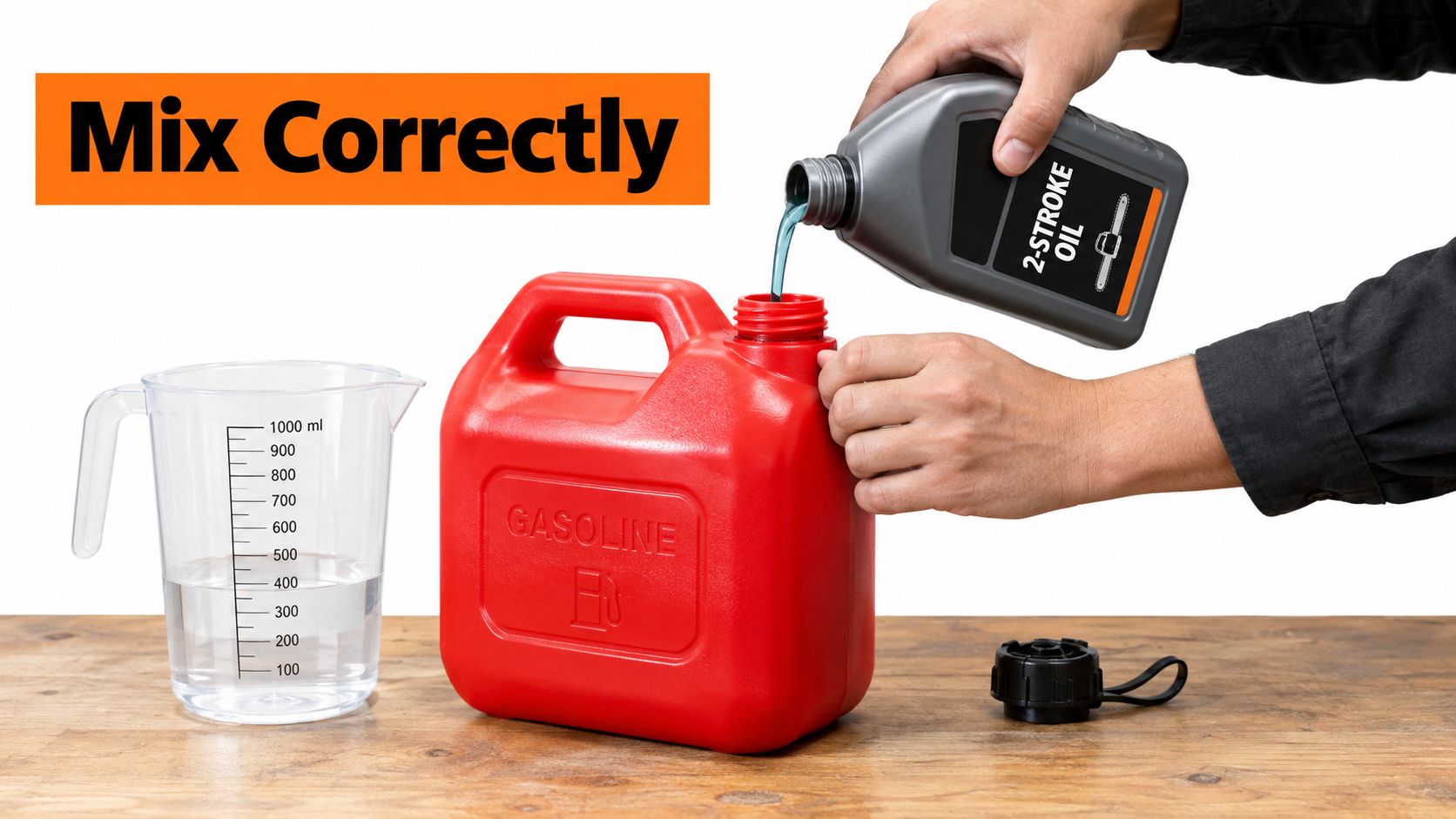
Prepare the mixture in an approved fuel container, not in a glass jar, food bottle, or unmarked household container. Work outdoors or in a well-ventilated area, keep the fuel away from flames and hot exhausts, and wear protection that prevents splashes reaching your eyes or skin.
A clean mixing sequence
- Read the required ratio. Confirm that the engine uses premix and note whether the manual specifies 50:1, 40:1, 32:1, 25:1, or another value.
- Use a clean approved can. Don't reuse a container that held diesel, solvent, water, or another chemical.
- Measure the oil accurately. Use a marked measuring bottle or graduated jug. Eye estimates are unreliable.
- Add the petrol and oil in a controlled sequence. For a practical workshop routine, put the fuel in the approved can, add the measured oil, and leave enough room for mixing.
- Close the cap firmly and shake gently. Move the container until the oil is distributed throughout the fuel. Don't shake an open can.
- Check the mixture before filling the bike. Look for obvious separation, contamination, or an unusual appearance. If the mixture looks wrong, don't pour it into the tank.
The familiar errors are simple: adding an unmeasured splash, using the wrong ratio from another bike, topping up a can without knowing what is already inside, or leaving the container unlabelled. Petrol and oil can look similar across different batches, so write the ratio, date, and intended machine on the can.
Never fill a hot motorcycle, and wipe up spills immediately. Keep the can closed between uses, store it away from heat, and avoid preparing more mixture than you can use responsibly.
Carburetor Engines, Oil Injection and Conversion
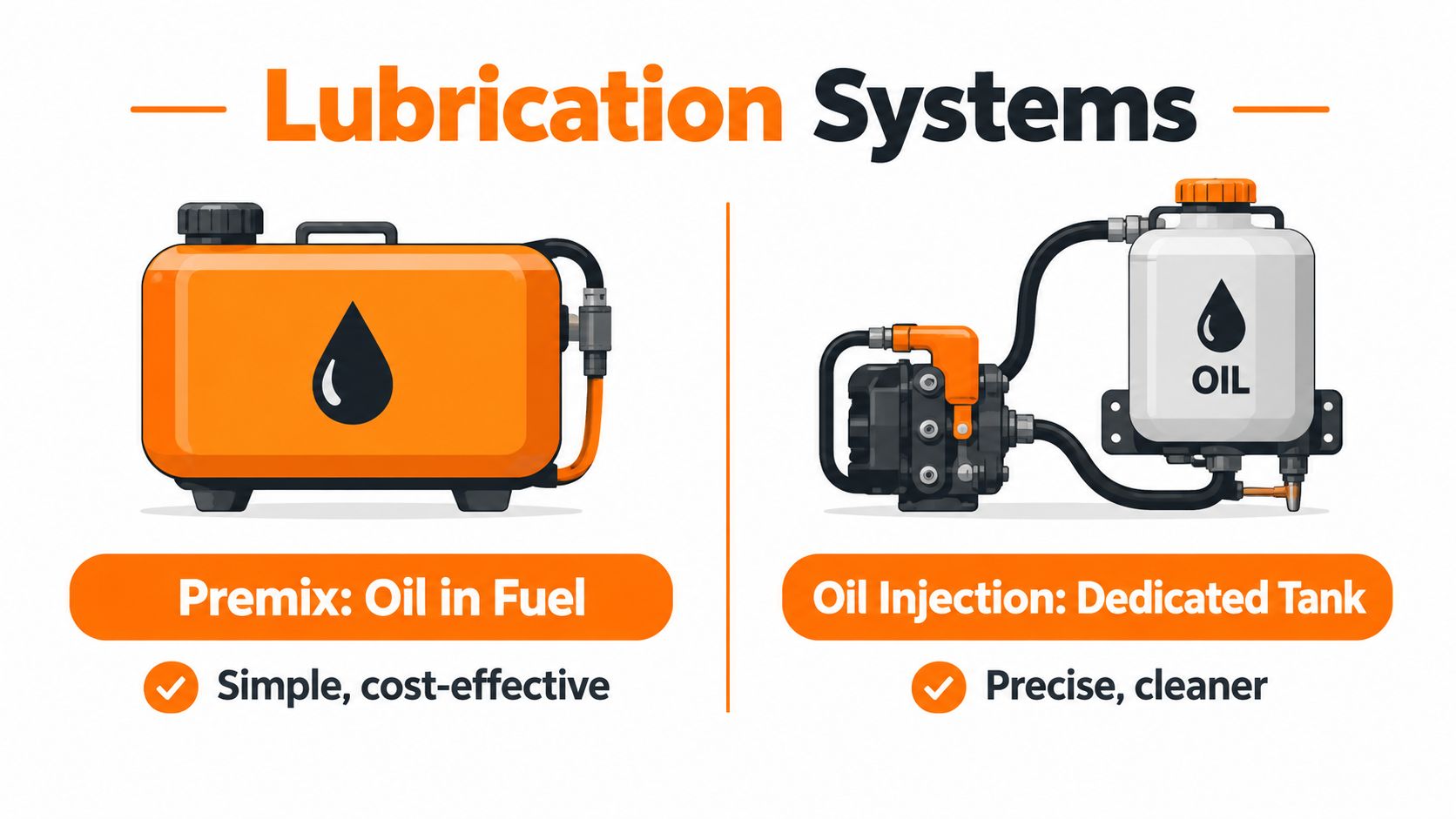
Two-stroke engines generally receive oil in one of two ways. A premix-only carbureted engine carries oil inside the fuel, while an oil-injection system stores oil in a separate tank and meters it through a pump into the intake or another designated point.
Premix is mechanically straightforward. The rider controls the ratio at the fuel can, so the measurement must be accurate every time. Injection is more convenient because the pump can vary the oil delivery according to engine demand, but it creates another maintenance system. The rider must keep the oil reservoir filled with a compatible product, inspect the lines, and confirm that the pump is correctly primed and operating.
Choosing and changing the system
An injection engine still needs an oil designed for the application. Look for the required motorcycle specification, such as JASO FD or ISO-L-EGD, and follow the manufacturer's instruction for the separate oil tank. Don't assume that a product intended only for premix belongs in an injection reservoir.
Conversion requires more than removing a hose. If an older motorcycle is changed from injection to premix, the pump must be disabled correctly, residual oil must be handled, and the new fuel ratio must be written clearly on the machine and fuel can. If someone converts from premix to injection, the pump, lines, tank, and control system need proper installation and bleeding.
Do not run both systems by accident. A converted engine needs one clearly documented lubrication method, not an unknown combination of premix and active injection.
Carburation work also depends on the exact motorcycle and component specification. A product such as this 1 Jet Kit for Suzuki RF 900 1994-1999 illustrates why fitment details matter. Oil delivery, carburetor settings, and fuel preparation should each be checked against the actual engine rather than copied from a different model.
Common Myths About Olio 2 Tempi per Miscela
The most persistent workshop mistakes come from rules that sound protective but ignore how the engine really works. More oil isn't automatically more safety, and “2T” on the label isn't a universal approval.
Myth one says more oil always protects better
More oil can alter the fuel mixture and combustion behaviour. It may increase smoke and deposits, foul the spark plug, or interfere with clean running. The correct ratio provides the lubrication the engine was designed around. It isn't a contest to see how much oil the can will hold.
Myth two says every two-stroke oil works everywhere
A basic oil may be acceptable in the application named by its manufacturer, but a demanding motorcycle engine may need stronger detergency and deposit control. JASO FD exists as a higher-cleanliness benchmark than the lower JASO grades, so read the approval panel instead of relying on the large “2T” lettering.
Myth three says brands can always be mixed
Mixing products may be uneventful, but the rider often doesn't know whether their base oils and additive packages are compatible. The safer workshop practice is to use one known product, drain and clean the system before changing formulation, and avoid topping up an unidentified mixture.
Myth four says synthetic oil is only for racers
Synthetic oil can be selected for demanding use, but its value isn't limited to racing. A correctly specified low-ash formulation may help control smoke and deposits in other applications too. Mineral oil isn't automatically safer for an old bike, either. The manual, certification, condition of the engine, and intended workload should guide the decision.
| Common Myth | Technical Reality |
|---|---|
| More oil always protects better | The specified ratio balances lubrication with combustion behaviour and deposits |
| Any 2T oil works in any engine | Certification and application determine suitability |
| Mixing brands is always harmless | Unknown base oils and additive packages create avoidable uncertainty |
| Synthetic oil is only for racers | It can be useful wherever its formulation and approval match the engine |
| A familiar ratio fits every bike | Engine family, oil type, and lubrication system can change the correct choice |
The practical sentence to remember is: use the required oil specification at the required ratio in the required lubrication system.
Storage, Shelf Life and Safe Disposal of Used Mix
Fuel mixture deserves the same care after preparation as it receives during measuring. Keep it in a sealed, approved fuel can, away from direct sunlight, ignition sources, and excessive heat. Write the ratio, preparation date, and intended engine on the label so nobody has to guess what is inside later.
Petrol changes during storage, and the oil may no longer remain evenly distributed. Petrol containing ethanol can also absorb moisture, which makes long storage less attractive for small two-stroke fuel systems. If a mixture looks separated, cloudy, contaminated, or smells abnormal, don't pour it into the motorcycle just because it's already been paid for.
Workshop storage habits
- Use small batches: Prepare only what the intended machine can use within a reasonable period.
- Seal the container: A tight cap limits vapour loss and contamination.
- Keep the can stable: Store it upright where it won't be knocked over.
- Inspect before use: Check the appearance and smell, then mix the container as appropriate before filling.
- Prepare for lay-up: If the motorcycle will sit unused, follow the manufacturer's procedure for the carburetor, tank, and fuel system.
Don't pour old mixture down a drain, onto soil, or into ordinary household waste. Used fuel is hazardous and should go to a certified collection point or an authorised garage that accepts it. If the carburetor contains stale fuel, drain it into a suitable container and handle that liquid through the same approved disposal route.
A checklist for the fuel cabinet
- Approved can, clean and sealed.
- Ratio and preparation date written on the label.
- Stored away from heat, sparks, children, and animals.
- Mixture inspected before use.
- Old fuel collected for authorised disposal.
- Carburetor and tank serviced according to the motorcycle manual before extended storage.
For replacement parts, model-specific accessories, and motorcycle maintenance products, visit Sixrace. Check your two-stroke manual first, then use the site's model and application details to identify compatible equipment for the machine you're maintaining.
 Italiano
 Deutsch
 Français
 Español
 English
 Polski