
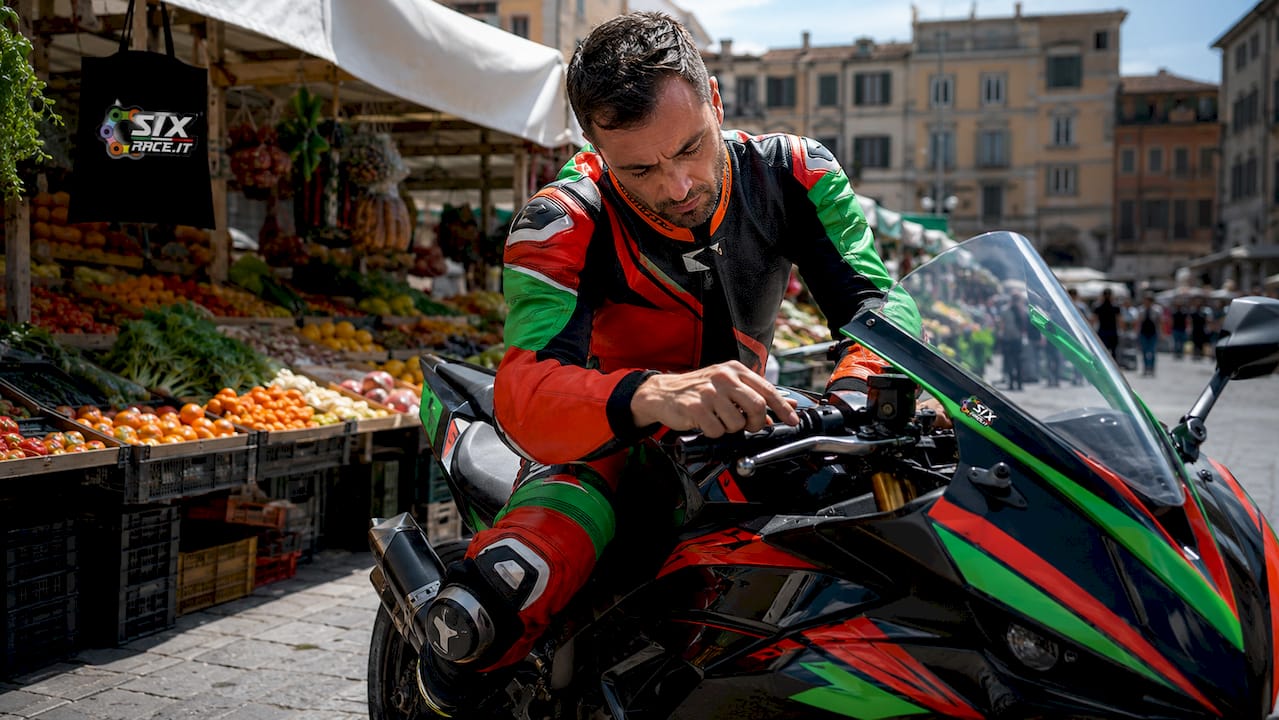
Sport motorcycle ergonomics is defined as the deliberate arrangement of handlebars, seat, and footpegs to shape the rider’s posture, weight distribution, and control on a sport bike. This geometry, known as the rider triangle, is the foundation of every handling decision a sport motorcycle makes. Understanding what is sport motorcycle ergonomics means understanding why your body position directly affects braking precision, cornering accuracy, and fatigue levels. Expert coaching experience with over 10,000 riders confirms that ergonomics is not a comfort luxury. It is a core riding skill.
What is the rider triangle in sport bike ergonomics?
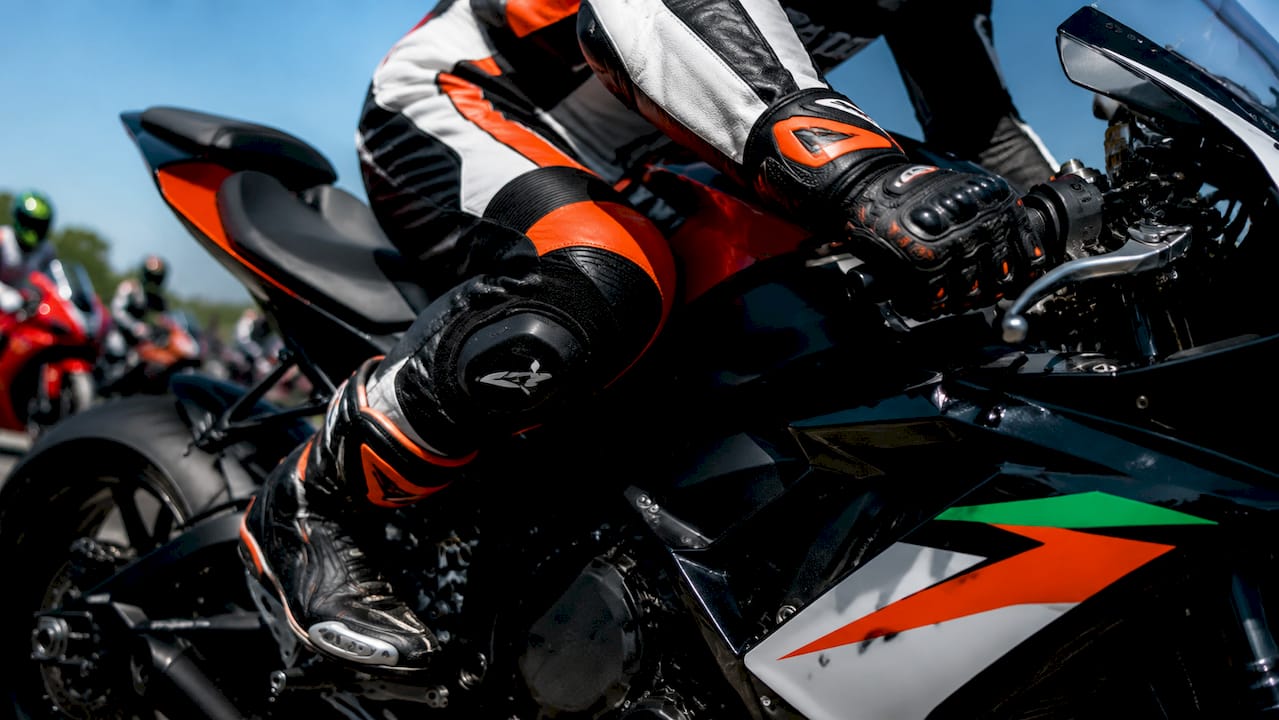
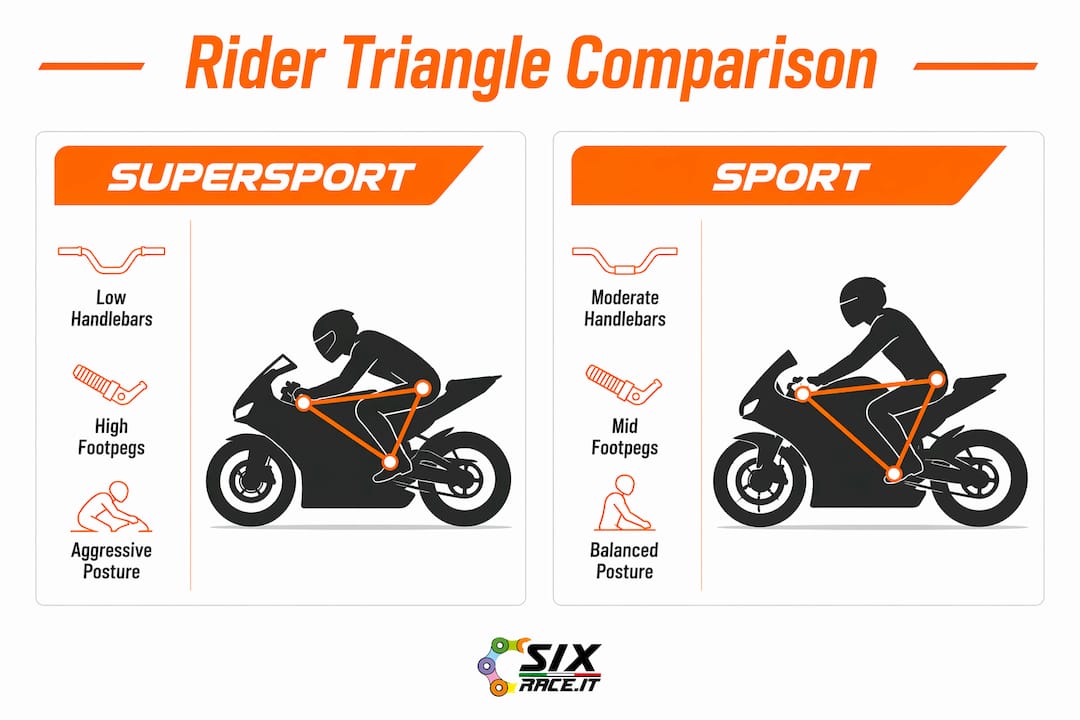
The rider triangle is the geometric relationship between three contact points: the handlebars, the seat, and the footpegs. On a sport motorcycle, this triangle is configured to push the rider forward and low. Clip-on handlebars sit below the top yoke, rear-set footpegs raise the feet behind the hips, and the seat pitches the pelvis forward. The result is a forward-leaning posture that loads the front tyre and sharpens steering response.
This geometry does more than shape your silhouette. It shifts weight onto the front axle, which improves front-end feel and cornering precision. A rider sitting upright on a touring bike places most mass over the rear wheel, which suits long-distance stability but dulls sport handling. The rider triangle configuration on a sport bike is a calculated trade-off: more control and aerodynamic efficiency in exchange for a more demanding posture.
The table below shows how the rider triangle differs across three motorcycle categories.
| Category | Handlebar height | Footpeg position | Rider posture |
|---|---|---|---|
| Supersport | Very low (clip-ons below yoke) | High and far back | Aggressive forward lean |
| Sport | Low (clip-ons at or near yoke) | Moderately rear-set | Moderate forward lean |
| Standard | Upright (flat or raised bars) | Mid-mounted | Neutral, upright |
Pro Tip: If your wrists ache after 30 minutes on a sport bike, your rider triangle is likely misaligned. Raising the clip-ons by 10–20 mm or moving the footpegs forward slightly can redistribute load without sacrificing handling.
How does sport motorcycle ergonomics differ from other styles?
Sport bike ergonomics prioritise aerodynamic efficiency and front-end control above all else. Honda Powersports technical guidance notes that supersport and sport bikes use higher rear-set footpegs and lower clip-on handlebars specifically to enhance front-end feel and reduce aerodynamic drag. Touring and adventure bikes take the opposite approach, using raised bars and forward-mounted footpegs to reduce spinal load over long distances.
The ergonomic differences between styles are not simply about comfort preference. They reflect entirely different riding priorities.
- Supersport bikes (track-focused): extreme forward lean, minimal seat padding, footpegs positioned to clear the ground at maximum lean angles. Designed for lap times, not touring.
- Sport bikes (road-focused): moderate forward lean, greater seat comfort, clip-ons closer to the top yoke. A balance between performance and everyday usability.
- Standard bikes: upright posture, neutral spine, wide handlebars. Prioritise comfort and low-speed manoeuvrability over outright performance.
- Touring bikes: reclined or upright position, forward footpegs, wide seats. Built for sustained comfort over hundreds of miles.
The gradation between supersport and sport is particularly important. A supersport posture demands constant core engagement and suits riders who spend time on track. A sport riding position offers more forgiveness on public roads while retaining meaningful aerodynamic and handling benefits. Choosing the wrong category for your riding style creates fatigue and reduces control.
What common misconceptions exist about sport motorcycle ergonomics?
The most damaging misconception is that ergonomics is purely about comfort. Ergonomics is a foundational skill that directly affects reaction time, braking precision, and overall safety. A rider who is uncomfortable is a rider who is distracted. Distraction costs milliseconds. On a sport bike, milliseconds matter.
A second misconception is that good ergonomics means staying rigidly fixed in one position. Sport ergonomics are designed for dynamic movement, not static postures. Riders should move fluidly around the tank during cornering, shifting weight to load the appropriate tyre and maintain balance. A rider locked stiffly into position cannot respond to changing road conditions.
“Most riders incorrectly support their upper body weight through their wrists. Effective riding depends on hinging at the hips and engaging the core, keeping the arms loose for delicate steering inputs.” — Bennetts Bikesocial, Advanced Body Position
The wrist load issue is widespread and genuinely dangerous. When arms bear upper body weight, steering inputs become heavy and imprecise. The rider loses the ability to feel feedback through the bars. Hinging at the hips with a neutral spine transfers that load to the core muscles, freeing the arms entirely.
Pro Tip: To check whether you are loading your wrists, hover your hands one centimetre above the bars while stationary. If your torso drops forward, your core is not supporting your weight. Practise holding that torso position with hands off the bars before every ride.
How can riders improve their sport motorcycle ergonomics?
Improving your ergonomic setup starts with an honest assessment of your three contact points. Small adjustments to each one compound into a significantly better riding experience.
- Assess your current rider triangle. Sit on the bike in your normal riding position and note where your weight falls. If your wrists feel loaded or your lower back aches within 20 minutes, the triangle needs adjustment.
- Adjust handlebar height and reach. Clip-on handlebars on most sport bikes accept height and angle adjustments. Raising them slightly reduces wrist load without meaningfully affecting aerodynamics at road speeds.
- Reposition the footpegs. Aftermarket rear-set footpegs from brands such as Gilles Tooling offer multiple mounting positions. Moving them forward and down even slightly can relieve knee and hip pressure on longer rides.
- Check seat height. A seat that is too high forces you onto your toes at stops and creates hip tension while riding. Aftermarket seats with different foam densities and profiles can correct this without altering the frame geometry.
- Practise correct posture actively. Hinge at the hips with a neutral spine. Grip the tank with your thighs, particularly under braking. Keep your elbows slightly bent and your grip light.
- Use your thighs, not your arms. Gripping the tank with your thighs during deceleration prevents arm pump and allows greater steering precision. This single technique change transforms how a sport bike feels.
Aftermarket components make a measurable difference. Adjustable clip-on handlebars, rearsets, and ergonomic seats are the three most impactful upgrades for sport motorcycle comfort and control. Sixrace stocks a wide selection of these components from established manufacturers, matched to your specific make, model, and year.
What are the effects of sport motorcycle ergonomics on safety and performance?
Poor ergonomics create friction between the rider and the machine. That friction reduces braking precision and slows reaction times. Poor ergonomics increase risk on the road by degrading the quality of every control input the rider makes. The effect is cumulative: as fatigue builds, inputs become coarser, and the margin for error shrinks.
Good ergonomics do the opposite. They maintain what coaches describe as the rider’s safety bubble: a state of relaxed alertness where the body is supported, the vision is clear, and the hands are free to respond to the road. Good ergonomics reduce rider fatigue by supporting proper vision, relaxed posture, and core stability, which sustains control over longer rides.
The table below summarises the key effects of ergonomics on performance and safety metrics.
| Metric | Poor ergonomics | Good ergonomics |
|---|---|---|
| Braking precision | Reduced, coarse inputs | Sharp, consistent inputs |
| Reaction time | Slowed by fatigue and tension | Maintained through relaxed posture |
| Cornering control | Limited by rigid body position | Enhanced by dynamic weight shifting |
| Rider fatigue | Rapid onset, especially wrists and lower back | Delayed through core support and correct posture |
| Vision | Restricted by neck tension | Clear, supported by relaxed upper body |
Neck posture is an underappreciated factor. A rider with tense shoulders and loaded wrists instinctively drops their chin, narrowing their field of vision. A rider with a supported torso and loose arms naturally raises their gaze, scanning further ahead and processing hazards earlier.
Key takeaways
Sport motorcycle ergonomics is the single most impactful variable a rider can adjust to improve both safety and performance, because it governs every control input made from the saddle.
| Point | Details |
|---|---|
| The rider triangle is foundational | Handlebars, seat, and footpegs define posture, weight distribution, and control on every sport bike. |
| Ergonomics affects safety, not just comfort | Poor ergonomic setup reduces braking precision and reaction time, increasing on-road risk. |
| Core engagement is non-negotiable | Hinging at the hips and gripping the tank with the thighs frees the arms for precise steering inputs. |
| Dynamic movement beats rigid posture | Sport ergonomics are designed for fluid weight shifting during cornering, not static fixed positions. |
| Small adjustments deliver large gains | Raising clip-ons, repositioning footpegs, and changing seat profile can transform riding comfort and control. |
Ergonomics over aesthetics: a perspective from experience
Riders consistently underestimate how much their body position shapes the machine’s behaviour. I have watched riders spend thousands on suspension upgrades while sitting in a posture that negates every benefit those components offer. The bike cannot communicate through the bars if the rider’s arms are rigid and loaded with body weight.
The most common mistake I observe is treating the forward lean of a sport bike as a fixed, uncomfortable price to pay for performance. It is not. The lean angle is a tool. When you hinge correctly at the hips, engage your core, and grip the tank with your thighs, that forward position becomes a source of control rather than a source of pain. The front tyre tells you everything. You just need to be relaxed enough to listen.
Riders who invest time in understanding their ergonomic setup ride better for longer. They make fewer errors under fatigue, they corner with more confidence, and they arrive at their destination without the wrist and lower back pain that plagues riders who never address their triangle. Ergonomics is not a one-time setup task. It is an ongoing conversation between your body and your machine. The riders who treat it that way are, without exception, the ones who improve fastest.
— Matteo
Upgrade your sport bike setup with Sixrace
Riders who understand their ergonomic needs can act on them directly. Sixrace stocks adjustable clip-on handlebars, rearsets from Gilles Tooling, ergonomic seat options, and a full range of motorcycle accessories matched to your specific bike by make, model, and year. Every product in the catalogue is sourced from established manufacturers and ships across Europe with tracked delivery.

Whether you are correcting wrist load with a handlebar adjustment or improving your cornering posture with new footpeg positions, Sixrace has the components to support the change. Visit the Sixrace discount page to access your reserved discount on premium ergonomic upgrades and performance parts.
FAQ
What is the rider triangle on a sport motorcycle?
The rider triangle is the geometric relationship between the handlebars, seat, and footpegs. On a sport bike, this triangle is configured to create a forward-leaning posture that loads the front tyre and improves cornering precision.
Why do sport bikes have such an aggressive riding position?
Sport bikes use low clip-on handlebars and high rear-set footpegs to shift rider weight forward, improving front-end feel, aerodynamic efficiency, and steering response. This geometry is a deliberate performance trade-off rather than a design oversight.
How do I reduce wrist pain on a sport motorcycle?
Wrist pain is caused by supporting upper body weight through the arms rather than the core. Hinging at the hips, engaging the core, and gripping the tank with the thighs transfers load away from the wrists and resolves the issue in most cases.
Can I adjust the ergonomics on my sport bike without modifying the frame?
Yes. Adjustable clip-on handlebars, aftermarket rearsets, and different seat profiles all alter the rider triangle without any frame modification. These are the three most effective ergonomic adjustments available to sport bike riders.
Does ergonomics affect cornering performance?
Good ergonomics allow dynamic weight shifting around the tank during cornering, which improves balance and tyre loading. Poor ergonomics lock the rider into a rigid position, reducing the ability to respond to changing conditions mid-corner.
 Italiano
 Deutsch
 Français
 Español
 English
 Polski