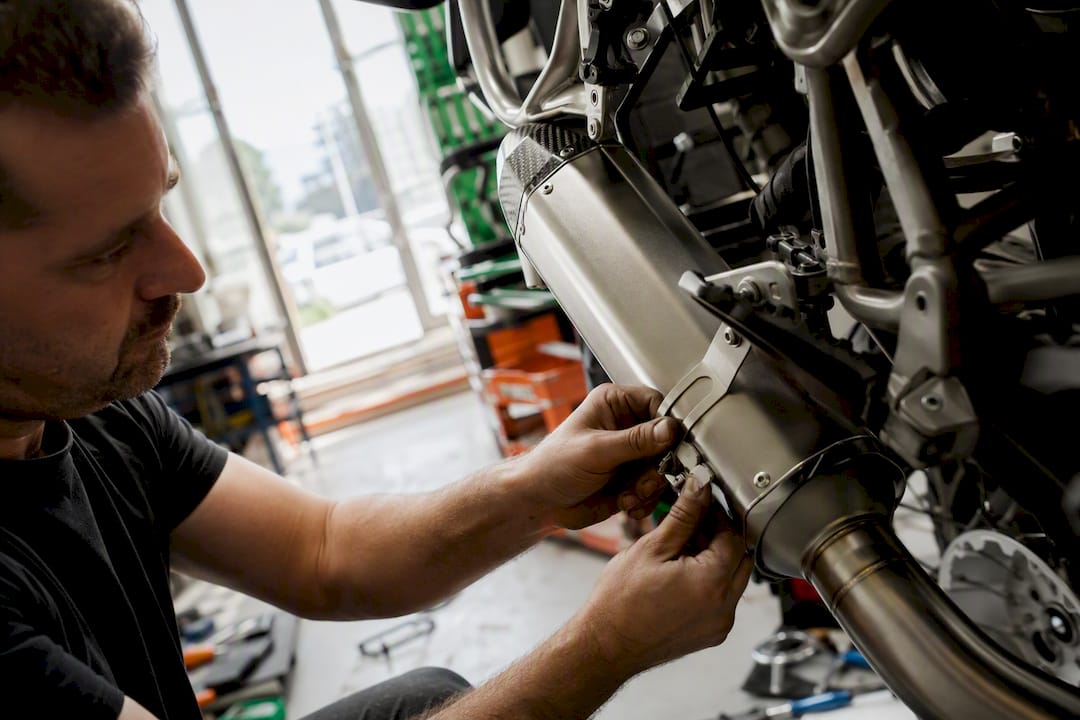
Yes, you can legally fit a Euro 5 aftermarket exhaust in Italy, provided it carries the correct approval and stays fitted exactly as that approval describes. The legality is conditional, not automatic: the part itself must be homologated, it must genuinely fit your motorcycle’s make, model and year, and any component the approval specifies, such as a db-killer or catalytic converter, has to stay in place.
Before you spend a single euro, verify three things:
- The homologation code and certificate. A visible e-mark and paperwork you can produce during a check.
- Exact bike compatibility. Matched by make, model and year, not “should fit most.”
- Required components retained. If the approval assumes a db-killer or catalyst, removing it voids the homologation.
Pro Tip: Ask the seller for the homologation certificate before you buy, not after. If they can’t produce it on request, that tells you everything about whether the exhaust is actually road-legal.
Key Takeaways
Legally fitting a Euro 5 exhaust in Italy depends entirely on matching a genuinely homologated part to your exact bike and keeping every approved component in place.
| Point | Details |
|---|---|
| Approval is conditional | The e-mark and certificate must match your specific model, year and configuration, not just exist. |
| Never remove approved components | Taking off a db-killer or catalyst voids the homologation and risks fines or a Motorizzazione visit. |
| Match product to goals | Slip-ons suit sound and styling changes; full systems suit riders chasing measurable performance shifts. |
| Keep documents with the bike | Store the homologation certificate alongside your registration for roadside checks and revisione. |
| Buy from a model-matched retailer | Sixrace maps exhausts by make, model and year and works with brands supplying full homologation paperwork. |
Table of Contents
- What does Euro 5 compliance mean for motorcycle exhausts in Italy?
- How do you check an exhaust is compatible and legal before buying?
- Slip-on vs full system: which exhaust suits Euro 5 riders?
- What happens if you remove the db-killer or catalyst?
- How do you choose a reputable retailer for Euro 5 exhausts in Italy?
- Why the “just check for an e-mark” advice misses the point
- Where to buy a Euro 5-homologated exhaust with confidence
- Sources
What does Euro 5 compliance mean for motorcycle exhausts in Italy?
Euro 5 is an emissions and noise standard applied to L-category vehicles, which includes motorcycles, scooters and quads. The rules that govern exhaust silencers specifically sit under UN Regulation No. 41, the UNECE text covering noise from motorcycles, while EU Regulation 2018/858 sets the broader administrative framework for type-approval and market surveillance of vehicles and their components across the EU.
Italy has formally adopted recent amendments to this framework. The Ministry of Infrastructure and Transport confirmed that Supplement 2 to series 05 of Regulation No. 41 entered into force in early 2024, with Italy listed among the adopting states. That matters because it shows the noise rules governing your exhaust are actively maintained, not a static text from a decade ago.
In practice, compliance shows up as an e-mark, a code such as e1 or e13, stamped or printed on the silencer body. This is effectively the exhaust’s technical ID: it tells you which country’s type-approval authority certified the part, and it should be accompanied by a homologation certificate confirming the approval covers your specific L-category classification.
Two checks matter at the roadside and at the biennial revisione:
- Motorizzazione and traffic police can inspect the e-mark and match it against the certificate.
- A mismatch, or a missing certificate, can flag the vehicle for further testing.
Recent parliamentary discussion has also proposed simplifying the “visita e prova” procedure for certain approved aftermarket parts, limiting checks to installation verification rather than a full re-approval process, according to a legislative dossier reviewing article 78 of the Code of the Road. Nothing has changed yet, but it signals the administrative direction is toward clarity, not stricter friction, for buyers who choose properly approved parts.
How do you check an exhaust is compatible and legal before buying?
Confirming legality before checkout takes a few minutes and saves a lot of hassle later. Work through this sequence with any seller or product page:
- Check the fitment table. Confirm the listing states your exact model and production year, not a generic “fits most 600cc sport bikes” claim.
- Ask for VIN or variant confirmation. Some models had mid-cycle changes to mounting points or catalyst position; a reputable seller will confirm coverage for your variant if you ask.
- Locate the approval code. Look for the engraved or printed e-mark on the silencer body itself, not just in marketing copy.
- Request the homologation certificate. Manufacturers such as SC-Project state clearly that their Euro 5 systems are valid across the EU and ship with visible marking and certification documents. That is the standard to expect from any brand.
- Confirm which components are covered. If a db-killer or catalytic insert is part of the approval, it needs to stay on the bike.
Pro Tip: Keep a photo of the e-mark and a PDF of the certificate on your phone. If you’re stopped, producing both immediately is far more convincing than promising to “email it over later.”
Slip-on vs full system: which exhaust suits Euro 5 riders?
The two main product categories serve different goals, and Euro 5 constraints shape what each can realistically deliver.
- Slip-on silencers replace only the end can, keeping the factory header and catalyst. They’re cheaper, lighter to install, and the most common upgrade for sound and styling changes.
- Full systems replace the header, mid-pipe and silencer as one unit. They cost more, take longer to fit, and offer the best chance of a measurable performance shift, though Euro 5 homologation typically still requires a catalyst somewhere in the system to keep the whole unit compliant.
Material choice affects weight, cost and longevity rather than legality:
- Stainless steel is the most affordable and durable, at the cost of extra weight.
- Titanium cuts weight significantly but carries a higher price.
- Carbon fibre (usually just the outer sleeve) shaves further weight and adds a visual upgrade, though it’s the priciest option.
Euro 5’s tighter noise and emissions limits compared with Euro 4 mean homologated exhausts, whichever material, rarely deliver dramatic power gains on their own. A full system paired with an ECU remap or a fuelling module tends to close that gap more than the exhaust alone. Racing systems without homologation can produce bigger dyno numbers, but they’re explicitly not legal for public roads, so they belong on a track day trailer, not your daily commute.
What happens if you remove the db-killer or catalyst?
Removing a db-killer or catalytic converter specified in the homologation is one of the most common ways riders unintentionally break the law. Once that component is gone, the exhaust no longer matches the certified configuration, and the approval no longer applies to what’s actually fitted on the bike.
Italian road-law practice treats this as an alteration under the Code of the Road, with sanctions that vary by the nature of the offence. Depending on severity, consequences can range from an on-the-spot fine to a required Motorizzazione visit with noise testing using a fonometro, and in more serious cases, suspension of the vehicle’s registration document until the bike is brought back into compliance.
A few practical habits keep you on the right side of this:
- Have the exhaust fitted by a workshop familiar with homologation requirements, not a general garage.
- Ask the fitter to note the installation on your paperwork, especially if any adjustment was needed.
- Store the homologation certificate with your other vehicle documents, ready for revisione or a roadside check.
- Never treat a db-killer as an optional accessory. If the certificate lists it, it stays on.
How do you choose a reputable retailer for Euro 5 exhausts in Italy?
A trustworthy seller makes the legal checks easy rather than something you have to chase down after payment. Look for these signals before you buy:
- Visible homologation on every listing. The e-mark and approval status should be stated plainly, not buried in a downloadable PDF you have to hunt for.
- Genuine model and year mapping. Fitment should be searchable by your exact bike, the way Sixrace’s catalogue matches parts to make, model and year rather than offering vague “universal fit” claims.
- Documented returns and warranty terms. A seller confident in their compliance will state these clearly.
- Tracked shipping within Italy and responsive support. You want to know where your order is and be able to ask a real question about fitment.
Sixrace works with brands including SC-Project, Evotech Performance and other established manufacturers who supply Euro 5 homologation certificates as standard, and its Italy base means shipping timelines and support are built around Italian buyers rather than treated as an afterthought.
Pro Tip: Before fitting anything, check whether you’ll need supporting parts too, such as an exhaust valve eliminator if you’re moving from a factory system with an electronic valve. Sixrace lists these as standalone components so you’re not caught out mid-installation.
Once you’ve chosen a system, request the homologation certificate at checkout, arrange fitting through a workshop that understands the paperwork, and keep every document with the bike afterwards.
Why the “just check for an e-mark” advice misses the point
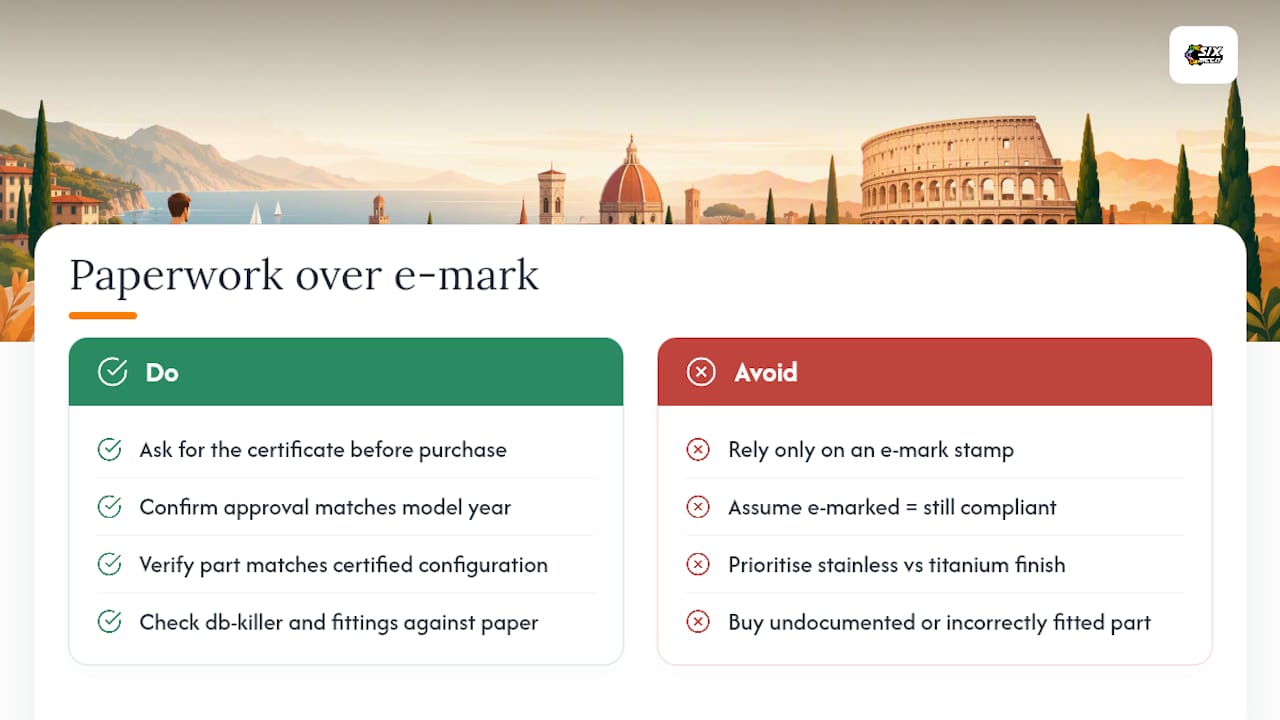
Most guidance on this topic stops at “look for the e-mark,” as though a stamped code on a silencer settles the matter. It doesn’t. The mark tells you a type-approval exists somewhere; it says nothing about whether that specific approval covers your model year, or whether the exhaust in front of you still matches the configuration it was certified in.
The more useful discipline is treating the certificate as a document that travels with the specific part and the specific bike, not a badge the exhaust simply wears. A slip-on that lost its db-killer at some point in its life still carries an e-mark. It just no longer represents what was approved.
What I’d prioritise differently: spend less energy debating stainless versus titanium, and more time confirming the paperwork trail before the exhaust arrives. Performance differences between compliant systems are modest by design under Euro 5. The real risk sits in buying something that looks right and turns out to be undocumented, or fitted incorrectly by someone who never checked the certificate against the bike. Ask for the paper first. Choose the finish second.
Where to buy a Euro 5-homologated exhaust with confidence
Sixrace built its catalogue around exactly the problem this guide has walked through: matching an exhaust to your precise make, model and year, with the homologation documentation ready to hand, not hidden behind a support ticket. Working with manufacturers such as SC-Project, Evotech Performance and other established names, the platform lets you filter by your bike rather than guess from a generic photo.
If you’re ready to fit a compliant system, browse the Honda spare parts range or the wider exhaust catalogue for your model, and claim your reserved discount on your order. Whichever system you choose, request the homologation certificate at the point of purchase, keep it with your bike’s documents, and you’re set for both the road and the next revisione.
Sources
- Circolare ministeriale — Ministero delle infrastrutture e dei trasporti
- Regolamento (UE) 2018/858 del Parlamento europeo e del Consiglio
- Scarico moto aftermarket: basta che sia omologato per essere in regola? - Infomotori
- SC‑Project — scarichi moto omologati
- Scarichi omologati per moto: cosa sono, normative e migliori marche | Anteprima Motori
 Italiano
 Deutsch
 Français
 Español
 English
 Polski