
An aftermarket quickshifter conviene, in plain terms, if you ride hard, ride often, and value smoother upshifts over the cost of the kit and its fitting. Track riders and spirited road riders see the biggest return through faster, cleaner gear changes. Commuters stuck in stop-start traffic gain far less, since the benefit only shows itself once you’re properly on the throttle. Read on for the checklist that turns this general rule into a decision for your own bike.
TL;DR:
- Quickshifters provide the most benefit for track and spirited riding, allowing faster, smoother gear changes and reducing rider fatigue.
- Systems with Ride-by-Wire enable full auto-blip downshifting support, which is unlikely on bikes without electronic throttle control.
- Installing a quickshifter correctly and calibrating it properly can prevent gear damage and ensure long-term durability.
- Premium kits with dual-channel support and fine mapping generally outperform basic single-channel units, especially on Ride-by-Wire bikes.
- Fitting a quickshifter can affect warranty and insurance, so riders should verify policies before installation, particularly for high-tier or professional kits.
Table of Contents
- How does a quickshifter work, and why does Ride-by-Wire matter?
- What are the real benefits and the risks worth knowing?
- What’s inside an aftermarket kit, and how do you judge quality?
- Can you install a quickshifter yourself, or do you need a fitter?
- How much should you budget, and is it worth the outlay?
- Is a quickshifter worth it for your riding style? Quick checklist
- Where can you check fitment and get installation guidance?
- What do riders actually say once they’ve fitted one?
- Will your quickshifter still work properly in three years?
- How do popular aftermarket quickshifter kits compare?
- Does fitting a quickshifter affect your warranty or insurance?
- When would I actually fit one, and when would I hold off?
- Ready to fit a model-matched quickshifter?
- Sources
How does a quickshifter work, and why does Ride-by-Wire matter?
A quickshifter interrupts power for a fraction of a second at exactly the moment you move the gear lever, letting the next gear engage without you closing the throttle or touching the clutch. A sensor on the linkage detects lever movement and sends that signal to a control unit, which cuts ignition or fuel for a few milliseconds. That gap in drive removes the load between the gearbox dogs, letting the next gear slide home cleanly.
Basic kits are single-channel: they cover upshifts only. You still need the clutch for downshifts, exactly as before. Dual-channel kits add downshift support, sometimes called auto-blipper function, and this is where sensor type and control unit design start to matter a great deal.
Ride-by-Wire changes what’s possible on the downshift side. Because the throttle is controlled electronically rather than by a cable, the control system can blip the throttle automatically as you shift down, matching engine speed to road speed without you touching the clutch lever. Bikes without Ride-by-Wire can still take a quickshifter, but full auto-blip downshifting typically needs that electronic throttle link in place. This is one reason two bikes that look similar on paper can offer very different quickshift experiences.
What are the real benefits and the risks worth knowing?
The benefits are genuine but not universal. On track or during committed road riding, a quickshifter noticeably speeds up gear changes, cuts physical fatigue from repeated clutch and throttle work, and keeps the chassis more settled mid-corner because you’re not upsetting weight transfer with a manual shift. Riders doing multiple track sessions a year tend to notice this most.
At low revs and in city traffic, the picture flips. Systems are tuned for mid-to-high RPM, so shifting at low speed often feels rough or hesitant, and the clutch remains the better tool for stop-start riding.
The risk side is mechanical, not cosmetic. If the ignition cut is timed wrong, or a poorly installed budget kit fires the cut at the wrong moment, the gearbox dogs can take the full load of a half-completed shift. Repeated over time, that causes rounding of the dog teeth, missed gears, and eventual gearbox damage.
Pro Tip: Set the cut time longer than you think you need on first installation. A slightly slower shift beats a rounded gear dog every time, and you can shorten the cut gradually once you trust the setup.
What’s inside an aftermarket kit, and how do you judge quality?
A typical kit has three core parts: a sensor (single or dual channel), a control unit, and wiring built for your specific model. Optional extras include model-specific brackets and, on more advanced kits, a mapping tool for fine adjustment.
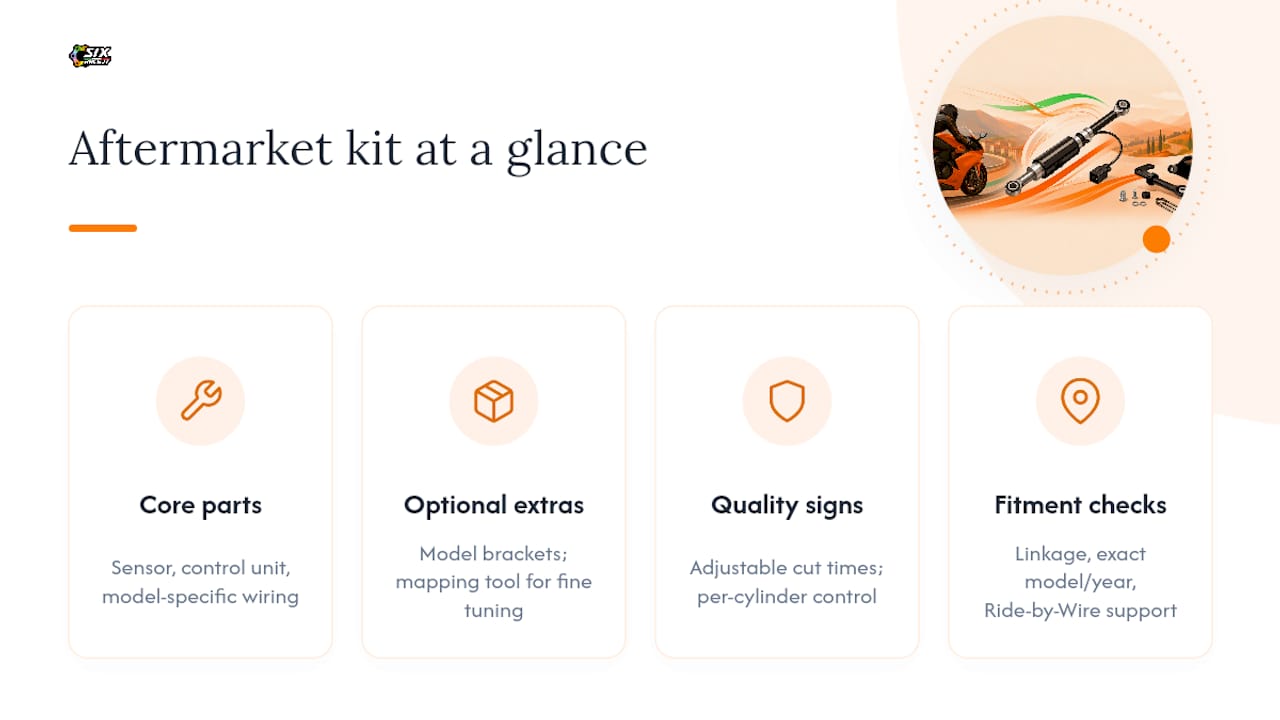
Quality shows up in details rather than branding. Look for adjustable cut times and, on better units, cylinder-by-cylinder cut control rather than one fixed setting for every gear. Cabling quality matters too: connectors rated for vibration and weather hold up far longer than generic splices.
Before buying, check three things. First, your bike’s shift linkage type, since sensors are built for specific lever geometries. Second, whether the kit appears on a model fitment list for your exact make, model and year, not a generic “universal” listing. Third, whether downshift support requires Ride-by-Wire your bike may not have. Sixrace’s electronic shifter category organises kits by fitment for exactly this reason, and a push-pull sensor example shows how model-specific these parts really are.
Can you install a quickshifter yourself, or do you need a fitter?
Installation follows a fairly consistent sequence, and it rewards patience over speed.
- Mount the sensor on the shift linkage, following the model-specific bracket instructions closely.
- Wire the control unit to the ignition or fuel system, keeping connectors away from heat and moving parts.
- Set a conservative, longer cut time as your starting point.
- Bench test with the engine off, checking the sensor triggers cleanly on lever movement.
- Run a low-speed test in an open area before trusting it in traffic or on track.
- Take it on a proper road or track test and reassess.
DIY suits riders comfortable with basic wiring, multimeters, and reading a fitment diagram carefully. If your bike uses a non-standard linkage, if the kit’s instructions assume knowledge you don’t have, or if you’re not confident bleeding through calibration steps without guessing, a professional fitter is the safer call. Log any missed shifts or hesitation after your first rides and recheck fitment; small adjustments early prevent bigger problems later.
How much should you budget, and is it worth the outlay?
Entry-level kits sit at the low end of the market, while premium dual-channel systems with Ride-by-Wire integration and finer mapping control climb considerably higher, sometimes exceeding €1,000 once professional fitting is included. Professional fitting itself typically adds a separate labour cost on top of the kit price.
Value comes down to how you ride. Track riders and those doing frequent spirited road miles recoup that cost in fatigue reduction and smoother shifts within a season. Urban commuters rarely reach the RPM range where the benefit shows, so the same spend buys little in daily use. Factor in occasional recalibration or replacement cabling as a long-term cost, not a one-off.
Is a quickshifter worth it for your riding style? Quick checklist
Run through this before you commit to a purchase:
- Do you ride track days or aggressive road routes regularly? If yes, the case for buying strengthens considerably.
- Does your bike have Ride-by-Wire? This determines whether full downshift auto-blip is realistic.
- Do you have budget for both the kit and professional fitting, not just the cheapest kit you can find?
- Is most of your riding low-speed or urban? If so, the gains will feel marginal at best.
- Are you unwilling to pay for calibration or a first-time professional fit? That’s a red flag against buying now.
If the checklist points towards yes, confirm fitment against your exact model, get advice from a fitter on calibration, and consider trialling a kit at a track day before investing in a premium system.
Where can you check fitment and get installation guidance?
Getting the fitment right matters more than picking a big-name brand. Sixrace’s dedicated guide to electronic shifting breaks down model compatibility and installation basics, and product pages such as the iQSE module for the QJ Motor SVT 650 X show exactly how model-specific these fitments are, right down to year ranges.
If you’re unsure whether your bike’s shift linkage or throttle system supports a given kit, checking the model listing before ordering saves a return and a wasted afternoon. Sixrace’s electronics category also covers control units and cabling separately, useful if you’re upgrading an existing kit rather than starting from scratch.
What do riders actually say once they’ve fitted one?
Feedback from riders splits fairly cleanly along the lines the technical side would predict. On owner forums and technical discussion threads, a recurring theme is that quickshifters transform confidence on committed road rides and track sessions, particularly when braking hard into a corner and needing a clean downshift without disturbing the chassis.
The same threads carry a consistent warning: shifting at low revs or crawling through traffic produces a noticeably rougher change, sometimes described as a clunk rather than a shift. Riders who bought a kit expecting it to smooth out every gear change, including gentle city riding, tend to be the ones who come away disappointed. Those who bought specifically for spirited or track riding report the opposite, often citing the change in shift feel as one of the more noticeable upgrades they’ve made to a bike.
A second pattern worth flagging: riders who bought unbranded, generic “universal” kits report more inconsistent results than those who bought model-matched systems. This lines up with the technical risk of poor calibration, since a universal kit has to guess at settings a model-specific unit already knows.
Will your quickshifter still work properly in three years?
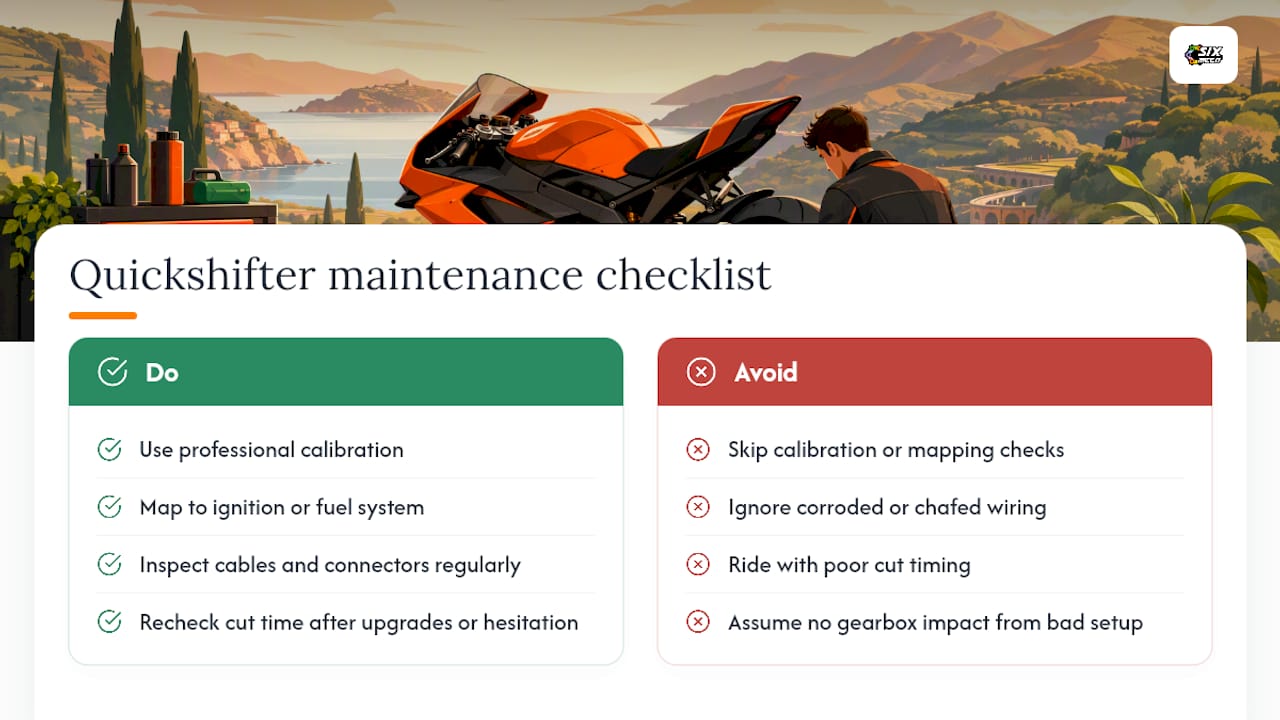
Durability depends far more on installation quality than on the kit itself. A well-calibrated unit from an established manufacturer, correctly mapped to your bike’s ignition or fuel system, should run for years without issue. The wear that does occur tends to show up in cabling and connectors rather than in the sensor or control unit, particularly on bikes ridden in wet or exposed conditions.
Gearbox wear is the real long-term concern, but it’s linked to calibration quality rather than the mere presence of a quickshifter. A correctly timed cut avoids extra load on the gear dogs, so a properly set-up system shouldn’t accelerate wear compared with clutched shifting. Poor calibration is the opposite story, and it’s cumulative: small amounts of incomplete engagement, repeated over thousands of shifts, eventually round off the dog teeth.
Practical maintenance is light. Check cabling and connectors periodically for corrosion or chafing, especially near the swingarm and footpeg area where the sensor usually sits. Recheck cut time settings if you notice hesitation returning, since throttle bodies and sensors can drift slightly with wear. If you upgrade the exhaust, ECU mapping, or swap sprockets, it’s worth revisiting your quickshifter’s settings too, since any of those changes can shift the ideal cut time.
How do popular aftermarket quickshifter kits compare?
Kits generally split into three tiers rather than by brand loyalty. Entry-level single-channel units cover upshifts only, using a basic sensor and a fixed or lightly adjustable cut time. They suit riders who want faster upshifts without the cost of a full auto-blip system.
Mid-range dual-channel kits add downshift support and adjustable cut times per gear, and this is where Ride-by-Wire integration becomes the key differentiator between kits that merely claim downshift support and kits that deliver it smoothly across the rev range.
Premium systems add cylinder-specific cut control, finer mapping software, and often integration with a full electronics suite including traction control and launch settings. These suit riders chasing every fraction of a second on track, where the cost difference against a mid-range kit is easier to justify.
Rather than comparing by brand name, compare by these three functional tiers and match the tier to your actual riding, not your budget’s upper limit. A mid-range dual-channel kit on a Ride-by-Wire bike will usually outperform a premium single-channel kit on a bike without electronic throttle, regardless of price paid.
Does fitting a quickshifter affect your warranty or insurance?
This is the question riders ask last and regret not asking first. Fitting any aftermarket electronic component, including a quickshifter, can affect your manufacturer warranty if the installation causes a fault or if the dealer deems the part responsible for a failure. Manufacturers vary in how strictly they enforce this, and the safest approach is to check your specific warranty terms, or ask your dealer directly, before fitting anything to a bike still under cover.
Insurance is a separate consideration. Many policies require you to declare modifications that alter the bike’s performance characteristics, and a quickshifter can fall into that category depending on your insurer’s definition. Failing to declare a fitted modification risks a claim being reduced or refused entirely if the modification is later found relevant to an incident. It costs nothing to ask your insurer directly whether a quickshifter needs declaring under your specific policy, and it’s a far cheaper conversation to have before fitting than after a claim.
When would I actually fit one, and when would I hold off?
For a track-day regular, fitting a quality dual-channel kit is close to a formality: the return in consistency and reduced fatigue justifies the spend almost every time. For a weekend sporty rider, it’s worth it if the budget stretches to professional fitting, not just the cheapest kit available. For a city commuter, I’d hold off entirely and put that money towards tyres or servicing instead. Whichever camp you’re in, avoid cheap universal kits and lean on model-matched products with proper calibration for your first install.
— Matteo
Ready to fit a model-matched quickshifter?
Getting the fitment right is the difference between a transformative upgrade and a frustrating one, and that’s exactly where Sixrace’s model-matched approach pays off. Rather than guessing from a generic listing, you can check compatibility by make, model and year across electronic shifter modules and the broader electronics range, so you’re ordering a kit built for your bike’s actual linkage and throttle system, not a universal unit that hopes for the best.
If your bike shares a platform with popular models, the complete electronic shifting guide is worth reading before you buy, and if you’re new to fitting electronics, arranging professional installation and calibration is the sensible choice for a first attempt rather than learning on a kit that’s already been mounted wrong once. When you’re ready to order, check the Sixrace discount page for your reserved discount on quickshifter kits and the wider range of motorcycle accessories and parts.
Sources
- Quickshifter e Downshifter: come funziona il cambio elettronico? | inSella
- Quickshifter: tutto quello che bisogna sapere sul cambio elettronico | Infomotori
- DCT, E‑Clutch, QS o cambio manuale? Vantaggi e svantaggi | 1000PS
 Italiano
 Deutsch
 Français
 Español
 English
 Polski