
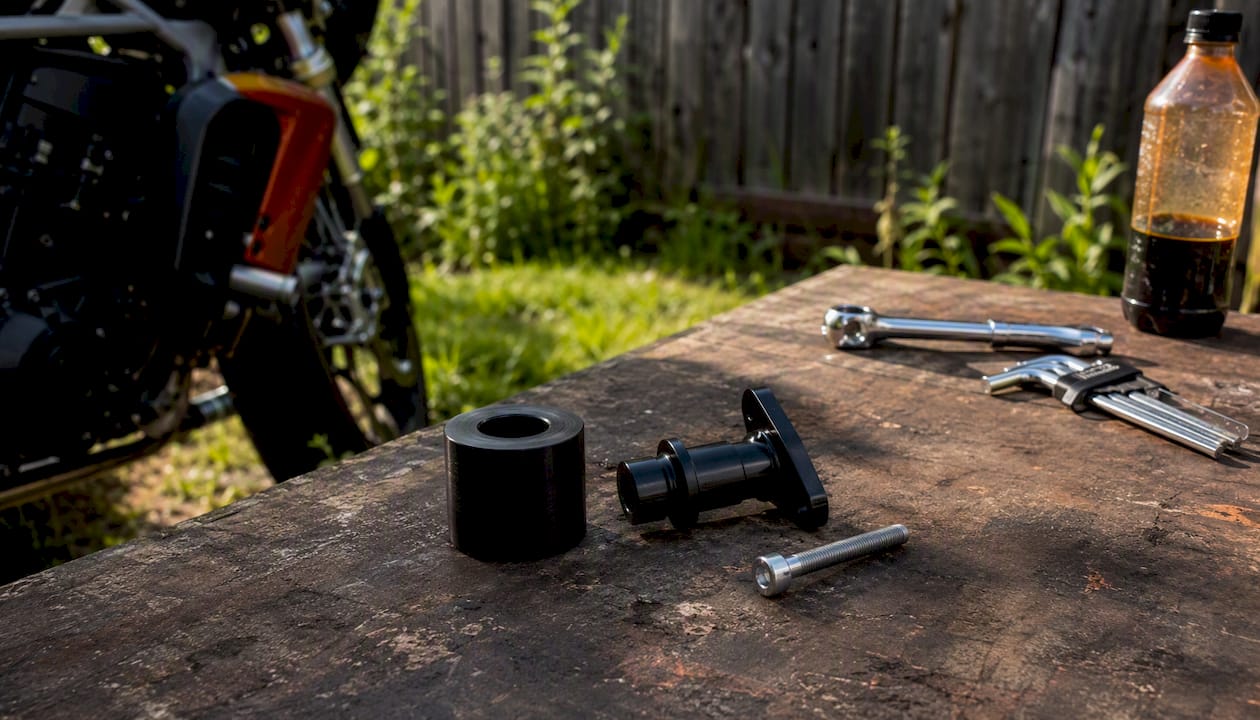
Frame sliders are sacrificial protrusions bolted to your bike’s frame or engine mounts that absorb abrasion and stretch out the collision timeline, so your fairings and engine cases stand a far better chance of missing the tarmac altogether. That is the whole job, in one sentence. The catch is equally simple: how well they do it depends entirely on impact angle, road surface, speed and whether the kit was mounted correctly in the first place. A slider bolted on badly, or fitted to a bike that goes down at the wrong angle, can do almost nothing. Understanding the mechanics behind that trade-off is what separates riders who buy the right kit from those who buy the cheapest one.
Two physics concepts explain almost everything that follows in this article, and it helps to name them now:
- Momentum and impulse — a slider does not stop the crash energy, it extends the time over which that energy is absorbed, which lowers the peak force transmitted to the frame, as HowStuffWorks explains in its breakdown of slider mechanics.
- Sacrificial materials — engineering plastics such as Delrin (acetal) and UHMW are chosen because they wear predictably and slide rather than grip, a property Engineerskill identifies as the industry standard for puck design.
Key Takeaways
Frame sliders work by extending collision time and sacrificing a low-friction puck so fairings and engine cases avoid direct road contact, but their effectiveness always depends on impact angle, surface and correct fitment.
| Point | Details |
|---|---|
| Sliders reduce, not eliminate, damage | They lower peak impact force via impulse physics but can’t guarantee protection in every crash type. |
| Material choice decides slide vs snag | Delrin and UHMWPE slide predictably; exposed aluminium can grab the road and increase flip risk. |
| Mount type trades strength for convenience | Cut kits offer stronger load paths; no-cut brackets avoid fairing modification but flex more. |
| Torque and bolt spec are not optional | Fitting to OEM torque preserves the calculated shear point that keeps load off the frame. |
| Buy from brands with published fitment data | Evotech Performance, R&G and GB Racing kits, available through Sixrace, include replaceable pucks and model-specific fitment charts. |
Table of Contents
- How motorcycle frame sliders work: the anatomy of a slider
- How do frame sliders reduce damage during a crash?
- What types of frame sliders and mounting methods exist?
- What do frame sliders actually protect, and where do they fail?
- Which materials do the best frame sliders use, and why?
- What are the common failure modes and installation risks?
- How do you choose the right frame sliders for your bike?
- How do you install and maintain frame sliders correctly?
- Why does slider quality matter, and which brands are worth trusting?
- What riders get wrong about frame slider protection
- Get the right protection for your bike from Sixrace
- Frequently asked questions
- Sources
How motorcycle frame sliders work: the anatomy of a slider
A frame slider is a deceptively simple assembly, and understanding its parts explains why fitment quality matters so much more than most riders assume.
The visible part is the puck, sometimes called a bobbin on smaller or naked bikes, a cylindrical or dome-shaped block of engineered plastic that makes first contact with the ground. Behind it sits a mounting bolt, usually a replacement for an existing engine mount or frame bolt, engineered with specific tensile properties so it bends or shears at a predictable load rather than transmitting that load into the frame casting. Many kits add a spacer or aluminium core inside the puck, giving it enough rigidity to survive vibration and road grime without collapsing prematurely under normal riding.
Mounting points matter structurally as much as materially. Sliders typically bolt through existing engine case bolt holes or into dedicated frame spar lugs, points chosen because they are already reinforced to carry load. This is why American Sport Touring stresses using OEM-spec hardware rather than generic bolts: a mount that isn’t rated for the job becomes the weak point in the wrong place.
You will also see two terms used almost interchangeably in listings: cut kits, which bolt directly to the frame and require removing a section of fairing, and no-cut kits, which use a bracket to route around the fairing without modification. Each implies a different balance of strength, cost and cosmetic compromise, covered in detail further down.
How do frame sliders reduce damage during a crash?
Frame sliders reduce damage by doing two things simultaneously: they extend the duration of the impact and they offer up a low-friction, disposable surface instead of the bike’s own bodywork. Both effects trace back to a basic physics principle, impulse, which states that force multiplied by the time over which it acts produces a fixed change in momentum. Stretch that time out, and the peak force drops. A frame slider does exactly that. Instead of a fairing panel striking the road and stopping almost instantly, the puck contacts first, deforms or grinds down, and lets the bike’s momentum bleed off gradually as it slides.
HowStuffWorks frames this well: the puck is designed to wear away or break off, absorbing the initial abrasion so the crankcase and fairing behind it never touch down. That sacrificial behaviour is deliberate engineering, not a manufacturing defect. A puck that survives every crash intact and unscratched probably isn’t doing its job.
Friction is the other half of the story. A low-friction material like Delrin or UHMWPE lets the bike glide across tarmac in a relatively controlled line. A high-friction material, or a puck that’s chipped and exposing a rough edge, can grab the road instead, and grabbing is what turns a slide into a tumble. This is why the choice of plastic compound is not a cosmetic detail. It governs whether the bike travels in a straight, predictable line or starts cartwheeling.
Pro Tip: A bolt that visibly bends after a crash isn’t a sign of cheap hardware, it’s usually the design working as intended. Manufacturers calculate a deliberate shear or bend point into the bolt so the slider assembly absorbs the load before it reaches the frame or engine casing. If the bolt is straight and undamaged but the frame is cracked, something in the mounting chain was too rigid.
What types of frame sliders and mounting methods exist?
Not every slider bolts on the same way, and the mounting method changes how much protection you get and how much risk you take on in return.
Cut kits (direct frame mount) bolt straight into the frame or engine casing, usually requiring you to trim or remove a section of fairing to expose the mounting point. This gives the most direct load path: force travels straight from puck to bolt to a structurally reinforced point on the frame, with no intermediate bracket to flex or fail. Jalopnik notes this is why track riders lean towards direct mounts almost universally, despite the fairing modification required.
No-cut kits (bracket-mounted) route around the fairing using a bracket, usually attached to the same engine mount bolts, avoiding any cutting. They’re popular with street riders who want to keep their bodywork stock or preserve resale value, but the bracket introduces an extra joint that can flex under load, slightly reducing how directly force transfers away from the fairing.
Axle sliders bolt into the front and rear axle ends rather than the frame, offering a secondary contact point that helps prevent the bike tumbling end over end during a low-speed slide. Handlebar sliders perform a similar role at the front, protecting bar-end controls and mirrors. Neither replaces frame sliders, they supplement them.
Crash bars, more common on adventure and touring bikes, work on a different principle entirely: rigid tubular structures designed to hold the bike off the ground rather than let it slide. They protect differently and suit different riding, a distinction worth understanding before you assume one product family can substitute for the other.
Length matters more than most buyers expect. A longer puck holds the fairing further from the ground, which sounds like an advantage, but it also increases the leverage arm acting on the mounting bolt and frame during impact. Jalopnik points out that this extra leverage raises the chance of the slider catching and flipping the bike, which is exactly why shorter, stiffer sliders dominate on track bikes while longer ones are more common on street machines doing lower-speed drops.
| What it protects | Best for | Mount type | Snag risk | Install difficulty |
|---|---|---|---|---|
| Fairings, frame rails | Street, low-speed drops | No-cut / bracket | Moderate | Easy, no fairing removal |
| Fairings, engine cases | Track, high-speed slides | Cut / direct frame | Low with short length | Moderate, fairing modification needed |
| Wheel ends, forks | Any riding style | Axle mount | Low | Easy |
| Bar-end controls | Any riding style | Handlebar mount | Low | Easy |
| Engine, radiator, full structure | Adventure, off-road | Crash bar (rigid) | Higher on soft ground | Moderate to advanced |
What do frame sliders actually protect, and where do they fail?
Frame sliders are consistently good at protecting a specific, limited set of components, and honest expectations start with naming them plainly.
- Fairing panels, the most common casualty in a low-speed tip-over, are the primary target and the reason most riders buy sliders at all.
- Engine cases, particularly clutch and alternator covers, are protected when the slider is positioned close enough to the case to intercept contact before the casing itself grounds out.
- Levers and bar-end hardware benefit from handlebar sliders specifically, rather than frame sliders alone.
- Fork legs and lower fairings get partial protection depending on slider placement and bike geometry.
Where sliders genuinely struggle is just as important to understand. SlashGear makes the point directly: effectiveness depends on impact angle, terrain, fitment quality and how the bike is actually travelling when it goes down, and no single kit performs consistently across every one of those variables.
A low-speed car park tip-over is the scenario sliders handle best: the bike falls sideways at near-zero forward speed, the puck takes the weight, and the fairing never touches down. A high-speed track slide is different: the bike stays upright on its side and travels a long distance, and here the slider’s job shifts from absorbing a single impact to surviving sustained abrasion, which is why puck material and length both matter more at speed. A high-side or snagging event is the scenario where sliders can make things worse rather than better; if a puck catches a kerb edge, a drain cover, or soft gravel rather than sliding across it, that snag point can act as a pivot and flip the bike, a risk Motorcyclist highlights when weighing whether sliders are unambiguously good or occasionally counterproductive. Pairing sliders with engine covers closes some of that gap by giving the crankcase a second layer of defence when the slider alone can’t fully clear it.
Which materials do the best frame sliders use, and why?
Material choice governs how a slider behaves in the two seconds that actually matter, and the differences between compounds are larger than most buyers assume.
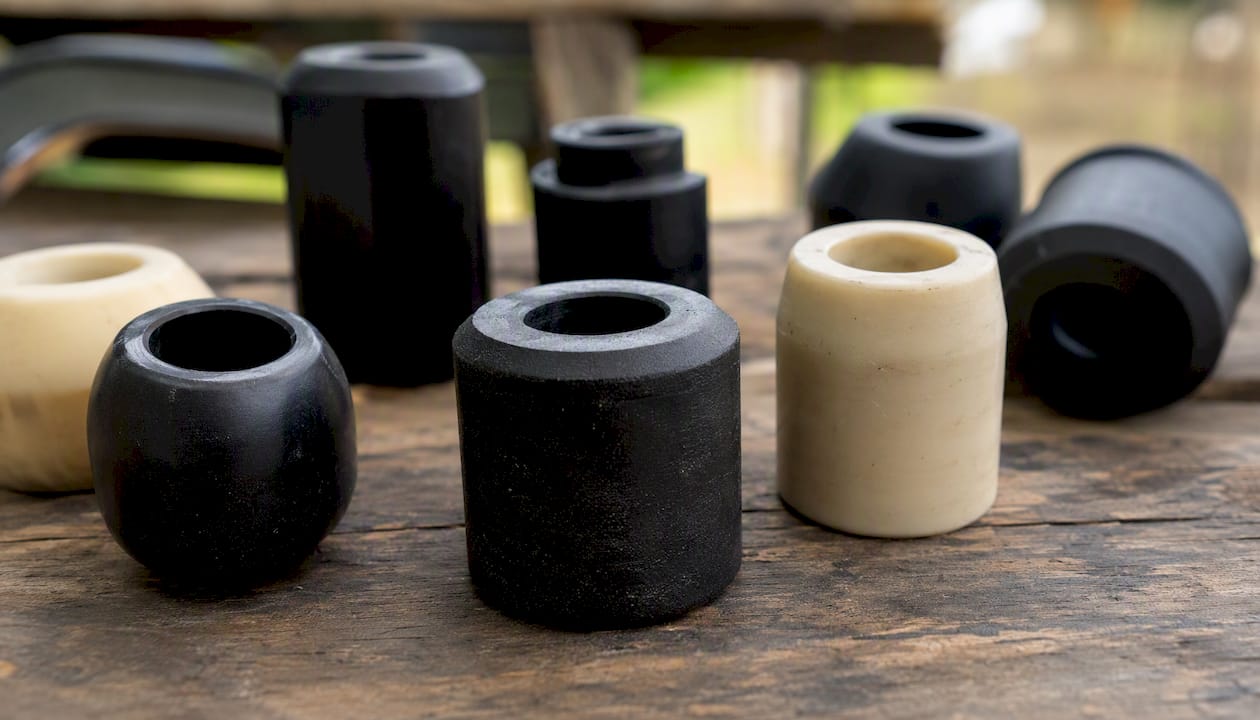
Delrin (acetal) is the material EngineerSkill.blog calls the industry benchmark, prized for a low coefficient of friction that lets a puck slide rather than catch, combined with wear characteristics predictable enough that manufacturers can engineer the shear point around it. UHMWPE (ultra-high-molecular-weight polyethylene) offers comparable abrasion resistance, and its mechanical profile, described on the material’s own technical reference page, makes it a common choice where manufacturers want slightly higher impact toughness alongside the low-friction slide. Both are thermoplastics, a category of engineering plastic that can be moulded to precise shapes while retaining the wear behaviour engineers need for sacrificial parts.
Nylon appears on budget kits and offers reasonable abrasion resistance at lower cost, though it tends to wear less predictably than Delrin under sustained sliding. Aluminium inserts or cores show up inside many pucks to add rigidity, but an aluminium-faced puck with no plastic sliding surface is a different story: metal can bite into tarmac rather than glide across it, and American Sport Touring flags this as one reason cut kits pair aluminium cores with a plastic outer shell rather than exposing bare metal.
| Material | Friction behaviour | Wear pattern | Snagging tendency |
|---|---|---|---|
| Delrin (acetal) | Low, slides smoothly | Predictable, grinds evenly | Low |
| UHMWPE | Low to moderate | Gradual, high abrasion resistance | Low |
| Nylon | Moderate | Less predictable under sustained load | Moderate |
| Aluminium (exposed) | Higher, can grip | Deforms rather than grinds | Higher |
Pro Tip: Avoid aluminium-only pucks for road riding. They’re common on cheap knock-off kits because raw aluminium is easy to machine, but exposed metal has a habit of grabbing tarmac rather than sliding across it. Look for kits with replaceable plastic pucks specifically, so a single hard drop doesn’t mean replacing the whole bracket.
What are the common failure modes and installation risks?
Even a well-designed slider can underperform if it’s poorly made or badly fitted, and the failure modes tend to fall into a short, recognisable list.
- Bolt shear or thread stripping happens when the mounting bolt fails at the wrong point, transferring load into the frame casing instead of absorbing it as designed.
- Bracket tearing affects no-cut kits specifically, where a thin bracket flexes and fatigues under repeated stress before the puck has even finished doing its job.
- Snagging-induced flips occur when a puck’s shape or surface catches an obstacle rather than sliding across it, converting a slide into a rotational fall.
- Frame mount damage results from oversized or overly rigid bolts that don’t shear when they should, passing peak force straight into the casting.
- Engine sag from missing spacers happens on some no-cut installs, where skipping a spacer changes engine alignment and introduces vibration over time.
Installation hazards compound these risks. Over-tightening a mounting bolt beyond OEM torque spec can pre-stress the thread and make it more, not less, likely to fail under shock loading. Using a generic hardware-store bolt instead of the one supplied with the kit removes the calculated shear point altogether. And SlashGear is blunt about build quality: cheap replicas with unknown plastic grades and no published fitment data are the products most likely to fail exactly when you need them not to.
Red flags worth remembering before you buy: no stated material specification, no replaceable puck option (meaning a scuff means buying the whole kit again), vague or missing fitment data for your exact model year, and pricing that seems too low relative to known brands using Delrin or UHMW compounds.
How do you choose the right frame sliders for your bike?
Choosing correctly comes down to five checks, done roughly in this order.
- Confirm fitment by make, model and year. A slider engineered for a specific frame geometry mounts cleanly and sits at the correct standoff distance; a generic universal kit often doesn’t.
- Decide your mount type based on use. Track or aggressive riding favours direct cut-mount kits for rigidity; daily street riding often suits no-cut brackets that avoid fairing modification.
- Prioritise low-friction, replaceable pucks. Delrin or UHMWPE compounds with a puck you can swap out after contact, rather than a fixed one-piece assembly.
- Match length to riding style. Shorter for track (less leverage, lower flip risk), longer for street bikes prioritising fairing clearance over cornering ground clearance.
- Confirm bolt spec and torque values. The kit should list the correct hardware grade and the torque figure for your specific engine mount, ideally matching OEM specification.
A short buyer’s Q&A helps when comparing listings from unfamiliar sellers. Ask what material the puck is made from, whether replacement pucks are sold separately, whether the bolt kit is rated to a specific torque spec, and whether there’s a documented fitment guide for your exact model year rather than a generic “universal fit” claim.
Pro Tip: Buy from retailers that publish fitment by model and year rather than generic listings, and consider pairing sliders with matching engine covers from the same range. A reputable supplier of frame protections will list compatible parts together, which removes most of the guesswork around whether a puck actually sits where it needs to on your specific bike.
How do you install and maintain frame sliders correctly?
Installation follows a broadly similar sequence whether you’re fitting a cut kit or a no-cut bracket, and getting the order right avoids most common mistakes.
- Remove the relevant fairing panel if you’re fitting a cut kit; no-cut kits usually skip this step entirely.
- Identify the correct mounting bolt or engine case bolt the slider hardware is designed to replace.
- Fit one side at a time, checking clearance against the fairing or bodywork before fully tightening.
- Torque to OEM engine-mount specification, using the figure from your bike’s service manual or the kit’s documentation, American Sport Touring stresses this step specifically because under or over-torquing both introduce failure risk.
- Recheck fitment after a short ride, confirming nothing has shifted and the puck still clears the fairing at full lean.
Maintenance is simple but easy to neglect. Inspect pucks after any contact with the ground, even a minor tip-over in a car park, and replace a scuffed or cracked puck before it goes soft or brittle from UV exposure. Check mounting bolts periodically for bending or thread damage, particularly after any impact, since a bolt that’s taken a hit once may be weakened even if it looks straight.
Pro Tip: Use a proper torque wrench rather than guessing “hand tight,” and apply threadlocker only where the manufacturer specifies it. Over-application of threadlocker on a bolt designed to shear can change how it fails under load, which defeats the point of the calculated weak point in the first place.
Why does slider quality matter, and which brands are worth trusting?
Quality separates a slider that does its job from one that becomes a second problem the moment your bike hits the ground. Cheap replicas frequently use unidentified plastic blends, skip the calculated bolt shear point entirely, and publish no fitment data beyond a vague model range, exactly the combination SlashGear and Motorcyclist both warn against when discussing why sliders sometimes fail to help.
Buying from an established manufacturer buys you three things a knock-off usually can’t offer: engineer-matched fitment for your exact frame, hardware made from a bolt grade chosen deliberately rather than whatever was cheapest to source, and a replaceable puck system so one scrape doesn’t mean replacing the whole kit. Brands including Evotech Performance, R&G, and GB Racing have built their reputations specifically on this combination, publishing detailed fitment charts and using Delrin or UHMW compounds rather than unspecified plastics.
Sixrace carries kits from these manufacturers, organised by motorcycle make, model and year so you’re not left guessing whether a listing actually fits your bike, and stocks replacement pucks separately so a single drop doesn’t force a full kit replacement. If you’re building out wider protection alongside sliders, categories covering fork protectors and broader protection accessories cover the components sliders don’t reach.
What riders get wrong about frame slider protection
Most riders treat frame sliders as a binary: fitted, or not fitted, protected, or not protected. That framing misses the point entirely. Sliders are one layer in a stack of protection, and the layer they cover is narrower than most people assume, mainly low-speed drops and controlled slides where the bike stays roughly upright and travels in a reasonably straight line.
The compromise worth accepting, in my view, is fitting sliders to almost any bike that gets ridden regularly, because the cost of a decent Delrin-based kit is trivial against a single cracked fairing panel from a car park tip-over. Where I’d add more, engine covers specifically, is on any bike that sees track days or aggressive cornering, because that’s where a slider alone is more likely to be outpaced by the energy involved. Crash bars earn their place on adventure bikes for a different reason entirely: off-road falls tend to happen at lower speed but on harder, less forgiving ground, and a rigid bar does a job a plastic puck simply isn’t built for.
The practical rule I’d give any rider deciding what to fit: match the slider’s mount type and length to how you actually ride, short and direct-mounted for track work, longer and bracket-mounted is fine for a bike that mostly sits on the street, rather than buying whatever’s cheapest and assuming all sliders do the same job.
Get the right protection for your bike from Sixrace
Sixrace is where riders who’ve just read this far go next, a European retailer stocking frame sliders from Evotech Performance, R&G and GB Racing, matched to your exact make, model and year so you’re not fitting a bracket that almost fits.

Every kit listing shows the mount type, puck material and whether replacement pucks are sold separately, so you can apply the checklist above without digging through five different spec sheets. Browse the full frame and protection range to compare cut kits against no-cut brackets for your bike, or check the Evotech Performance accessories collection if you already know the brand you want. Riders who prefer to see everything Sixrace sells before deciding can also browse the full accessories catalogue for spare pucks, cleaners and other aftercare items worth keeping alongside a slider kit, and pair protection with the right riding gear through partners like URBALENTI’s motorcycle apparel range. Current customers and new buyers can check the reserved discount page for savings on frame sliders and the rest of Sixrace’s protection range before checking out.
Frequently asked questions
Do frame sliders actually work? Yes, within specific conditions. They reduce damage most reliably in low-speed drops and controlled slides, but their effectiveness drops in high-side crashes, severe impacts, or when the puck snags rather than slides, as SlashGear confirms.
How do frame sliders prevent damage exactly? They extend the time over which impact force is absorbed and offer a sacrificial, low-friction surface that contacts the ground instead of the fairing or engine case, lowering the peak force transmitted to the bike.
What’s the difference between frame sliders and crash bars? Frame sliders let the bike slide across the ground on a small sacrificial puck; crash bars are rigid structures designed to hold the bike off the ground entirely. Sliders suit sport bikes on tarmac; crash bars suit adventure bikes facing rougher terrain.
Are cut kits stronger than no-cut kits? Generally yes. Direct frame-mounted cut kits distribute load more efficiently because there’s no intermediate bracket to flex, which is why track riders favour them despite the fairing modification required.
How often should I replace my frame slider pucks? Replace a puck immediately after any contact with the ground, even a minor low-speed tip-over, since scuffed or cracked plastic loses its predictable wear behaviour and won’t perform the same way twice.
Can frame sliders make a crash worse? In rare cases, yes. If a puck snags on a kerb, drain cover or soft ground instead of sliding across it, that snag point can act as a pivot and flip the bike, a risk Jalopnik associates particularly with longer sliders.
Sources
- How does a frame slider prevent damage during a crash? | HowStuffWorks
- Crash guards or frame sliders? Here’s what each one actually does | Jalopnik
- What you need to know about frame sliders | American Sport Touring
- Engineerskill
- How motorcycle frame sliders work | SlashGear
 Italiano
 Deutsch
 Français
 Español
 English
 Polski