

A stone flicks off the vehicle ahead and strikes your KTM's exposed radiator. A superficial mark is annoying, but a punctured coolant passage can turn the ride into a recovery job and a radiator replacement. Cooling fins need access to moving air, which also leaves them exposed to road debris and roost. A guard puts a deflecting barrier ahead of the core, but it shouldn't compromise the airflow that keeps the engine cool. The best radiator guards for KTM start with exact model compatibility, not a familiar logo. Match the mounting points, assess the material and opening design, then consider installation access and how easily you'll clean it.
Table of Contents
- 1. Griglia Radiatore Ktm 1290 Super Duke GT 2019+ Evotech-performance
- Match the motorcycle before comparing construction
- Compare road protection with off-road bracing
- Judge airflow by geometry, not appearance
- Installation effort includes access and alignment
- Compare alternatives only within their stated applications
- Maintenance determines whether protection stays useful
- KTM Radiator Guard Comparison at a Glance
- Fit It Right Without Compromising Cooling
1. Griglia Radiatore Ktm 1290 Super Duke GT 2019+ Evotech-performance
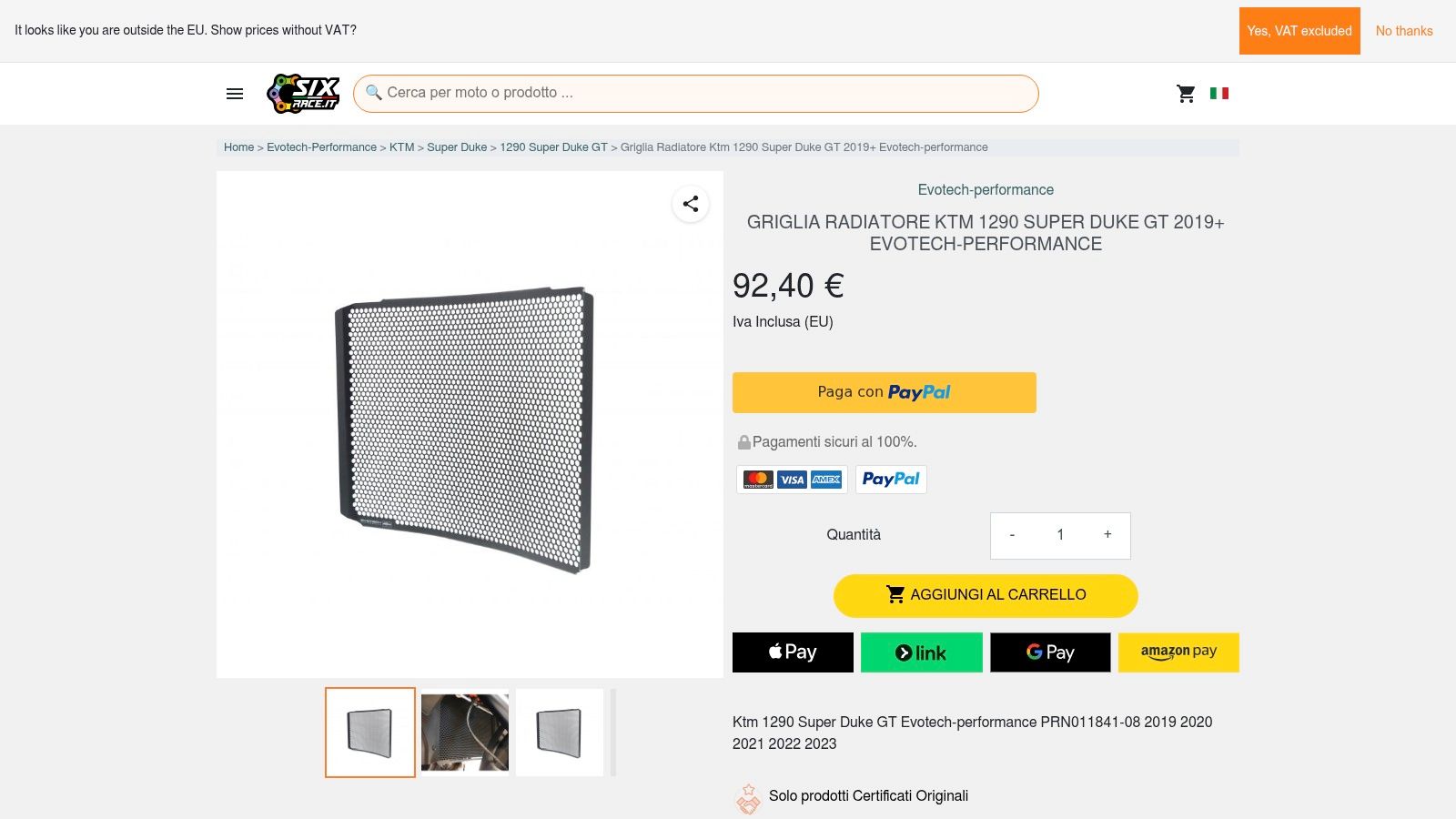
This is a model-specific candidate, not a universal KTM recommendation. The linked catalog entry identifies the Super Duke GT application, its individual fitment years, and an Evotech Performance product code. Those references are the useful starting point because a guard that looks right in a photograph can still have the wrong brackets or perimeter shape.
The catalog snapshot doesn't establish material specification, installation time, independently measured airflow, or crash performance. I'd shortlist it for a matching GT, but I wouldn't describe it as the strongest or coolest-running option without supporting documentation.
Match the motorcycle before comparing construction
Use the motorcycle's actual model designation and model year, rather than its registration date alone. Then match the product code on the listing to the packaging and installation instructions. If those references disagree, resolve the mismatch before removing bodywork.
GT, R, and Evo aren't interchangeable fitment labels. For a concrete comparison, Evotech Performance's radiator-guard page identifies a separate application for the 2024 KTM 1390 Super Duke R Evo. That listing isn't evidence that its guard fits a GT, even though both motorcycles carry the Super Duke name.
Check these details while browsing our motorcycle radiator grille category:
- Full model name: Keep GT, R, Adventure, EXC, and EXC-F applications separate unless the manufacturer explicitly lists shared compatibility.
- Listed year: Treat an open-ended title as a prompt to inspect the detailed fitment list, not as automatic approval for every later motorcycle.
- Product code: Match the complete reference, including its suffix, rather than comparing only the brand and product photograph.
- Existing equipment: Identify auxiliary lights, aftermarket bodywork, oil-cooler protection, or other accessories occupying the mounting area.
Fitment rule: A guard that needs its brackets forced into alignment hasn't passed the compatibility check.
Compare road protection with off-road bracing
For a road-focused GT, start by evaluating protection against stones and debris reaching the core. Look for coverage across the exposed radiator face, sensible clearance around the edges, and mounting arrangements that don't place hardware against the fins. Don't assume that a grille also provides meaningful protection against a sideways fall.
An enduro brace serves a different purpose. Depending on its construction, it may support the radiator against lateral deformation, while a front grille primarily intercepts debris. A rider choosing protection for an EXC should therefore compare bracing and face protection separately rather than borrowing a road-bike recommendation.
KTM's cooling requirements also vary across its motorcycle families. The Motorcycle.com KTM history documents the company's move into water-cooled motocross machinery and its subsequent development of other platforms, which helps explain why brand-wide compatibility is an unreliable shortcut.
The practical comparison is coverage versus load path. A substantial front panel can still be a poor choice if an impact pushes its edge into the radiator. Examine where the guard attaches and what stops it moving rearward before deciding that heavier construction means better protection.
Judge airflow by geometry, not appearance
A close-pattern mesh can look reassuring while making cooling more difficult. Conversely, a very open guard may preserve airflow but leave larger paths for debris. Assess the openings, their depth and orientation, and the space between the guard and radiator together.
A motorcycle radiator-shield CFD study found that a conventional cover reduced air mass flow by 13% compared with the uncovered radiator. That result concerns the tested shield, not this Evotech product, so it's a reason to request validation rather than assign a performance penalty to an untested guard.
For a GT used in traffic or loaded touring, pay particular attention to fan clearance and cleaning access. A guard that clears the radiator when stationary can still cause trouble if loose hardware moves toward the core or wiring during use.
- Opening design: Inspect how much of the radiator face the solid sections cover, including borders and mounting tabs.
- Core clearance: Confirm that neither the panel nor its fasteners touch the fins.
- Fan compatibility: Keep wiring, hoses, and the fan assembly clear throughout installation.
- Debris removal: Choose a layout you can clean without pushing trapped grit into the core.
Don't transfer the geometry from a laboratory shield directly to your motorcycle. The complete installation, including bodywork and fan arrangement, determines whether the guard works properly.
Installation effort includes access and alignment
Before buying, obtain the fitting instructions and identify which panels or fasteners must come off. A straightforward-looking grille can become inconvenient if every cleaning session requires substantial disassembly. That matters more over ownership than whether the initial installation feels quick.
Work with the engine cold and support removed panels on a clean surface. Use correctly fitting sockets or hex bits, a suitable torque wrench, and a light that lets you inspect the lower mounting area. Keep loose fasteners away from the radiator face.
Start the mounting hardware loosely so the assembly can settle into position. Check clearance around the entire perimeter before tightening to the specified values, following the manufacturer's sequence where one is provided. Don't use threadlocker or substitute longer bolts unless the instructions call for them.
The fasteners should secure an aligned guard, not pull a misaligned guard into shape.
After tightening, inspect from the side as well as the front. Confirm that the grille doesn't preload the radiator, pinch a hose, or trap wiring against an edge. If access prevents a reliable inspection, remove the obstructing panel rather than guessing.
Compare alternatives only within their stated applications
Reviews can help identify installation frustrations, but they can't establish compatibility for another motorcycle. The RevZilla R&G Racing radiator-guard listing reports 4.0 out of 5 from 340 reviews for its listed KTM Adventure and SMT applications. That makes it a separate shopping candidate for those applications, not a substitute for the GT-specific entry.
Likewise, comparing a low-cost guard against this option requires more than matching the overall outline. Ask whether the alternative includes documented mounting instructions, identifies the intended fan arrangement, and provides an unambiguous model-year list. A seller's broad KTM-compatible description doesn't answer those questions.
Value comes from correct fit and manageable upkeep, not purchase price or material thickness alone. Repeated removal, awkward hardware access, and debris trapped behind the panel can make an inexpensive guard frustrating to own.
For the featured candidate, the defensible advantage is its model-specific catalog identification. The unanswered questions remain construction details, supplied hardware, installation requirements, and measured cooling performance. Verify those before treating it as the best choice for your particular motorcycle.
Maintenance determines whether protection stays useful
A grille doesn't eliminate radiator maintenance. The KTM owner's manual hosted by ManualsLib identifies dirty radiators and restricted airflow among cooling concerns and directs owners to check coolant and leaks when overheating occurs. That maintenance principle matters even when the guard itself remains undamaged.
After dirty rides, let the motorcycle cool, then remove loose debris with a soft brush and gentle water flow. Avoid a close pressure-washer jet that could fold fins or drive contamination farther into the core. Remove the guard when necessary to clean and inspect behind it.
Establish how your motorcycle normally behaves before installation, then compare it under similar conditions afterward. Watch the temperature display and fan operation without deliberately running the engine toward an overheat warning. An unexpected change calls for inspection of blockage, clearance, coolant condition, and installation, not an assumption that the new guard is harmless.
KTM Radiator Guard Comparison at a Glance
| Item | KTM Model Compatibility | Year Range | Best For |
|---|---|---|---|
| Evotech-Performance Radiator Guard | 1290 Super Duke GT | 2019+ | Model-specific radiator protection for GT road and touring use |
| 1390 Super Duke R Evo application | 1390 Super Duke R Evo | 2024 | Later Super Duke fitment where the listing names the Evo model |
| R&G Adventure/SMT listing | Adventure / SMT | Stated application only | Cross-platform option when the exact model and year match |
Use the table as a shortlist, not a universal answer. A 1290 Super Duke GT guard belongs on the 2019+ GT application, while the 1390 Super Duke R Evo and Adventure/SMT entries count only when their stated model and year match the bike in front of you. If two rows look close, choose the one with the exact code and fitment range for your motorcycle rather than the stronger-looking grille.
Fit It Right Without Compromising Cooling
Verify the model, listed year, and complete product code before ordering. Keep the fitting instructions with your service records so replacement hardware and future removal don't become guesswork. A matching name is useful, but matching documentation is what makes the purchase defensible.
During installation, follow the specified torque values rather than tightening small brackets by feel. Confirm clearance around the core, hoses, wiring, and fan, then check the assembly again after its initial use. If the guard rattles or shifts, stop and correct the mounting rather than adding improvised packing against the radiator.
After an off-road hit, inspect more than the guard's front surface. Look behind it for contact marks, displaced brackets, bent fins, wet coolant traces, and hose damage. A panel can spring back while leaving damage underneath.
Workshop priority: Protect the radiator without making it harder to inspect, clean, or cool.
At Sixrace, we're the first official Evotech Performance dealer in Italy, and our model-specific product pages list fitment years and product codes. We sell motorcycle accessories and spare parts, with shipping across Europe. Use those references to narrow the choice, then confirm installation details and compatibility with your existing accessories before buying.
We offer model-specific radiator guards alongside other motorcycle protection and replacement parts. Visit Sixrace to compare the listed KTM applications, check the product code against your motorcycle, and choose protection you can install and maintain correctly.
 Italiano
 Deutsch
 Français
 Español
 English
 Polski